
 대표어
대표어
 학술연구정보서비스(KERIS)







권호기사보기
| 기사명 | 저자명 | 페이지 | 원문 | 기사목차 |
|---|
결과 내 검색
동의어 포함
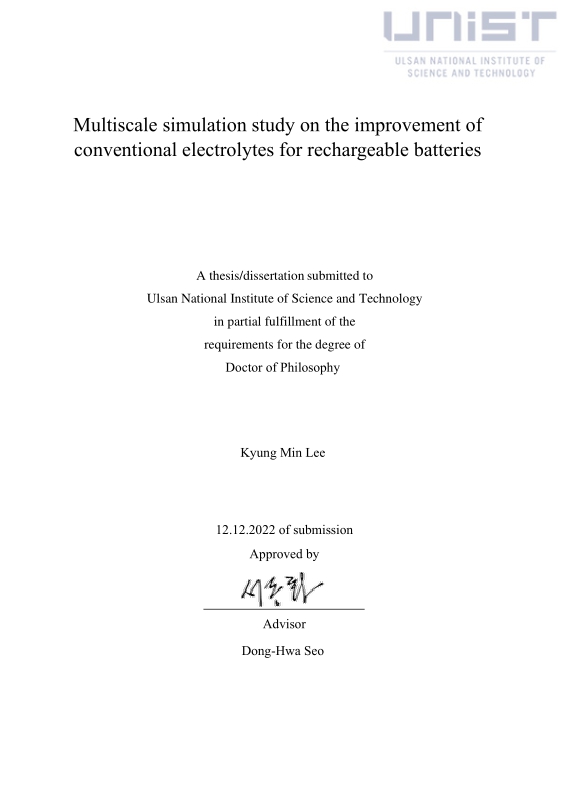
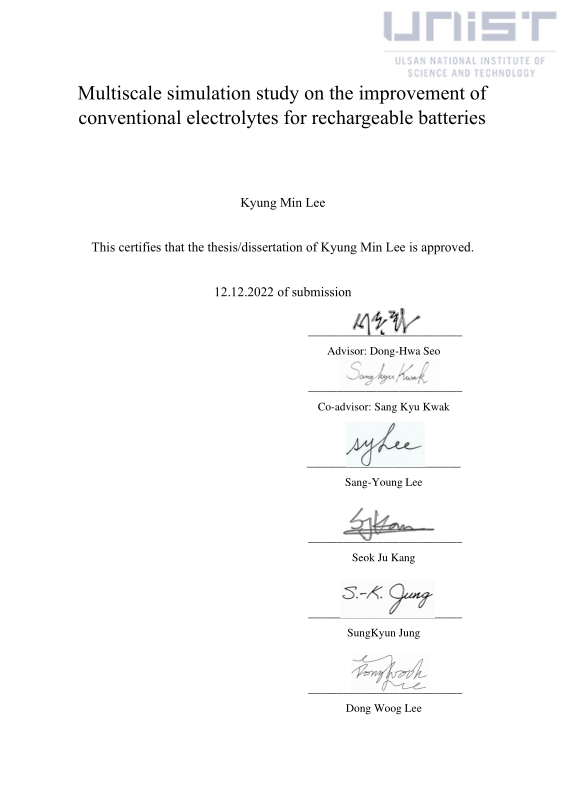
Title Page
Abstract
Contents
Chapter 1. Introduction 18
1.1. Introduction to rechargeable battery electrolytes 18
1.1.1. Demands for the improvement of rechargeable batteries 18
1.1.2. Role of electrolytes and their design principles 22
1.1.3. Limitations of conventional organic electrolytes 26
1.1.4. Aqueous electrolytes 28
1.1.5. Solid-state electrolytes 30
1.2. Introduction to multi-scale molecular simulation 33
1.2.1. Concept and importance of multi-scale simulation 33
1.2.2. Density functional theory 35
1.2.3. Molecular dynamics (MD) simulation 36
1.3. References 38
Chapter 2. Manipulation of Electrolyte Structure 45
2.1. Regulating electrostatic phenomena by cationic polymer binder: Toward scalable high-areal-capacity Li battery electrodes 45
2.1.1. Introduction 45
2.1.2. Computational models and method 47
2.1.3. Results and discussion 49
2.1.4. Conclusion 55
2.1.5. References 56
2.2. Aqueous eutectic lithium-ion electrolytes for wide-temperature operation 58
2.2.1. Introduction 58
2.2.2. Computational models and method 59
2.2.3. Results and discussion 61
2.2.4. Conclusion 68
2.2.5. References 69
Chapter 3. Design of Biphasic Electrolytes applying Kosmotropic Effect 72
3.1. Introduction 72
3.2. Computational models and method 74
1) MD simulations for single-phase electrolytes 74
2) MD simulations for anion effect toward AN/DEE-aqueous electrolyte system 75
3) MD simulations to compare solvent mixture (H₂O/AN) and electrolyte mixture (3.4 m ZnSO₄ in H₂O/0.5 m Zn(TFSI)₂ in AN) system 77
4) MD simulations to calculate Zn²⁺ conduction behavior and free energy profile 77
3.3. Results and discussion 78
3.3.1. Effects of kosmotropic/chaotropic anions on electrolyte structure 78
3.3.2. Relationship between electrolyte structure and phase separation 81
3.3.3. Biphasic liquid electrolytes for Zn-metal full cells 83
3.3.3. Ion transport phenomena at Biphasic liquid electrolytes 85
3.4. Conclusion 87
3.5. References 88
Chapter 4. Development of Novel Solid-electrolyte Material 92
4.1. Introduction 92
4.2. Ion Slippage through Li⁺-centered G-quadruplex 95
4.2.1. Computational Models and Method 95
4.2.2. Results and Discussion 97
4.3. G-quadruplex with Various Cations as Single-ion Conductor 109
4.3.1. Computational Models and Method 109
4.3.2. Results and Discussion 111
4.4. Conclusion 114
4.5. References 115
Chapter 5. Summary and Future Perspectives 121
5.1. Summary 121
5.2. Future Perspectives 123
5.3. References 125
List of Publications 131
Chapter 1 18
Figure 1.1. The necessity of developing efficient energy storage system (ESS) to apply renewable energy sources for the usage of electric vehicles (EV), industrial fields and portable IT devices. Note... 18
Figure 1.2. (a) Practical volumetric and gravimetric energy densities per technology at cell level: current high-energy LIB cell as minimum and advanced LIB configuration (the latter using, for example, a... 19
Figure 1.3. (a) Practical volumetric and gravimetric energy densities per technology at cell level: current high-energy LIB cell as minimum and advanced LIB configuration (the latter using, for example, a... 21
Figure 1.4. Schematic illustration of the Li-ion battery. 22
Figure 1.5. Important considerations for the appropriate electrolyte design. 25
Figure 1.6. An outline of the battery thermal runaway mechanisms and the thought of time sequence regulation. 27
Figure 1.7. Redox potential of electrode materials for Li-ion batteries and electrochemical stability window of pure water (pH 7) and aqueous (WiS) electrolytes. 29
Figure 1.8. General trend for the present automobile battery R&D objectives with respect to the employed anode, electrolyte, and cathode materials; please note that this trend is to be taken rather... 31
Figure 1.9. Methods and their traits applied in multi-scale computational approach in this thesis, according to time and length scales; density functional theory (DFT) and molecular dynamics (MD) simulation. 34
Figure 1.10. Role of molecular simulation, which arbitrate theory and experiment 34
Figure 1.11. DFT abandons the many-particle electron reality in favor of electron density. Constitutive relations constructed to relate energy to this density seek to capture the self-interactions of electrons. 35
Figure 1.12. Illustration of the fundamental force field energy terms. 36
Chapter 2 51
Figure 2.1.1. RDF profiles of the phosphorous atom of PF₆⁻ (a), Li⁺ atom (b) at the binder-electrolyte interface. (c), Rinternal and DLi⁺ of the c-IPN (vs. control n-IPN) cathodes (M/A = 65 mg cm⁻²) as a function of discharge voltage, which were estimated from the GITT results. (d), Schematic illustration depicting...[이미지참조] 51
Figure 2.1.2. RDF profiles and coordination number (between Li⁺ and solvents in the liquid electrolyte) of EC (a), DEC (b), and PF₆⁻ (c) at the binder (n-IPN vs. c-IPN)-electrolyte interface and coordination... 52
Figure 2.1.3. HOMO energy levels and relative ratios of the Li⁺ solvation structures in the liquid electrolyte (1M LiPF₆ in EC/DEC = 1/1 (v/v)): n-IPN (a) and c-IPN (b) cathode. The major Li⁺ solvation... 53
Figure 2.1.4. (a) Relative ratio of Li⁺ solvation structure of the liquid electrolyte (1M LiPF₆ in EC/DEC = 1/1 (v/v)) inside the n-IPN and c-IPN cathodes. The Li⁺ solvation structures are denoted as X-Y-Z,... 54
Figure 2.2.1. (a) Photograph of the AEE and control electrolytes (dilute aqueous electrolyte (1 m LiTFSI in water) and organic electrolyte (1 M LiPF₆ in EC/DMC = 1/1 (v/v))) at -40 ℃. (b) Ionic... 63
Figure 2.2.2. (a) Arrhenius plots of Rct for the eutectic HSC and dilute HSC (control). (b) Interaction energy (△Eint) between ions and water molecules at various temperatures: AEE vs. dilute aqueous...[이미지참조] 65
Figure 2.2.3. Radial distribution function (g(r)) (solid line) and coordination number (dotted line) at (a-b) the dilute electrolyte and at (c-d) the AEE, between Li⁺ and (a, c) oxygen atom of water molecules,... 66
Figure 2.2.4. Representative solvation structure type of Li⁺ for (a) free ions, (b) solvent separated ion-pair (SSIP), and (c) contact ion-pair (CIP) in the AEE. Purple, red, yellow, blue, gray, white and cyan... 66
Figure 2.2.5. Comparison in the free energy for Li⁺ solvation (∆Gsolv*(Li)) between the dilute aqeuous electrolyte (for the free Li⁺ ion state) and AEE (for the SSIP state) at 298 K.[이미지참조] 67
Chapter 3 79
Figure 3.1. Electrostatic potential of anions depicted on the isosurface of electron density with isovalue 0.08 a.u. 79
Figure 3.2. The relation between the strongest electrostatic potential and water structure forming properties in various kinds of anions. Note that anion-water interaction energy, water coordination number and anion-water distance are averaged value from the last 2ns of MD trajectories. 79
Figure 3.3. Hydration structure of (a) TFSI⁻, (b) OTf⁻, (c) Cl⁻, (d) OAc⁻, and (d) SO₄²⁻ anions. Gray, blue, white, red, yellow, cyan and light green balls represent carbon, nitrogen, hydrogen, oxygen, sulfur,... 80
Figure 3.4. Calculated Hildebrand solubility parameter (δ) of the single-phase electrolytes. 80
Figure 3.5. (a) Photograph of miscibility tests between aqueous electrolytes/AN (1/1, v/v) at ambient temperature. (b) Snapshots of AN/Aqueous electrolytes after 5 ns of MD simulation. (c) Time evolution of the interaction energy (△Eint) between aqueous electrolytes and AN. Note that △Eint is normalized by the...[이미지참조] 82
Figure 3.6. Calculated Hildebrand solubility parameter (δ) of the solvents and electrolytes. △δ denotes the difference in the solubility parameter between the two components in system. 83
Figure 3.7. MD simulation result of the miscible phase of the solvent mixture (a), and immiscible phase of the electrolyte mixture (b). H₂O, AN, Zn²⁺, SO₄²⁻, and TFSI⁻ molecules are depicted as blue, orange,... 84
Figure 3.8. Time evolution of the demixing index (χdemix) (a) and the interaction energy between components (△Eint) (b) calculated for electrolyte mixture and solvent mixture for the 50 ns of MD...[이미지참조] 85
Figure 3.9. (a) The system for MD simulation to calculate ion conduction mechanism of Zn²⁺ ion, transported through interface region of ZBPE electrolyte. H₂O, AN, Zn² , SO₄²⁻, and TFSI⁻ molecules are depicted as blue, orange, cyan, red and green color, respectively. (b) PMF profiles for Zn²⁺ ion transportation.... 86
Chapter 4 94
Figure 4.1. (a) Schematic comparison of ion transport phenomena in various ion conductors: traditional conductors versus an ideal conductor. (b) Chemical structure of the LiGQ and its self-assembly... 94
Figure 4.2. (a) Optimized structure of Li⁺ centered quartet, ribbon A and ribbon B, which are self-assembly structure made of guanine molecule. Orange, gray, white, blue, red, yellow colors represent lithium,... 98
Figure 4.3. (a) Three variables that are considered to find the most stable stacking sequence of LiGQ. (b) Contour plot of relative formation energy, with every possible combination of variables. (c) The most stable stacking sequence found for LiGQ. 100
Figure 4.4. (a) Initially constructed systems to elucidate position of anions. In "Trapped anion" system, all anions are bound to G-quartet at initial structure while "Free anion" system is not. (b) Anion position... 102
Figure 4.5. (a) Relaxed structure of LiGQ with and without Li salts, respectively. (b) Inner hydrogen bond distribution of G-quartet for the last 100 ps of trajectory. (c) Outer hydrogen bond distribution of... 103
Figure 4.6. Contour plot of Li⁺ number density of the LiGQ under an electric field. Red bar indicates the 2D number density of Li⁺ projected to the yz-plane. 104
Figure 4.7. (a) Schematic depicting direction of applied electric field E relative to Li channel direction (along z-axis). (b) MSD of Li⁺ and OTf⁻ under 2 V nm⁻¹ strength of electric field applied to LiGQ along... 105
Figure 4.8. (a) Schematic representation of the chemical structures and Li⁺ binding states of the LiGQ and conventional single-ion conductors. (b) PDOS of the ion-conducting moieties and Li⁺. Colored and... 107
Figure 4.9. Contour plot of relative formation energy, with every possible combination of variables for central cation (a) Na⁺, (b) K⁺ and (c) Mg²⁺. 110
Figure 4.10. Structural variations between the G-quadruplexes in terms of (a) the number of valence electrons and (b) ionic size, and (c) the ion conduction barrier of the G-quadruplexes, which can be affected by (d) the electrostatic and (e) Van der Waals interactions of G-quadruplexes. 113
In current, one of urgent crisis that modern civilization has faced is global warming, mostly due to their strong dependence on fossil fuels. In this regard, demand for safe, reliable, and sustainable energy supply is growing, which facilitates the usage of renewable energy sources. However, the supply from renewable energy sources is not continuous, and importance of development of efficient energy storage systems (ESS) have been emphasized. In this context, rechargeable batteries got a lot of attentions as candidates for next-generation energy storage device. However, low energy density compared to required demands, safety issues, deterioration of cell lifetime remains challenge to lithium-ion rechargeable battery's application. The electrolyte plays a key role toward battery performance, including current density, stability, and safety, since it interacts with other three major components. Thus, reasonable design for electrolyte is crucial for improving rechargeable battery's efficiency. In this dissertation, we have employed multi-scale computational approach to improve battery electrolytes in three ways (i.e., manipulation of conventional electrolyte structure, design of biphasic electrolyte and development of novel solid electrolyte material) exploiting the benefits of simulation that resolves the limitation of traditional trial-and-error method, which requires expensive cost, time-consuming and labor-intensive process.
In Chapter 1, rechargeable batteries, and the needs to enhance them for sustainable growth were introduced. The role of electrolytes in the cell and electrolyte design were then discussed. We also discussed the several types of battery electrolytes (organic, aqueous, and solid-state) and their merits and disadvantages. Finally, we discussed multi-scale simulation, including DFT and MD simulation, and its importance on material development.
In Chapter 2, we revealed how molecular electrolyte structure might boost performance. First, cationic monomers were added to the binder to make high C/A electrodes. Imidazolium-based cationic groups of the c-IPN binder boost C/A ratio, trap PF6- of the liquid electrolyte, and allow facile Li+ transport across the cathode. This modifies solvation structures beneath c-IPN binders to have stronger oxidation stability than n-IPNs, encouraging the formation of F-rich stable CEI. Second, aqueous eutectic electrolyte (AEE) was presented as a wide-temperature aqueous electrolyte approach. Detailed examination of water molecule networks, interaction energy of water molecules with Li salts, and solvation free energy data indicated that AEE could retain strong ionic conductivity even at -40 ℃ because water molecules were tightly bound to Li+ and TFSI- throughout a broad temperature range.
In Chapter 3, unique biphasic liquid electrolyte (BLE) design technique using kosmotropic effect was described. First, the effects of kosmotropic/chaotropic anions on solvent intermolecular interaction were studied. By using DFT and MD simulations, we found that the capacity of kosmotropic and chaotropic anions to grab water molecules can alter solvation structures, intermolecular interactions, ultimately their miscibility. Electrolytes consisting of a cathode-customized AE (3.4 m ZnSO₄ in water) and an anode-customized OE (0.5 m Zn(TFSI)₂ in AN) were proposed to function on desired anode and cathode conditions. Despite the excellent miscibility of water (in the AE) with AN, the structural alteration of the AE generated phase separation with the OE (in the OE). Also, BLE exhibited non-sluggish ion conduction at the interface because to continuous desolvation-solvation structure change.
In Chapter 4, we presented the Li+-centered G-quadruplex single-ion conductor (LiGQ). LiGQ are vertically stacked G-quartets that generate Li+ conducting channels in the center and holds counter anions at the outside via H-bonds with guanine molecules. From MD simulations, LiGQ is projected to demonstrate ion-slippage, one-dimensional and single-ion conduction behavior with high tLi+ (~0.91). This suggests LiGQ's possibility to be applicated as a novel solid electrolyte material. Also, LiGQ's low Ea for ion migration and weak Li+ binding energy give them competitive ionic conductivity compared to previously reported single-ion conductors. We confirmed that G-quadruplex structure and ion migration barrier may be modified by coordinating cations. Compared to other cations, Na+, Mg+, and K+, GQ with Li+ was expected to have superior ionic conductivity than the others.*표시는 필수 입력사항입니다.
| 전화번호 |
|---|
| 기사명 | 저자명 | 페이지 | 원문 | 기사목차 |
|---|
| 번호 | 발행일자 | 권호명 | 제본정보 | 자료실 | 원문 | 신청 페이지 |
|---|
도서위치안내: / 서가번호:

우편복사 목록담기를 완료하였습니다.
*표시는 필수 입력사항입니다.
저장 되었습니다.
