
 대표어
대표어
권호기사보기
| 기사명 | 저자명 | 페이지 | 원문 | 기사목차 |
|---|
결과 내 검색
동의어 포함
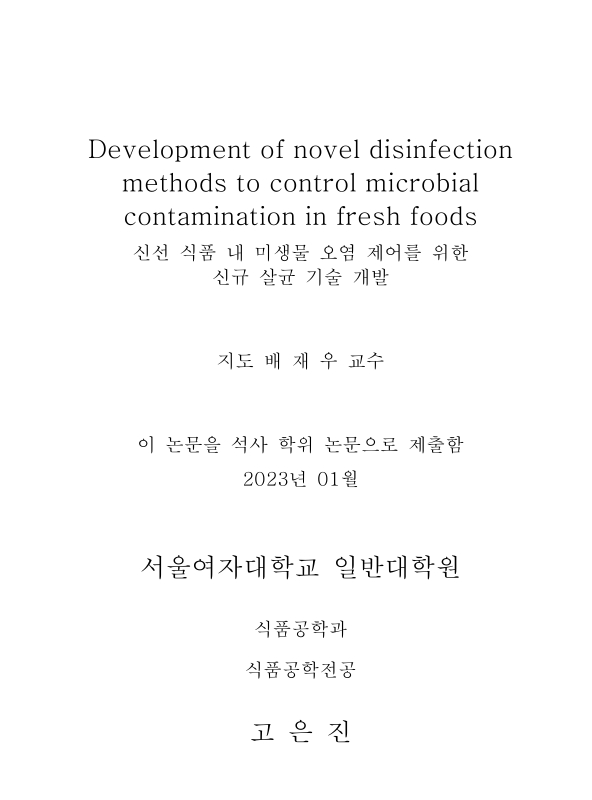
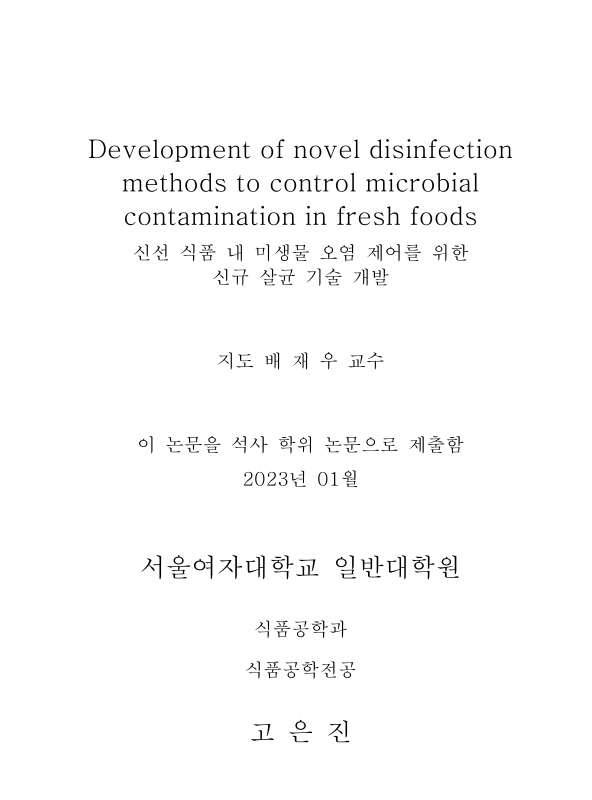
Title Page
Contents
I. Effective control of antibiotic resistance using a sonication - based combinational treatment and its application to fresh foods 14
1. Introduction 15
2. Materials and methods 18
2.1. Reagents 18
2.2. Bacterial strains, plasmids, culture methods, and bacterial enumeration 18
2.3. Assessment of antimicrobial efficacy and nucleic acid release 19
2.4. Inactivation of ARGs 21
2.5. Food application 22
2.6. Food quality analysis 24
3. Results and discussion 26
3.1. Microbial inactivation efficacy 26
3.2. Nucleic acid release 30
3.3. Agarose gel electrophoresis 36
3.4. HGT efficacy 40
3.5. Inactivation of ARB in fresh food 45
3.6. Inactivation of ARGs in fresh food 49
3.7. Evaluation of color and firmness 52
4. Conclusion 59
II. Isolation, characterization of a novel lytic bacteriophage SSP49 and its application on baby spinach leaves to control of Staphylococcus aureus contamination 60
1. Introduction 61
2. Materials and Methods 65
2.1. Bacterial strains, media, and culture conditions 65
2.2. Isolation, purification, and propagation of bacteriophage 65
2.3. Characterization of the isolated bacteriophage 66
2.4. Food application 73
3. Results and Discussion 75
3.1. Bacterial challenge assay 75
3.2. Morphological analysis of phage SSP49 78
3.3. Host range analysis of phage SSP49 80
3.4. Host receptor analysis of phage SSP49 81
3.5. Whole genome sequencing (WGS) 83
3.6. Thermal and pH stability 87
3.7. Control of microbial contamination in fresh food 90
4. Conclusion 96
References 98
국문초록 113
Figure 1. Microbial inactivation efficacy of physical treatments. 29
Figure 2. Nucleic acid release assay. 33
Figure 3. Correlation analysis. 35
Figure 4. Agarose gel electrophoresis. 39
Figure 5. Horizontal gene transfer efficacy test. 44
Figure 6. Microbial inactivation efficacy of HS treatment in foods. 48
Figure 7. Inactivation of antibiotic resistance genes (ARGs) in fresh foods. 51
Figure 8. Challenge assay of phage SSP49 against Staphylococcus aureus ATCC 13301. 77
Figure 9. Morphology analysis of phage SSP49 by transmission electron microscope (TEM). 79
Figure 10. Receptor analysis of phage SSP49. 82
Figure 11. Genome map of bacteriophage SSP49. 86
Figure 12. Stability test of bacteriophage SSP49. 89
Figure 13. Food application of bacteriophage SSP49 on fresh produce. 94
Figure 14. Titer of phage SSP49 on fresh produce during treatments. 95
*표시는 필수 입력사항입니다.
| 전화번호 |
|---|
| 기사명 | 저자명 | 페이지 | 원문 | 기사목차 |
|---|
| 번호 | 발행일자 | 권호명 | 제본정보 | 자료실 | 원문 | 신청 페이지 |
|---|
도서위치안내: / 서가번호:

우편복사 목록담기를 완료하였습니다.
*표시는 필수 입력사항입니다.
저장 되었습니다.
