
 대표어
대표어
 학술연구정보서비스(KERIS)
권호기사보기
| 기사명 | 저자명 | 페이지 | 원문 | 기사목차 |
|---|
결과 내 검색
동의어 포함
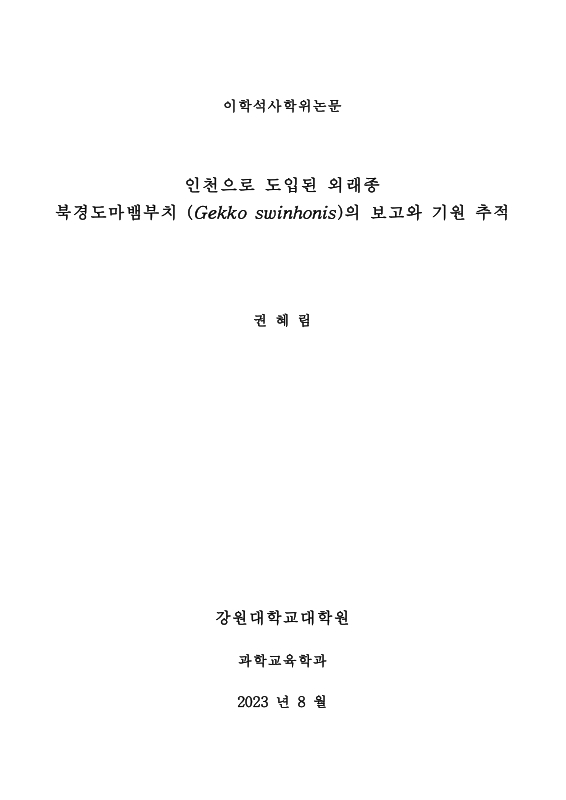
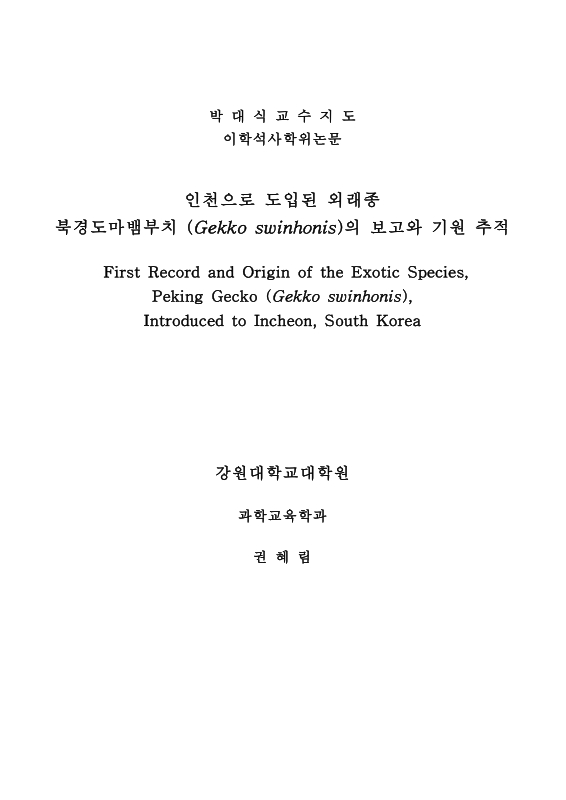
표제지
요약
목차
Ⅰ. 서론 13
Ⅱ. 연구재료 및 방법 16
1. 야외조사 및 개체 채집 16
2. 외부형태 자료 수집 및 형태적 동정 18
3. 유전적 자료 수집 20
1) genomic DNA 추출, 증폭 및 시퀀싱 20
2) 유전자를 이용한 종 동정 21
3) 인천 개체군의 기원 추적 22
Ⅲ. 결과 23
1. 야외조사 결과 23
2. 형태적 분석을 통한 종 동정 24
3. 유전적 분석을 통한 종 동정 25
4. 인천 개체군의 Cytb 유전자 haplotype 분석 27
Ⅳ. 고찰 31
1. 형태적 및 유전적 분석을 통한 종 동정 31
2. 인천에서 확인된 Gekko swinhonis 개체군의 기원 32
3. 인천 Gekko swinhonis 개체군의 확장 35
Ⅴ. 결론 37
Ⅵ. 참고문헌 38
Ⅶ. 부록 45
Abstract 52
Figure 1. Survey sites (circles, a) and the building in the Incheon Customs History Park (b), indicated by a yellow arrowhead. Red and white circles indicate the presence and absence of geckos, respectively. 17
Figure 2. Morphological parameters. Dorsal view of the body (a), dorsal view of the head (b), lateral view of the head (c) and ventral... 19
Figure 3. Number of tubercles (yellow circles) on the right-side occiput (blue boxes) in Gekko sp. (G01580GS, female), newly discovered in Incheon, South Korea (a) and in G. japonicus (YenC28,... 19
Figure 4. Distribution map (a) and a median-joining network (b) of 38 Cytb (1,140 bp) haplotypes of Gekko swinhonis across the Incheon population in South Korea and 27 populations in China (Yan... 29
Figure 5. Bayesian inference (BI) phylogenetic trees constructed with the Cytb sequence (1,140 bp) of 322 Gekko swinhonis from Incheon (21 individuals) and 27 Chinese populations (301 individuals).... 30
Appendix figure 1. Bayesian inference (BI) phylogenetic trees constructed with the COI sequence (658 bp). Type 1-3 indicate the Incheon geckos. See Appendix table 4 for sequence information.... 51
*표시는 필수 입력사항입니다.
| 전화번호 |
|---|
| 기사명 | 저자명 | 페이지 | 원문 | 기사목차 |
|---|
| 번호 | 발행일자 | 권호명 | 제본정보 | 자료실 | 원문 | 신청 페이지 |
|---|
도서위치안내: / 서가번호:

우편복사 목록담기를 완료하였습니다.
*표시는 필수 입력사항입니다.
저장 되었습니다.
