
 대표어
대표어
권호기사보기
| 기사명 | 저자명 | 페이지 | 원문 | 기사목차 |
|---|
결과 내 검색
동의어 포함
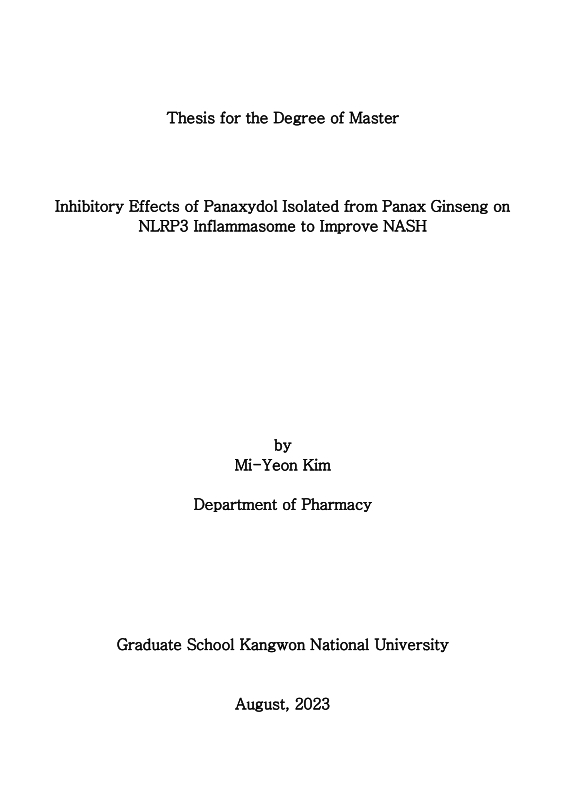
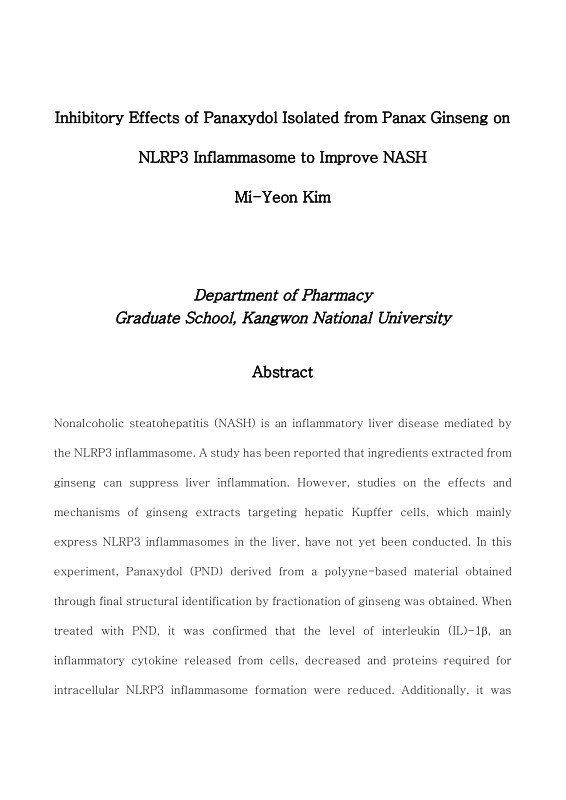
Title Page
Abstract
Contents
Ⅰ. Introduction 10
Ⅱ. Meterials and Methods 15
2.1. Panax Ginseng structure identification 15
2.1.1. Plant material 15
2.1.2. Reagents and Instruments 15
2.1.3. Extraction and Isolation of Polyynes 16
2.2. Isolation of primary Bone Marrow-Derived Macrophages (BMDMs) and Kupffer Cells (KCs) 16
2.3. Cell Treatment 17
2.3.1. Nigericin-mediated NLRP3 inflammasome induce 17
2.3.2. THP-1 cell line 17
2.3.3. Transfection 17
2.4. Enzyme-linked immunosorbent assay (ELISA) 18
2.5. ASC oligomerization assay 18
2.6. Concentrated protein in Media 19
2.7. Western Blotting 20
2.8. Cell viability assay 20
2.8.1. LDH release assay 20
2.8.2. MTT Assay 21
2.9. Animal experiments 21
2.9.1. MCD Diet Model 21
2.9.2. Gout Model 22
2.10. Flow cytometry 23
2.11. Measurement of plasma ALT and AST 24
2.12. Hepatic proteins 24
2.13. Staining of BMDMs and sectioned liver tissues 25
2.14. Statistics 26
Ⅲ. Results 27
3.1. Panax ginseng fraction suppress inflammasome 27
3.2. Panaxydol specifically inhibits the NLRP3 inflammasome 33
3.3. Modeling of Panaxydol 39
3.4. Panaxydol inhibits IL-1β emitted by NLRP3 inflammasome activation in a Gout model 42
3.5. Panaxydol demonstrated an inflamasome inhibitory effect in NASH 45
Ⅳ. Discussion 48
Ⅴ. Reference 51
Ⅵ. Summary in Korean 57
Figure 1. Ginseng extract and inhibition of inflammasome 30
Figure 2. Panaxydol is a main components of EA fractions in panax ginseng. 32
Figure 3. Inhibition of inflammation a representative NLRP3 inflammasome disease by panaxydol 37
Figure 4. The process of obtaining panaxydol from Panax ginseng and how to inhibit inflammasome. 41
Figure 5. Panaxydol inhibits IL-1β emitted by NLRP3 inflammasome activation in a Gout model 44
Figure 6. Inflammation-reducing effect of panaxydol in MCD-fed NASH model 47
*표시는 필수 입력사항입니다.
| 전화번호 |
|---|
| 기사명 | 저자명 | 페이지 | 원문 | 기사목차 |
|---|
| 번호 | 발행일자 | 권호명 | 제본정보 | 자료실 | 원문 | 신청 페이지 |
|---|
도서위치안내: / 서가번호:

우편복사 목록담기를 완료하였습니다.
*표시는 필수 입력사항입니다.
저장 되었습니다.
