권호기사보기
| 기사명 | 저자명 | 페이지 | 원문 | 기사목차 |
|---|
| 대표형(전거형, Authority) | 생물정보 | 이형(異形, Variant) | 소속 | 직위 | 직업 | 활동분야 | 주기 | 서지 | |
|---|---|---|---|---|---|---|---|---|---|
| 연구/단체명을 입력해주세요. | |||||||||
|
|
|
|
|
|
* 주제를 선택하시면 검색 상세로 이동합니다.
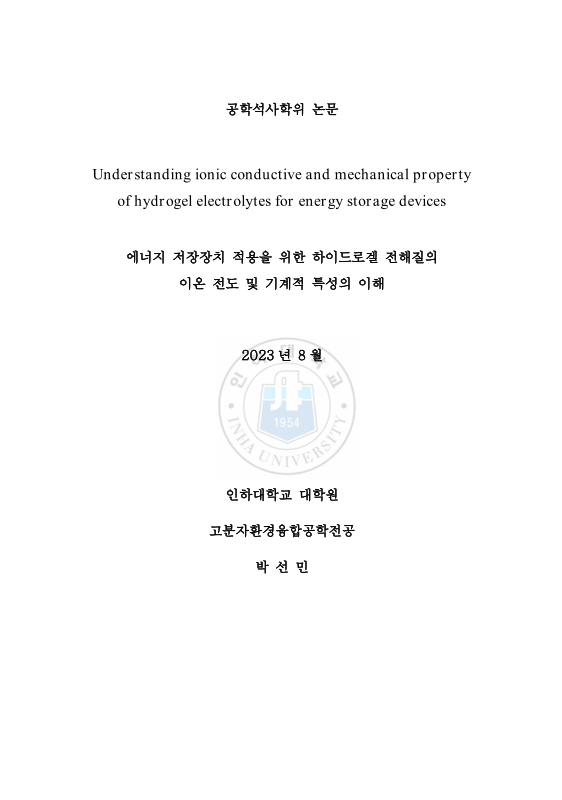
Title Page
국문요약
ABSTRACT
Contents
Chapter 1. Introduction 16
1.1. Solid-State Electrolyte 16
1.2. Hydrogel electrolyte 19
1.3. Electrochemical energy storage device 21
REFERENCE 23
Chapter 2. Optimizing characteristics of salt-inpolyampholyte for high-voltage aqueous quasi-solid-state supercapacitors 26
2.1. Introduction 26
2.2. Experimental section 29
2.2.1. Materials 29
2.2.2. SIPA synthesis 30
2.2.3. Activated carbon-based electrode Fabrication 31
2.2.4. Quasi-solid-state Supercapacitor (QSS) Preparation 32
2.2.5. Characterization 33
2.3. Results and discussion 35
2.3.1. Mechanical property 37
2.3.2. Ionic conducting property 42
2.3.3. Non-freezable property (Water analysis) 47
2.3.4. Electrochemical performance of quasi-solid-state supercapacitor 53
2.4. Conclusion 61
REFERENCES 62
Chapter 3. Highly stretchable and conductive hybrid gel polymer electrolytes enabled by a dual cross-linking approach 66
3.1. Introduction 66
3.2. Experimental section 69
3.2.1. Materials 69
3.2.2. GPE synthesis 70
3.2.3. Fabrication and electrochemical measurements of GPE-based supercapacitors 72
3.2.4. GPE characterization 73
3.3. Results and discussion 74
3.3.1. GPE thermal properties 74
3.3.2. GPE ionic conductivity 77
3.3.3. GPE mechanical properties 81
3.3.4. Electrochemical properties of GPE-based supercapacitors 88
3.4. Conclusions 94
REFERENCES 95
Figure 2-1. The shear storage modulus G' (a) with various water contents (ΦH₂O=40 to 80 wt %) and (b) with various LiCl concentrations (CLiCl=0, 1.6, 3.1, 4.7 and 6.3 M)....[이미지참조] 40
Figure 2-2. (a) The shear storage modulus G' and shear loss modulus G'' for SIPA. (b) Recovery test of SIPA at 298K; time sweep increasing 1 % to 500 % of strain. (c) Stress-... 41
Figure 2-3. The σDC of SIPA with different water contents at 298 K.[이미지참조] 44
Figure 2-4. (a) The σDC of SIPA with different monomer molar ratio of LiA monomer and DAC monomer at 298 K. (b) An optimization structure of LiA monomer and DAC monomer...[이미지참조] 45
Figure 2-5. (a) Illustration of the interaction between molecules in SIPA system. (b) FT-IR peaks in 4000-2500 cm⁻¹ of SIPA with different LiCl concentrations. (c) An area fraction... 50
Figure 2-6. Deconvolution of FT-IR peaks corresponding to bound water peaks at 3420 cm⁻¹ and 3580 cm⁻¹ and free water peaks at 3210 cm⁻¹. 51
Figure 2-7. (a) Characteristics (σDC, G', and toughness) of SIPA with different monomer molar ratio of LiA monomer and DAC monomer. (b) Characteristic (σDC, Tm, and Xc) of...[이미지참조] 52
Figure 2-8. (a) Schematic description of our symmetric SIPA-based QSS using the AC electrodes. (b) CV curves of SIPA-based QSS at various scan rates at 298 K. (c) GCD curves... 57
Figure 2-9. (a) GCD curves of SIPA-based QSS every 10000 cycles at 298K. (b) Cycling performance of SIPA-based QSS with the inset showing GCD curves at initial and final... 58
Figure 2-10. Electrochemical performance under mechanical deformations. CV curves of SIPA (a) in the bent states (0°, 45°, 90°, and 135°) and (d) in the rolled state at 50 mV/s.... 59
Figure 2-11. (a) GCD curves and (b) Cycling test of SIPA-based QSS in a Wide temperature range from 243 K to 333 K. (c) Nyquist plots of SIPA at each temperature. (d) GCD curves... 60
Figure 3-1. DSC thermal curves of P(LiA), P(LiA)/LiAlg, P(LiA)-VSNP, and P(LiA)-VSNP/LiAlg with the solid arrows indicating Tg, Tcc, and Tm.[이미지참조] 76
Figure 3-2. (a) In-phase conductivity σ′ of P(LiA)-VSNP/LiAlg at the frequency range of 10⁻¹~10⁷ Hz and 298 K, where DC ionic conductivity σDC was indicated by the dashed...[이미지참조] 80
Figure 3-3. (a) Photographs of the bent, stretched, and initial state of P(LiA)-VSNP/LiAlg. (b) Frequency dependence of storage G' and loss G'' moduli for P(LiA)-VSNP/LiAlg and... 84
Figure 3-4. (a) Strain sweep test of G' and G'' moduli at 10 rad/s for P(LiA)-VSNP/LiAlg. (b, c) Recovery tests of (b) P(LiA)-VSNP/LiAlg and (c) P(LiA)-VSNP at 298 K; step strain... 85
Figure 3-5. (a) Room temperature σDC (left axis) and G' (right axis) of GPEs with various ratios of LiA:VSNP. (b) Storage modulus as a function of ionic conductivity for all the GPEs studied. 86
Figure 3-6. FE-SEM cross-sectional image of P(LiA)-20_VSNP-20/LiAlg, showing silica nanoparticle aggregation. 87
Figure 3-7. (a, c) CV curves of (a) P(LiA)-VSNP/LiAlg and (c) P(LiA)/LiAlg at various scan rates. (b, d) GDC profiles of (b) P(LiA)-VSNP/LiAlg and (d) P(LiA)/LiAlg at various... 91
Figure 8. Nyquist plot of P(LiA)-VSNP/LiAlg and P(LiA)/LiAlg (its magnified view in the inset). 92
Figure 9. (a) Specific capacitance from CV tests as a function of scan rate for P(LiA)-VSNP/LiAlg- and P(LiA)/LiAlg-based SSCs. (b) Ragone plot of power density vs. energy... 93
Scheme 1-1. A historical outline of solid-state electrolytes. 18
Scheme 1-2. Illustration of the electrode processes occurring at a) electric double layer capacitive, b) pseudocapacitive, and c) faradaic electrodes. 22
Scheme 2-1. A schematic description and appearance of salt-in-polyampholyte (SIPA). 36
Scheme 3-1. Preparation of vinyl lithium acrylate (LiA), vinyl silica nanoparticle (VSNP), lithium alginate (LiAlg), and the corresponding GPE, and schematic description of the GPE... 71
하이드로겔 전해질은 우수한 유연성, 높은 신축성 및 높은 이온 전도성과 같은 뛰어난 고유의 물리적 특성으로 인해 수십년 동안 집중적으로 연구되어 왔다. 그러나 낮은 기계적 강도(<10³ Pa)와 저온에서의 낮은 이온 전도도(<1 mS/cm)로 인해 많은 연구자들이 이러한 문제를 개선하기 위해 주목하고 있다.
먼저, 우리는 UV 라디칼 한단계 중합을 통해 수계 매질 상에서 두 개의 서로 다른 전하를 띠는 이온(Li+와 Cl-)을 갖는 염 포함 폴리 양쪽성 전해질(SIPA)를 준비했다. 폴리 양쪽성 전해질은 (PA)고분자 사슬 내에서 서로 반대되는 전하 사이의 이온간 상화작용을 유도하여 기계적 물성을 향상시킬 수 있다. 더하여 우리는 PA 시스템에 염을 도입하여 저온에서도 얼지 않는 특성을 부여하고 고전압(2.0V)에서 작동 가능한 슈퍼커패시터를 제작하였다. 따라서 이 SIPA 기반의 슈퍼커패시터는 0.1 A/g 에서 높은 비용량(Cs=241 F/g)을 가지며, 1 A/g 에서 20000 사이클 후에는 91%의 용량 유지율을 보인다. 또한 기계적으로 굽힘 및 압연 변형 하에서도 SIPA 기반 슈퍼커패시터는 5 A/g 에서 100 사이클 후 88%의 용량 유지율을 보여주었다.
두번째로는, 리튬 아크릴레이트(LiA), 비닐 실리카 나노입자(VSNP), 리튬알긴산염(LiAlg)의 이중 가교를 유도하여 리튬 이온 전도성 겔 고분자 전해질을 제작하였다. P(LiA)-VSNP/LiAlg 기반 겔 고분자 전해질은 높은 신축성, 유연성 및 우수한 자체 복원 특성을 갖추고 있다. 또한 비닐 실리카 나노입자를 겔 고분자 전해질에 도입하여 상온에서 약 10-2 S/cm 의 높은 이온 전도도를 달성하였다. 리튬 알긴산염의 첨가는 고분자의 리튬 알긴산염와 리튬 아크릴레이트 사슬 사이의 물리적 가교를 통해 기계적 물성을 향상시켜 105 Pa 의 높은 저장 계수를 보여주었다. 더 나아가 P(LiA)-VSNP/LiAlg 기반 겔 고분자 전해질과 활성 탄소 전극을 기반으로 유연한 고체 상태 슈퍼캐패시터 (SSC)를 제작하여 다양한 전기화학적 성능을 평가하였다.*표시는 필수 입력사항입니다.
| 전화번호 |
|---|
| 기사명 | 저자명 | 페이지 | 원문 | 기사목차 |
|---|
| 번호 | 발행일자 | 권호명 | 제본정보 | 자료실 | 원문 | 신청 페이지 |
|---|
도서위치안내: / 서가번호:

우편복사 목록담기를 완료하였습니다.
*표시는 필수 입력사항입니다.
저장 되었습니다.
