
 대표어
대표어
권호기사보기
| 기사명 | 저자명 | 페이지 | 원문 | 기사목차 |
|---|
결과 내 검색
동의어 포함
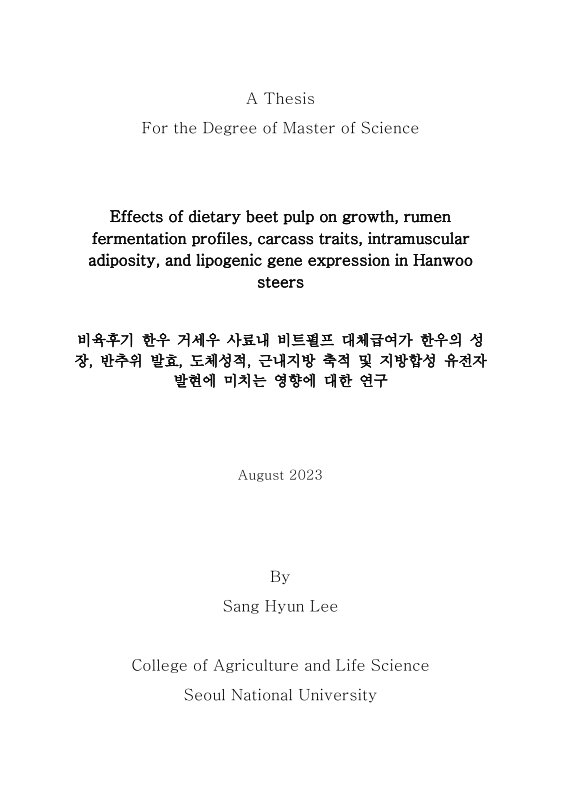
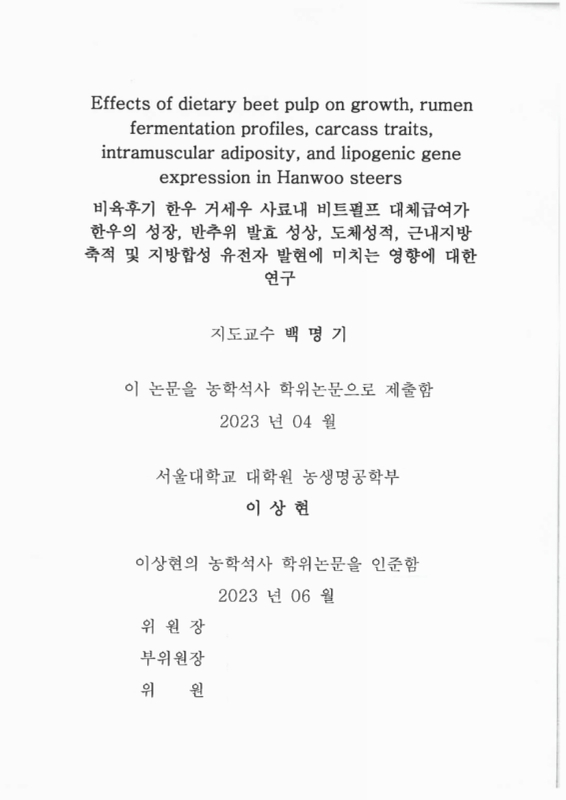
Title Page
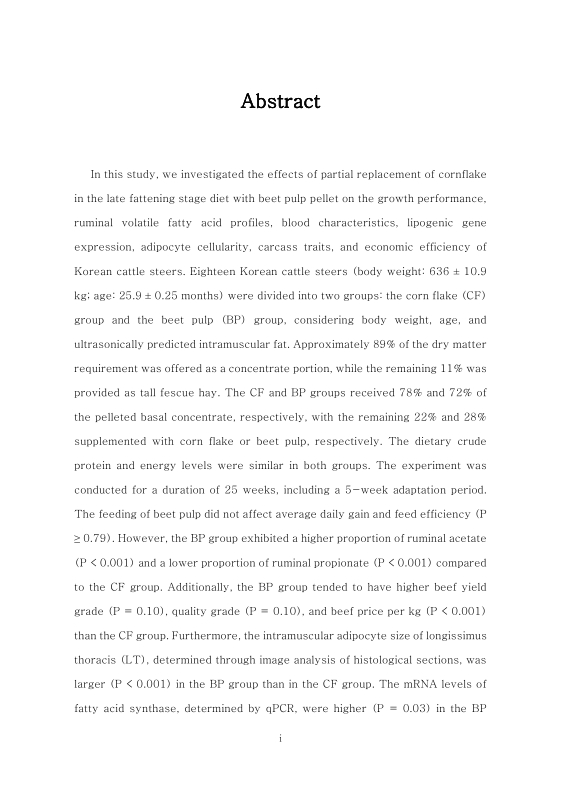
Abstract
Contents
List of abbreviations 10
Units and marks 12
Ⅰ. Introduction 13
Ⅱ. Literature review 15
1. Beet pulp 15
Beet pulp as alternative feed stuff 15
Beet pulp as source for improving beef quality 18
Grain feeds as energy source in ruminants 22
2. Intramuscular fat deposition 23
Adipocyte growth 23
Factors affecting IMF deposition 26
3. Physiological changes by feeding beet pulp in ruminant 31
Methane release 31
Gene expression 33
4. References 35
Ⅲ. Materials and methods 46
1. Animals, Experimental Design, and Diets 46
2. Analysis of chemical composition of feedstuffs and tissue physicochemical characteristics 50
3. Rumen fluid collection and analysis 51
4. Blood collection and analysis 52
5. Slaughter procedure, tissue sampling, carcass measurements, and meat physicochemical traits 53
6. Computer image analysis (CIA) of the marbling characteristics 54
7. Histological analysis 55
8. Quantitative polymerase chain reaction (qPCR) analysis 56
9. The CH₄ measurement by CO₂ method 60
10. Economic efficiency analysis 61
11. Statistical analysis 62
Ⅳ. Results 63
1. Growth performance and feed intake 63
2. Ruminal fermentation characteristics 65
3. Blood metabolites and hormones 68
4. Adipose cellularity 71
5. Carcass, CIA, and physicochemical characteristics 73
6. Lipid metabolism and muscle growth gene expression in the LT 76
7. Methanogenesis 78
8. Economic efficiency 79
Ⅴ. Discussion 80
1. Growth performance and feed intake 80
2. Ruminal fermentation characteristics and blood parameters 81
3. Carcass, CIA, and physicochemical traits of the LT 83
4. Adipocyte cellularity of the LT 84
5. Lipid metabolism and muscle growth gene expression in the LT 85
6. Methanogenesis 86
7. Economic efficiency 87
Ⅵ. Conclusion 88
Ⅶ. References 89
Ⅷ. Summary in Korean 101
Figure 1. The timelines of adipocyte formation in beef cattle life cycle. 25
Figure 2. The pathway of fatty acid (FA) synthesis in ruminants. 29
Figure 3. The overall effects of feeding beet pulp in beef cattle. 34
Figure 4. Representative adipocyte images of longissimus thoracis in Hanwoo steer. Area of a captured image is 2.12mm2. Black scale bar, 500μm. 72
Figure 5. Effects of partial replacement of corn flake with beet pulp on intramuscular adipocyte size distribution in the longissimus thoracis (LT) of... 72
Figure 6. Effects of partial replacement of corn flake with beet pulp on mRNA levels associated with fatty acid uptake and transport (A), lipogenesis (B),... 77
현재 국내 사료산업 시장 상황과 축산업의 현황을 고려하였을 때, 인간과 동물의 영양적 경쟁을 줄이고 생산성을 높일 수 있는 사료가 꾸준히 요구되고 있다. 국내 쇠고기 시장에서 근내지방의 축적, 즉 마블링은 쇠고기의 풍미, 기호성 및 소비자의 수요에 가장 결정적인 영향을 미친다. 일반적으로 높은 수준의 전분을 함유하고 있는 곡물 기반 사료를 급여하는 것이 쇠고기의 마블링 함량을 높이는 일반적인 전략으로 적용되었다. 그러나 옥수수와 같이 전분 함량이 높은 사료를 과도하게 급여하면 반추위 pH가 감소하고 반추위 산과다증이 발생할 위험이 있다. 비트펄프는 사탕무에서 당분을 추출한 후 남는 식품 부산물로, 중성 세제 섬유 (NDF)와 펙틴을 비롯한 소화율이 높은 섬유소를 많이 함유하고 있으며, 반추위 안정화에 도움을 주고 Acetate 발효를 촉진하여 반추동물 사료로 적합하다. 또한 비트펄프는 옥수수의 약 85%의 에너지 가치를 가진 대체 에너지원으로 볼 수 있다.
본 연구는 한우 거세우의 비육 후기 사료 내 옥수수의 일부를 비트펄프 펠렛으로 대체 급여하여 한우 거세우의 성장능력, 반추위 발효 특징, 혈액 대사 물질 및 호르몬, 지방합성 관련 유전자 발현, 지방세포의 발달, 도체 특성 및 경제성에 미치는 영향을 분석하였다.
비육후기 한우 거세우 18마리(체중 636±10.9kg; 연령 25.9±0.25개월)를 체중, 연령, 초음파 예측 근내지방을 고려하여 옥수수 플레이크(CF) 그룹과 비트펄프(BP) 그룹으로 나누었다. 건물기준 영양소 요구량의 약 89%는 농후사료로 급여하였고 나머지 11%는 톨페스큐 건초로 급여 되었다. 총 농후사료 중 각각 78%와 72%는 CF 및 BP 그룹에 시중의 일반 농후사료로 제공되었고, 나머지 22%와 28%는 각각 옥수수 플레이크 또는 비트펄프 펠렛으로 급여되었다. 두 그룹의 사료내 총 조단백질과 에너지 수준은 동일하게 설정되었다.
실험은 5주간의 적응기간을 포함하여 총 25주간 진행되었다. 총 증체량, 일당 증체량 및 사료 효율은 비트 펄프의 대체 급여에 의해 영향을 받지 않았다 (p ≥ 0.79). Ruminal acetate, C2/C3 비율 (둘 다 p < 0.001)은 CF 그룹보다 BP 그룹에서 더 높았다. 한편, Ruminal propionate (p < 0.001), iso-valerate (p = 0.002)의 비율은 CF 그룹보다 BP 그룹에서 더 낮았다. FASN (fatty acid synthase) mRNA 발현 수준은 CF 그룹보다 BP 그룹에서 더 높았다 (P = 0.03).
등심 내 근내지방의 세포 크기 (p < 0.001)는 CF 그룹보다 BP 그룹에서 더 높았다. 또한, 상대적으로 크기가 작은 근내지방구 세포의 비율은 CF 그룹이 BP 그룹보다 높았으며, 상대적으로 크기가 큰 (100μm 이상)근내지방구 세포의 비율은 BP 그룹이 CF 그룹보다 더 높았다 (p < 0.04). 육량지수, 육량등급, 품질등급은 BP 그룹에서 더 높은 경향을 보였다 (p ≤ 0.1). 1Kg당 지육단가 (p < 0.001)는 CF 그룹보다 BP 그룹에서 더 높았으며, 총 수입 (p = 0.06)과 총 경제적 효율 (p = 0.001)은 BP그룹에서 더 높게 나타났다.
결론적으로, 비육 후기 한우의 사료내 옥수수 일부가 비트펄프로 대체되어도 성장 능력, 혈액 내 호르몬 및 메탄 발생량에 부정적인 영향을 미치지 않으면서, 일부 지방합성 관련 유전자 발현 량을 증가시킬 수 있고, 지방분해 관련 유전자의 발현량을 감소시킬 가능성이 등심의 지방 세포 크기 증가에 영향을 미칠 수 있다. 그 결과, 향상된 근내지방 합성으로 인하여 마블링의 함량이 증가하여 육질 등급의 긍정적인 영향을 미치고 이는 경제적인 효율의 증가로 이어질 수 있다.*표시는 필수 입력사항입니다.
| 전화번호 |
|---|
| 기사명 | 저자명 | 페이지 | 원문 | 기사목차 |
|---|
| 번호 | 발행일자 | 권호명 | 제본정보 | 자료실 | 원문 | 신청 페이지 |
|---|
도서위치안내: / 서가번호:

우편복사 목록담기를 완료하였습니다.
*표시는 필수 입력사항입니다.
저장 되었습니다.
