권호기사보기
| 기사명 | 저자명 | 페이지 | 원문 | 기사목차 |
|---|
| 대표형(전거형, Authority) | 생물정보 | 이형(異形, Variant) | 소속 | 직위 | 직업 | 활동분야 | 주기 | 서지 | |
|---|---|---|---|---|---|---|---|---|---|
| 연구/단체명을 입력해주세요. | |||||||||
|
|
|
|
|
|
* 주제를 선택하시면 검색 상세로 이동합니다.
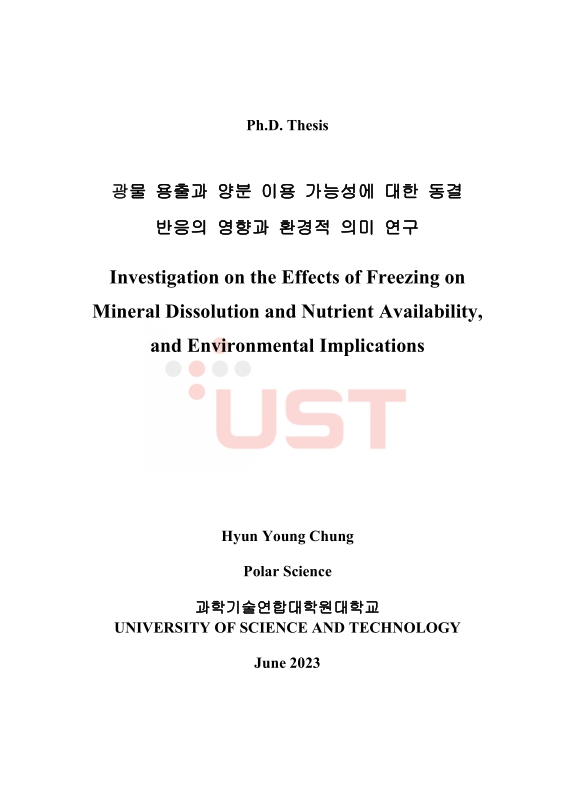
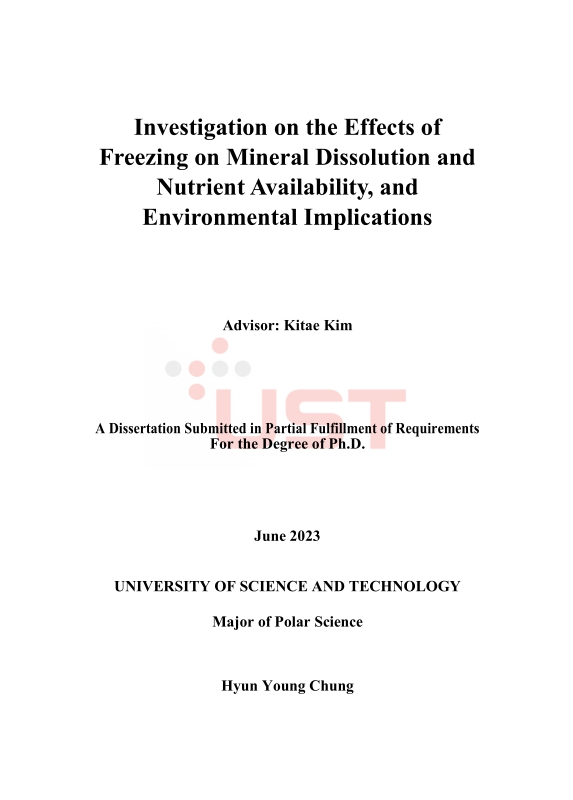
Title Page
ABSTRACT
국문 초록
Contents
1. General Introduction 18
1.1. Ice Chemical Reactions 18
1.2. Cryogenic Geochemical Reactions 22
1.3. Research Topics 23
1.4. References 26
2. Chemical Weathering of Granite in Ice and Its Implication for Weathering in Polar Regions 30
2.1. Introduction 30
2.2. Materials and Methods 32
2.2.1. Materials 32
2.2.2. Pretreatment and Batch Experiments 32
2.2.3. Chemical and Optical Analysis 33
2.3. Results 36
2.3.1. Filtrate Analysis 36
2.3.2. XRD Analysis and Amorphous Silica Formation 39
2.3.3. Optical Images of Ice Grain Boundaries 42
2.4. Discussion 43
2.4.1. The Mechanism behind the Dissolution of Granite in Ice 43
2.4.2. Silica Polymerization in Ice and Its Implication for Polar Regions 45
2.5. Conclusions 48
2.6. References 49
3. Cryogenic Iron-Phosphate Formation as a Sink for Bioavailable Iron and Phosphorus 53
3.1. Introduction 53
3.2. Materials and Methods 55
3.2.1. Materials 55
3.2.2. Experimental Design 56
3.2.3. Chemical and Microscopic Analysis 57
3.3. Results and Discussion 58
3.3.1. Accelerated Removal of Phosphate and Ferrous in Ice 58
3.3.2. Observations of the Solid Particles Formed during the Freezing Process 62
3.3.3. Identification of Amorphous Ferric Phosphate 64
3.3.4. Mechanism of Enhanced Removal of P and Fe Reactions in Ice 67
3.4. Implications 69
3.5. References 71
4. Frozen Clay Minerals as a Potential Source of Bioavailable Iron and Magnetite 79
4.1. Introduction 79
4.2. Materials and Methods 82
4.2.1. Materials 82
4.2.2. Batch Experiment 83
4.2.3. Chemical Analysis and Microscopic Analyses 84
4.2.4. Electron Microscopy Analyses 85
4.3. Results and Discussion 86
4.3.1. Enhanced Reductive Dissolution of Fe(III) from Nontronite in Ice 86
4.3.2. Mechanisms of the Reductive Dissolution and Freeze Concentration Effect 90
4.3.3. Accelerated Transformations of Iodine Species in Ice 93
4.3.4. Irreversibility of Reactive Iodine Species Generated from Iodide 94
4.3.5. Abiotic Formation of Magnetite in Ice 97
4.4. Environmental Implications 101
4.5. References 103
5. Conclusions 114
Figure 1-1. Scheme of acceleration mechanism in ice. A single crystal of ice (I), concentrated phase (C), solution enclosed within the ice grain boundaries (S), and... 21
Figure 1-2. Changes in the distribution of hexavalent chromium concentration of a frozen solution containing hexavalent chromium and iodide. 21
Figure 2-1. Pretreatments and batch experiments of the bulk type of granite. (a) Bulk rock sample, (b) diamond blade, (c) small rock chips sliced with (b), (d) ring... 35
Figure 2-2. Chemical composition changes of filtrate after a batch experiment with a pH 3 solution and DW. (a) [Na⁺], (b) [K⁺], (c) [Mg²⁺], and (d) [Ca²⁺]. 37
Figure 2-3. Chemical composition changes of filtrate after batch experiment with pH 2 solution and DW. (a) [Na⁺], (b) [K⁺], (c) [Mg²⁺], and (d) [Ca²⁺]. 38
Figure 2-4. XRD patterns for a fresh granite sample and filtered solid material after the 29-day batch experiment under different conditions; quartz (Q),... 40
Figure 2-5. SiO₂ concentration analysis of filtrate after a batch experiment with a pH 2 solution. 41
Figure 2-6. Representative optical images of (a) pH 3 solution and (b) the mixture of PH 3 solution and granite powder frozen to -20 ℃ on the Linkam stage with... 41
Figure 2-7. Scheme of dissolution of granite in ice. 41
Figure 3-1. Time profiles of dissolved P, Fe(II), and total Fe concentrations in aqueous and ice samples after filtering. Experimental conditions were as described... 60
Figure 3-2. Time profiles of dissolved Fe(II) and total Fe concentrations in aqueous and ice samples after filtering. The circle, triangle, inverted triangle, square, and diamond shapes... 61
Figure 3-3. UV/Vis full spectra of unfiltered samples after reaction time. (a) aqueous samples, (b) ice samples after thawing. The peaks at around 210 and 310 nm indicate the... 61
Figure 3-4. X-ray diffraction (XRD) pattern of freeze-dried solid particles with a characteristic amorphous peak. 63
Figure 3-5. Representative transmission electron microscopy (TEM) image of the collected from solid particles and corresponding energy-dispersive X-ray... 63
Figure 3-6. Selected area diffraction (SAED) patterns of (a) single globule and (b) agglomerated globules of freeze-dried solid particles. 64
Figure 3-7. Raman spectrum of the centrifuged and freeze-dried solid particles. Mono-chromatic irradiation at 532 nm was used to analyze the composition of the... 66
Figure 3-8. ATR-FTIR spectrum of freeze-dried solid particles. The sample surface was in contact with a Ge tip ATR accessory to obtain the spectrum. 66
Figure 4-1. Time profiles of dissolved Fe concentrations in aqueous and ice samples with or without iodide. Filled markers represent the data of frozen samples... 88
Figure 4-2. The transformations of iodine species. (a) I¯ concentrations of aqueous and ice samples measured using IC system (b) UV/Vis spectra of I¯ in aqueous and ice... 89
Figure 4-3. Optical image of concentrated NAu-2 particles at the ice grain boundaries. Experimental condition: [NAu-2]=0.2 g L¯¹, [DW]=10 mL, freezing rate: -2 ℃ min¯¹,... 89
Figure 4-4. UV/Vis spectra of iodine species of the ice sample taken after 24h of reaction and filtered. (a)UV/Vis spectradenoting I¯ around 226 nm and (b)UV/Vis... 96
Figure 4-5. Images of the thawed and filtered 24h ice sample (before and after 24 h) left to be evaporated at room temperature. Experimental conditions: [NAu-2]=... 96
Figure 4-6. TEM images of NAu-2 with the corresponding SAED patterns. (a) TEM image of initial NAu-2 and (b) NAu-2 after 24 h of freezing. 99
Figure 4-7. TEM images of NAu-2 and magnetite. (a) NAu-2 after 24 h of freezing (b) nanoparticulate magnetite (c) corresponding SAED pattern and (d)... 99
Figure 4-8. X-ray diffraction profiles of initial NAu-2 and NAu-2 after 12 and 24 h of freezing. 100
Figure 4-9. Scheme of the freezing induced reductive dissolution of clay mineral and transformation of iodine species, and magnetite formation 100
*표시는 필수 입력사항입니다.
| 전화번호 |
|---|
| 기사명 | 저자명 | 페이지 | 원문 | 기사목차 |
|---|
| 번호 | 발행일자 | 권호명 | 제본정보 | 자료실 | 원문 | 신청 페이지 |
|---|
도서위치안내: / 서가번호:

우편복사 목록담기를 완료하였습니다.
*표시는 필수 입력사항입니다.
저장 되었습니다.
