대표어
대표어
 학술연구정보서비스(KERIS)
권호기사보기
| 기사명 | 저자명 | 페이지 | 원문 | 기사목차 |
|---|
결과 내 검색
동의어 포함
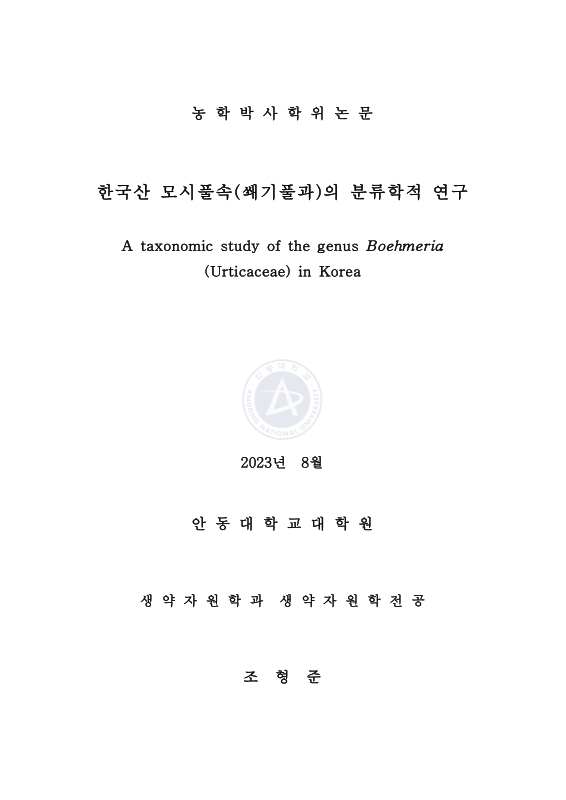
표제지
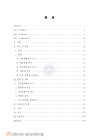
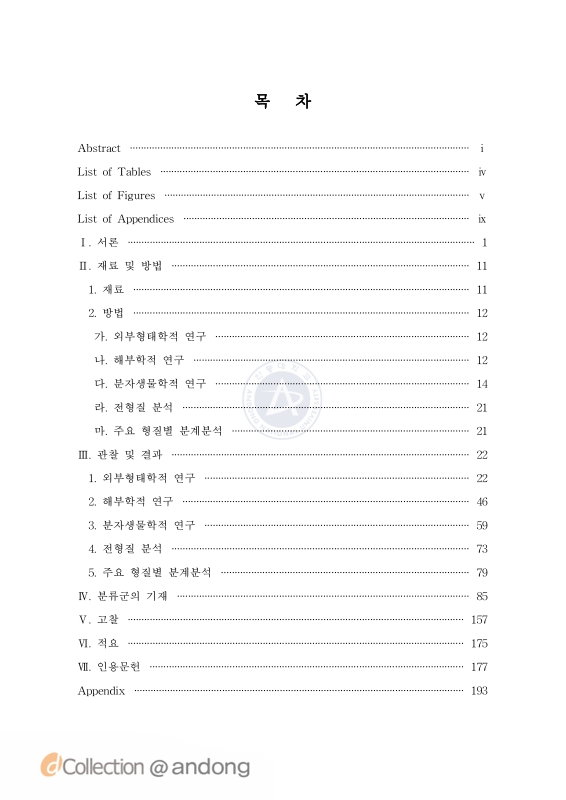
목차
Abstract 5
Ⅰ. 서론 14
1. 식물지리학적 분포 14
2. 모시풀속(Boehmeria Jacq.)의 분류체계 및 분류학적 연구 15
3. 한국산 모시풀속(Boehmeria Jacq.)의 분류학적 연구 20
4. 한국산 모시풀속(Boehmeria Jacq.)의 문제점 및 연구목표 22
1) 주요 식별형질에 대한 유용성 검토 22
2) 한국 특산 4종 및 근연 분류군에 대한 실체 규명 22
3) 분류군에 대한 정확한 학명 부여 및 분류군 수 정리 23
4) 주요 식별형질에 대한 진화경향성 파악 23
5) 기존 분류체계의 타당성 검토 및 한국산 분류체계 정립 23
Ⅱ. 재료 및 방법 24
1. 재료 24
2. 방법 25
가. 외부형태학적 연구(External morphological study) 25
나. 해부학적 연구(Anatomical study) 25
다. 분자생물학적 연구(Molecular study) 27
라. 전형질 분석(Phenetic analysis) 34
마. 주요 형질별 분계분석(Cladistic analysis by key characteristics) 34
Ⅲ. 관찰 및 결과 35
1. 외부형태학적 연구(External morphological study) 35
가. 생육지(Habitat) 35
나. 생활형(Life form) 35
다. 줄기(Stem) 36
라. 잎(Leaf) 38
바. 화서(Inflorescence) 48
사. 꽃(Flower) 51
아. 과서(Infructescence) 55
자. 수과(Achene) 56
2. 해부학적 연구(Anatomical study) 59
가. 줄기(Stem) 59
나. 엽병(Petiole) 64
다. 잎(Leaf) 65
라. 수과(Achene) 71
3. 분자생물학적 연구(Molecular study) 72
가. 전체 엽록체 게놈 분석 72
나. 전체 엽록체 게놈 계통수 분석 75
다. 염기서열 분석 75
라. 계통수 분석 78
4. 전형질 분석(Phenetic analysis) 86
5. 주요 형질별 분계분석(Cladistic analysis by key characteristics) 92
Ⅳ. 분류군의 기재 98
Ⅴ. 고찰 170
1. 형질의 분류학적 유용성과 진화경향성 170
1) 절의 구분형질에 대한 유용성 및 진화경향성 170
2) 열 및 종의 구분형질에 대한 유용성 및 진화경향성 173
2. 한국산 모시풀속의 분류체계의 타당성 검토 및 학명 정리 181
3. 유연관계 183
Ⅵ. 적요 188
Ⅶ. 인용문헌 190
Appendices 13
Appendix 1. Collection data and voucher specimens of Korean Boehmeria. 206
Appendix 2. Additional specimens examined for this study. 215
Appendix 3. Qualitative characteristics in Korean Boehmeria. 232
Appendix 4. Quantitative characteristics in Korean Boehmeria. 242
Fig. 1. Distribution map of the genus Boehmeria in the world. 14
Fig. 2. Morphological characteristics measured in this study. A. Plant, B. Stipule, C. Middle leaf, D. Staminate inflorescence, E. Pistillate inflorescence,... 26
Fig. 3. nrDNA ITS and cpDNA regions and primer locations for molecular analyses in this study (redrawn from Geneious prime 2022.2.2.).... 29
Fig. 4. Types of life form in Korean Boehmeria. A. perennial herb, B. subshrub, C. shrub. 36
Fig. 5. Types of stem color in Korean Boehmeria. A. yellow green, B. red 37
Fig. 6. Illustrations of trichome types and lithocyst in this study. A. Hirsute (조장모), B. Hirsutulous (세조장모), C. Lanate (양모), D. Scabrous (조모), E.... 38
Fig. 7. Trichomes of the stems in Korean Boehmeria (SEM). A. B. nivea, B. B. nipononivea, C. B. holosericea, D. B. longispica, E. B. platanifolia,... 39
Fig. 8. Types of phyllotaxis in Korean Boehmeria. A. alternate, B. opposite. 41
Fig. 9. Types of stipule attachment in Korean Boehmeria. A. intrapetiolar, B. interpetiolar. st: stipule, pe: petiole. 41
Fig. 10. Types of stipule connation in Korean Boehmeria. A. free, B. connate. 42
Fig. 11. Types of reflex stipule in Korean Boehmeria. A. not reflex, B. reflex. 42
Fig. 12. Types of stipule shape in Korean Boehmeria. A. oblong-lanceolate, B. lanceolate, C. narrowly triangular, D. triangular-ovate 43
Fig. 13. Types of middle leaf blade shape in Korean Boehmeria. A. rhombic, B. 5-angled, C. ovate. 44
Fig. 14. Types of margin shape in Korean Boehmeria. A. serrulate-dentate, B. serrate-dentate, C. crenulate. 44
Fig. 15. Types of tooth uniformity in Korean Boehmeria. A. uniform, B. ununiform. 45
Fig. 16. Types of lobed apex in Korean Boehmeria. A. unlobed, B. lobed. 46
Fig. 17. Presence of white trichome on the leaf abaxial surface in Korean Boehmeria.... 46
Fig. 18. Trichomes of the leaf abaxial surface in Korean Boehmeria (SEM). A. B. nivea, B. B. nipononivea, C. B. holosericea, D. B. longispica, E. B. platanifolia,... 49
Fig. 19. Types of inflorescence in Korean Boehmeria. A. unbranched, B. branched. 50
Fig. 20. Colors of inflorescence in Korean Boehmeria. A-1, 2. yellow green, B-1, 2. red. A-1, B-1. staminate inflorescence, A-2,... 51
Fig. 21. Perianth appendages and trichomes of the staminate flowers in Korean Boehmeria (SEM).... 54
Fig. 22. Box plot based on data of glomerule width at the fruiting stage in Korean Boehmeria.... 55
Fig. 23. Arrangement of glomerules at the fruiting stage in Korean Boehmeria.... 56
Fig. 24. Shapes and trichomes of the achenes in Korean Boehmeria (SEM). A. B. nivea, B. B. nipononivea, C. B. holosericea, D. B. longispica, E. B. platanifolia,... 58
Fig. 25. Cross-sections of the stems in Korean Boehmeria (LM). A-1, 2. B. nivea, B-1, 2. B. nipononivea, C-1, 2. B. holosericea, D-1, 2. B.... 61
Fig. 26. Bast fibers of the stems in Korean Boehmeria (LM). A. B. nivea, B. B. quelpaertensis. Arrow: bast fiber. 63
Fig. 27. Cross-sections of the petioles in Korean Boehmeria (LM). A. B. nivea, B. B. nipononivea, C. B. holosericea, D. B. longispica, E. B. platanifolia,... 66
Fig. 28. Cross-sections of the leaves in Korean Boehmeria (LM). A. B. nivea, B. B. nipononivea, C. B. holosericea, D. B. longispica, E. B. platanifolia,... 69
Fig. 29. Cross-sections of the achenes in Korean Boehmeria (LM). A-1, 2. B. nivea, B-1, 2. B. nipononivea, C-1, 2. B. holosericea, D-1, 2. B.... 73
Fig. 30. The chloroplast genome maps of the five taxa of Korean Boehmeria. A. B. holosericea, B. B. platanifolia, C. B. hirtella, D. B.... 76
Fig. 31. Phylogram obtained from Maximum parsimony and Maximum likelihood based on the complete chloroplast genomes. Bootstrap percentages for... 77
Fig. 32. Bayesian inference tree based on the internal transcribed spacer of nrDNA sequences. Bayesian posterior probability for each clades are... 82
Fig. 33. Bayesian inference tree based on the ndhF region of cpDNA sequences. Bayesian posterior probability for each clades are indicated on the branch. 83
Fig. 34. Bayesian inference tree based on the trnK region of cpDNA sequences. Bayesian posterior probability for each clades are indicated on the branch. 84
Fig. 35. Bayesian inference tree based on the combined ITS and cpDNA(ndhF, trnK) data set. Bayesian posterior probability for each clades are... 85
Fig. 36. UPGMA phenogram based on the morphological and anatomical characteristics of Korean Boehmeria. 91
Fig. 37. Ancestral characteristic reconstruction for life form and stem trichome in the Bayesian inference tree based on the combined ITS and... 94
Fig. 38. Ancestral characteristic reconstruction for phyllotaxis and veinlet trichome of leaf abaxial surface in the Bayesian inference tree based on the... 95
Fig. 39. Ancestral characteristic reconstruction for the type of pistillate inflorescence and appendage of staminate flower perianth in the Bayesian... 96
Fig. 40. Ancestral characteristic reconstruction for trichome of staminate flower perianth and achene trichome in the Bayesian inference tree based... 97
Fig. 41. Distribution map of Boehmeria nivea in Korea and neighboring countries. solid circle: native species, open circle: cultivated species. 104
Fig. 42. Photograph of Boehmeria nivea. A. Habit, B. Underground structure, C. Base stem, D. Middle stem, E. Adaxial surface... 106
Fig. 43. Type specimen of Boehmeria nivea. China. Unknown collector s.n. (Lectotype in LINN). 107
Fig. 44. Distribution map of Boehmeria nipononivea in Korea and neighboring countries. solid circle: native species, open circle: cultivated species. 110
Fig. 45. Photograph of Boehmeria nipononivea. A. Habit, B. Underground structure, C. Base stem, D. Middle stem, E. Adaxial... 111
Fig. 46. Type specimen of Boehmeria nivea var. reticulata. Japan. P.F. von Siebold s.n. (Syntype: L, photo!). 112
Fig. 47. Distribution map of Boehmeria holosericea in Korea and neighboring countries. 115
Fig. 48. Photograph of Boehmeria holosericea. A. Habit, B. Underground structure, C. Base stem, D. Middle stem, E. Adaxial... 118
Fig. 49. Type specimen of Boehmeria holosericea. Japan. H. Bürger s.n. (Lectotype in L). 119
Fig. 50. Distribution map of Boehmeria longispica in Korea and neighboring countries. 122
Fig. 51. Photograph of Boehmeria longispica. A. Habit, B. Underground structure, C. Base stem, D. Middle stem, E. Adaxial... 123
Fig. 52. Type specimen of Boehmeria longispica. China. Ningpo, Aug 1844, Fortune 85A (Lectotype in P). 124
Fig. 53. Distribution map of Boehmeria platanifolia in Korea and neighboring countries. 127
Fig. 54. Photograph of Boehmeria platanifolia. A. Habit, B. Underground structure, C. Base stem, D. Middle stem, E. Adaxial... 129
Fig. 55. Type specimen of Boehmeria platanifolia. Japan, jugo Hakone, Aug ?, P. A. L. Savatier 1117 (Holotype in P). 130
Fig. 56. Distribution map of Boehmeria quelpaertensis in Korea and neighboring countries 133
Fig. 57. Photograph of Boehmeria quelpaertensis. A. Habit, B. Underground structure, C. Base stem, D. Middle stem, E. Adaxial... 134
Fig. 58. Type specimen of Boehmeria quelpaertensis. Korea. Quelpaert Island, 3 Nov 1917, T. Nakai 4999 (Holotype in TI). 135
Fig. 59. Distribution map of Boehmeria hirtella in Korea and neighboring countries. 138
Fig. 60. Photograph of Boehmeria hirtella. A. Habit, B. Underground structure, C. Base stem, D. Middle stem, E. Adaxial surface... 139
Fig. 61. Type specimen of Boehmeria hirtella. Korea. Quelpaert Island, 16 Aug 1910, E. Taquet 4433 (Holotype in TI). 140
Fig. 62. Distribution map of Boehmeria nakashimae in Korea and neighboring countries 142
Fig. 63. Photograph of Boehmeria nakashimae. A. Habit, B. Underground structure, C. Base stem, D. Middle stem, E. Adaxial surface... 143
Fig. 64. Type specimen of Boehmeria nakashimae. Japan. Kyushu, Fukuoka Pref., Fukuoka City, Shikanoshima, 19 Sep 1937, K.... 144
Fig. 65. Distribution map of Boehmeria sieboldiana in Korea and neighboring countries. 147
Fig. 66. Photograph of Boehmeria sieboldiana. A. Habit, B. Underground structure, C. Base stem, D. Middle stem, E. Adaxial surface... 149
Fig. 67. Type specimen of Boehmeria sieboldiana. Japan. H. Bürger s.n. (Isosyntype in L). 150
Fig. 68. Distribution map of Boehmeria gracilis in Korea and neighboring countries. 152
Fig. 69. Photograph of Boehmeria gracilis. A. Habit, B. Underground structure, C. Base stem, D. Middle stem, E. Adaxial surface... 154
Fig. 70. Type specimen of Boehmeria gracilis. China. Hubei, Patung, Ichang, May 1888, A. Henry 4692 (Lectotype in K). 155
Fig. 71. Distribution map of Boehmeria paraspicata in Korea and neighboring countries 157
Fig. 72. Photograph of Boehmeria paraspicata. A. Habit, B. Underground structure, C. Base stem, D. Middle stem, E. Adaxial surface... 158
Fig. 73. Type specimen of Boehmeria paraspicata. Japan. Hokkaido, Prov. Hidaka, Mt. Apoi, Aug 1928, T. Nakai s.n. (Holotype... 159
Fig. 74. Distribution map of Boehmeria silvestrii in Korea and neighboring countries. 162
Fig. 75. Photograph of Boehmeria silvestrii. A. Habit, B. Underground structure, C. Base stem, D. Middle stem, E. Adaxial surface... 163
Fig. 76. Type specimen of Boehmeria silvestrii. China. Hubei, 1912, P. C. Silvestri 4070 (Lectotype in FI). 164
Fig. 77. Comparative photographs of Boehmeria silvestrii and B. platanifolia. A. B. silvestrii, B. B. platanifolia. a. Base stem, b. Middle stem, c. Middle leaf, d.... 165
Fig. 78. Distribution map of Boehmeria spicata in Korea and neighboring countries. 167
Fig. 79. Photograph of Boehmeria spicata. A. Habit, B. Underground structure, C. Base stem, D. Middle stem, E. Adaxial surface... 168
Fig. 80. Type specimen of Boehmeria spicata. Japan. 1984, C. P. Thunberg 22115 (Lectotype in UPS). 169
Fig. 81. Evolutionary trend of stipule connation inferred in this study. A. connate, B. free. 171
Fig. 82. Evolutionary trend of life form inferred in this study. A. shrub, B. sub-shirub, C. perennial herb. 174
Fig. 83. Evolutionary trend of trichome inferred in this study. A. appressed trichome without basal cell, B. erect trichome with basal cell. 175
Fig. 84. Evolutionary trend of inflorescence inferred in this study. A. raceme of spicates with glomerules (branched), B. spicate (unbranched). 178
Fig. 85. Evolutionary trend of the appendage of staminate flower perianth inferred in this study.... 179
Fig. 86. Lithocyst with cystolith of the leaf upper epidermis in Korean Boehmeria. A. cross-section of leaf, B. scanning electron micrographs of... 181
Fig. 87. Phylogenetic tree based on ITS, ndhF, and trnK of Korean Boehmeria and key characteristics. Key characteristics for presented on tree; A. Sect.... 184
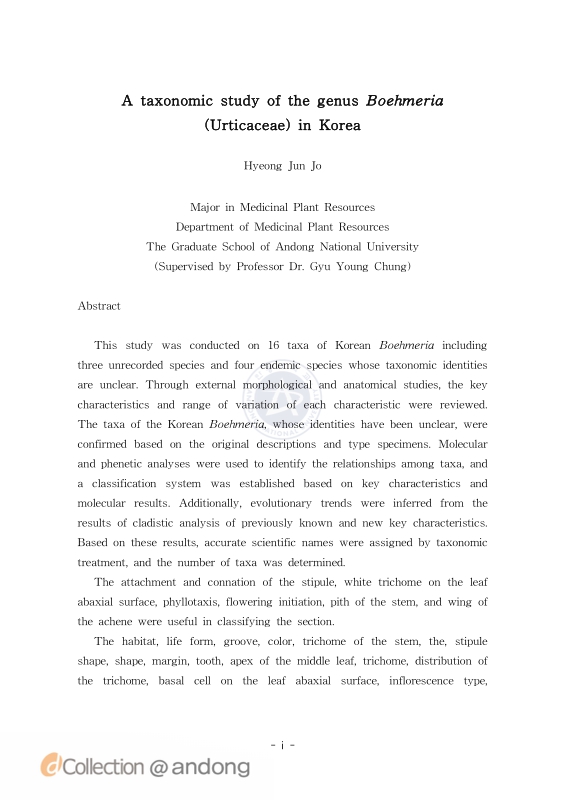
본 연구는 미기록 3종과 실체가 불분명한 것으로 여겨지는 한국특산 4종을 포함한 총 16분류군의 한국산 모시풀속을 대상으로 수행되었다. 외부형태학적, 해부학적 연구를 통해 주요 식별형질과 각 형질별 변이 폭을 검토하였고, 원기재문과 기준표본을 바탕으로 그 동안 실체가 혼동되어 온 한국산 모시풀속의 분류군을 규명하였다. 분자생물학적 연구와 전형질 분석으로 분류군 간의 유연관계를 파악하였고, 주요 식별형질에 근거하여 분류체계를 정립하였다. 또한, 기존에 알려진 주요 식별형질과 새로운 식별형질에 대한 분계분석을 통해 진화 경향성을 추론하였다. 이와 같은 결과를 토대로 분류학적 처리를 수행하여 정확한 학명을 부여하였고, 분류군 수를 정리하였다.
절의 구분 형질로는 탁엽의 부착위치, 탁엽의 합생 또는 이생 여부, 잎 이면의 백색 모용의 유무, 엽서의 종류, 개화시기, 줄기의 수(pith) 및 수과의 날개 유무가 유용한 것으로 나타났다.
열 또는 종을 구분하는 형질로는 생육지, 생활형, 줄기의 홈, 줄기의 색, 줄기의 모용, 탁엽의 젖혀짐 여부, 탁엽의 형태, 중부잎의 형태, 엽연의 형태, 거치의 균일성, 엽선의 갈라짐, 잎 이면의 주맥과 세맥의 모용, 화서의 형태, 수꽃화피 부속체의 유무, 수꽃화피의 모용, 단집과서의 배열 및 수과의 모용이 관찰되었다. 또한, 줄기의 해부학적 형질에서는 횡단면의 형태, 표피의 층 수, 인피 섬유 조직의 너비, 인피 섬유 세포의 두께 및 수의 형태가 종을 구분하는 형질로 나타났다. 엽병의 해부학적 형질에서는 횡단면의 형태, 사출수유관속의 유무, 인피 섬유의 유무 및 수의 유무가 종을 구분하는데 유용하였다. 잎의 해부학적형질에서는 향축면 중륵의 형태, 책상유조직의 수 및 중륵 유관속의 형태가 종의 구분형질로 관찰되었다.
한국산 모시풀속의 핵DNA의 ITS구간과 엽록체DNA의 ndhF, trnK에 대한 분자생물학적 연구결과는 절과 열의 분류체계에서 잘 지지되는 것으로 확인되었다. 모시풀절(sect. Tilocnide)과 왜모시풀절(sect. Duretia) 등 2개의 절로 분기하였고, 모시풀절 내에는 왜모시풀열(ser. Longispicae), 긴잎모시풀열(ser. Sieboldianae), 그리고 좀깨잎나무열(ser. Spicatae) 등 3개의 열로 다시 구분되었다. 그러나 38개의 외부형태학적 및 해부학적 형질에 근거하여 수행된 전형질 분석 결과는 절 수준에서는 분자생물학적 연구결과와 동일하게 나타났지만 왜모시풀열과 긴잎모시풀열은 같은 유집군을 형성하였다.
주요 형질별 분계분석에서는 생활형, 줄기의 모용, 엽서, 잎 이면의 모용, 암화서, 수꽃화피의 부속체, 수꽃화피의 모용 및 수과의 모용에 대한 진화경향성을 파악하여 원시형질과 파생형질을 추론하였다.
한국산 모시풀속의 분류학적 처리 결과, 기존 'var. tenacissima'로 취급되었던 섬모시풀의 학명은 종 수준에서 선취권을 갖는 B. nipononivea로 학명을 정리하였다. 거북꼬리(B. tricuspis)는 개모시풀(B. platanifolia)에 이명 처리되었으며, 개모시풀의 학명은 B. platanifolia (Maxim.) C. H. Wright로 취급하였다. 한국 특산종으로 알려진 제주긴잎모시풀(B. nakaiana), 섬거북꼬리(B. taquetii)은 긴잎모시풀(B. sieboldiana)에 이명 처리하였고, 털긴잎모시풀(B. hirtella)과 제주모시풀(B. quelpaertensis)은 실체가 확인되었으나 일본에도 분포하는 것으로 확인되었다.
결과적으로 한국산 모시풀속을 2절 3열 총 13분류군으로 분류하였다. 첫 번째 모시풀절에는 모시풀, 섬모시풀이 해당되고, 두 번째 왜모시풀절 내의 왜모시풀열에는 왕모시풀(B. holosericea), 왜모시풀(B. longispica), 개모시풀, 제주모시풀이 속하며, 긴잎모시풀열에는 털긴잎모시풀, 제주톱모시풀(B. nakashimae), 긴잎모시풀이 해당되고, 이 절은 본 연구에서 새롭게 열 계급으로 격하시켰다. 마지막으로 좀깨잎나무열은 톱거북꼬리(B. gracilis), 풀거북꼬리(B. paraspicata), 참거북꼬리(B. silvestrii), 좀깨잎나무(B. spicata)가 속한다. 본 연구에서 각 분류군에 대한 분류학적 처리, 기재문, 도판, 기준표본 및 검색표를 제시하였다.*표시는 필수 입력사항입니다.
| 전화번호 |
|---|
| 기사명 | 저자명 | 페이지 | 원문 | 기사목차 |
|---|
| 번호 | 발행일자 | 권호명 | 제본정보 | 자료실 | 원문 | 신청 페이지 |
|---|
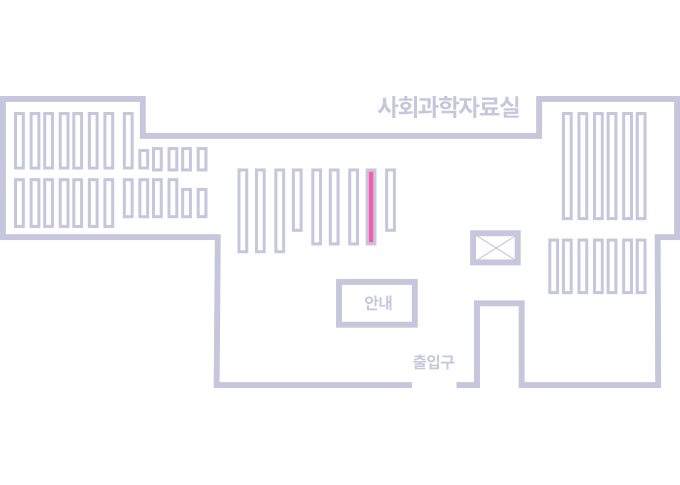
도서위치안내: / 서가번호:
우편복사 목록담기를 완료하였습니다.
*표시는 필수 입력사항입니다.
저장 되었습니다.