
 대표어
대표어
권호기사보기
| 기사명 | 저자명 | 페이지 | 원문 | 기사목차 |
|---|
결과 내 검색
동의어 포함
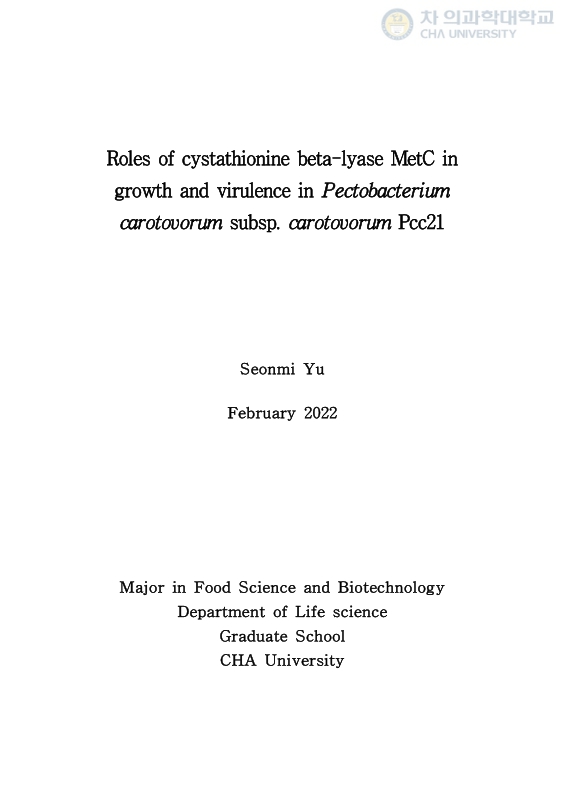
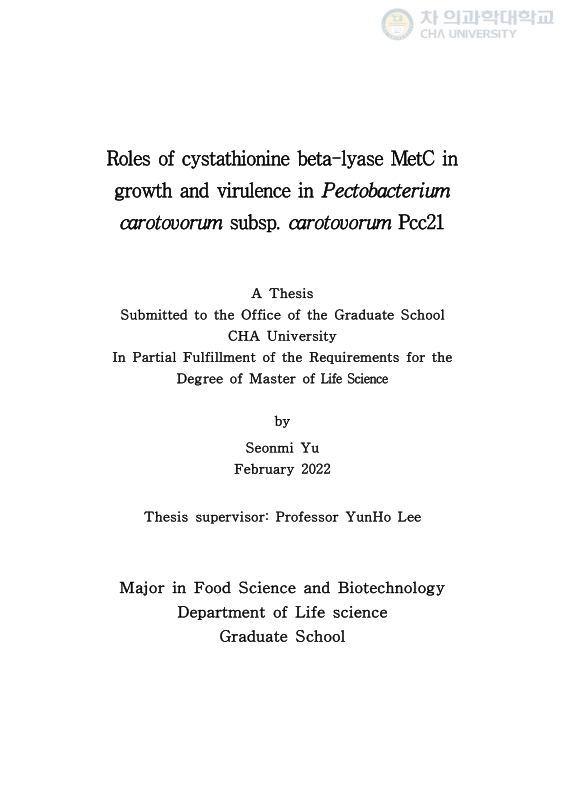
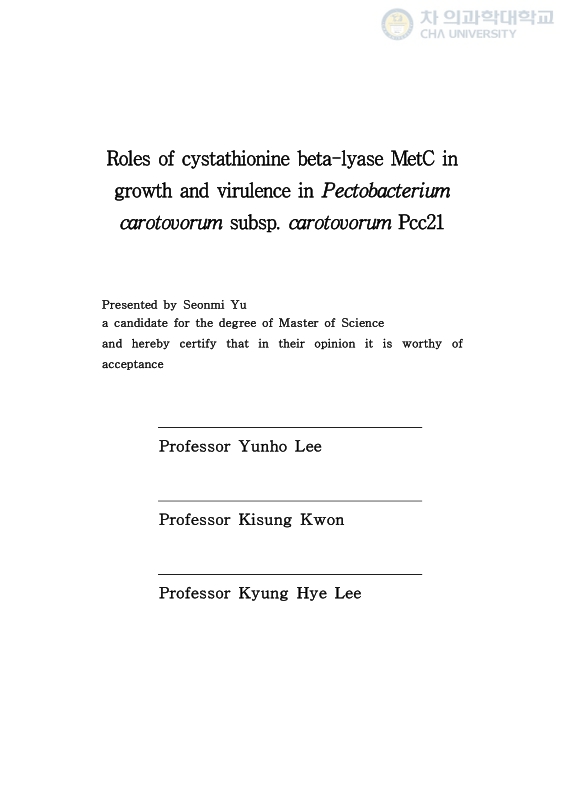
Title Page
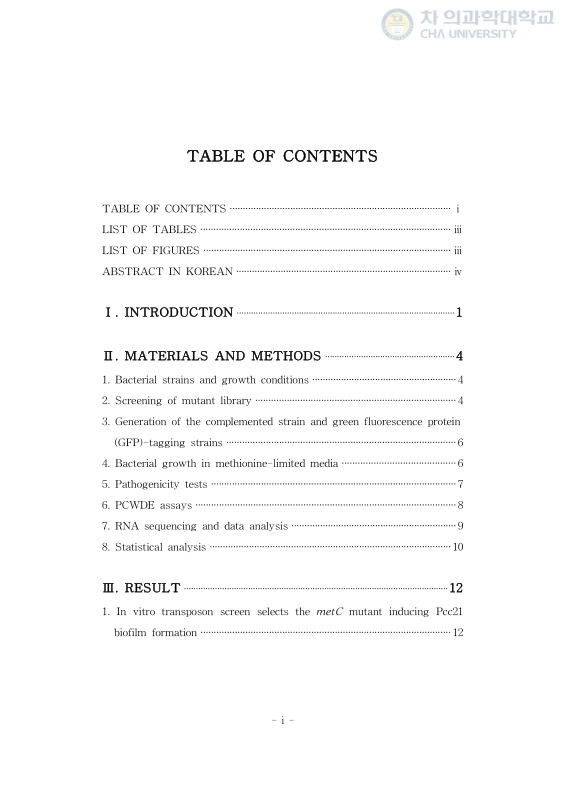
Contents
ABSTRACT IN KOREAN 8
Ⅰ. INTRODUCTION 10
Ⅱ. MATERIALS AND METHODS 13
1. Bacterial strains and growth conditions 13
2. Screening of mutant library 13
3. Generation of the complemented strain and green fluorescence protein (GFP)-tagging strains 15
4. Bacterial growth in methionine-limited media 15
5. Pathogenicity tests 16
6. PCWDE assays 17
7. RNA sequencing and data analysis 18
8. Statistical analysis 19
Ⅲ. RESULTS 21
1. In vitro transposon screen selects the metC mutant inducing Pcc21 biofilm formation 21
2. Inactivating metC becomes a methionine auxotroph 23
3. Inactivating metC requires a higher concentration of exogenous methionine to overcome auxotrophy 26
4. Inactivating metC decreases soft rotting symptoms in Chinese cabbages and potato tubers, regardless of extracellualr enzymatic and motile activities 28
5. Inactivating metC requires a large amount of exogenous methionine for virulence 32
6. Differentially expressed genes (DEGs) between Pcc21 wild-type and ΔmetC at the early infection stage 35
Ⅳ. DISCUSSION 40
Ⅴ. CONCLUSION 44
REFERENCES 45
Abstract 52
Fig. 1. Verification of the metC mutant in Pcc21. 24
Fig. 2. Requirement of exogenous methionine to overcome methionine auxotrophy 27
Fig. 3. Virulence and growth of the metC mutant on Chinese cabbage and potato tuber. 30
Fig. 4. Plant cell-wall degrading enzymes (PCWDEs) activities and swimming motility of ΔmetC. 31
Fig. 5. Growth and viability of the metC mutant on Chinese cabbage for 36 hpi. 33
Fig. 6. Requirement of exogenous methionine to restore virulence of the metC mutant on potato tuber. 34
Fig. 7. Comparative transcriptomic analysis in Pcc21 wild-type and the metC mutant infecting to Chinese cabbage slices at 4 hpi. 38
*표시는 필수 입력사항입니다.
| 전화번호 |
|---|
| 기사명 | 저자명 | 페이지 | 원문 | 기사목차 |
|---|
| 번호 | 발행일자 | 권호명 | 제본정보 | 자료실 | 원문 | 신청 페이지 |
|---|
도서위치안내: / 서가번호:

우편복사 목록담기를 완료하였습니다.
*표시는 필수 입력사항입니다.
저장 되었습니다.
