
 대표어
대표어
권호기사보기
| 기사명 | 저자명 | 페이지 | 원문 | 기사목차 |
|---|
결과 내 검색
동의어 포함
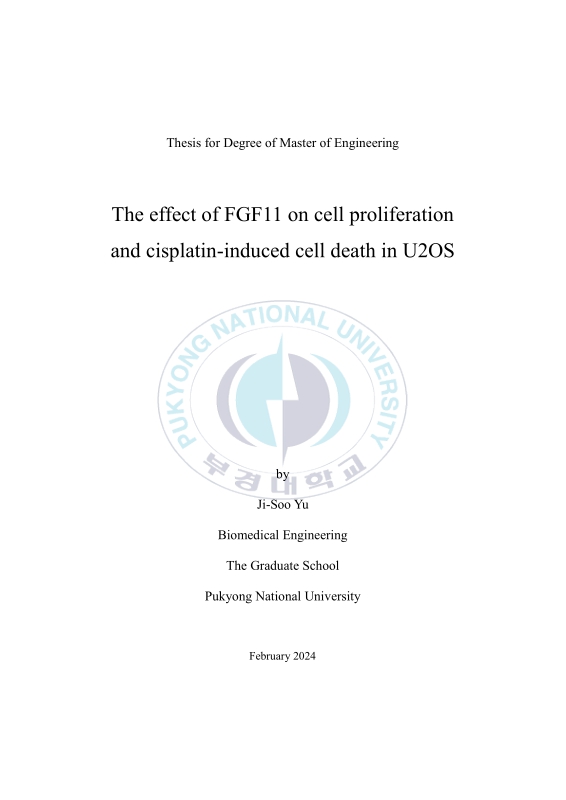
Title Page
Contents
List of Abbreviation 12
Abstract 15
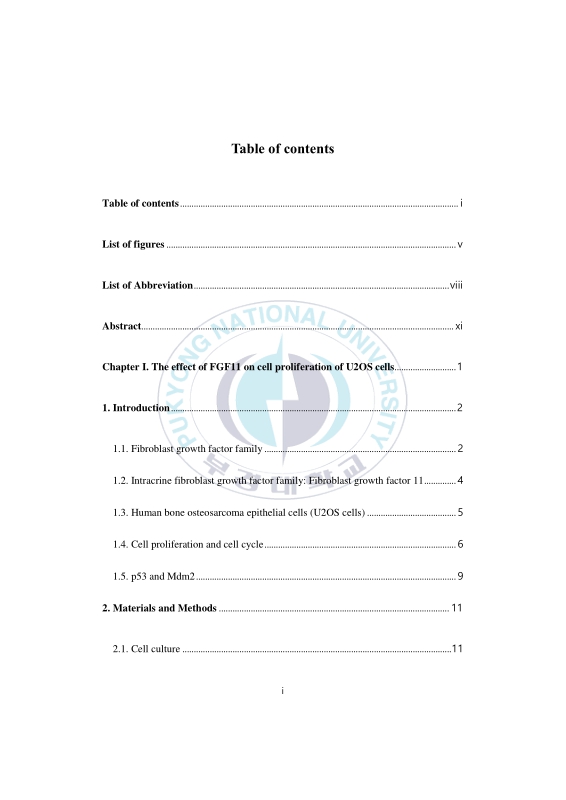
Chapter Ⅰ. The effect of FGF11 on cell proliferation of U2OS cells 17
1. Introduction 18
1.1. Fibroblast growth factor family 18
1.2. Intracrine fibroblast growth factor family: Fibroblast growth factor 11 20
1.3. Human bone osteosarcoma epithelial cells (U2OS cells) 21
1.4. Cell proliferation and cell cycle 22
1.5. p53 and Mdm2 25
2. Materials and Methods 27
2.1. Cell culture 27
2.2. Preparation of plasmids 27
2.3. Transient transfection with plasmid or small interfering RNA (siRNA) 27
2.4. Western blot analysis 28
2.5. RNA preparation and Real-time quantitative reverse transcription PCR (real-time RT-PCR) 29
2.6. Cell proliferation by live imaging 30
2.7. Apoptosis assay by flow cytometry 30
2.8. Cell cycle assay by flow cytometry 30
2.9. Immunoprecipitation 31
2.10. Statistical Analysis 32
3. Results 33
3.1. FGF11 knockdown inhibits cell proliferation 33
3.2. FGF11 knockdown arrests the S and G2/M phases of the cell cycle 36
3.3. FGF11 knockdown increases proteins expression of p27 and p53 39
3.4. Inhibition of cell proliferation by FGF11 knockdown is regulated by two pathways: p27 and p53 43
3.5. FGF11 knockdown arrests the cell cycle by regulating p53. 45
3.6. FGF11 knockdown increased proteins levels of Mdm2 47
3.6. FGF11 interacts with Mdm2 49
4. Discussion 51
Chapter Ⅱ. The effect of FGF11 on cisplatin-induced cell death of U2OS cells 56
1. Introduction 57
1.1. Osteosarcoma and Cisplatin 57
1.2. Cisplatin in cancer therapy: Molecular mechanisms of action 58
2. Materials and Methods 62
2.1. Cell culture and cisplatin treatment 62
2.2. Transient transfection with plasmid or siRNA 62
2.3. Western blot analysis 62
2.4. Apoptosis assay by flow cytometry 63
2.5. Live imaging analysis of apoptosis and necrosis 64
2.6. Intracellular ROS detection 64
2.7. Statistical analysis 65
3. Results 66
3.1. FGF11 knockdown increases cisplatin-induced apoptosis of U2OS cells 66
3.2. FGF11 knockdown and cisplatin induce ROS production 71
3.3. Cisplatin induces ROS-mediated apoptosis 73
3.4. Cisplatin induces p53-mediated apoptosis 77
4. Discussion 80
5. Conclusion 84
6. Reference 85
Chapter 1 9
Fig. 1. Evolutionary relationships within the human FGF gene family 19
Fig. 2. The canonical cell cycle and its main regulatory mechanisms 24
Fig. 3. The degradation of p53 and its major E3 ligase Mdm2 26
Fig. 4. Observation of cell proliferation by knockdown of FGF11 in U2OS cells using live imaging analysis 34
Fig. 5. Observation of cell proliferation by overexpression of FGF11 in U2OS cells using live imaging analysis 35
Fig. 6. Assessment of cell death levels by knockdown of FGF11 in U2OS cells using flow cytometry 37
Fig. 7. Assessment of cell cycle by knockdown of FGF11 in U2OS cells using flow cytometry 38
Fig. 8. Effect on mRNA transcript levels related to cell cycle by knockdown of FGF11 in U2OS cells using real-time RT-PCR 41
Fig. 9. Effect on the protein levels related to cell cycle by knockdown of FGF11 in U2OS cells using western blot analysis 42
Fig. 10. Effect on double knockdown of cell cycle inhibitor and FGF11 in U2OS cells using siRNA 44
Fig. 11. Observation of cell proliferation by knockdown of FGF11 and p53 in U2OS cells using live imaging analysis 46
Fig. 12. Effect on the expression of Mdm2 by knockdown of FGF11 in U2OS cells using western blot analysis 48
Fig. 13. Interaction of FGF11 with Mdm2 in U2OS cells by immunoprecipitation 50
Fig. 14. Mechanism of cell proliferation inhibition in FGF11 knockdown U2OS cells 55
Chapter 2 10
Fig. 1. Molecular mechanisms of cisplatin in cancer treatment 60
Fig. 2. The p53-mediated DNA damage response 61
Fig. 3. Assessment of cell death levels upon cisplatin treatment after knockdown of FGF11 in U2OS cells using live imaging analysis 68
Fig. 4. Assessment of cell death levels upon cisplatin treatment after knockdown of FGF11 in U2OS cells using flow cytometry 69
Fig. 5. Effect on protein levels related to apoptosis upon cisplatin treatment after knockdown of FGF11 in U2OS cells using western blot analysis 70
Fig. 6. Assessment of ROS levels upon cisplatin treatment after knockdown of FGF11 in U2OS cells using CM-H2DCFDA assay 72
Fig. 7. Assessment of ROS levels upon cisplatin and NAC treatment after knockdown of FGF11 in U2OS cells using CM-H2DCFDA assay 74
Fig. 8. Observation of cell death upon cisplatin and NAC treatment after knockdown of FGF11 in U2OS cells using live imaging analysis 75
Fig. 9. Effect on protein levels related to apoptosis upon cisplatin and NAC treatment after knockdown of FGF11 in U2OS cells using western blot analysis 76
Fig. 10. Effect on p53 protein levels upon cisplatin treatment after knockdown of FGF11 in U2OS cells using western blot analysis 78
Fig. 11. Effect on protein levels related to apoptosis upon cisplatin treatment after knockdown of FGF11 and p53 in U2OS cells using western blot analysis 79
Fig. 12. Cisplatin-induced apoptosis mechanism by knockdown of FGF11 83
*표시는 필수 입력사항입니다.
| 전화번호 |
|---|
| 기사명 | 저자명 | 페이지 | 원문 | 기사목차 |
|---|
| 번호 | 발행일자 | 권호명 | 제본정보 | 자료실 | 원문 | 신청 페이지 |
|---|
도서위치안내: / 서가번호:

우편복사 목록담기를 완료하였습니다.
*표시는 필수 입력사항입니다.
저장 되었습니다.
