
 대표어
대표어
권호기사보기
| 기사명 | 저자명 | 페이지 | 원문 | 기사목차 |
|---|
결과 내 검색
동의어 포함
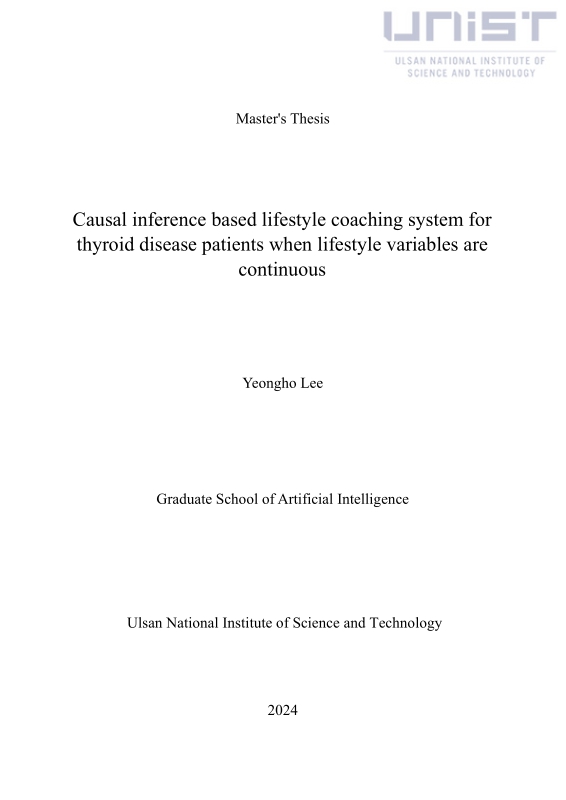
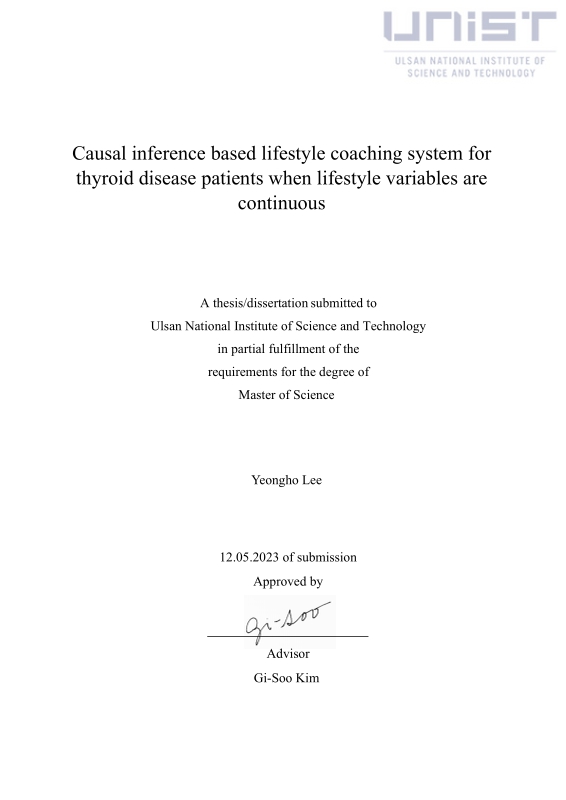
Title Page
Abstract
Contents
Ⅰ. Introduction 10
Ⅱ. Related works 13
2.1. Causal Inference 13
2.2. Propensity Score 13
2.3. Covariate Balancing Propensity Score (CBPS) 13
2.4. Multinomial Logistic Regression 13
Ⅲ. Settings 15
3.1. Assumptions 15
3.2. Theorem 16
3.3. Problem Setting 16
Ⅳ. Method 18
4.1. Estimation of GPS 18
4.2. Balance Test 20
4.3. Modeling of treatment effect 22
Ⅴ. Application 23
5.1. Description of the data 23
5.2. Preprocessing 23
5.3. Balance test 25
5.4. Estimation of causal effect 26
Ⅵ. Conclusion 29
References 30
Appendix 34
6.1. Appendix A : Derivation of (3) 34
6.2. Appendix B: Derivation of (5) 34
Figure 1. Confidence band of potential outcome when treatment is Iodine. 26
Figure 2. Confidence band of potential outcome when treatment is Smoking. 26
Figure 3. Confidence band of potential outcome when treatment is Drinking. 27
Figure 4. Confidence band of potential outcome when treatment is Strength training. 27
Figure 5. Confidence band of potential outcome when treatment is Cardio training. 27
Figure 6. Confidence band of potential outcome when treatment is Sleeping time. 27
Figure 7. Confidence band of potential outcome when treatment is Medication compliance. 28
*표시는 필수 입력사항입니다.
| 전화번호 |
|---|
| 기사명 | 저자명 | 페이지 | 원문 | 기사목차 |
|---|
| 번호 | 발행일자 | 권호명 | 제본정보 | 자료실 | 원문 | 신청 페이지 |
|---|
도서위치안내: / 서가번호:

우편복사 목록담기를 완료하였습니다.
*표시는 필수 입력사항입니다.
저장 되었습니다.
