
 대표어
대표어
권호기사보기
| 기사명 | 저자명 | 페이지 | 원문 | 기사목차 |
|---|
결과 내 검색
동의어 포함
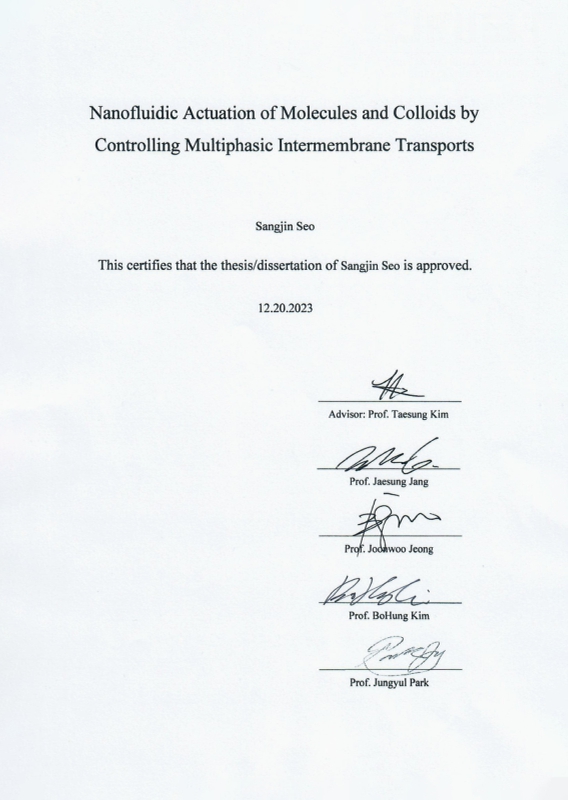
Title Page
ABSTRACT
Contents
Nomenclature 21
Chapter 1. Introduction 24
1-1. Nanofluidic Actuations for Molecular/Colloidal Transport Control 24
1-2. Multiphasic Intermembrane Transports in Microfluidics 28
1-3. Basic Transport Mechanisms of Gas Transport in Microfluidics. 34
1-4. Overview of dissertation 37
Chapter 2. Pervaporation-induced Nanoslits Actuation for Controlling Transport of Small Molecules 39
2-1. Introduction 39
2-2. Methods 40
2-3. Results 44
2-4. Conclusion 57
Chapter 3. Nanoparticle Accumulation via Pervaporation-induced Flow for Fabricating Nanoporous Membrane 59
3-1. Introduction 59
3-2. Methods 61
3-3. Results 65
3-4. Conclusion 79
Chapter 4. Gas-madidate Surface Modification of Nanopores for Modulating Ionic Diode 80
4-1. Introduction 80
4-2. Methods 81
4-3. Results 84
4-4. Conclusion 99
Chapter 5. Conclusion and perspective 101
REFERENCES 105
SANGJIN SEO 121
Figure 1-1. Types of molecules and colloids in microfluidic applications. 25
Figure 1-2. Types of nanopore actuating mechanisms and cutting-edge technologies. 27
Figure 1-3. Diffusive gas transport via GPM for various microfluidic applications. 30
Figure 1-4. Gas transport in the form of bubbles and its microfluidic applications. 33
Figure 1-5. Solvent transport with phase change for various microfluidic applications. 34
Figure 1-6. Gas transport mechanisms facilitated by conventional GPMs, specifically highlighting the process of gas dissolution through the membranes. 37
Figure 1-7. Integration of GPMs into microfluidic devices for controlled gas transport. 38
Figure 2-1. GECMN for transport control of small molecules. 45
Figure 2-2. Characterization of fluorescence intensity with test chamber. 46
Figure 2-3. Diffusive transport rate of the FITCs along the nanoslit in the GECMN, quantified using varying RH. 47
Figure 2-4. Repeatable switching between dehydration (RH~20%) and rehydration (RH~95%) at 2 h intervals, conducted three times to control the mass transport of small molecules. 48
Figure 2-5. Numerical simulation results validating diffusion- and advection-driven mass transport. 51
Figure 2-6. LECMN, enabling addressable molecule transport gating in a micro/nanofluidic device. 52
Figure 2-7. FIs along the nanoslit during dehydration and rehydration. 53
Figure 2-8. Rehydration after aggregation/crystallization of FITC molecules inside the nanoslit. 54
Figure 2-9. Independent and addressable control of mass transport in a nanoslit array. 55
Figure 2-10. SEM images of the bottom of the NAQDs. 56
Figure 3-1. Concept and fabrication process of PAMs integrated into a microfluidic channel network. 66
Figure 3-2. Quantification and analysis of the PIF inside the bridge channel using PTV. 68
Figure 3-3. Particle velocities inside the ROI measured by PTV under repeatedly switching pervaporation conditions. 69
Figure 3-4. PIF-induced particle and solute transport along the bridge channel. 70
Figure 3-5. Individual and selective controllability of multiple PAM-integrated microchannels. 71
Figure 3-6. Geometric modification of the bridge channel increases the inlet velocity. 72
Figure 3-7. SEM images of PAMs in the bridge channel containing several different-sized PS particles. 73
Figure 3-8. PAMs made up of five different-sized PS particles and experimental validation of their resulting pore sizes via electrokinetic selective ion transport. 74
Figure 3-9. Fabrication of heterogeneous PAM arrays/junctions in series in the bridge channel and validation of their working principles. 76
Figure 3-10. Various PAM-integrated microchannels with different structural properties. 78
Figure 4-1. PAIDs-integrated microfluidic device and working principles 84
Figure 4-2. Rectifying properties of PAIDs. 86
Figure 4-3. Normalized I-V curve measurement with 1 mM HCl solution and various lengths of PAIDs. 86
Figure 4-4. I-V curve measurement with different scanning direction. 87
Figure 4-5. Normalized I-V curves with L=500 µm devices and various solution conditions in the main channels. 88
Figure 4-6. Rectification ratio (I-5V /I5V) measured with various types and concentrations of solution using L=500 µm devices.[이미지참조] 88
Figure 4-7. Capacitor-like property of PAIDs. 90
Figure 4-8. Experimental setup for gas switching. 91
Figure 4-9. Transient measurement of current across bare bridge channel with intermittent CO₂ gas flow into the control channel. 92
Figure 4-10. Current measurements with a gas switching system. 93
Figure 4-11. Current measurements with a switching system of gas-dissolved solution. 95
Figure 4-12. Recoveries of PAIDs using (a) DI and (b) 10 mM HCl solution. 97
Figure 5-1. Summary diagram of thesis 101
Figure 5-2. Diagram representing the progress made by this thesis and indicating future directions in this field. 104
Surface-dominated physicochemical phenomena assume a pivotal role in mediating the migration of fluids and suspended or dissolved solutes within nanopores, exhibiting exquisite sensitivity to external stimuli. These nanofluidic phenomena propel not only the fluids themselves but also transport dissolved solutes. Activating nanopores provides precise control of dissolved solutes by modulating the nanopore's characteristics, such as pore dimensions and surface properties. The solutes encompass nanometer-scale colloids and highly diffusive molecules in diverse configurations, spanning biomolecular to engineered materials. Nanofluidic actuation — encompassing gating, accumulation, and pumping mechanisms — offers both fundamental and advanced methods of microfluidic manipulation. Gating provides foundational controllability over fluidic transport through on-off switching. Accumulation proves a tool to manage low-concentration solutes for targeted ion detection and sample pre-concentration. Meanwhile, the ion pump is utilized to heighten concentration differences of diffusive molecules. These nanofluidic actuations offer the robustness and versatility of fluidic devices, enriching their unique functions and applications.
Microfluidics predominantly favors liquid-only systems due to their viscosity-driven benefits. However, the extension of microfluidics with the gas phase overcomes its traditional liquid-centric precepts, embracing a more expansive understanding of "fluid." Incorporating gases into microfluidics involves trade-offs between durable operation and effective transport. However, phase separation in membrane-integrated microfluidic devices enables various functions in both durable and effective manners. These functions enrich versatilities across multiple fields, including biology, chemistry, and physics. The primary objective of this research is to explore an innovative approach for manipulating small molecules and colloids within a microfluidic chip using liquid-gas interphase transport mechanisms. The improvement of precision and labor-efficiency could lead to significant advancements. Spontaneous processes such as pervaporation and diffusion are designed in a guided manner to achieve improvements without relying on external energy sources. Therefore, the primary focus is on designing and fabricating a membrane-integrated microfluidic device. Nanostructures are further integrated to obtain the capability of molecular and colloidal manipulation. The devices are utilized for various purposes depending on the target.
First, pervaporation is utilized to control the transport of small molecules along nanoslits. The local and independent switching of humidity conditions near nanoslits facilitates the concentration, separation, and actuation of small molecules. Pervaporation-induced flow of solvent and diffusion of small molecules along nanoslits are analyzed via fluorescent signals and theoretical modeling simultaneously to investigate critical parameters. These parameters are concluded to provide insightful control of small molecules.
Second, a pervaporation-assisted method for fabricating a particle assembly membrane (PAM) is developed. The concentrating property of pervaporation-induced flow is utilized to in-situ assemble sub-micron to nano-sized particles in microchannels. The assembled particles containing nanopore networks serve as nanoporous membranes. Forced assembly due to liquid flow enables the adoption of various types of particles in terms of size, surface functionality, and wettability. Furthermore, the heterogeneous structure in parallel and serial configurations offers possibilities for numerous applications.
Third, gas dissolution is employed to modulate the functions of ionic diodes. Asymmetrically charged heterogeneous PAMs serve as ionic diodes. A control channel is placed in the middle of the ionic diode to supply gas molecules through diffusion via a gas-permeable film. Gases and gasdissolved solutions are introduced to construct a concentration gradient in a switchable and programmable manner. The diodes exhibit different responses to bias when gas is supplied from the control channel, resulting in the modulation of rectification ratios. Several demonstrations are also conducted, including chemical reactions in an accumulated state and ion signal amplification.
In summary, the methods of fabrication and control serve as the basis for designing liquid-gas interphase transport in an on-chip manner. Furthermore, this research accelerates molecular, colloidal, and ionic manipulation in microfluidic devices, thereby enriching micro/nanofluidics and various fields. Spontaneous working mechanisms, especially, enhance the key value of microfluidics, offering low cost and portability. A wide range of target molecules enables the development of multi-functional devices for practical applications, such as cell culture, chemical reactions/sensing, and colloidal delivery.*표시는 필수 입력사항입니다.
| 전화번호 |
|---|
| 기사명 | 저자명 | 페이지 | 원문 | 기사목차 |
|---|
| 번호 | 발행일자 | 권호명 | 제본정보 | 자료실 | 원문 | 신청 페이지 |
|---|
도서위치안내: / 서가번호:

우편복사 목록담기를 완료하였습니다.
*표시는 필수 입력사항입니다.
저장 되었습니다.
