
 대표어
대표어
 학술연구정보서비스(KERIS)
권호기사보기
| 기사명 | 저자명 | 페이지 | 원문 | 기사목차 |
|---|
결과 내 검색
동의어 포함
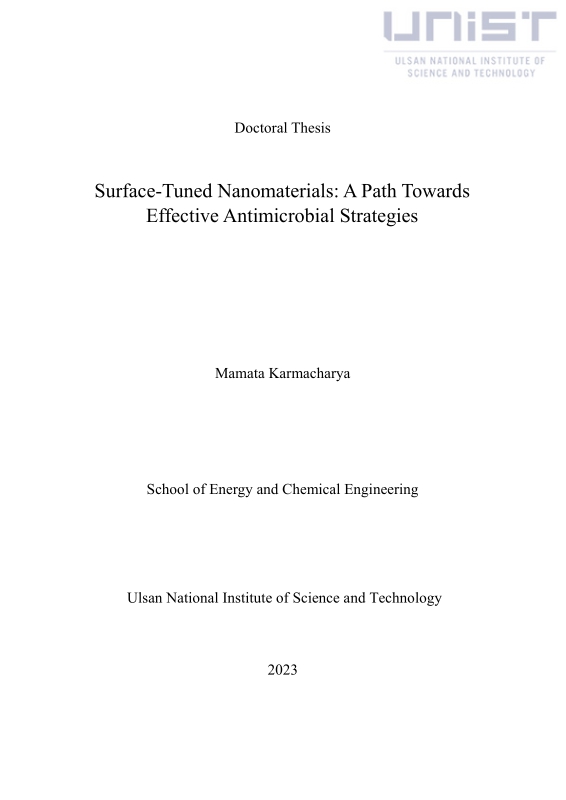
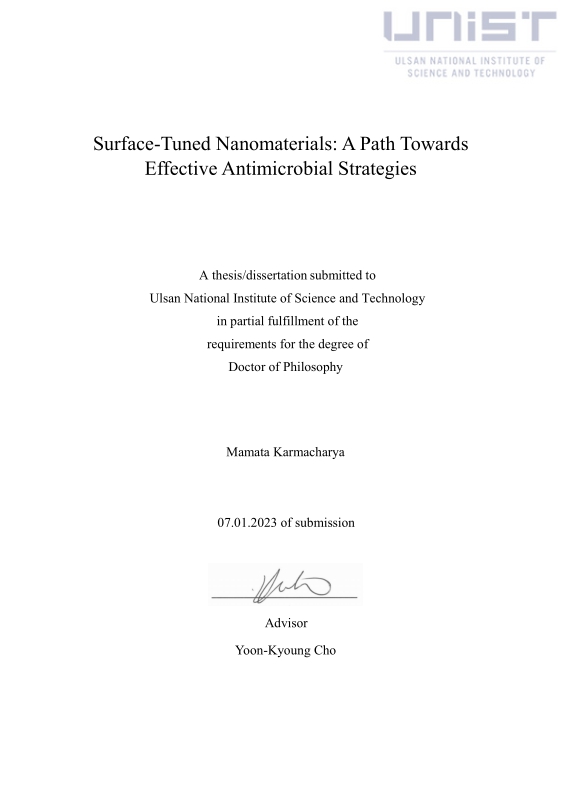
Title Page
Abstract
Contents
List of abbreviations 22
Chapter 1. Introduction 24
1.1. Overview 25
1.2. Backgrounds and motivation. 26
1.2.1. Bacterial biofilm 26
1.2.2. Antibiotic resistance 27
1.2.3. Advances in antibiotics during pandemic era. 28
1.2.4. Mechanism of action. 28
1.2.5. Nanomaterial-Integrated solutions for bacterial infections. 29
1.2.6. Challenges in developing nanoantibiotics. 32
1.3. Research aim. 32
Chapter 2. Surface-Textured Mixed-Metal-Oxide Nanocrystals as Efficient Catalysts for ROS Production and Biofilm Eradication 33
2.1. Introduction. 34
2.2. Experimental details 37
2.3. Results and discussion. 40
2.3.1. Bactericidal action of MTex-500 nanocrystals. 40
2.3.2. Bactericidal action of MTex-500 into the biofilms. 45
2.3.3. Disruption of biofilm in microfluidic channel. 49
3.1. Conclusion 51
Chapter 3. Photoactive Antiviral Face Mask with Self-Sterilization and Reusability 52
3.1. Introduction 53
3.2. Experimental details 56
3.3. Results and Discussion 61
3.3.1. Synthetic approach for photoactive mask. 61
3.3.2. Wetting property of photoactive mask. 62
3.3.3. Photothermal and photocatalytic performances of photoactive mask. 64
3.3.4. Filtration efficiency of photoactive mask. 66
3.3.5. Photocatalytic antimicrobial surface property 68
3.3.6. Performance of photoactive mask for inactivation of VLPs 70
3.4. Conclusion 72
Chapter 4. Platelet Membrane-Enclosed Biorthogonal Catalysis for Combating Dental Caries 73
4.1. Introduction. 74
4.2. Target-specific antibiotics. 74
4.3. Experimental details 77
4.4. Results and discussion. 85
4.4.1. Synthesis and characterization of PLT-reactor. 86
4.4.2. Bioorthogonal catalysis by PLT-reactor for antimicrobial drug synthesis. 90
4.4.3. Penetration and catalytic action of PLT-reactor into biofilms. 92
4.4.4. Hematological and cytotoxic side-effect of PLT-reactor. 97
4.4.5. Suppression of biofilm associated dental caries. 101
4.5. Conclusion 105
Chapter 5. Concluding remarks 106
5.1. Summary 107
5.2. Future perspective 108
Chapter 6. References 110
MAMATA KARMACHARYA 125
Figure 1.1. Strategies at the nanoscale to combat multidrug-resistant bacteria. 31
Figure 2.1. Synthetic scheme and bactericidal action of metaphasic-surface textural mixed metal-oxide nanocrystals (MTex-NCs). 36
Figure 2.2. Characterization of MTex-500. 42
Figure 2.3. Antibacterial activity of MTex-500. 44
Figure 2.4. Biofilm penetration by MTex-500. 46
Figure 2.5. Effects of MTex-500 in biofilm 48
Figure 2.6. Magnetically-assisted antibiofouling studies of microchannels using MTex. 50
Figure 3.1. Surface modification of surgical masks with catalytic nanocomposite. 55
Figure 3.2. Wetting properties and chemical analysis of the coating on the pristine surgical mask. 63
Figure 3.3. Thermal and catalytic performances of the masks under solar illumination. 65
Figure 3.4. Evaluation of particle filtration efficiency and air permeability. 67
Figure 3.5. Photocatalytic antimicrobial properties of the surface. 69
Figure 3.6. Evaluation of CAM's effectiveness in rapidly inactivating Virus-like particles (VLPs). 71
Figure 4.1. A schematic representation of PLT-reactor killing the biofilm. 76
Figure 4.2. Physiochemical characterization of PLT-reactor. 88
Figure 4.3. Antibacterial activity of PLT-reactor. 91
Figure 4.4. Penetration and diffusion of the PLT-reactor. 93
Figure 4.5. Antibiofilm effect of the PLT-reactor. 95
Figure 4.6. Hematological effect and biocompatibility of PLT-reactor. 99
Figure 4.7. Antibacterial action for the S. mutans 3065 biofilm on human teeth using PLT-reactor. 104
Antimicrobial resistance is a significant issue associated with biofilms, resulting in an increased need for higher doses of antimicrobial agents. Several hypotheses have been proposed to explain the mechanisms behind biofilm antibiotic resistance. One of these hypotheses suggests that the delayed penetration of antibiotics into the biofilm is a contributing factor. Another hypothesis relates to alterations in the chemical microenvironment within the biofilm such as differences in oxygen and pH levels between the bulk fluid and biofilm interior that can lead to changes in antibiotic activity. Specifically, osmotic stress responses resulting from changes in the biofilm's osmotic environment can also decrease cell envelope permeability to antibiotics and alter antibiotic susceptibility. A third mechanism of antibiotic resistance involves subpopulations of microorganisms within the biofilm matrix, which have different genotypes and phenotypes that affect their antibiotic susceptibility profiles. The complexity of biofilm structures and their presence in sites such as oral cavities and wounds make complete eradication challenging with conventional methods.
To tackle the challenges posed by antimicrobial resistance, there is an urgent requirement for advanced catalysts capable of functioning in the intricate and harsh chemical environments of biofilms. Our solution involves the utilization of mixed-FeCo-oxide-based surface-textured nanostructures (MTex) as highly efficient magneto-catalytic platforms. These MTex structures generate reactive oxygen species (ROS) with defensive properties across a wide pH range. They possess the ability to permeate the biofilm and effectively eliminate bacteria that are embedded within it. Additionally, their magnetic properties enable the removal of biofilm debris from microchannels. The unique surface topography of these nanostructures resembles that of a ploughed field, contributing significantly to their exceptional antifouling effectiveness. The formation of these surfaces occurs during the oxidative annealing and solid-state conversion of β-FeOOH nanocrystals, presenting an avenue for the development of novel enzyme-like properties at the interface between nanomaterials and biology.
Since the onset of the COVID-19 pandemic, the surging demand for surgical masks has had notable ecological and financial repercussions. To tackle this concern, we devised a novel technique involving a dual-channel spray-assisted nanocoating on nonwoven surgical masks, utilizing shellac/copper nanoparticles. This coating effectively enhances the hydrophobicity of the masks, repelling aqueous droplets. Furthermore, the coated surface exhibits exceptional photoactivity, enabling both photocatalytic and photothermal properties to exert antimicrobial effects. This innovation renders the masks reusable and self-sterilizing. When exposed to solar illumination, the photoactive antiviral mask (CAM) rapidly achieves temperatures exceeding 70°C, generating free radicals that disrupt the membranes of virus-like particles at the nanoscale. Consequently, the masks possess self-cleaning properties, rendering them reusable. Our CAM design offers significant protection against the transmission of viral aerosols in the battle against the COVID-19 pandemic, while simultaneously reducing environmental waste and mitigating the economic costs associated with disposable masks.
Next, to develop an innovative therapeutic system that can leverage the platelet-bacteria interactions have shown promise for targeting oral microbiota, but platelet-based delivery has encountered difficulties such as cargo loading, low efficacy in diffusing through biofilms, and regulating release. To overcome these obstacles, we propose a method that employs biorthogonal catalysis within human platelet membrane vesicles (h-PMV) with supramolecular metal catalysts (SMCs) to create "nanofactories" that convert prodrugs into antimicrobial therapeutic molecules in the vicinity of bacteria. Using this approach, we investigate the use of SMCs inside h-PMVs, known as PLT-reactor, to activate pro-antibiotic drugs (pro-ciprofloxacin and pro-moxifloxacin) for efficient killing of Escherichia coli ATCC 25922 and Staphylococcus aureus ATCC 25923 bacteria. This "bind and kill" strategy demonstrates the potent antimicrobial specificity of PLT-reactors against oral biofilms harboring Streptococcus mutans 3065 through preferential binding and in-situ drug production, resulting in efficient bacterial killing. The analysis indicates that h-PMVs not only provide PLT-reactors with targeting capability but also minimize hemolytic effects. Our findings suggest that platelet membrane-cloaked surfaces possess unique features of robust, multifaceted, and pathogen-specific binding affinity, excellent biocompatibility, and potential as an alternative to antibody-based targeted therapy for infectious diseases.*표시는 필수 입력사항입니다.
| 전화번호 |
|---|
| 기사명 | 저자명 | 페이지 | 원문 | 기사목차 |
|---|
| 번호 | 발행일자 | 권호명 | 제본정보 | 자료실 | 원문 | 신청 페이지 |
|---|
도서위치안내: / 서가번호:

우편복사 목록담기를 완료하였습니다.
*표시는 필수 입력사항입니다.
저장 되었습니다.
