
 대표어
대표어
권호기사보기
| 기사명 | 저자명 | 페이지 | 원문 | 기사목차 |
|---|
결과 내 검색
동의어 포함
Title Page 1
ABSTRACT 4
Contents 6
Nomenclature 12
1. Introduction 13
1.1. Research background 13
1.2. Research history 14
1.2.1. Research of Water stress in plants 14
1.2.2. Non-destructive analysis 15
2. Methodology 20
2.1. Cultivation experiment 20
2.2. Soil composition of experimental field 23
2.2.1. Soil used in the water stress experiment 23
2.2.2. Analysis of soil physiochemistry 23
2.3. A method of water treatment 24
2.4. Measurement method 26
2.4.1. Chlorophyll fluorescence analysis 26
2.4.2. Vegetation index 26
2.4.3. Multispectral image analysis 31
2.5. Statistic analysis 37
3. Results 38
3.1. Environmental changes during water stress treatment period 38
3.1.1. Changes in Soil moisture content 38
3.1.2. Changes in Temperature and Relative humidity 40
3.2. Analysis of water stress response of garden plants 42
3.2.1. Photochemical reaction analysis 42
3.2.2. Photosynthetic system activity performance evaluation 67
3.2.3. Selection of spectral vegetation index 70
3.2.4. Spectral image analysis 77
3.3. Diagnosis of water stress in garden plants using non-destructive analysis methods 91
3.3.1. Calculation of photochemical integrated index and cluster analysis of garden plants 91
3.3.2. Establishment of water stress diagnosis standard using non-destructive analysis 95
3.3.3. Possibility of water stress diagnosis using multispectral image analysis 98
4. Discussion 104
5. Conclusion 108
Bibliography 111
Summary in Korean 116
Fig. 1. The water stress experimental site for garden plants 22
Fig. 2. RGB image of experiment target plant 32
Fig. 3. Red-edge image of experiment target plant 33
Fig. 4. NIR image of experiment target plant 34
Fig. 5. Pre-processing to the spectral image of garden plants 36
Fig. 6. The treatments soil moisture contents after treatment 39
Fig. 7. Soil moisture characteristics curve (SMCC) by sandy loam 39
Fig. 8. Daily average temperature of the Water stress experiment field after treatment 41
Fig. 9. Daily average relative humidity of Water stress experiment field after treatment 41
Fig. 10. Change in vegetation index of Polygonatum odoratum drought stress treatments 44
Fig. 11. Change in vegetation index of Polygonatum odoratum wet stress treatments 45
Fig. 12. Chlorophyll fluorescence analysis of Polygonatum odoratum drought stress treatments 46
Fig. 13. Chlorophyll fluorescence analysis of Polygonatum odoratum wet stress treatments 46
Fig. 14. Change in vegetation index of Phlox drummondii drought stress treatments 48
Fig. 15. Change in vegetation index of Phlox drummondii wet stress treatments 49
Fig. 16. Chlorophyll fluorescence analysis of Phlox drummondii drought stress treatments 50
Fig. 17. Chlorophyll fluorescence analysis of Phlox drummondii wet stress treatments 50
Fig. 18. Change in vegetation index of Pachysandra terminalis drought stress treatments 52
Fig. 19. Change in vegetation index of Pachysandra terminalis wet stress treatments 53
Fig. 20. Chlorophyll fluorescence analysis of Pachysandra terminalis drought stress treatments 54
Fig. 21. Chlorophyll fluorescence analysis of Pachysandra terminalis wet stress treatments 54
Fig. 22. Change in vegetation index of Aquilegia buergeriana drought stress treatments 56
Fig. 23. Change in vegetation index of Aquilegia buergeriana wet stress treatments 57
Fig. 24. Chlorophyll fluorescence analysis of Aquilegia buergeriana drought stress treatments 58
Fig. 25. Chlorophyll fluorescence analysis of Aquilegia buergeriana wet stress treatments 58
Fig. 26. Change in vegetation index of Pseudolysimachion linaritfolium drought stress 60
Fig. 27. Change in vegetation index of Pseudolysimachion linariifolium wet stress treatments 61
Fig. 28. Chlorophyll fluorescence analysis of Pseudolysimachion linariifolium drought stress treatments 62
Fig. 29. Chlorophyll fluorescence analysis of Pseudolysimachion linariifolium wet stress treatments 62
Fig. 30. Change in vegetation index of Astillbe chinensis drought stress treatments 64
Fig. 31. Change in vegetation index of Astillbe chinensis wet stress treatments 65
Fig. 32. Chlorophyll fluorescence analysis of Astillbe chinensis drought stress treatments 66
Fig. 33. Chlorophyll fluorescence analysis of Astillbe chinensis wet stress treatments 66
Fig. 34. Assessment of photosynthetic system performance of garden plants under drought stress using the Drought Factor Index (DFI) 68
Fig. 35. Assessment of photosynthetic system performance of garden plants under wet stress using the Wet Factor Index (WFI) 69
Fig. 36. Change in spectral image index of Polygonatum odoratum drought stress treatments 79
Fig. 37. Change in spectral image index of Polygonatum odoratum wet stress treatments 80
Fig. 38. Change in spectral image index of Phlox drummondii drought stress treatments 81
Fig. 39. Change in spectral image index of Phlox drummondii wet stress treatments 82
Fig. 40. Change in spectral image index of Pachysandra terminalis drought stress treatments 83
Fig. 41. Change in spectral image index of Pachysandra terminalis wet stress treatments 84
Fig. 42. Change in spectral image index of Aquilegia buergeriana drought stress treatments 85
Fig. 43. Change in spectral image index of Aquilegia buergeriana wet stress treatments 86
Fig. 44. Change in spectral image index of Pseudolysimachion linariifolium drought stress treatments 87
Fig. 45. Change in spectral image index of Pseudolysimachion linariifolium wet stress treatments 88
Fig. 46. Change in spectral image index of Astillbe chinensis drought stress treatments 89
Fig. 47. Change in spectral image index of Astillbe chinensis wet stress treatments 90
Fig. 48. Changes in photochemical integrated index of garden plants calculated under drought stress 93
Fig. 49. Changes in photochemical integrated index of garden plants calculated under wet stress 93
Fig. 50. The cluster analysis of drought stress (D-1 group : Pachysandra terminalis, Polygonatum... 94
Fig. 51. The cluster analysis of wet stress (W-1 group : Astillbe chinensis, Phlox drummondii,... 94
Fig. 52. Selection of drought stress mdex using photochemical reaction (Indicates p-value from simple... 97
Fig. 53. Selection of wet stress index using photochemical reaction (Indicates p-value from simple... 97
Fig. 54. Selection of drought stress index using BGI (Indicates p-value from simple linear regression... 100
Fig. 55. Selection of drought stress index using NGRDI (Indicates p-value from simple linear regression... 100
Fig. 56. Selection of wet stress index using GLI (Indicates p-value from simple linear regression analysis... 101
Fig. 57. Selection of wet stress index using NDVI (Indicates p-value from simple linear regression... 101
Fig. 58. Selection of final index for drought stress diagnosis using photochemical integrated index -... 102
Fig. 59. Selection of final index for drought stress diagnosis using photochemical integrated index -... 102
Fig. 60. Selection of final index for wet stress diagnosis using photochemical integrated index - spectral... 103
Fig. 61. Selection of final index for wet stress diagnosis using photochemical integrated index - spectral... 103
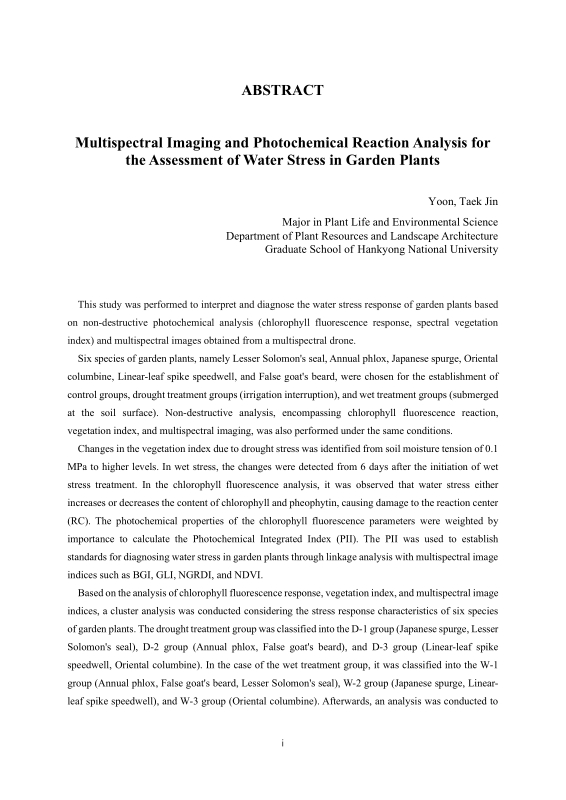
본 연구는 비파괴적 광화학 분석(엽록소 형광반응, 식생지수, 분광 영상 이미지)을 기반으로 하여 정원식물의 수분 스트레스 반응을 해석하고, 다분광 드론을 이용한 원격탐사를 통해 다분광 스펙트럼 이미지를 활용하여 정원식물의 수분 스트레스 진단 및 예측 가능성을 제안 하고자 수행되었다.
정원식물 (꼬리풀, 노루오줌, 둥굴레, 매발톱, 수호초, 플록스)6종을 대상으로 대조구, 건조 처리구(관수 중단), 습해 처리구(토양 표면까지 담수)를 구성하여 비파괴적 분석(엽록소 형광반응, 식생지수, 분광 영상 이미지 등)을 동일한 조건에서 진행하였다.
건조 스트레스에 의한 식생지수 변화는 전반적으로 토양 수분장력 0.1 MPa 이상부터 파악 되었으며 습해 스트레스의 경우 침수 처리 6일부터 변화가 나타났다. 엽록소 형광 반응 분석 결과, 수분 스트레스로 인해 엽록소 및 페오피틴의 함량을 증감시켜 반응중심 복합체 (RC)에 피해를 주는 것으로 파악되었다. 분석에 활용된 엽록소 형광 매개변수를 대상으로 광화학적 특성을 고려하여 중요도 별 가중치를 부여하여 광화학적 수분 스트레스 통합지표 (Photochemical Integrated Index; PII)를 산출하였다. 산출된 광화학 통합 평가지표는 BGI, GLI, NGRDI, NDVI 등 분광 영상 이미지 지표와의 연계 분석을 통해 정원식물의 수분 스트레스 진단 기준설정에 활용하였다.
비파괴적 광화학 특성분석을 기반으로 군집분석을 실시한 결과, 건조 처리구는 D-1 group (둥굴레, 수호초), D-2 group (노루오줌, 플록스), D-3 group (꼬리풀, 매발톱)으로 분류되었으며, 습해 처리구의 경우 W-1 group (노루오줌, 둥굴레, 플록스), W-2 group (꼬리풀, 수호초), W-3 group (매발톱)로 분류되어 이후, 군집 별 평균값으로 스트레스 기준 설정 분석을 진행하였다.
정원식물의 수분 스트레스 진단 기준은 비파괴적 분석 (엽록소 형광 반응, 식생지수 등)을 활용하여 산출된 광화학적 통합지표 (Photochemical Integrated Index; PII)및 분광 영상 이미지 지수 (BGI, GLI, NDVI, NGRDI)와 토양수분장력 및 침수 처리기간 간의 회귀분석을 활용하여 설정하였다. 건조 스트레스 기준은 PII < 0.6, BGI > 0.5, NGRDI < 0.12 로 설정하였고, 습해 스트레스 기준은 PII < 0.45, GLI < 0.26, NDVI < 0.6으로 설정하였다.
수분 스트레스 진단 및 예측의 효율성과정확성을 높이고자 선발된 지표 간의 최종 수분 스트레스 진단 모형을 도출하였다. 건조 스트레스 진단 기준은 BGI 모형: PII < 0.6, BGI > 0.5, NGRDI 모형: PII < 0.6, NGRDI < 0.12으로 설정되었다. 습해 스트레스의 진단 기준은 GLI 모형: PII < 0.45, GLI < 0.26, NDVI 모형: PII < 0.45, NDVI < 0.6으로 설정되었다.
본 연구를 통해 스트레스 내성 반응이유사한 식물 군집에 따라 광화학적 통합지표와 분광 영상 이미지 지수 선발을 통해 식물의 수분 스트레스 진단 및 예측에 적합한 진단 기준 설정이 가능하였다. 이를 통해 실시간 영상 모니터링을 통해 정원 식물의 수분 스트레스 진단이 가능 할 것으로 판단되었다.*표시는 필수 입력사항입니다.
| 전화번호 |
|---|
| 기사명 | 저자명 | 페이지 | 원문 | 기사목차 |
|---|
| 번호 | 발행일자 | 권호명 | 제본정보 | 자료실 | 원문 | 신청 페이지 |
|---|
도서위치안내: / 서가번호:

우편복사 목록담기를 완료하였습니다.
*표시는 필수 입력사항입니다.
저장 되었습니다.
