
 대표어
대표어
권호기사보기
| 기사명 | 저자명 | 페이지 | 원문 | 기사목차 |
|---|
결과 내 검색
동의어 포함
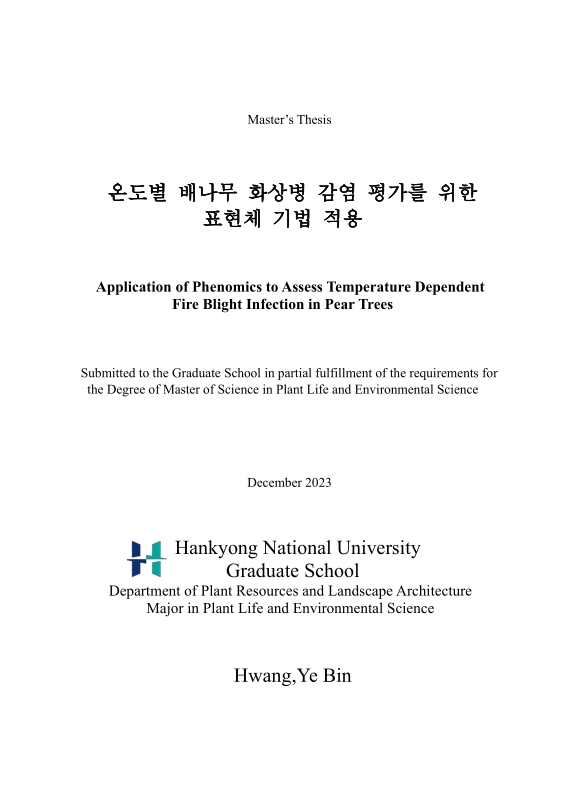
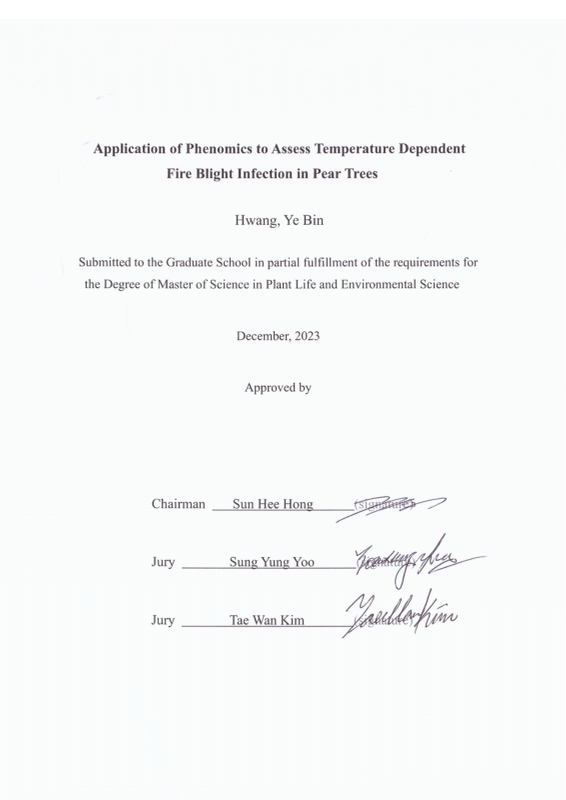
Title Page 1
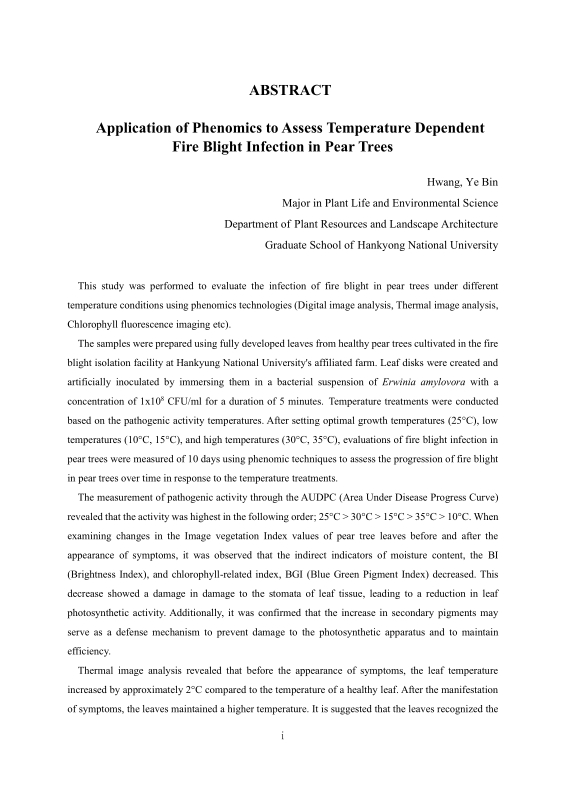
ABSTRACT 4
Contents 6
Nomenclature 11
1. Introduction 12
2. Research history 14
2.1. Research on Fire blight 14
2.2. Using Phenomic Technologies in Plant Disease Research 17
2.2.1. Digital Image Analysis 20
2.2.2. Thermal Image Analysis 23
2.2.3. Chlorophyll Fluorescence Imaging Analysis 24
3. Methodology 27
3.1. Making Leaf Disks 27
3.2. Cultivation and Inoculation of E. amylovora 27
3.3. Temperature Control 28
3.4. Phenotype Image Analysis 29
3.4.1. Digital Image Analysis 29
3.4.2. Thermal Image 36
3.4.3. Chlorophyll Fluorescence Image 37
3.5. Statistical analysis 40
4. Results and discussion 42
4.1. Analysis of Pathogen Activity Using AUDPC 42
4.2. Digital Image Analysis 48
4.3. Thermal Image Analysis 53
4.4. Chlorophyll Fluorescence Image Analysis 55
4.4.1. Chlorophyll fluorescence response before symptom expression 55
4.4.2. Chlorophyll fluorescence response after symptom expression 60
4.5. Setting the diagnostic criteria for fire blight in pear trees 75
4.5.1. Clustering analysis based on pathogen activity 75
4.5.2. Selection of variable importance indicators and establishment of diagnostic criteria 77
5. Conclusion 86
Bibliography 88
Summary in Korean 96
Fig. 1. Fire blight life cycle 16
Fig. 2. Protocol for quenching analysis using modulated fluorescence 25
Fig. 3. Artificial inoculation and leaf disk production 28
Fig. 4. Equipment used for digital image measurements 29
Fig. 5. Extraction of disease area and vegetation index using digital images 32
Fig. 6. Extraction of disease area and vegetation index using digital images 33
Fig. 7. Extraction of disease area and vegetation index using digital images 34
Fig. 8. Measurement of Thermal image 36
Fig. 9. RGB image used to calculate AUDPC 43
Fig. 10. Disease progress area by Temperature(10℃, 15℃, 25℃, 30℃, 35℃) treatments 44
Fig. 11. AUDPC (Area Under Disease Progress Curve) for 250℃ treatment 45
Fig. 12. AUDPC (Area Under Disease Progress Curve) results (A : 10℃ treatment; B : 15℃ treatment) 46
Fig. 13. AUDPC (Area Under Disease Progress Curve) results (A : 30℃ treatment; B : 35℃ treatment) 47
Fig. 14. Digital image indices before and after the manifestation of fire blight symptoms. Indicates p-value from one-way analysis of variance under... 50
Fig. 15. Digital image indices before and after the manifestation of fire blight symptoms. Indicates p-value from one-way analysis of variance under... 51
Fig. 16. Changes in digital image indices based on temperature treatments and pathogen activity. Indicates p-value from one-way analysis of variance... 52
Fig. 17. Changes in leaf temperature over time due to fire blight infection compared to healthy leaves 54
Fig. 18. Chlorophyll fluorescence response before the onset of disease symptoms (A : 6 Hours treatment; B : 12 Hours treatment) 57
Fig. 19. Chlorophyll fluorescence response before the onset of disease symptoms (A : 24 Hours treatment; B : 36 Hours treatment) 58
Fig. 20. Changes in chlorophyll fluorescence parameters before disease symptoms (A : Fₒ; B : Fₘ; C : Fᵥ; D : Fₜ_Lss; E : Fᵥ/Fₘ_Lₛₛ; F : NPQ_Lₛₛ)[이미지참조] 59
Fig. 21. Chlorophyll fluorescence image changes in the 10℃ treatment after symptoms 61
Fig. 22. Chlorophyll fluorescence image changes in the 15℃ treatment after symptoms 62
Fig. 23. Chlorophyll fluorescence image changes in the 25℃ treatment after symptoms 63
Fig. 24. Chlorophyll fluorescence image changes in the 30℃ treatment after symptoms 64
Fig. 25. Chlorophyll fluorescence image changes in the 35℃ treatment after symptoms 65
Fig. 26. Chlorophyll fluorescence response after the onset of disease symptoms (A : 2 DAT; B : 3 DAT) 68
Fig. 27. Chlorophyll fluorescence response after the onset of disease symptoms (A : 4 DAT; B : 5 DAT) 69
Fig. 28. Chlorophyll fluorescence response after the onset of disease symptoms (A : 7 DAT; B : 10 DAT) 70
Fig. 29. Changes in chlorophyll fluorescence parameters after disease symptoms. Indicates p-value from one-way analysis of variance under... 71
Fig. 30. Changes in chlorophyll fluorescence parameters after disease symptoms. Indicates p-value from one-way analysis of variance under... 72
Fig. 31. Changes in chlorophyll fluorescence parameters after disease symptoms. Indicates p-value from one-way analysis of variance under... 73
Fig. 32. Changes in chlorophyll fluorescence parameters after disease symptoms. Indicates p-value from one-way analysis of variance under... 74
Fig. 33. Cluster analysis results based on the collected data for pathogen activity (F-1 Group : 15℃, 25℃, 30℃, 35℃; F-2 Group: Control, 10℃) 76
Fig. 34. The results of the relative variable importance assessment for F-1 Group are as fbllowse 78
Fig. 35. The results of the relative variable importance assessment for F-2 Group are as followse 79
Fig. 36. Setting diagnostic criteria for F-1 Group using Digital image index (BGI) and Chlorophyll fluorescence parameter (Fₚ) 82
Fig. 37. Setting diagnostic criteria for F-1 Group using Digital image index (BGI) and Chlorophyll fluorescence parameter (Fₜ_Lₛₛ)[이미지참조] 83
Fig. 38. Setting diagnostic criteria for F-2 Group using Digital image index (BGI) and Chlorophyll fluorescence parameter (Fᵥ) 84
Fig. 39. Setting diagnostic criteria for F-2 Group using Digital image index (BGI) and Chlorophyll fluorescence parameter (Fₒ_Lₛₛ)[이미지참조] 85
본 연구는 표현체 기술(디지털 영상 이미지 분석, 열화상 이미지 분석, 엽록소 형광 이미지 등)을 활용하여 온도 별 Erwinia amylovora 의 활성에 따른 배나무 화상병 예측 및 평가 연구를 수행하였다.
시료는 한경국립대학교 부속농장 내 화상병 격리시설에서 재배한 건전한 신고 배나무의 전개된 잎을 이용하여 Leaf disk를 제작하고 E. amylovora 균주를 1x10⁸ CFU/ml 농도로 현탁하여 인공접종하였다. 병원균 활성 온도에 따라 생육적온(25℃), 저온(10℃, 15℃), 고온(30℃, 35℃)처리구로 설정한 후, 10 일동안 온도 별 화상병 진전 및 양상을 표현체 기술(디지털 영상 이미지, 열화상 이미지, 엽록소 형광 이미지 등)을 활용하여 평가하였다.
디지털 이미지 지표를 활용하여 병진전곡선(AUDPC)을 산출한 결과 25℃ > 30℃ > 15℃ > 35℃ > 10℃ 순으로 활성이 높았다. 이미지식생 지표 값을 통해 병징이 나오기 전과 이후의 변화를 확인하였을 때 수분함량을 간접적으로 평가할 수 있는 BI와 엽록소 관련 지표인 BGI 가 감소하여 잎 조직의 기공 손상으로 잎의 증산작용이 감소하고, 광수확복합체의 손상방지 및 광합성 효율 유지를 위한 방어기작으로 보조색소를 증가시키는 것으로 판단되었다.
열화상 이미지 분석 결과 병징이 나타나기 전 엽온이 약 2℃ 증가하고 병징이 나타난 이후에도 건전한 잎 대비 높은 엽온을 유지하였으며 이는 잎이 병원체를 인식하여 기공 폐쇄에 따른 증산작용 저해가 일어나, 수분 이용 효율을 감소시키는 것으로 판단되었다.
엽록소 형광 반응 분석 결과 과수화상병 감염 잎은 병징이 나타나기 전부터 엽록소 형광량을 감소시키며 이는 광수확복합체(LHC)의 손상으로 인해 광에너지를 받지 못하며 환원능이 감소하는 것으로 판단되었으나 지속적인 빛의 투입 시 에너지를 전달하려는 양상을 보이며 광합성 기작을 유지하는 것으로 판단되었다. 그러나 병징이 나타난 이후 비광화학적 소광을 증가시켜 광수확복합체의 과도한 여기에너지를 제거하고 활성산소 손상을 방지하는 보호메커니즘을 보였으며 시간 경과에 따라 잎이 타들어가면서 에너지를 받지못하고 고사하는 것으로 판단되었다.
병원균 활성에 따라 군집분석을 실시한 결과, 병원균 활성이 높았던 25℃ 처리구, 30℃ 처리구와 병원균 활성이유지가 되었던 15℃ 처리구, 35℃ 처리구는 동일한 군집을 이루었으나, 병원균 활성이 가장 낮았던 10℃처리구는 건전한 배나무와 동일한 군집을 형성하였다.
F-1 Group(25℃, 30℃, 15℃, 35℃ 처리구)에서 가장 중요도가 높았던 Fp와 BGI를 활용하여 병원균의 활성이 높을 때 BGI < 0.55, Fp < 6000 기준에서 화상병 진단을 할 수 있었다. F-2 Group(건전구, 10℃ 처리구)에서는 Fv와 BGI를 활용하여 BGI < 0.55, Fv < 10500 기준에서 과수 화상병 평가를 진행할 수 있었다.
따라서 본 연구에서는 디지털 영상 이미지를 통해 온도 별 병원균 활성을 파악하였으며, 엽록소 형광 반응과 디지털 영상 이미지와의 연계를 통해 과수 화상병 감염 평가가 가능할 것으로 판단되었다.*표시는 필수 입력사항입니다.
| 전화번호 |
|---|
| 기사명 | 저자명 | 페이지 | 원문 | 기사목차 |
|---|
| 번호 | 발행일자 | 권호명 | 제본정보 | 자료실 | 원문 | 신청 페이지 |
|---|
도서위치안내: / 서가번호:

우편복사 목록담기를 완료하였습니다.
*표시는 필수 입력사항입니다.
저장 되었습니다.
