
 대표어
대표어
권호기사보기
| 기사명 | 저자명 | 페이지 | 원문 | 기사목차 |
|---|
결과 내 검색
동의어 포함
Title Page 1
ABSTRACT 3
Contents 6
List of abbreviation 9
1. Introduction 10
1.1. Incidence and mortality of cancer 10
1.2. Chemotherapy 12
1.3. Drug resistance 12
1.4. Mechanisms of drug resistance 13
1.5. Tumor dormancy 13
1.6. Fluorescent Ubiquitination-based Cell Cycle Indicator (FUCCI) 15
2. Purpose of study 16
3. Materials and methods 17
3.1. Cell lines and Cell culture 17
3.2. FUCCI cell line 17
3.3. Clonogenic assay 18
3.4. Real-time imaging 18
3.5. Flow cytometry analysis 19
3.6. Flow cytometry sorting 19
3.7. RNA sequencing & Analysis 20
4. Results 21
4.1. A rare subpopulation of surviving cells continues to divide after anticancer drug treatment 21
4.2. Establishment of the FUCCI system to identify rsCCs 25
4.3. The isolated rsCCs are able to survive and proliferate in the presence of anticancer drugs 28
4.4. The drug resistance of rsCCs is not consistently maintained 30
4.5. Drug cycles prolong transient resilient state 32
4.6. rsCCs represent an entirely distinct subpopulation from dormant cancer cells 35
5. Discussion 38
BIBLIOGRAPHY 41
Figure 1. Estimated number of incidence and mortality in GLOBOCAN 2020 11
Figure 2. A rare subpopulation of surviving cells continues to divide after... 24
Figure 3. Establishment of the FUCCI system to identify rsCCs 27
Figure 4. The isolated rsCCs are able to survive and proliferate in the presence... 29
Figure 5. The drug resistance of rsCCs is not consistently maintained 31
Figure 6. Drug cycles prolong transient resilient state 33
Figure 7. rsCCs represent an entirely distinct subpopulation from Dormant... 37
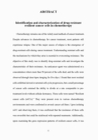
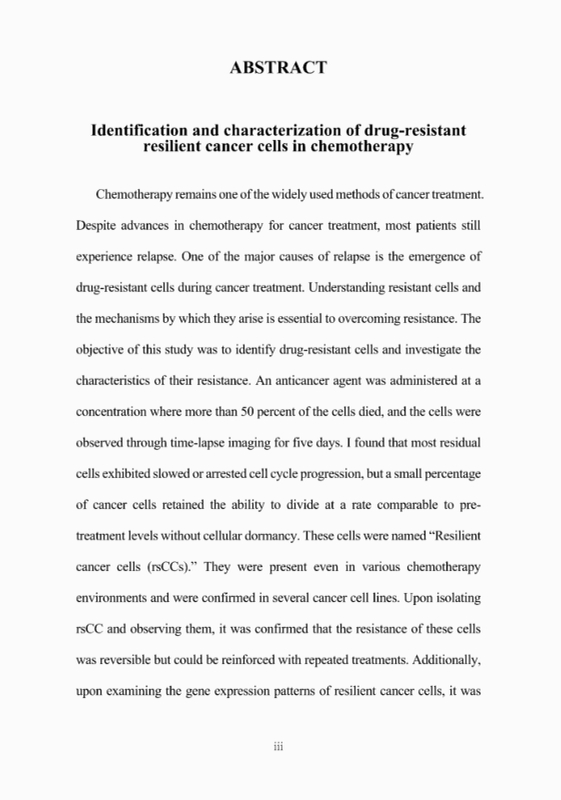
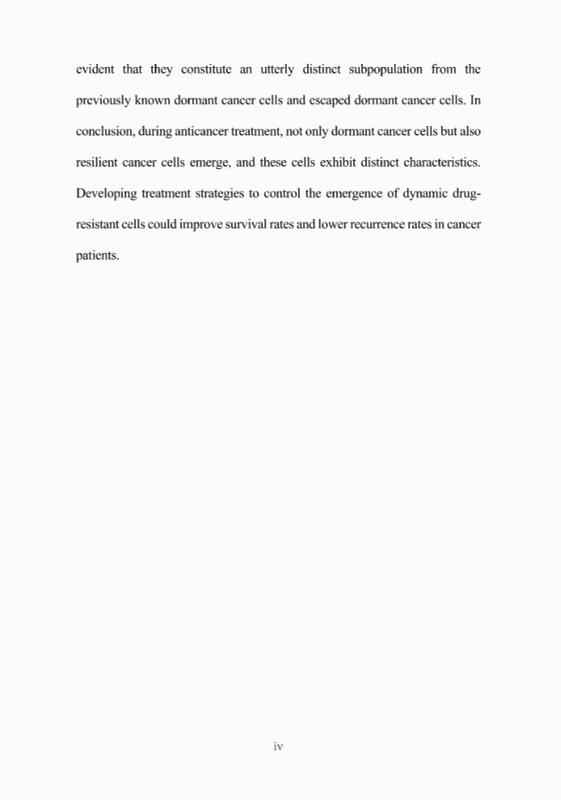
Chemotherapy remains one of the widely used methods of cancer treatment. Despite advances in chemotherapy for cancer treatment, most patients still experience relapse. One of the major causes of relapse is the emergence of drug-resistant cells during cancer treatment. Understanding resistant cells and the mechanisms by which they arise is essential to overcoming resistance. The objective of this study was to identify drug-resistant cells and investigate the characteristics of their resistance. An anticancer agent was administered at a concentration where more than 50 percent of the cells died, and the cells were observed through time-lapse imaging for five days. I found that most residual cells exhibited slowed or arrested cell cycle progression, but a small percentage of cancer cells retained the ability to divide at a rate comparable to pre-treatment levels without cellular dormancy. These cells were named "Resilient cancer cells (rsCCs)." They were present even in various chemotherapy environments and were confirmed in several cancer cell lines. Upon isolating rsCC and observing them, it was confirmed that the resistance of these cells was reversible but could be reinforced with repeated treatments. Additionally, upon examining the gene expression patterns of resilient cancer cells, it was
evident that they constitute an utterly distinct subpopulation from the previously known dormant cancer cells and escaped dormant cancer cells. In conclusion, during anticancer treatment, not only dormant cancer cells but also resilient cancer cells emerge, and these cells exhibit distinct characteristics. Developing treatment strategies to control the emergence of dynamic drug-resistant cells could improve survival rates and lower recurrence rates in cancer
patients.*표시는 필수 입력사항입니다.
| 전화번호 |
|---|
| 기사명 | 저자명 | 페이지 | 원문 | 기사목차 |
|---|
| 번호 | 발행일자 | 권호명 | 제본정보 | 자료실 | 원문 | 신청 페이지 |
|---|
도서위치안내: / 서가번호:

우편복사 목록담기를 완료하였습니다.
*표시는 필수 입력사항입니다.
저장 되었습니다.
