
 대표어
대표어
권호기사보기
| 기사명 | 저자명 | 페이지 | 원문 | 기사목차 |
|---|
결과 내 검색
동의어 포함
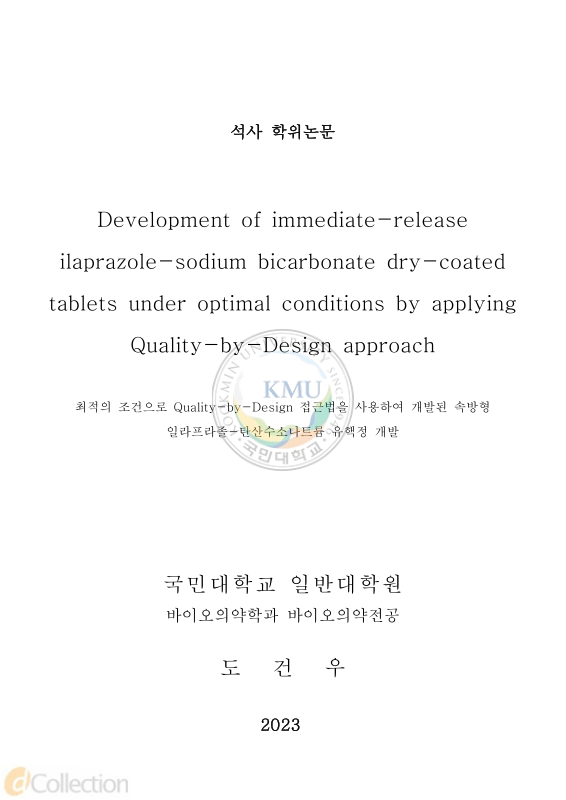
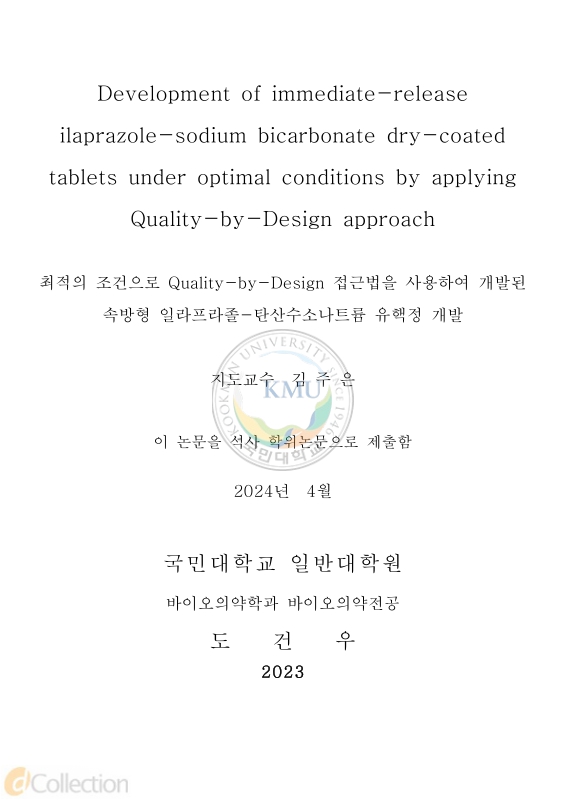
Title Page 2
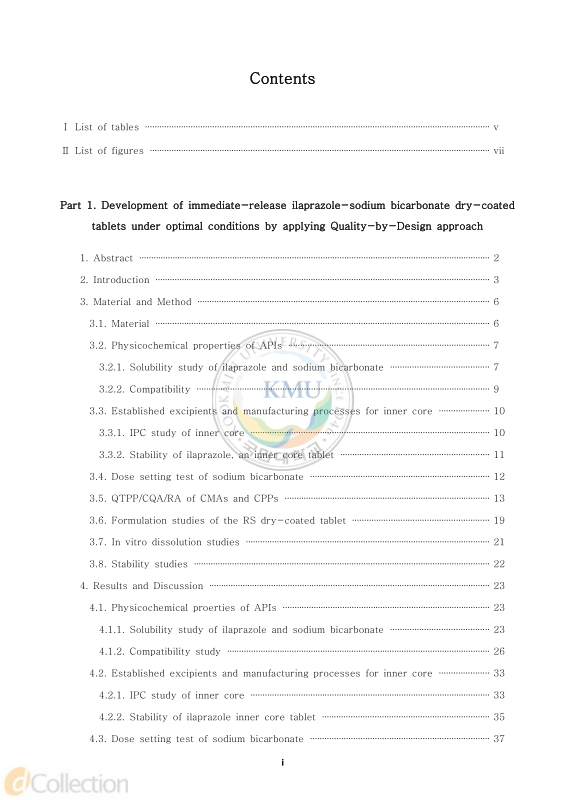
Contents 5
Part 1. Development of immediate-release ilaprazole-sodium bicarbonate dry-coated tablets under optimal conditions by applying Quality-by-Design approach 13
1. Abstract 14
2. Introduction 15
3. Material and Method 18
3.1. Material 18
3.2. Physicochemical properties of APIs 19
3.3. Established excipients and manufacturing processes for inner core 22
3.4. Dose setting test of sodium bicarbonate 24
3.5. QTPP/CQA/RA of CMAs and CPPs 25
3.6. Formulation studies of the RS dry-coated tablet 31
3.7. In vitro dissolution studies 33
3.8. Stability studies 34
4. Results and Discussion 35
4.1. Physicochemical proerties of APIs 35
4.2. Established excipients and manufacturing processes for inner core 45
4.3. Dose setting test of sodium bicarbonate 49
4.4. QTPP/CQA/RA of CMAs and CPPs 51
4.5. Formulation studies 56
4.6. In vitro dissolution profile 63
4.7. Stability studies 65
5. Conclusion 67
6. References 69
Part 2. Development of content analysis method for ilaprazole-sodium bicarbonate dry-coated tablet by applying QbD 75
1. Abstract 76
2. Introduction 77
3. Material and Method 80
3.1. Material 80
3.2. Chromatographic Conditions (RP-HPLC) 81
3.3. Preparations of the Standard solutions and QC samples 82
3.4. Method Validation 83
4. Results 89
4.1. System suitability 90
4.2. Specificity 92
4.3. Linearity and range 94
4.4. Accuracy and precision 97
4.5. Intermediate precision 99
4.6. Limit of detection and Limit of quantitation 101
4.7. Solution stability 103
4.8. Application of the Method 105
5. Discussion 106
6. Conclusion 107
7. References 108
국문요약 112
Part 1. Development of immediate-release ilaprazole-sodium bicarbonate dry-coated tablets under optimal conditions by 11
Figure 1. Changes in the appearance of (a) ilaprazole and (b) sodium bicarbonate in the range of pH 1.2. to 12.0 (using the apparent solubility test method) 37
Figure 2. Ilaprazole / The compatibility of each excipient was assessed using differential scanning calorimetry (DSC) 43
Figure 3. Ilaprazole / The compatibility of each excipient was evaluated through impurity analysis using HPLC 44
Figure 4. Results of DoE depicted by pareto chart and Residual plots 59
Figure 5. Results of DoE depicted Factorial plots 60
Figure 6. Results of DoE depicted by contour and response surface plots 61
Figure 7. Results of DoE depicted by contour plots and response optimization 62
Figure 8. In vitro dissolution profiles of ilaprazole and sodium bicarbonate dry-coated tablet at pH 10,0 64
Part 2. Development of content analysis method for ilaprazole - sodium bicarbonate dry-coated tablet by applying QbD 12
Figure 1. The chemical structure of ilaprazole (A), Sodium bicarbonate-ilaprazole dry-coated tablet (B) 78
Figure 2. Typical HPLC chromatograms demonstrating the selectivity of the analytical method for the sodium bicarbonate-ilaprazole dry-coated tablet 93
Figure 3. Typical calibration curves of sodium bicarbonate-ilaprazole dry-coated tablet 96
최적의 조건으로 Quality-by-Design 접근법을 사용하여 개발된 속방형 일라프라졸- 탄산수소나트륨 유핵정 개발
위식도 역류질환 치료제로 사용되는 일라프라졸은 산성 환경에서 불안정 하여 분해되기 쉽기 때문에 장용정 형태로만 개발되어 판매되고 있다. 그러나 이러한 장용정은 onset time이 느리다는 단점을 가지고 있어 빠른 치료효과가 필요한 GERD 환자들에게 적합하지 않다. 본 연구의 목적은 탄산수소나트륨을 외층부로 하고, 내핵으로 일라프라졸을 함유한 유핵정을 개발하여 즉각적인 치료효과를가지는 GERD 치료제를 개발하는 것이다. 또한, 본 연구에서는 의약품 주요 품질 특성에 대해 체계적으로 접근하는 QbD(Quality by Design)를 적용하여 주성분인 일라프라졸을 내부로 함유하고 외층부로 위산의 환경을 중화시키기 위해 제산제로 탄산수소나트륨을 사용하여 정제를 제형화하고 최적화하였다. 또한, 우리는 개발된 제형의 안정성과 약동학적 프로파일을 조사하였다. 그 결과 개발된 정제는 약 6개월동안 안정적이며 대조약과 큰 차이가 없었으며, 30분에 80% 이상의 용출률을 나타내며 기준을 충족하였다. 또한, 비글 약동학 시험을 통해, 개발된 일라프라졸 속방형 정제는 기존의 일라프라졸 정제와 생물학적으로 동등한 AUCt 값을 가지는 것을 확인하였으며, Tmax는 기존 정제에 비해 약 3배 빠른 것이 확인 되었다. 따라서 속방형(IR) 정제는 위에서 즉시 흡수되는 것으로 밝혀졌다. 이러한 속방형 일라프라졸은 즉각적인 치료가 필요한 위식도 역류 질환 환자의 치료에 도움이 될 수 있다.
QbD를 적용한 일라프라졸-탄산수소나트륨 유핵정 함량분석법 개발
현재 일라프라졸은 장용코팅정으로 개발되어 시판되고 있다. 그러나 이러한 장용코팅정은 위장에서의 분해로부터 보호하기 위해 장용코팅이 되어있어 약효발현시간이 길다는 단점을 가지며 빠른치료가 필요한 GERD환자들에게 적합하지 않다. 이러한 문제를 해결하기 위해, 속방형 GERD 치료제인 탄산수소 나트륨-일라프라졸 복합유핵정을 개발하였다. 그러나 탄산수소나트륨-일라프라졸 복합유핵정의 분석법이 개발되어 있지 않아 관련 연구를 진행하는데 여러 문제가 존재한다. 본 연구의 목적은 RP-HPLC를 사용하여 기존에 존재하지 않던 탄산수소나트륨-일라프라졸 복합유핵정제의 정량 분석법을 개발 및 검증하는 것이다. 또한, 의약품 주요 품질 특성에 대해 체계적으로 접근하는 QbD (quality-by-design) 접근 방식을 적용하였으며 risk assessment (RA) 중 preliminary hazard analysis (PHA)를 통하여 정량분석법을 도출하고 설계하였다. 새롭게 개발된 RP-HPLC 분석법은 Zorbax C18 column (4.6 x 150 mm, 5 μm)이 사용되었고 유속과 주입량은 각각 1.0 mL/min, 20 μL으로 설정하였다. 또한 이동상으로는 인산염완충액:아세토니트릴혼합액 (6:4)을 사용하였다. 분석 시간은 10분으로 설정하였으며, 측정 파장대는 주요 주성분인 일라프라졸의 최대흡수파장인 237nm로 설정하였다. 일라프라졸의 피크 유지시간은 4.53분이다. 새롭게 개발된 탄산수소나트륨-일라프라졸 복합유핵정의 정량 분석법 검증을 통해 실시된 시스템적합성은 상대표준편차가 0.06%임을 확인하여 품질 기준을 충족하였다. RP-HPLC를 통해 두 주성분과 부형제사이의 peak 간섭이 없다는 것을 확인하여 특이성을 확보하였다. 또한, 직선성 연구에서는 표준액 대비 30~130% 농도 범위에서 상관계수 1.000로 바람직한 선형성을 나타내었다. 뿐만 아니라, 정확성 및 정밀성, 검출한계 및 정량한계, 용액 안정성 시험을 통해 탄산수소나트륨과 일라프라졸 복합유핵정의 정량분석방법에 대한 검증연구를 수행 하였다. 본 연구를 통해 개발된 탄산수소나트륨과 일라프라졸 복합유핵정의 정량분석법은 method validation의 항목인 시스템적합성, 특이성, 정밀성, 정확성, 검출한계 및 정량한계, 용액안정성 시험을 통해 타당성이 검증되었다.*표시는 필수 입력사항입니다.
| 전화번호 |
|---|
| 기사명 | 저자명 | 페이지 | 원문 | 기사목차 |
|---|
| 번호 | 발행일자 | 권호명 | 제본정보 | 자료실 | 원문 | 신청 페이지 |
|---|
도서위치안내: / 서가번호:

우편복사 목록담기를 완료하였습니다.
*표시는 필수 입력사항입니다.
저장 되었습니다.
