
 대표어
대표어
권호기사보기
| 기사명 | 저자명 | 페이지 | 원문 | 기사목차 |
|---|
결과 내 검색
동의어 포함
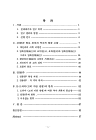
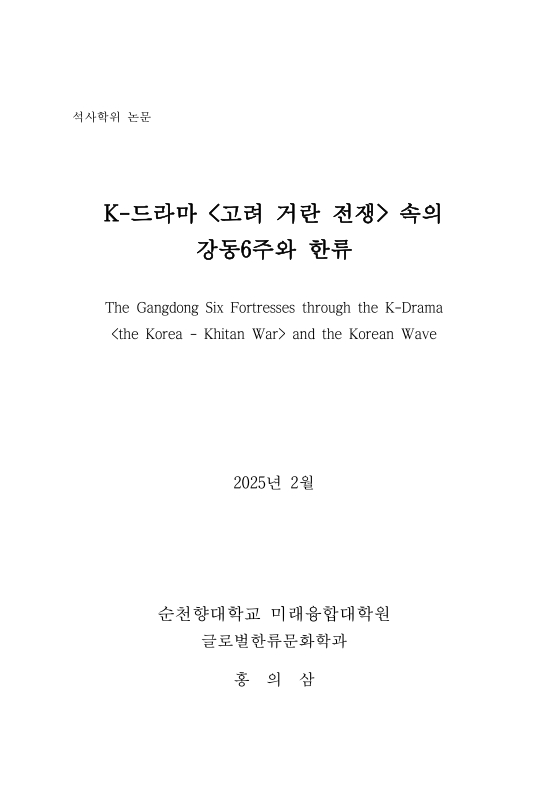
표제지 2
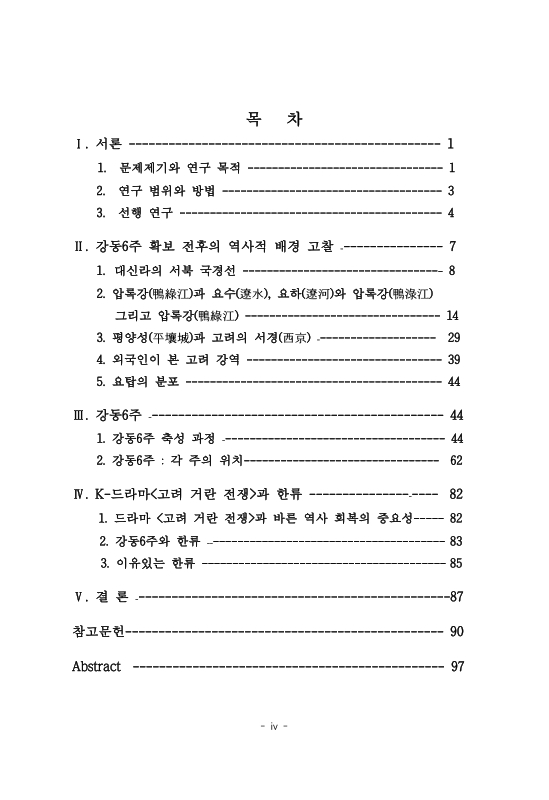
목차 5
국문초록 9
Ⅰ. 서론 13
1. 문제제기와 연구 목적 13
2. 연구 범위와 방법 15
3. 선행연구 16
Ⅱ. 강동6주 확보 전후의 역사적 배경 고찰 19
Ⅱ-1. 대신라의 서북 국경선 20
Ⅱ-2. 압록강(鴨綠江)과 요수(潦水), 요하(遼河)와 압록강(鴨淥江) 그리고 압록강(鴨綠江) 26
Ⅱ-2-1. 고대 요수(潦水)와 압록강(鴨綠江) 27
Ⅱ-2-2. 압록강(鴨淥江) = 요하(遼河)와 압록강(鴨綠江) 35
Ⅱ-3. 평양성(平壤城)과 고려의 서경(西京) 41
Ⅱ-3-1. 왕검성의 평양성 43
Ⅱ-3-2. 요양의 평양성 46
Ⅱ-4. 외국인이 본 고려 강역 51
Ⅱ-4-1. 서긍의 고려도경(高麗圖經)〈1123년〉 51
Ⅱ-4-2. 허항종의 『선화을사봉사금국행정록(宣化乙巳奉使金國行程錄)』 〈1125년〉 51
Ⅱ-5. 요탑의 분포 56
Ⅲ. 강동6주 56
Ⅲ-1. 강동6주 축성 과정 56
Ⅲ-1-1. 가주(嘉州)와 송성(松城) 57
Ⅲ-1-2. 보주(保州), 내원성(來遠城), 흥화진(興化鎭)의 위치 60
Ⅲ-1-3. 흥화진(興化鎭), 내원성(來遠城), 보주(保州)의 위치 69
Ⅲ-2. 강동6주 각 주의 위치 74
Ⅲ-2-1. 통주(通州) 76
Ⅲ-2-2. 용주(龍州) 77
Ⅲ-2-3. 철주(鐵州) 79
Ⅲ-2-4. 귀주(龜州) 81
Ⅲ-2-5. 곽주(郭州) 88
Ⅲ-2-6. 흥화진(興化鎭) 90
Ⅳ. K-드라마 〈고려 거란 전쟁〉과 한류 94
Ⅳ-1. K-드라마 〈고려 거란 전쟁〉과 바른 역사 회복의 중요성 94
Ⅳ-2. 강동6주와 한류 95
Ⅳ-3. 한류의 원천 96
1. 홍익인간 사상과 전통(弘益人間 思想과 傳統) 96
2. 세종대왕 96
3. 호머 헐버트(Homer B. Hulbert, 1863~1949) 96
4. 백범 김구(1876~1949) 97
5. 기 소르망(Guy Sorman, 1944~) 97
6. 김대중 대통령(1924~2009) 97
6. 정주영 98
Ⅳ-4. 대한민국의 길 98
1. 홍익인간으로 대표되는 우리 고유사상을 더욱 체화하여야 한다 98
2. 우리의 역사를 바로 세워야 한다 98
3. 창의가 들풀처럼 피어나고 강물처럼 흐르는 사회를 만들어야 한다 98
4. 일방적 착취 제국시대는 가고 상생 협력해야만 하는 시대가 왔다 98
5. 남북통일을 달성하는 일이 시급하다 99
6. 개성있는 전통문화를 계승 발전시켜야 한다 99
Ⅴ. 결론 99
참고문헌 102
ABSTRACT 109
그림 1. 연과 조선의 경계 27
그림 2. 위만의 동진 28
그림 3. 패수가 흐르는 낙랑군 동쪽, 요동군 험독현의 왕험성 29
그림 4. 낙랑군 속의 왕험성(평양성) 31
그림 5. 대명일통지(大明一統志) :... 41
그림 6. 평양성의 이동 49
그림 7. 보주의 위치 68
그림 8. 보주-내원성-흥화진-개주의 위치 69
그림 9. 흥화진 위치 72
그림 10. 보주-내원성-흥화진-개주 72
그림 11. 요하의 지류들 75
그림 12. 철주의 위치 80
그림 13. 철주의 위치 80
그림 14. 철주의 위치도 81
그림 15. 귀주의 변천 : 귀주 ⇒ 정주 82
그림 16. 귀주의 위치 : 다하(시하) ~ 타하(범하) 사이의 철령 부근 88
그림 17. 흥화진 위치 93
지도 1. 고려초기 강역 18
지도 2. 쓰다소키치의 강동6주 18
지도 2-1. 교과서 속의 강동6주 18
지도 2-2. 대신라 강역 20
지도 2-3. 통일 전 신라 강역 20
지도 3. 해성하와 길림을 잇는 선이 대신라 서북방 경계 25
지도 3-1. 해성하와 길림을 잇는 요하를 따라 그은 선 25
지도 4. 대신라 강역 26
지도 5. 대신라 강역 26
지도 6. 서한군국도(西漢君國圖: 서한(西漢) BC202~AD8,... 32
지도 7. 고대의 요수와 고려시대의 요하 35
지도 8. 요(遼) - 압록강(鴨淥江) - 고려(高麗)의 위치 지도 37
지도 9. 고등학교 역사교과서 상의 고려 영토 40
지도 10. 기존사학계가 말하는 평양성 42
지도 11. 기존사학계가 말하는 평양성(왕검성) 42
지도 12. 잘못된 서경(평양성)의 위치 43
지도 13. 서한군국도, (BC202~AD8) 44
지도 13-1. 서한군국도(西漢君國圖: 서한(西漢) BC202~AD8, 당(唐)... 44
지도 14. 서진군국도(西晋郡國圖) 서진 265년 ~ 317년 송본지리지장도(宋本処理指掌圖) 44
지도 15. 요수 = 압록강 = 패수, 왕험성의 위치 45
지도 16. 서경 - 자비령 50
지도 17. 연운 16주 53
지도 18. 허항종의 행로 및 일차별 지명 54
지도 19. 허항종 일행이 동쪽으로 본 신라산(길림합달령) 29일차 함주~숙주 구간 55
지도 20. 요탑의 분포도 56
지도 21. 심양과 북진시 사이가 가주 61
지도 22. 요의 동경 - 요양, 신민시, 의현, 진황도시 68
지도 23. 보주 - 내원성 - 흥화진 - 심양 72
지도 24. 조선사편수회와 한국의 기존사학계 주장 강동6주 위치 - 국사교과서 74
지도 25. 통주의 위치: 철령시~개원시 사이 77
지도 26. 용주(龍州): 철령시~개원시 사이 79
지도 27. 철주의 위치 81
지도 28. 귀주의 위치 85
지도 29. 귀주의 위치 88
지도 30. 곽주의 위치 89
지도 31. 흥화진 위치 보주-내원성-흥화진-심양시 93
지도 32. 강동6주의 위치 종합 94
지도 33. 넓게 본 거란 - 강동6주 - 고려의 위치 94
The common belief is that Gangdong six Fortresses are located in the west of North Pyongan Province, south of the Yalu River in North Korea. This was summarized as such in 『History of Joseon』 by Tsuda Sokichi and later by the Joseon History Compilation Society(朝鮮史編修會) under the Japanese Government-General of Korea. After liberation, Lee Byeong-do and others, who played a part in the Joseon History Compilation Society, took control of Korea's existing history academia and created textbooks that accepted the manipulated and distorted descriptions of 『Joseon History(朝鮮史)』 and made them common belief.
However, according to ⓵ 『History of Korea(高麗史)』, the biography of Hong Yu(洪儒) in "Yeoljeon(列傳)", "Hong Yu(洪儒)'s first name was Sul(術), and he was from Uiseongbu(義城府). In the last years of Gungye's reign, he became a cavalry general along with Bae Hyeon-gyeong, Shin Sunggyeom, and Bok Ji-gyeom, and they secretly conspired to visit King Taejo's house at night and say, "After the division of the Three Han Dynasties, A group of thieves arose, and now the king [Gungye] They rose up and gave a loud shout, finally annihilating the band of thieves and occupying almost half of Liaodong, which was divided into three." There is a record. What is noteworthy here is the fact that half of Liaodong was already occupied during Wang Geon's reign. ⓶ The northwest boundary of the New Kingdom, ⓷ Liaosu, Yalu River, Yalu River, ⓸Wanggeomseong's Pyeongyangseong Fortress(平壤城), Liaoyang's Pyeongyangseong Fortress, North Korea's Pyeongyangseong Fortress, ⓹ Seo Geung's KoreaDogyeong(高麗圖經) and HeoHang-jong's Geumguk Administrative Rok(金國行程錄), ⓺ Distribution of Yotap(遶塔), ⓻ If the common belief is that Gangdong six Fortresses are the western part of North Pyongan Province, south of the Yalu River in North Korea, then that places are not eastern part of the river but southern part of the river. That it cannot be done, ⓼ The Khitan capital, Sanggyeong Imperial Palace, is now Parimjwagi. Considering these factors, one cannot help but raise doubts that the front line between Korea and Khitan is North Korea's Yalu River.
Accordingly, prior research by Lee Duk-il, Lee In-cheol, Yoon Han-taek, and Nam Ju-seong, as well as domestic sources such as 『KoreaSa(高麗史)』, 『KoreaSajeolyo(高麗史節要)』, 『Sejong Annals(世宗實錄)』, and 『Dongguk Tonggam(東國通鑑)』 Study based on Chinese historical sources such as 『History of Liao(遼史)』, 『History of Jin(金史』, History of Song(宋史)』, 『History of Yuan(元史)』,『History of Ming(明史)』 and 『Heinjeong Manchurianyugo(欽定滿洲源流考)』 result, Contrary to the common belief that Gangdong six Fortresses were located in the southern part of North Korea's Yalu River and the western part of North Pyongan Province, they were located along the east side of the Liao River, which flows west of Shenyang City, Liaoning Province, China, and in the southern region of Gaewon City, Cheolnyeong City, and Shenyang City. It was confirmed that they were distributed throughout the area along the connecting line. This can be seen to be consistent with the record in 『Koreasajeolyo(高麗史節要)』 that the fortresses were built on the 280 ri(112km) belt along the east of Liaohe.
As a result of the negotiation between Seohee and Sosonnyeong in the 13th year of King Seongjong's reign(993), in the 14th year of King Seongjong's reign(994), the two jins(鎭) of Jangheungjin(長興鎭) and Guihwajin(歸化鎭) and Gwakju(郭州) and Guiju(龜州) were formed. Castles were built in two states. In the 15th year of King Seongjong's reign(995), two castles, Anuijin(安義鎭) and Heunghwajin(興化鎭), were built, and in 996, castles were built in Seonju(宣州) and Maengju(孟州). In this way, eight castles were built. Gwakju, Guiju, and Heunghwajin were named as part of the Gangdong six fortresses. Tongju(通州), Yongju(龍州), and Cheolju(鐵州) were added there. they have been the Gangdong six fortresses of the common belief.
It is a research topic to determine why the common belief was that the Gangdong six fortresses were named. However, in this paper, the goal was to reveal the location of Gangdong six fortresses according to the traditional theory by limiting the scope. As a result of the study, Gangdong six fortesses follows the main stream of the Liao River, which flows west of Shenyang City, Liaoning Province, China, from Kaiyuan City in the north to the south of Shenyang City in the south. It was distributed in the following order: Tongju, Yongju, Cheolju, Guiju, Gwakju, and Heunghwajin. Naewonseong Fortress was located 40 ri(16km) west of Heunghwajin. There was a castle, 40 ri(16km) west of it. It was also confirmed that Boju existed. This paper's tracking location of the Gangdong six fortresses is significant in that the specific location was confirmed by analyzing previous research and domestic and Chinese literature. However, verifying the exact location through a field trip is left as future homework.
It was confirmed that there was a greater gap than imagined between the location of the common belief about the six fortresses of Gangdong, which became the setting for the K-drama 〈Korea Khitan War〉, and the location confirmed in this paper. The Korea territory has been so reduced and distorted that it is shocking to modern Koreans. Moreover, when a K-history drama based on this distorted history is aired to Hallyu enthusiasts around the world, the adverse effects are indefinite and thrilling.
In relation to the Korean Wave, the K-drama 〈Korea Khitan War〉 is especially significant because its stage, the restoration of the Gangdong six fortresses and the suppression of the Khitan through the Battle of Guizhou, stabilized the balance of power among Korea, Khitan(Yao) and Song in East Asia at the time. It was an opportunity to achieve this. Korea emerged as the proud winner of East Asia by subduing the Khitan, an object of fear for the Song Dynasty, to a state where they could not relapse through the Battle of Guizhou. Korea was not the shabby peninsula state that was commonly believed. At least at that time, it was an empire that ruled the continent. With the conclusion of the Korea-Khitan War, Korea began active exchanges across the continent and the sea, making its name, Korea, known to the world.
The Korean Wave in a practical sense has begun. The capital, Gaegyeong(開京) became an international city as envoys and merchants from the Song Dynasty as well as envoys and merchants from distant western regions frequented the area, and Byeokran Island(碧瀾渡) flourished as an international trading port. As international exchanges became more active, Korea announced the beginning of the Korean Wave under the name 'Korea' on the international stage.*표시는 필수 입력사항입니다.
| 전화번호 |
|---|
| 기사명 | 저자명 | 페이지 | 원문 | 기사목차 |
|---|
| 번호 | 발행일자 | 권호명 | 제본정보 | 자료실 | 원문 | 신청 페이지 |
|---|
도서위치안내: / 서가번호:

우편복사 목록담기를 완료하였습니다.
*표시는 필수 입력사항입니다.
저장 되었습니다.
