
 대표어
대표어
 학술연구정보서비스(KERIS)
권호기사보기
| 기사명 | 저자명 | 페이지 | 원문 | 기사목차 |
|---|
결과 내 검색
동의어 포함
Title Page 2
Abstract 5
Contents 8
Chapter 1. General Introduction 22
1.1. Oak mushroom 23
1.2. Genus Vanrija 25
1.3. Pathogens of mushrooms and their pathogenic mechanism 26
1.4. Fungal metabolites 27
1.5. Genetic tools for yeast 29
1.6. trans-aconitic acid in Tricarboxylic Acid (TCA) Cycle 31
1.7. The aim of this study 33
Chapter 2. Analysis of metabolites related to growth inhibition and browning of the oak mushroom produced by Vanrija pseudolonga 34
2.1. Introduction 35
2.2. Materials and Methods 36
2.2.1. Strain and media 36
2.2.2. Verification of growth inhibition and browning ability of the alcohol precipitate from V. pseudolonga cell free YNB-D broth to the mycelium of the oak mushroom strain 36
2.2.3. Verification of growth inhibition and browning ability of the V. pseudolonga cell free 2% dextrose broth to the mycelium of the oak mushroom strain 36
2.2.4. HPLC-MS analysis of the alcohol precipitate from V. pseudolonga cell free YNB-D broth 37
2.2.5. HPLC-MS analysis of the methanol eluate from V. pseudolonga cultured PDA 37
2.2.6. HPLC-MS analysis of the V. pseudolonga cell free 2% dextrose broth 38
2.2.7. HPLC-MS analysis condition 38
2.2.8. Evaluation of the biological activity of metabolites predicted to be produced by V. pseudolonga on the mycelium of the oak mushroom strain 40
2.2.9. Concentration of the ethyl acetate extract from the V. pseudolonga cell free 2% dextrose broth 40
2.2.10. Evaluation of oak mushroom mycelium dissolution by the ethyl acetate extract 40
2.2.11. Evaluation of browning induction in oak mushroom fruiting bodies by the ethyl acetate extract 41
2.2.12. Evaluation of antibacterial activity of the ethyl acetate extract 41
2.2.13. Evaluation of cytotoxicity of the ethyl acetate extract 42
2.2.14. Evaluation of antifungal activity of the ethyl acetate extract against various fungal species 42
2.3. Results 44
2.3.1. Verification of growth inhibition and browning ability of the alcohol precipitate from V. pseudolonga cell free YNB-D broth to the mycelium of the oak mushroom strain 44
2.3.2. Verification of growth inhibition and browning ability of the V. pseudolonga cell free 2% dextrose broth to the mycelium of the oak mushroom strain 45
2.3.3. HPLC-MS result of the alcohol precipitate from V. pseudolonga cell free YNB-D broth 46
2.3.4. HPLC-MS results of the methanol eluate from V. pseudolonga cultured PDA 49
2.3.5. HPLC-MS results of the V. pseudolonga cell free 2% dextrose broth 54
2.3.6. Verification of the ability of candidate metabolites to inhibit growth and browning on the mycelium of the oak mushroom strain 59
2.3.7. Concentration of the ethyl acetate extract from the V. pseudolonga cell free 2% dextrose broth 67
2.3.8. Mycelial dissolution of the oak mushroom strain by the ethyl acetate extract 68
2.3.9. Browning induction in the fruiting bodies of oak mushroom by the ethyl acetate extract 70
2.3.10. Antibacterial activity test of the ethyl acetate extract of V. pseudolonga 74
2.3.11. Cytotoxicity of the ethyl acetate extract of V. pseudolonga 75
2.3.12. Test of antifungal activity of the ethyl acetate extract of V. pseudolonga to other fungal species 78
2.4. Discussion 80
Chapter 3. Analysis of V. pseudolonga genome 83
3.1. Introduction 84
3.2. Materials and Methods 86
3.2.1. Strain, media and condition 86
3.2.2. Extraction of high-quality genomic DNA 86
3.2.3. Whole genome De novo sequencing 87
3.2.4. Phylogenetic analysis and genome comparison with other fungi 89
3.2.5. Functional classification of 10,066 genes in V. pseudolonga through EGGNOG analysis 89
3.2.6. Prediction of secondary metabolite biosynthetic clusters based on antiSMASH analysis of the V. pseudolonga genome sequence 90
3.2.7. Carbohydrate active enzymes (CAZymes) analysis 90
3.3. Results 91
3.3.1. Extraction of genomic DNA and quality check 91
3.3.2. Whole genome De novo sequencing of V. pseudolonga DUCC4014 92
3.3.3. Phylogenetic analysis and genome comparison with related fungi 97
3.3.4. EGGNOG analysis 107
3.3.5. Prediction of secondary metabolite biosynthetic clusters through antiSMASH 110
3.3.6. CAZymes of V. pseudolonga 115
3.4. Discussion 120
Chapter 4. Transcriptome analysis of V. pseudolonga and oak mushroom 122
4.1. Introduction 123
4.2. Materials and Methods 124
4.2.1. Strains and media 124
4.2.2. Dual culture 124
4.2.3. Extraction of total RNA and sample naming 126
4.2.4. Transcriptome analysis 126
4.2.5. Analysis of gene ontology and differentially expressed genes 127
4.2.6. Investigation of genes inducing browning in oak mushroom strain using reverse transcription PCR (RT-PCR) and quantitative PCR (qPCR) 127
4.3. Results 129
4.3.1. Quality check of extracted RNA of V. pseudolonga and the oak mushroom strain 129
4.3.2. Verification of RNA-Seq data quality and correlation of V. pseudolonga under different conditions 130
4.3.3. Genome-wide analysis of differentially expressed genes in V. pseudolonga under co-culturing with the oak mushroom strain 135
4.3.4. Number of functional categories of V. pseudoionga transcripts affected when dual cultured with the oak mushroom strain 137
4.3.5. Verification of RNA-Seq data quality and correlation of the oak mushroom strain under different conditions 146
4.3.6. Genome-wide analysis of differentially expressed genes in the oak mushroom strain under condition of dual culture with V. pseudolonga 151
4.3.7. Number of functional categories of the oak mushroom strain transcripts affected when dual cultured with V. pseudolonga 153
4.3.8. Investigation of genes inducing browning in the oak mushroom strain using RT-PCR and qPCR 162
4.4. Discussion 164
Chapter 5. Generation of prpF knockout mutant of V. pseudolonga 167
5.1. Introduction 168
5.2. Materials and Methods 169
5.2.1. Strains and plasmids 169
5.2.2. Extraction of genomic DNA 169
5.2.3. Identification of prpF in V. pseudolonga 170
5.2.4. PCR 170
5.2.5. Overlapping PCR and nest PCR 170
5.2.6. Construction of plasmid for ΔprpF of V. pseudolonga 171
5.2.7. Transformation of V. pseudolonga 174
5.2.8. Evaluation of ΔprpF of V. pseudolonga by PCR 174
5.2.9. Antifungal activity of ΔprpF of V. pseudolonga against oak mushroom 175
5.2.10. Phenotype analysis of ΔprpF of V. pseudolonga 175
5.3. Results 176
5.3.1. Identification of prpF in V. pseudolonga 176
5.3.2. Generation and characterization of V. pseudolonga ΔprpF 180
5.3.3. Antifungal activity of V. pseudolonga ΔprpF against the oak mushroom strain 182
5.3.4. Phenotype of the V. pseudolonga ΔprpF strain 183
5.4. Discussion 187
Reference 189
국문초록 203
Curriculum Vitae 207
Appendix 212
Figure 1-1. Representative images of oak mushroom 24
Figure 1-2. Fungal metabolites and their importance in pharmaceutical industry 28
Figure 1-3. Yeast transformation methods 30
Figure 1-4. Proposed schematic representation of trans-aconitic acid assimilation and... 32
Figure 2-1. Antifungal activity of the alcohol precipitate from V. pseudolonga cell free YNB-... 44
Figure 2-2. Ⅴ. pseudolonga does not produce browning-inducing metabolites for the... 45
Figure 2-3. Chromatogram obtained from HPLC analysis of the alcohol precipitate from V. pseudolonga cell free YNB-D broth 47
Figure 2-4. Chromatogram obtained through HPLC analysis of positively charged metabolites present in the methanol eluate... 50
Figure 2-5. Chromatogram obtained through HPLC analysis of the negatively charged metabolites present in the methanol... 52
Figure 2-6. Chromatogram obtained through HPLC analysis of the positively charged metabolites present in the V.... 55
Figure 2-7. Chromatogram obtained through HPLC analysis of the negatively charged metabolites present in the V.... 57
Figure 2-8. Antifungal activity of the major metabolites of the alcohol precipitate from V.... 61
Figure 2-9. Growth curve of V. pseudolonga cultured in YPDB containing different... 62
Figure 2-10. V. pseudolonga and the oak mushroom strain cultured on PDA containing... 63
Figure 2-11. Quantification of the mycelium length of the oak mushroom strain cultured on... 64
Figure 2-12. Antifungal activity of various concentrations of triethylamine against the... 64
Figure 2-13. Antifungal activity and browning-inducing ability of vincristine sulfate to the... 65
Figure 2-14. Antifungal activity and browning-inducing ability of vincristine sulfate when... 66
Figure 2-15. Dissolution and browning of the mycelium of the oak mushroom strain by the... 67
Figure 2-16. ATP measurement for dissolution of the mycelium of the oak mushroom strain... 69
Figure 2-17. Measurement of DNA released due to dissolution of the mycelium of the oak... 69
Figure 2-18. Strong browning of fruiting bodies of oak mushroom by the ethyl acetate... 71
Figure 2-19. Dissecting microscopic images of the gills of oak mushroom treated with the... 71
Figure 2-20. Dissecting microscopic images of the internal tissues of sliced fruiting bodies of... 72
Figure 2-21. Light microscopic images of basidia in the gills of oak mushroom treated with... 73
Figure 2-22. Antibacterial activity test of the ethyl acetate extract of V. pseudolonga to the... 74
Figure 2-23. Cytotoxicity of the ethyl acetate extract of V. pseudolonga to HEK 293T cells 76
Figure 2-24. Phase contrast microscopic images of HEK 293T cells treated with vincristine... 77
Figure 2-25. Antifungal activity of the ethyl acetate extract of V. pseudolonga cultured in... 79
Figure 2-26. Reduction of pigment formation in Didymosphaeria rubi-ulmifolii, which... 79
Figure 3-1. Overall workflow for whole genome de novo sequencing 88
Figure 3-2. Agarose gel electrophoresis of extracted DNA 91
Figure 3-3. Filtered subreads length distribution of V. pseudolonga DUCC4014 created with... 93
Figure 3-4. Annotated circular map of mitochondria genome of V. pseudolonga 95
Figure 3-5. ML phylogenetic tree constructed based on the ITS sequences of V. pseudolonga... 99
Figure 3-6. ML phylogenetic tree constructed based on the LSU sequences of V. pseudolonga... 100
Figure 3-7. ML phylogenetic tree constructed based on the combined sequences of the ITS... 101
Figure 3-8. ML phylogenetic tree constructed based on mitochondrial sequences of V.... 102
Figure 3-9. Result of Mauve analysis between V. pseudolonga (upper) and V. humicola (lower) genomes 104
Figure 3-10. Result of Mauve analysis between V. pseudolonga (upper) and A. porosum (lower) genomes 104
Figure 3-11. Result of Mauve analysis between V. pseudolonga (upper) and Cu.oleaginosus (lower) genomes 105
Figure 3-12. Result of Mauve analysis between V. pseudolonga (upper) and T. asahii (lower) genomes 105
Figure 3-13. Result of Mauve analysis between V. pseudolonga (upper) and C. neoformans (lower) genomes 106
Figure 3-14. Graph of the EGGNOG functional annotation results 108
Figure 3-15. Information on the first of the NRPS-like clusters that V. pseudolonga was analyzed to have through antiSMASH... 111
Figure 3-16. Information on the second of the NRPS-like clusters that V. pseudolonga was analyzed to have through... 112
Figure 3-17. Information on the first of the terpene clusters that V. pseudolonga was analyzed to have through of antiSMASH... 113
Figure 3-18. Information on the second of the terpene clusters that V. pseudolonga was analyzed to have through antiSMASH... 114
Figure 3-19. Functional classification of carbohydrate active enzymes predicted from the genome of V. pseudolonga 116
Figure 3-20. Family-level distribution of glycoside hydrolases predicted from the genome of V. pseudolonga 117
Figure 3-21. Family-level distribution of glycosyltransferases predicted from the genome of V. pseudolonga 118
Figure 3-22. Family-level distribution of four function classes predicted from the genome of V. pseudolonga 119
Figure 4-1. Schematic diagram of dual culture of oak mushroom strain and V.... 125
Figure 4-2. The number of filtered transcripts with at least one zero across samples in the... 131
Figure 4-3. Box plot of the V. pseudolonga transcript samples 132
Figure 4-4. Density plot diagram of the V. pseudolonga transcripts samples 132
Figure 4-5. Hierarchical clustering analysis of the V. pseudolonga transcript samples with... 133
Figure 4-6. Multidimensional scaling plot of the V. pseudolonga transcript samples 133
Figure 4-7. Correlation matrix for the V. pseudolonga transcript samples 134
Figure 4-8. Heat map of the one-way hierarchical clustering using Z-score for normalized... 136
Figure 4-9. GO analysis for DEGs whose expression changed among the genes of V.... 138
Figure 4-10. GO analysis for DEGs whose expression changed among the genes of V.... 139
Figure 4-11. The number of filtered transcripts with at least one zero across conditions in... 147
Figure 4-12. Box plot of the oak mushroom strain transcript samples 148
Figure 4-13. Density plot diagram of the oak mushroom strain transcript samples 148
Figure 4-14. Hierarchical clustering analysis of the oak mushroom strain transcript samples... 149
Figure 4-15. Multidimensional scaling plot of the oak mushroom strain transcript samples 149
Figure 4-16. Correlation matrix for the oak mushroom strain transcript samples 150
Figure 4-17. Heat map of the one-way hierarchical clustering using Z-score for normalized... 152
Figure 4-18. GO analysis for DEGs whose expression changed among the genes of the oak... 154
Figure 4-19. GO analysis for DEGs whose expression changed among the genes of the oak... 155
Figure 4-20. Amplification curves of genes involved in the browning of mycelium of the oak mushroom strain 163
Figure 5-1. The InterProScan result based on amino acid sequence of the V. pseudolonga... 176
Figure 5-2. ML phylogenetic tree constructed based on 50 prpF amino acid sequences of V.... 179
Figure 5-3. Generation of the prpF disrupted mutant of V. pseudolonga DUCC4014 181
Figure 5-4. Agarose gel electrophoresis of the PCR products of transformants 181
Figure 5-5. Antifungal activity of the wild type and the ΔprpF strain of V. pseudolonga... 182
Figure 5-6. Light microscopic image of cells of V. pseudolonga wild type and ΔprpF strains... 184
Figure 5-7. Light microscopic images of V. pseudolonga wild type and ΔprpF strains... 184
Figure 5-8. Dissecting and light microscopic images of V. pseudolonga wild type and ∆prpF... 185
Figure 5-9. Growth curves of the wild type and ΔprpF strains of V. pseudolonga cultured in... 185
Figure 5-10. Comparison of antifungal resistance against antifungal agents between the wild... 186
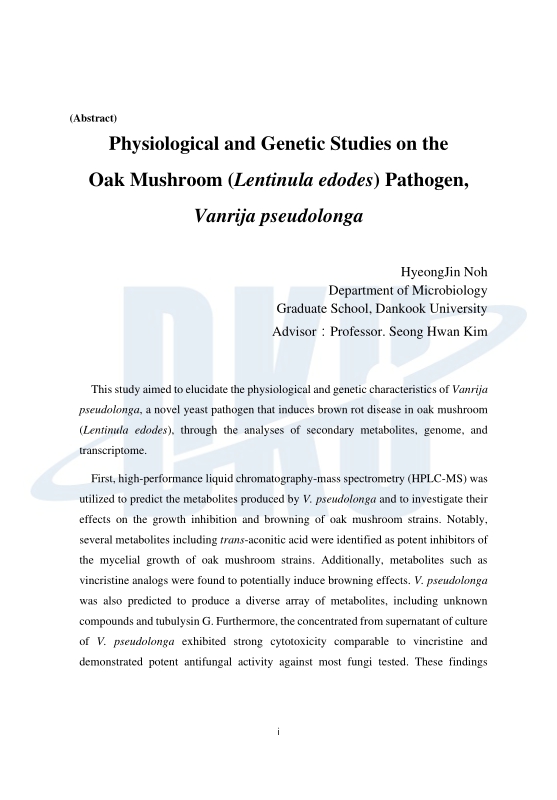
본 연구는 표고(Lentinula edodes)에 갈색 썩음병을 유발하는 새로운 효모 병원균 Vanrija pseudolonga 의 생리학 및 유전학적 특성을 2 차 대사산물 분석, 유전체 해독, 전사체 분석을 통해 구명하고자 하였다.
먼저, 고성능 액체 크로마토그래피-질량 분석법을 통해 V. pseudolonga가 생산하는 대사산물을 예측하고, 이들이 표고의 생장 억제와 갈변에 미치는 영향을 조사하였다. 특히, trans-aconitic acid와 같은 특정 대사산물이 표고의 생장을 강력하게 억제함을 확인하였다. 또한, vincristine 유사체와 같은 대사산물은 갈변 유도 효과를 나타낼 수 있음을 확인하였으며, pseudolonga 가 unknown 대사산물, tubulysin G 등을 포함한 다양한 대사산물을 생성할 수 있을 것으로 예상되었다. 또한 V. pseudolonga를 배양한 상층액을 농축한 것은 vincristine 과 유사할 정도의 강력한 세포 독성 및 대부분의 곰팡이의 생장을 저해하는 항진균 활성을 보여주었다. 이는 2 차 대사산물 또는 생리 활성 물질을 거의 생성하지 못하는 것으로 알려진 담자균류 효모인 V. pseudolonga가 다양한 생리 활성 물질을 만들 수 있는 능력을 보여준 최초의 사례이다.
유전체 분석 결과, V. pseudolonga는 NRPS 유사 및 테르펜 클러스터와 같은 2 차 대사산물 합성에 중요한 생합성 클러스터를 보유하고 있음이 확인되었다. 또한, 다양한 2 차 대사산물의 변형을 유도하는 데 중요한 유전자들을 다수 포함하고 있었다. DUCC4014 균주의 계통 분석은 관련 생물들과의 계통적 관계를 밝혔으며, EGGNOG 분석을 통해 10,066 개의 유전자를 분류하였다. CAZyme 분석은 해당 균주가 다양한 탄수화물 기질을 분해할 수 있는 능력을 보유하고 있음을 강조하며, 대사적 다양성을 뒷받침하였다.
전사체 분석에서는 V. pseudolonga 가 표고와의 대치배양 환경에 적응하기 위해 유의미한 대사적 변화를 겪는 것이 관찰되었다. 초기 단계에서는 포도당, 질소, 아미노산 운반과 관련된 유전자뿐만 아니라, 에너지 대사 및 산화 스트레스 조절 유전자가 상향 조절되었으며, 지질 대사와 TCA 회로와 관련된 유전자는 하향 조절되었다. 후기 단계에서는 해당과정, ATP 생산, 단백질 합성, 핵산 합성과 관련된 유전자가 상향 조절된 반면, 지질 대사 및 기질 재활용 관련 유전자는 하향 조절되었다. 이러한 결과는 V. pseudolonga가 표고버섯과 상호작용 중 에너지 생산과 스트레스 반응을 우선시함을 보여준다. 또한, 표고버섯 균주와의 대치배양에서 osmotin 합성 관련 유전자가 표고버섯 균주에서 크게 상향 조절되었고 mannoprotein 합성 관련 유전자는 현저히 감소한 것을 확인하였다. osmotin이 mannoprotein을 타겟으로 하여 곰팡이 세포벽과 막에 손상을 초래한다고 알려져 있기 때문에 이러한 결과는 V. pseudolonga 가 다양한 2 차 대사산물을 생산하여 표고 균사의 생장을 억제함과 동시에, osmotin 이 스트레스 요인으로 작용하여 균사 생장을 억제하고 갈변을 유도하는 복잡한 생화학적 상호작용을 뒷받침한다.
이 연구에서는 원형질체 생성 및 변형 조건을 확립하여 V.pseudolonga와 같은 비모델 생물의 유전적 편집을 가능하게 하였다. 최적화된 조건을 활용하여 aconitate isomerase를 암호화하는 prpF 유전자를 낙아웃하였다. 이 효소는 trans-aconitate 와 cis-aconitate 간의 이성질화 반응을 촉매하며, trans-aconitate는 aconitase의 경쟁적 억제제로 작용하여 TCA 회로의 효율적 진행을 방해할 가능성이 있다. prpF 돌연변이체의 표현형 분석 결과, 이 유전자는 2% 포도당 배지에서의 생장 동안 표고 생장 억제 대사산물 생산 및 위균사 형성에 관여하며, 다양한 배지에서의 V. pseudolonga 의 형태에 중요한 역할을 하는 것으로 나타났다.
본 연구는 표고 병원성 효모인 V. pseudolonga 의 생리적 및 유전적 특성을 구명함으로써, V. pseudolonga와 표고의 길항작용에 대한 이해를 심화하고, 농업 및 생명공학 분야에서의 V. pseudolonga 의 새로운 응용 가능성을 제시하였다.*표시는 필수 입력사항입니다.
| 전화번호 |
|---|
| 기사명 | 저자명 | 페이지 | 원문 | 기사목차 |
|---|
| 번호 | 발행일자 | 권호명 | 제본정보 | 자료실 | 원문 | 신청 페이지 |
|---|
도서위치안내: / 서가번호:

우편복사 목록담기를 완료하였습니다.
*표시는 필수 입력사항입니다.
저장 되었습니다.
