
 대표어
대표어
 학술연구정보서비스(KERIS)
권호기사보기
| 기사명 | 저자명 | 페이지 | 원문 | 기사목차 |
|---|
결과 내 검색
동의어 포함
표제지 2
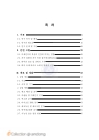
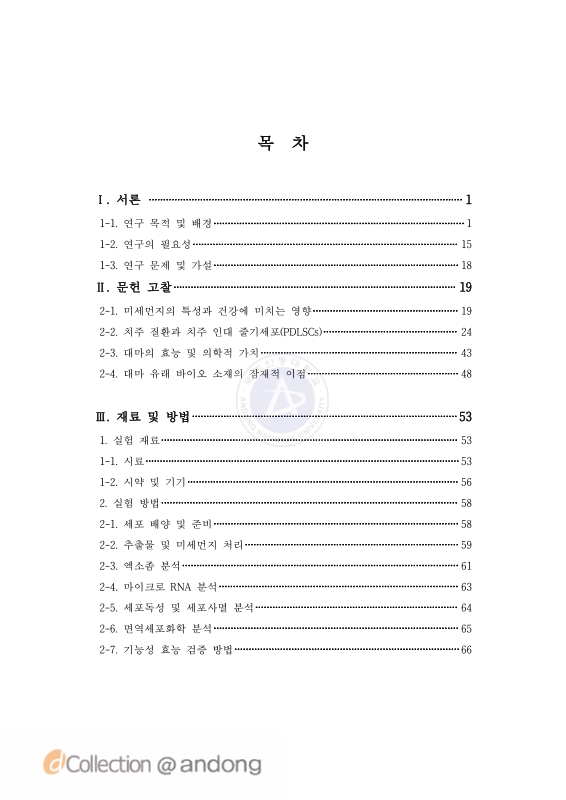
목차 4
Ⅰ. 서론 11
1-1. 연구 목적 및 배경 11
1-2. 연구의 필요성 25
1-3. 연구 문제 및 가설 28
1) 연구 문제 28
2) 연구 가설 28
Ⅱ. 문헌 고찰 29
2-1. 미세먼지의 특성과 건강에 미치는 영향 29
2-2. 치주 질환과 치주 인대 줄기세포(PDLSCs) 34
2-3. 대마의 효능 및 의학적 가치 53
2-4. 대마 유래 바이오 소재의 잠재적 이점 58
Ⅲ. 재료 및 방법 63
1. 실험 재료 63
1-1. 시료 63
1-2. 시약 및 기기 66
2. 실험 방법 68
2-1. 세포 배양 및 준비 68
2-2. 추출물 및 미세먼지 처리 69
2-3. 엑소좀 분석 71
2-4. 마이크로 RNA 분석 73
2-5. 세포독성 및 세포사멸 분석 74
2-6. 면역세포화학 분석 75
2-7. 기능성 효능 검증 방법 76
3. 추출 방법 78
3-1. 대마 줄기 용매 추출 78
3-2. 증류 및 농축 방법 79
3-3. 정제 방법 80
3-4. 엑소좀 추출 81
3-5. 엑소좀 농축 및 정제 과정 82
3-4. 통계 분석 방법 83
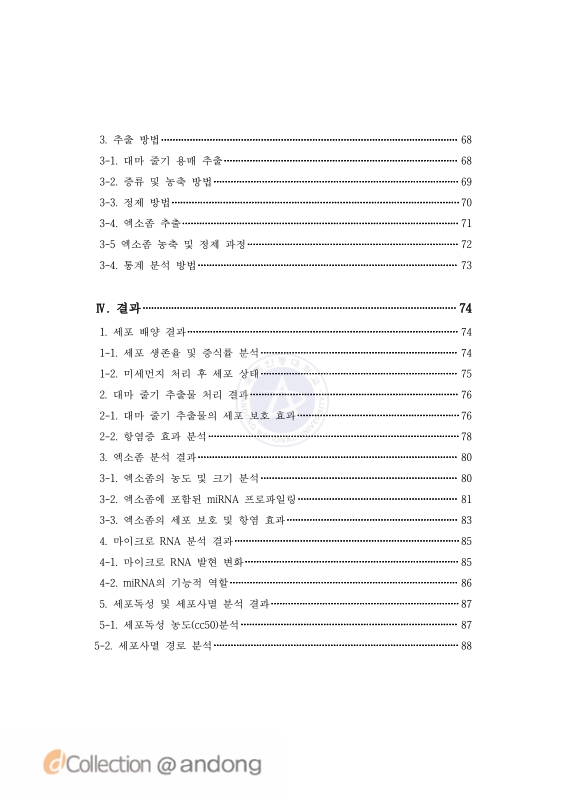
Ⅳ. 결과 84
1. 세포 배양 결과 84
1-1. 세포 생존율 및 증식률 분석 84
1-2. 미세먼지 처리 후 세포 상태 85
2. 대마 줄기 추출물 처리 결과 86
2-1. 대마 줄기 추출물의 세포 보호 효과 86
2-2. 항염증 효과 분석 88
3. 엑소좀 분석 결과 90
3-1. 엑소좀의 농도 및 크기 분석 90
3-2. 엑소좀에 포함된 miRNA 프로파일링 91
3-3. 엑소좀의 세포 보호 및 항염 효과 93
4. 마이크로 RNA 분석 결과 95
4-1. 마이크로 RNA 발현 변화 95
4-2. miRNA의 기능적 역할 96
5. 세포독성 및 세포사멸 분석 결과 97
5-1. 세포독성 농도(cc50)분석 97
5-2. 세포사멸 경로 분석 98
6. 기능성 효능 검증 결과 99
6-1. 항산화 효과 분석 99
6-2. 세포 분화 촉진 효과 100
6-3. MSEIEs에 의한 PDLC 분화 활성화 104
6-4. MSEIEs에 의한 PPC 분화 활성화 106
6-5. MSEIEs에 의한 항상성 단백질 발현 조절 107
7. 통계 분석 결과 109
7-1. 데이터의 통계적 유의성 검증 109
7-2. 다변량 분석 110
Ⅴ. 논의 111
Ⅵ. 결론 124
6-1. 항염증 효과 124
6-2. 세포 분화 촉진 125
6-3. 구강 환경 유지에 중요한 단백질 조절 126
6-4. 연구 요약 127
6-5. 연구의 학문적 및 실용적 기여 128
6-6. 향후 연구 방향 129
Ⅶ. Reference 130
초록 151
Abstract 153
Figure 1. Sources: (United States Environmental Protection Agency. EPA) 13
Figure 2. Monthly Average PM2.5 Concentrations (μg/m³) from 2015 to 2023 14
Figure 3. definition of fine dust exposure period 18
Figure 4. Pathways Involved in Immune Response and Airway Remodeling... 33
Figure 5. The Major Risk Factors of Periodontitis 36
Figure 6. Possible mechanisms between diabetes and periodontal disease have... 37
Figure 7. Physiological Model of the Impact of Stress on Periodontal Disease:... 39
Figure 8. Differentiation Pathways of Periodontal Ligament Stem Cells... 43
Figure 9. Exosomes and Their Therapeutic Potentials of Stem Cells... 49
Figure 10. Regenerative Effects of Mesenchymal Stem Cell-Derived... 51
Figure 11. Possible applications of hemp industrialization 53
Figure 12. The Appearance of a Cannabis Farm and Cannabis Stalks 64
Figure 13. Anatomical Structure of a Plant Stem and Cell Wall 65
Figure 14. Schematic Representation of Exosome Induction from Activated... 72
Figure 15. Functional Efficacy Validation of PDLSCs under Various Conditions... 77
Figure 16. Distillation and Concentration of Hemp Extract Using a Rotary... 79
Figure 17. Effect of PM10, MSE, and MSEIEs on the Expression of Apoptotic... 85
Figure 18. Treatment dosages of fine dust, mature stem extract (MSE), and... 87
Figure 19. Levels of anti-apoptotic and apoptotic genes in gingival cells... 89
Figure 20. Comparison of Exosome Size and Concentration Between PM10... 90
Figure 21. Profiling of miRNAs in various exosomes 92
Figure 22. Levels of anti-apoptotic and apoptotic genes in gingival cells after... 94
Figure 23. Effect of MSEIEs on miRNA Expression Compared to PM10... 95
Figure 24. Analysis of Apoptosis Pathway Inhibition by MSE and MSEIEs... 98
Figure 25. Differentiating patterns of PDLSCs cultured in an MSB-conditioned... 101
Figure 26. Differentiation patterns of PDLSCs under MSECM and MSEIEs... 102
Figure 27. Immunocytochemistry results for differentiation to osteoblasts or... 103
Figure 28. Effect of MSEIEs on PDLC Differentiation: Cell Counts and... 104
Figure 29. Immunocytochemistry results for differentiation to osteoblasts or... 105
Figure 30. Activation of PPC Differentiation by MSEIEs Under PM10... 106
Figure 31. Expression of homeostatic proteins under various conditions. (a)... 108
Figure 32. Illustration of Anti-inflammatory, Differentiation Activation, and... 111
Figure 33. Current Status of Exosome Market 121
*표시는 필수 입력사항입니다.
| 전화번호 |
|---|
| 기사명 | 저자명 | 페이지 | 원문 | 기사목차 |
|---|
| 번호 | 발행일자 | 권호명 | 제본정보 | 자료실 | 원문 | 신청 페이지 |
|---|
도서위치안내: / 서가번호:

우편복사 목록담기를 완료하였습니다.
*표시는 필수 입력사항입니다.
저장 되었습니다.
