
 대표어
대표어
 학술연구정보서비스(KERIS)


권호기사보기
| 기사명 | 저자명 | 페이지 | 원문 | 기사목차 |
|---|
결과 내 검색
동의어 포함
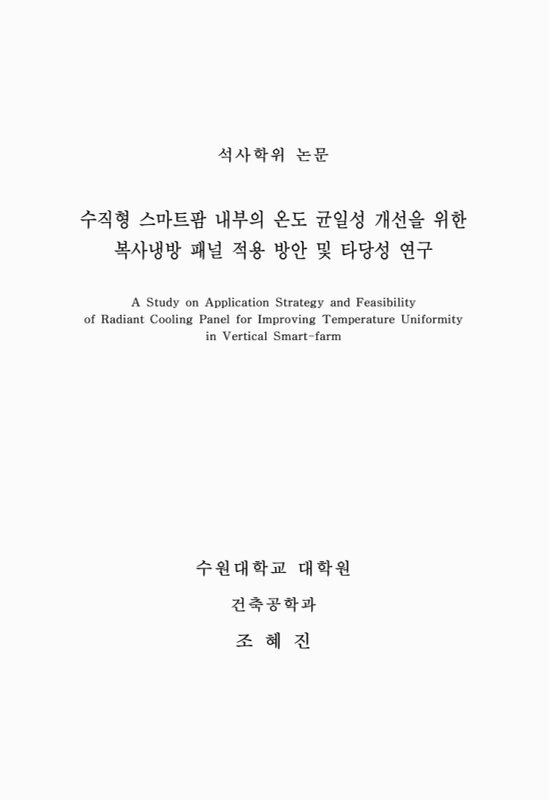
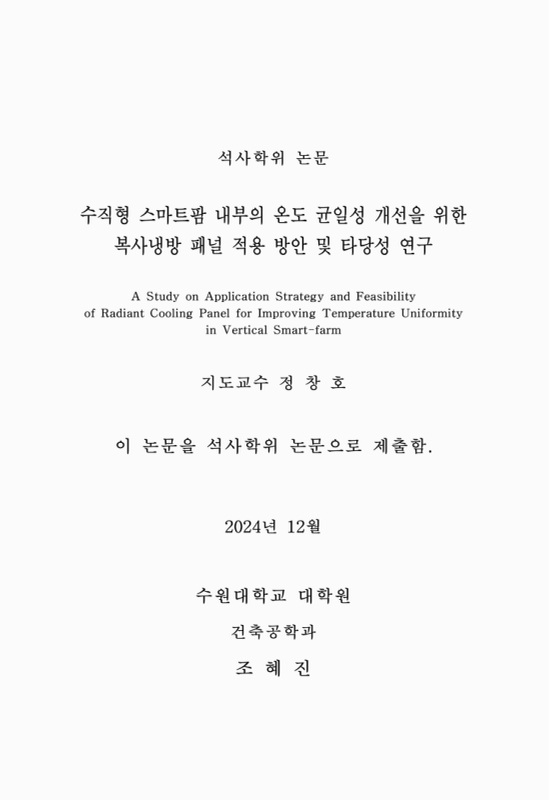
표제지 1
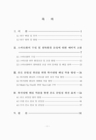
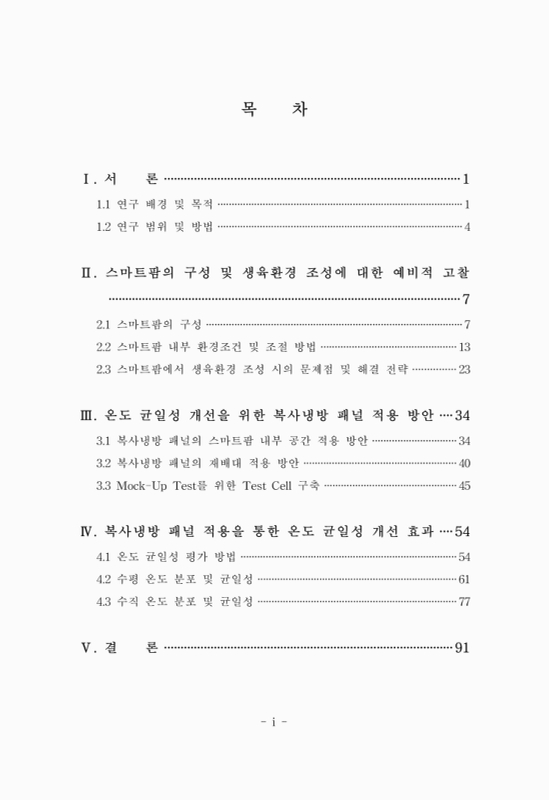
목차 4
Ⅰ. 서론 9
1.1. 연구 배경 및 목적 9
1.2. 연구 범위 및 방법 12
(1) 수직형 스마트팜 구성 현황 및 대류냉방 시스템 적용 한계점 분석 12
(2) 복사냉방 패널 적용 방안 제안 13
(3) Mock-Up Test를 통한 온도 균일성 개선 효과 검증 13
Ⅱ. 스마트팜의 구성 및 생육환경 조성에 대한 예비적 고찰 15
2.1. 스마트팜의 구성 15
2.1.1. 재배방식에 따른 스마트팜 분류 16
2.1.2. 재배 형태에 따른 스마트팜 분류 17
2.1.3. 작물의 이동 여부에 따른 스마트팜 분류 18
2.1.4. 광원에 따른 스마트팜 분류 19
2.2. 스마트팜 내부 환경 조건 및 조절 방법 21
2.2.1. 생육환경 조건 21
2.2.2. 생육환경 조성 및 조절 방법 27
2.3. 스마트팜에서 생육환경 조성 시의 문제점 및 해결 전략 31
2.3.1. 대류냉방 시스템 적용에 따른 온도 불균일 31
2.3.2. 대류냉방 시스템 적용에 따른 온도 불균일 해결 방안 36
Ⅲ. 온도 균일성 개선을 위한 복사냉방 패널 적용 방안 42
3.1. 복사냉방 패널의 스마트팜 내부 공간 적용 방안 42
3.1.1. 복사냉방 패널 설치 위치 선정 44
3.1.2. 천장 복사냉방 패널 설치 형태 선정 47
3.2. 복사냉방 패널의 재배대 적용 방안 48
3.2.1. 재배대 복사냉방 패널 적용 49
3.2.2. 수직형 스마트팜에 적용된 복사냉방 패널 51
3.3. Mock-Up Test를 위한 Test Cell 구축 53
3.3.1. Test Cell 구축 54
3.3.2. 복사냉방 패널 설치 58
Ⅳ. 복사냉방 패널 적용을 통한 온도 균일성 개선 효과 62
4.1. 온도 균일성 평가 방법 62
4.1.1. 측정 방법 62
4.1.2. 온도 균일성 평가 방법 66
4.2. 수평 온도 분포 및 균일성 69
4.2.1. 수평 온도 분포 69
4.2.2. 수평 온도 균일도 분석 73
4.2.3. 대류냉방 방식 대비 복사냉방 적용에 따른 수평 온도 균일성 개선 효과 83
4.3. 수직 온도 분포 및 균일성 85
4.3.1. 수직 온도 분포 85
4.3.2. 수직 온도 균일도 분석 89
4.2.4. 대류냉방 방식 대비 복사냉방 적용에 따른 수평 온도 균일성 개선 효과 96
Ⅴ. 결론 99
참고문헌 103
ABSTRACT 107
[그림 1.1] 연구의 흐름도 14
[그림 2.1] 재배 형태에 따른 스마트팜 17
[그림 2.2] 이동식 스마트팜 18
[그림 2.3] 스마트 온실의 구성 19
[그림 2.4] CO₂ 농도에 따른 광합성량과 상대수확률 변화 22
[그림 2.5] CO₂ 농도와 온도에 따른 광합성량 22
[그림 2.6] 습도와 온도에 따른 광합성량 23
[그림 2.7] 온도변화에 따른 결로 유무 25
[그림 2.8] 대류냉방 적용에 따른 수직 온도 분포 32
[그림 2.9] 대류냉방 적용에 따른 스마트팜 내부의 온도 분포 33
[그림 2.10] 대류냉방 적용에 따른 수평 온도 분포 34
[그림 2.11] 토출 기류 속도 조정 시 수직 온도 분포 36
[그림 2.12] 토출 기류 속도 조정 시 수평 온도 분포 37
[그림 2.13] 수평 급기 방식 38
[그림 2.14] 수평 급기 방식 적용 시 수평 온도 분포 39
[그림 3.1] 대류냉방 적용 시 스마트팜 내부의 온도 흐름도 43
[그림 3.2] 바닥 복사냉방 패널 적용 시 스마트팜 온도 분포도 44
[그림 3.3] 벽면 복사냉방 패널 적용 시 스마트팜 공기 흐름도 45
[그림 3.4] 천장 복사냉방 패널 적용 시 스마트팜 온도 분포도 46
[그림 3.5] 개방형 천장 복사냉방 패널 적용 방안 48
[그림 3.6] 재배대에서의 온도 불균일 문제 발생 예상도 49
[그림 3.7] 재배대 복사냉방 패널 적용 방안 50
[그림 3.8] 수직형 스마트팜에서의 복사냉방 패널 적용 방안 51
[그림 3.9] Test Cell 구성안 54
[그림 3.10] Test Cell 내부 계획안 55
[그림 3.11] 실험실 내부 Test Cell 구축 현황 56
[그림 3.12] Test Cell에 적용된 시스템 구축 현황 56
[그림 3.13] 히트펌프 기반의 복사냉방 시스템 계통도 57
[그림 3.14] 천장 복사냉방 패널 적용 결과 58
[그림 3.15] 재배대 복사냉방 패널 적용 결과 59
[그림 3.16] 재배대 복사냉방 패널 및 모종판 설치 결과 60
[그림 3.17] Test Cell 내 천장 및 재배대 복사냉방 패널 적용 결과 60
[그림 4.1] 재배대에서의 온도 측정 지점 63
[그림 4.2] Test Cell 내·외부의 온도 측정 지점 64
[그림 4.3] 재배대 A의 수평 온도 분포 71
[그림 4.4] 재배대 B의 수평 온도 분포 72
[그림 4.5] Layer 1의 수평 온도 균일성 76
[그림 4.6] Layer 2의 수평 온도 균일성 79
[그림 4.7] Layer 3의 수평 온도 균일성 82
[그림 4.8] 복사냉방 패널 적용에 따른 수평 온도 편차 83
[그림 4.9] 재배대 A의 수직 온도 분포 87
[그림 4.10] 재배대 B의 수직 온도 분포 88
[그림 4.11] Point 2의 수직 온도 균일성 91
[그림 4.12] Point 3의 수직 온도 균일성 93
[그림 4.13] Point 4의 수직 온도 균일성 95
[그림 4.14] 복사냉방 패널 적용에 따른 수직 온도 편차 97
This study aims to propose the application of radiant cooling panels to solve the temperature unevenness problem caused by the convection cooling system mainly used in artificial light type vertical smart farms, and to verify the effect of improving the temperature uniformity. The main components for creating a growing environment for vertical smart farms and the limitations of existing cooling systems were investigated through previous research. Based on this, ceiling radiant cooling panels and planting table radiant cooling panels were proposed. In order to verify the effectiveness of the proposed radiant cooling panel, a mock-up test was conducted and a test cell simulating the structure of a real smart farm was built. The horizontal and vertical temperature distribution was analysed under the condition of LED lighting and turning off.
The main findings of the study are as follows.
1) The limitations of the convection cooling method, temperature stratification and cold air flow, were compensated by using ceiling radiant cooling panels to control the temperature of the whole space by radiant heat exchange without relying on the air flow inside the vertical smart farm. The result was confirmation that the cooling efficiency inside the vertical smart farm can be improved.
2) Radiant cooling panels were applied to the lower part of the racks. This compensated for the cooling effect of the lower racks blocked by the upper racks. This improved the temperature uniformity of each rack. It showed that it is possible to improve the productivity of vertical smart farms and ensure uniform product quality.
3) Horizontal temperature distribution analysis revealed that the application of radiant cooling panels reduced horizontal temperature deviations by an average of 0.3~0.7℃ compared to convection cooling under LED off conditions while maintaining a highly favorable temperature uniformity level (above 97%). Although horizontal temperature deviations increased under LED on conditions, they remained within the optimal temperature range of 15~20℃ for lettuce growth, ensuring a stable growing environment.
4) In the vertical temperature distribution analysis, the radiant cooling panel reduced the vertical temperature deviation by an average of 4.5~5.2℃ compared to convection cooling when the LEDs were off. It also reduced the vertical temperature deviation by 2.9~3.9℃ when the LEDs were on. This shows that the problem of temperature stratification, which has been pointed out as a limitation of the existing convection cooling system, can be effectively solved by the application of radiant cooling panels.
5) The correlation analysis between temperature deviation and uniformity showed that the uniformity varied somewhat depending on whether the LEDs were lit or not. However, the radiant cooling panel was able to maintain high temperature uniformity overall. In particular, it was shown that the temperature variation in the center of the bed, where the temperature variation was greatest due to the weak airflow when convection cooling was used, could be consistently reduced.
6) Through the introduction of ceiling and planter radiant cooling panels as a cooling system for vertical smart farms, we have presented a technical proposal that can overcome the limitations of the existing convection cooling method. This is expected to contribute to presenting a new direction of environmental control technology in the field of smart agriculture.
7) A method for ensuring temperature uniformity through the application of ceiling and planting table radiant cooling panels to simultaneously increase crop quality and productivity was proposed and verified. In addition, it was evaluated as a valid alternative to solve the problem of heat generated by LEDs used to ensure the photosynthetic amount of crops. This has the potential to be applied to smart farms of different sizes and structures, fulfilling the purpose of implementing smart farms to ensure stable crop productivity.
This study provides foundational insights into the feasibility of employing radiant cooling panels to enhance temperature uniformity in vertical smart farms.*표시는 필수 입력사항입니다.
| 전화번호 |
|---|
| 기사명 | 저자명 | 페이지 | 원문 | 기사목차 |
|---|
| 번호 | 발행일자 | 권호명 | 제본정보 | 자료실 | 원문 | 신청 페이지 |
|---|
도서위치안내: / 서가번호:

우편복사 목록담기를 완료하였습니다.
*표시는 필수 입력사항입니다.
저장 되었습니다.
