
 대표어
대표어
권호기사보기
| 기사명 | 저자명 | 페이지 | 원문 | 기사목차 |
|---|
결과 내 검색
동의어 포함
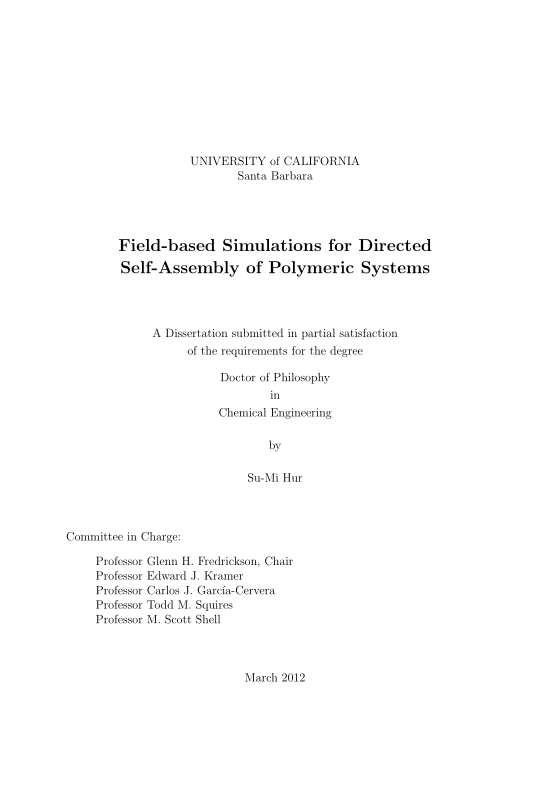
The self-assembly of block copolymer thin films has attracted considerable attention as a promising high resolution lithographic tool due to its scale of microdomain ordering and its facility for modulation of both size and pattern. Our research has focused on developing improved block copolymer lithography techniques by means of self-consistent field theory (SCFT) simulations. We have demonstrated that directed self-assembly (DSA), which has already been shown to improve long-range ordering, can also be used to dictate the configuration and fidelity of the self-assembled structure. We demonstrate that lateral confinement combined with homopolymer additive can stabilize non-natural square arrays of microdomain ordering that are not found in pure block copolymer systems. Furthermore, we have shown that DSA can be used for high resolution VIA (Vertical Interconnect Access) lithography since it enhances the processing window through its reduced size variation and rectification properties. We also have developed a powerful suite of field-based computer simulation tools for exploring the self-assembly of complex polymeric fluids under confinement including a Chebyshev-based pseudo-spectral approach and a model that can incorporate deformable polymer/air interfaces. Finally, we have extended SCFT DSA techniques to mixed polymer brushes, in which dissimilar A and B chains phase separate on molecular length scales due to constraints imposed by having their ends grafted to a substrate. We identified the phase diagram of mixed brushes in the melt and demonstrated that lateral confinement and grafting density modulation can induce technologically attractive lateral phase separation for the application of self-assembled mixed polymer brushes in next-generation information storage and electronic devices.
블락공중합체(block copolymer)는 자기조립(self-assembly) 성질을 가지며, 이때 얻어지는 나노스케일의 패턴을 얻을 수 있으며, 그 형태나 크기는 공중합체의 분자량과 조성에 따라 제어가 가능하다. 이러한 자기조립의 특성은 블락공중합체 박막을 차세대 고해상도 리소그래피의 대안으로서의 각광받게 하였다. 블락공중합체 리소그래피의 핵심기술이 되는 유도자기조립(directed self-assembly, DSA)은 고분자 자기조립 패턴보다 큰 주기를 가지는 기하학적 내지는 화학적 유도 패턴을 템플레이트로 이용하여 블락공중합체 박막의 결함구조를 최소화하고 나노구조의 정렬도를 증가 시키는 것으로 알려져있다. 본 연구에서는 다양한 고분자 시스템의 유도자기조립 패턴을 예측하고 분석하기 위한 self-consistent field theory (SCFT) 를 기반으로 하는 수치모델 개발과 그 결과 해석에 중점을 두었다.
첫번째 시스템에서는, 순수한 이종블락공중합체 (diblock copolymer)에서 얻을 수 없는 정사각 패턴을 안정화 시키는 방법을 보여주었다. 정사각 패턴은 현 리소그래피의 기본 패턴으로 사용되며, 나노스케일의 정사각패턴의 고분자 자기패턴은 현재의 기술과 반도체 소자 설계 로직을 고해상도 리소그래피에 그대로 사용할 수 있는 장점을 가지고 있다. 마이크로 스케일의 정사각 형태의 기하학적 유도패턴과 더불어 단일중합체 (homopolymer)를 첨가하여 비자연적인 패턴을 안정화 시킬 수 있음을 보였으며, 유도패턴 크기, 단일중합체의 분자량 및 조성에 대한 상평형도를 완성 하였다.
두번째 연구는 유도자기조립을 고해상도의 VIA(Vertical Interconnect Access)를 제작 하는데 응용하였다. IBM의 실험팀과 협력하여 실린더 형태의 기하학적 유도패턴을 이용한 유도자기조립을 VIA 리소그래피에 응용하였을때 마스크 패턴의 크기나 형태의 결함이 보정되어 광범위한 공정조건에서 보다 균일한 크기의 컨택트홀 (contact hole)을 얻을 수 있다는 것을 증명하였으며 수치모사 결과를 통하여 그 이유를 설명하였다.
그 다음 장에서는 기하학적 유도패턴 위에서 다양한 고분자 시스템의 자기조립을 보다 효과적으로 연구할 수 있도록 개발된 수치모사 방법을 소개하였다. 개발된 SCFT 기반의 수치모사 방법에서는 체비세프(Chebyshev) 다항식을 기저함수로 하는 수도스펙트랄(pseudo-spectral) 방법을 사용하여, 고분자를 가두는 기하학적 측면 벽에서의 거동을 보다 쉽고 정확하게 예측하도록 하였다. 나아가 비평면의 변형가능한 고분자/공기 계면이 모델에 포함되도록 하여, 다양한 고분자 시스템에 응용 가능하도록 하였다.
마지막으로, 블락공중합체 박막에 적용되는 유도자기조립 기술을 혼합 고분자브러쉬 (polymer brush) 시스템에 적용하였다. 혼합 고분자브러쉬 시스템은 서로 다른 단일고분자브러쉬들이 섞여있어 상분리가 일어나며, 한쪽 사슬끝이 기판에 붙어있기 때문에 블락공중합체의 자기조립과 유사한 분자크기(나노스케일)의 패턴이 얻어지게 된다. 본 연구에서는 SCFT 수치모사를 통하여 용융체 상태의 혼합 고분자브러쉬의 상평형도를 완성하였으며, 단일고분자브러쉬 영역을 템플레이트로 하여 혼합 고분자브러쉬에 유도자기조립 기술을 적용하였다. 또한, 기판에 결합된 고분자 사슬끝의 조성 및 밀도를 조절함으로써 차세대 저장매체와 전자기기개발에 필수적인 다양한 리소그래피 패턴을 얻을 수 있음을 보였다.*표시는 필수 입력사항입니다.
| 전화번호 |
|---|
| 기사명 | 저자명 | 페이지 | 원문 | 기사목차 |
|---|
| 번호 | 발행일자 | 권호명 | 제본정보 | 자료실 | 원문 | 신청 페이지 |
|---|
도서위치안내: / 서가번호:

우편복사 목록담기를 완료하였습니다.
*표시는 필수 입력사항입니다.
저장 되었습니다.
