
 대표어
대표어
권호기사보기
| 기사명 | 저자명 | 페이지 | 원문 | 기사목차 |
|---|
결과 내 검색
동의어 포함
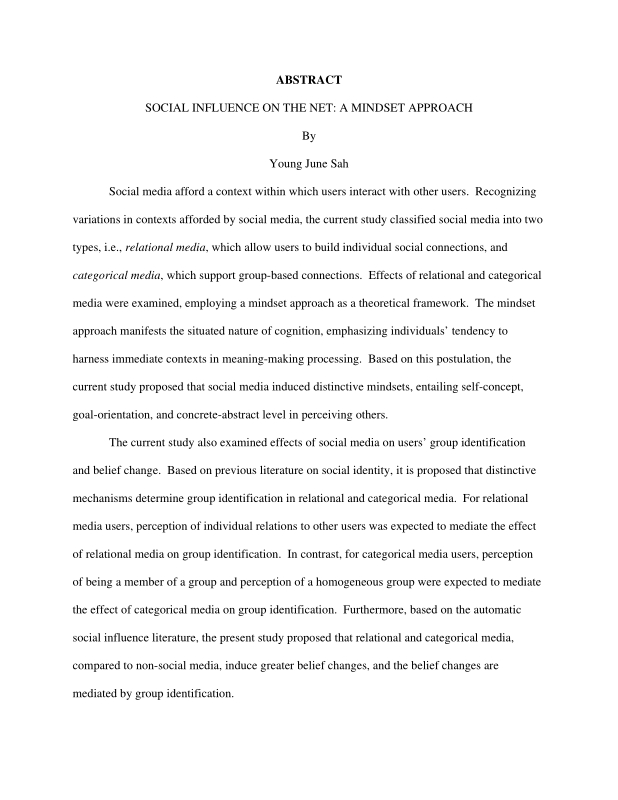
Social media afford a context within which users interact with other users. Recognizing variations in contexts afforded by social media, the current study classified social media into two types, i.e., relational media, which allow users to build individual social connections, and categorical media, which support group-based connections. Effects of relational and categorical media were examined, employing a mindset approach as a theoretical framework. The mindset approach manifests the situated nature of cognition, emphasizing individuals’ tendency to harness immediate contexts in meaning-making processing. Based on this postulation, the current study proposed that social media induced distinctive mindsets, entailing self-concept, goal-orientation, and concrete-abstract level in perceiving others.
The current study also examined effects of social media on users’ group identification and belief change. Based on previous literature on social identity, it is proposed that distinctive mechanisms determine group identification in relational and categorical media. For relational media users, perception of individual relations to other users was expected to mediate the effect of relational media on group identification. In contrast, for categorical media users, perception of being a member of a group and perception of a homogeneous group were expected to mediate the effect of categorical media on group identification. Furthermore, based on the automatic social influence literature, the present study proposed that relational and categorical media, compared to non-social media, induce greater belief changes, and the belief changes are mediated by group identification.
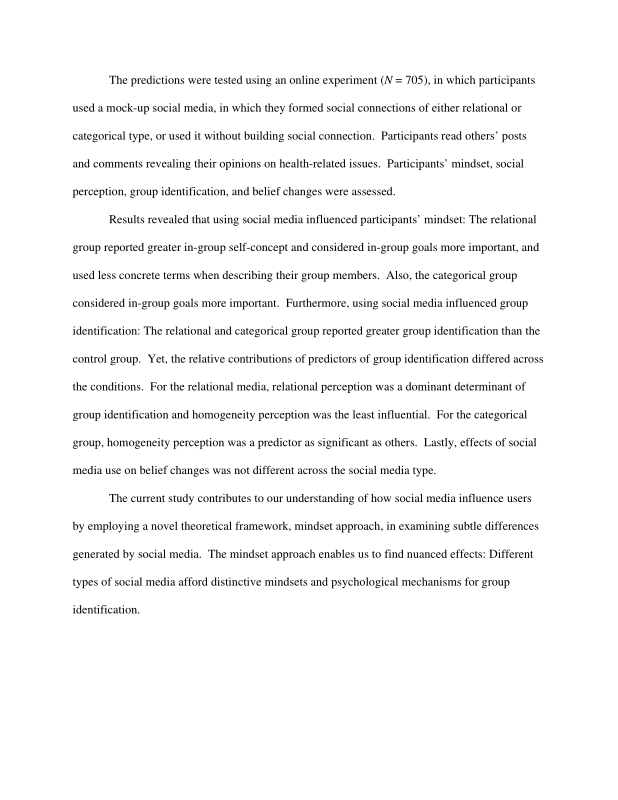
The predictions were tested using an online experiment (N = 705), in which participants used a mock-up social media, in which they formed social connections of either relational or categorical type, or used it without building social connection. Participants read others’ posts and comments revealing their opinions on health-related issues. Participants’ mindset, social perception, group identification, and belief changes were assessed.
Results revealed that using social media influenced participants’ mindset: The relational group reported greater in-group self-concept and considered in-group goals more important, and used less concrete terms when describing their group members. Also, the categorical group considered in-group goals more important. Furthermore, using social media influenced group identification: The relational and categorical group reported greater group identification than the control group. Yet, the relative contributions of predictors of group identification differed across the conditions. For the relational media, relational perception was a dominant determinant of group identification and homogeneity perception was the least influential. For the categorical group, homogeneity perception was a predictor as significant as others. Lastly, effects of social media use on belief changes was not different across the social media type.
The current study contributes to our understanding of how social media influence users by employing a novel theoretical framework, mindset approach, in examining subtle differences generated by social media. The mindset approach enables us to find nuanced effects: Different types of social media afford distinctive mindsets and psychological mechanisms for group identification.
본 논문에서는 소셜미디어의 사회심리적 효과를 검증하였다. 특히 오늘날 소셜미디어가 제공하는 관계의 형태가 다양하다는 점에 주목하여 그 형태를 관계형 미디어와 집단형 미디어의 두 가지로 구분하였다. 관계형 미디어를 사용자간 관계가 1:1로 맺어지는 형태 (예를 들어 페이스북), 집단형 미디어의 경우 기존 집단에 가입하여 관계가 맺어지는 형태 (예를 들어 온라인 커뮤니티)로 개념화 하였고, 이같은 온라인 관계의 서로 다른 형태가 사용자의 사회적 인지구조 (social cognitive structure) 와 집단 동일시화, 사회적 영향에 미치는 효과를 조사하였다.
이를 위해 본 논문에서는 마인드셋 접근법 (mindset approach)을 활용하였다. 마인드셋은 상황인지을 근간으로 한 이론으로 이용자들이 주어진 환경을 의미형성과정(meaning-making processing)으로 활용한다는 관점이다. 이를 소셜미디어 효과검증 연구에 적용하면, 관계형 미디어와 집단형 미디어가 제공하는 온라인 상의 사회적 구조가 사용자가 자신과 타인, 사회적 관계을 이해하는 의미형성과정에 활용한다는 명제를 도출할 수 있다. 구체적으로 본 연구에서는 소셜미디어의 관계형, 집단형 타입이 해당 사회적 맥락에 부합하는 자아개념(self-concept), 목적지향성(goal-orientation), 인지스타일(cognitive style)에 영향을 미친다는 가설을 유도하였다. 예를 들어, 관계형 미디어를 사용할 때는 다른 사용자와의 개별 관계를 중시하는 관계적 자아가, 집단적 미디어를 사용할 때는 집단의 목적과 가치를 중요시 하는 집단적 자아가 발현된다는 가설을 도출하였다. 아울러 본 연구에서는 자아개념과 목적지향성, 인지스타일을 마인드셋을 구성하는 요소로 보고 미디어 형태로 인해 독특한 마인드셋이 도출되는 것을 가정 하였다. 또한 소셜미디어의 사용으로 인해 유도된 마인드셋으로 인해, 집단 동일시 과정과 사회적 영향의 과정이 소셜미디어 형태에 따라 다르게 나타날 것으로 예상하였다.
이와 같은 가설을 검증하기 위해 본 논문은 온라인 실험을 진행하였다. 실험을 위해 두가지의 다른 형태의 소셜미디어를 개발하였고, 실험에 참여한 피실험자들은 소셜미디어를 이용한 후 설문에 참여하였다. 온라인 실험을 통해 본 연구는 소셜미디어를 이용하는 것이 사용자의 마인드셋에 영향을 미치는 것을 보였다. 관계형 미디어를 이용한 사람들은 대조군에 비해 집단적 자아개념과 집단적 목표를 더 중요시하였고, 집단적 미디어를 이용한 사람들도 대조군에 비해 집단적 목표를 더 중요시 하였다. 또한 소셜미디어는 사회적 동질화 과정에도 영향을 미쳤다. 관계형 미디어를 사용하였을 경우 다른 사용자에 대한 개별적 관계에 대해 인지할수록 사회적 동질화가 큰 반면, 집단형 미디어의 경우 다른 사용자를 집단으로 인식하는, 집단 동일성을 더 크게 인지할수록 사회적 동질화를 하는 경향이 높았다. 본 연구는 상황인지와 마인드셋 접근법을 이론적 토대로 이용하여 미디어 효과의 미묘한 차이에 대한 예측과 검증을 수행한 연구로, 소셜미디어의 구조적 차이가 집단 동일시와 사회적 영향의 기저작용에 차이를 만들 수 있음을 보였다. 아울러 온라인 공간에서의 사회적 관계가 집단 동일시와 사회적 영향을 촉진할 수 있음을 실증적으로 보여, 온라인 커뮤니케이션의 사회적 함의를 밝히고 있다.*표시는 필수 입력사항입니다.
| 전화번호 |
|---|
| 기사명 | 저자명 | 페이지 | 원문 | 기사목차 |
|---|
| 번호 | 발행일자 | 권호명 | 제본정보 | 자료실 | 원문 | 신청 페이지 |
|---|
도서위치안내: / 서가번호:

우편복사 목록담기를 완료하였습니다.
*표시는 필수 입력사항입니다.
저장 되었습니다.
