
 대표어
대표어

권호기사보기
| 기사명 | 저자명 | 페이지 | 원문 | 기사목차 |
|---|
결과 내 검색
동의어 포함
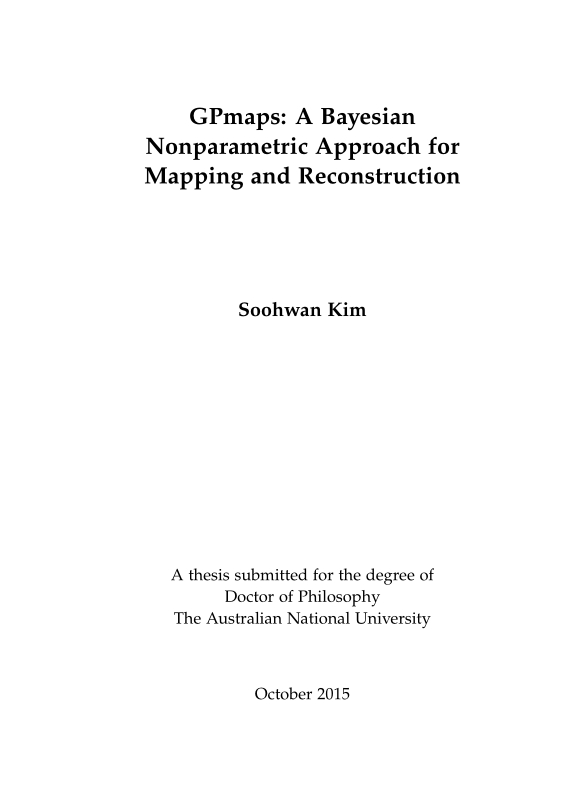
This thesis proposes new methods for robotic mapping using Bayesian nonparametric models. We first propose a unified framework for occupancy mapping and surface reconstruction using Gaussian processes called GPmaps. Gaussian processes are known to be the state-of-the-art technology for regression and classification, but not directly applicable to large-scale environmental mapping due to the high computational complexity. To improve the scalability of GPmaps while maintaining the map accuracy, we propose two types of approximations, spatial and temporal. The spatial approximations are based on a divide-and-conquer strategy. We propose global, local and glocal (global + local) spatial approximations based on the estimation scope. For the global approximation we apply a mixture of Gaussian process experts. Training data is partitioned into manageable subsets with Dirichlet process mixture models or line tracking, and individual Gaussian processes estimate global maps based on the local subsets, which are merged later by a gating network. We further improve the accuracy of this approach by applying infinite mixtures of Gaussian process experts where clustering and prediction steps are combined together. In large-scale environments, however, test positions are so enormous that estimating multiple global maps is inefficient. To handle this problem, we introduce the local approximation which factorizes the whole environment into blocks and predicts each block map with its own local observations. For doing that, we propose overlapping local Gaussian processes which partition both training and test data, and apply local Gaussian processes to extended training subsets. Particularly, with octree-based data partitioning, GPmaps with the local approximation are converted into a sliding window approach where we predict a block map with its local observations and move on to the next block iteratively. However, the local approximation has a limitation that no block map is generated if there exist no observations in its local area. To tackle this problem, we introduce the glocal approximation and propose hierarchical Gaussian processes which combine a global Gaussian process on top of the overlapping local Gaussian processes. On the other hand, we incorporate the temporal approximation of a static world assumption with the spatial approximations and propose Bayesian recursive updates to incrementally update GPmaps for sequential observations acquired from static environments.We demonstrate our GPmaps with simulated data and real datasets acquired from laser range finders and Microsoft Kinect depth cameras. Experimental results show that our GPmaps produce more accurate and reliable robotic maps as well as map uncertainties than occupancy grid maps and OctoMaps with additional computational time. We implement GPmaps with spatial and temporal approximations in C++ and publish on-line as open source software at GitHub.
로봇 지도 작성(robotic mapping)은 로봇이 주위 환경을 이해하고 물리적인 상호작용을 하기 위해 선행되어야 하는 가장 중요한 문제 중에 하나이다. 예를 들어 이동로봇(mobile robot)이 미지의 공간에서 자율주행(navigation)을 하기 위해서는 점유지도(occupancy map)가 필요하고, 로봇팔(manipulator)이 임의의 물체를 잡기(grasping)위해서는 물체 모형 모델(object shape model)이 수반되어야 하며, 작업자(remote operator)가 원격 제어(teleoperation)를 하기 위해서는 작업공간의 시각화(visualiz ation)가 먼저 이루어져야 한다. 따라서 로봇 지도 작성은 로봇이 주어진 작업(robot task)을 안전하고 정확하게 수행하기 위해 반드시 필요하다.한편, 로봇 지도 작성 문제는 컴퓨터 비전(computer vision) 과 컴퓨터 그래픽스(computer graphics)분야의 3차원 복원(3D reconstruction) 문제와 매우 밀접한 관계를 갖고 있다. 최근 다양한 종류의 레이저 센서 및 깊이 카메라(depthcamera)의 출현으로 주위 환경 또는 물체 모델을 3차원으로 복원하려는 연구가 활발히 진행되고 있다. 다양한 위치에서 거리센서(range sensor)를 이용하여 획득된 점구름(point cloud)은 음함수 곡면(implicit surface)의 표본점(sample)으로 생각될 수 있고, 따라서 물체의 곡면을 복원할 수 있다.본 연구에서는 보다 정확한 로봇 지도를 작성하기 위하여 기계학습(machine learning) 분야의 최신 기술(state-of-theart)인 가우시안 프로세스(Gaussian process) 방법을 사용하고자 한다. 가우시안 프로세스는 회귀(regression) 및 분류(classification)를 위해 고안된 베이지안 비모수 (Bayesian non-parametric) 방법으로 최근 로봇 및 컴퓨터 비젼 분야에서 활발히 응용되고 있다. 가우시안 프로세스의 장점 중 하나는 베이지안 방법이기 때문에 로봇 지도와 함께 지도의 불확실성(uncertainty)가 함께 얻어진다는 점이다. 이는 기존의 결정론적(deterministic)인 방법이 갖지 못하는 가우시안 프로세스의 확률적(stochastic)인 방법으로서의 이점이다.본 연구의 목적은 가우시안 프로세스를 응용하여 로봇 지도 작성을 수행함에 있어서 다음의 필요조건을 만족시키는 방법을 고안하는 것이다. 첫째, 데이터의 노이즈를 고려해야 한다. 이는 센서로부터 획득된 데이터에는 항상 노이즈가 존재하며, 추정된 센서의 자세 또한 완벽하지 않기 때문이다. 둘째, 대용량 데이터에 대응해야 한다. 대부분의 거리 센서는 한번의 스캔으로 백만개 이상의 데이터를 획득하며, 넓은 환경의 경우 이 문제는 더욱 심해진다. 따라서 알고리즘의 확장성(scalability )를 획득하는 것이 중요하다. 셋째, 연속으로 획득되는 데이터를 다룰 수 있어야 한다. 실제 데이터 획득 과정을 살펴보면 여러 위치에서 순차적으로 스캔을 하기 때문에 이미 완성된 로봇 지도를 순차적으로 갱신(sequential update)할 수 있어야 한다. 이를 만족시키기 위하여 본 연구에서는 다음의 방법을 제안한다. 첫째, 점구름과 이로부터 추정된 방향벡터에 각기 다른 수준의 노이즈 파라미터를 적용하여 데이터로부터 학습한다. 둘째, 분할 정복(divide and conquer) 전략을 따라 다량의 데이터를 클러스터링(clustering) 방법을 이용하여 독립적인 데이터 세트로 쪼개어 연산 복합도(computational complexity )를 낮춘다. 셋째, 베이지안 갱신(Bay esian update) 방법에 따라 기존에 획득된 로봇 지도의 확률분포와 추후에 획득된 로봇 지도의 확률분포를 병합하려 로봇 지도의 정확도를 높인다.*표시는 필수 입력사항입니다.
| 전화번호 |
|---|
| 기사명 | 저자명 | 페이지 | 원문 | 기사목차 |
|---|
| 번호 | 발행일자 | 권호명 | 제본정보 | 자료실 | 원문 | 신청 페이지 |
|---|
도서위치안내: / 서가번호:

우편복사 목록담기를 완료하였습니다.
*표시는 필수 입력사항입니다.
저장 되었습니다.
