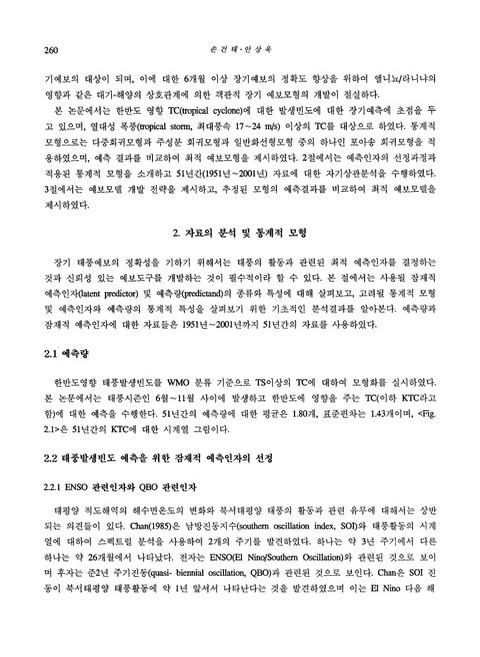
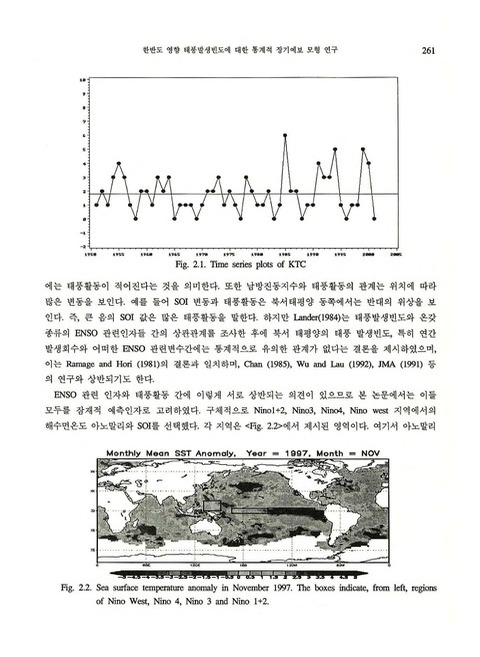
북서태평양 발생 태풍 중에서 한반도에 영향을 주는 TC(tropical cyclone)의 연간 발생빈도에 대하여 통계적 장기예보 모델을 개발하였다. 선행 연구에서 나타난 다양한 잠재적 예측인자를 고려하고 예측오차제곱합을 최소로 하는 변수선택기준과 모든 가능한 경우로부터의 변수선택 기법으로 최적 예측인자 조합을 탐색하였다. 예측량에 대한 자기상관분석을 통하여 유의한 시차를 탐색하여 잠재적 예측인자에 포함하였다.통계적 예보모형으로 중회귀모형, 주성분 회귀모형, 포아송 회귀모형을 고려하였으며, 각 모형에 대하여 30년 이동 예측모형 개발 전략과 변수선택기법을 적용하였다. 각 모형에 의한 예측 결과를 비교한 결과 포아송 회귀모형에 의한 예측이 가장 우수한 것으로 나타났다. 주요용어 : 태풍발생빈도예측, 포아송 회귀모형, 예측오차제곱합
This paper concentrates on the development of the statistical models for the long-term prediction of numbers of tropical cyclones that affect the Korea peninsula. the 51-year (1951∼2001) data, including the ENSO indices, various synoptic factors and the CLIPER factors, are used for our study. Three statistical models (multiple regression models, principal components regression models and Poisson regression models) are applied to predict the numbers of TC's which affect the Korea Peninsula. As a forecast strategy, the 30-year-moving-window technique is considered. Significant lag-years of predictands and 19 indices are used as potential predictors. Based on the PRESS criterion and all possible selection technique for the potential predictors, the optimal models are determined for each model. According to the comparison of the results of the estimated models, the Poisson regression models for TC are the most preferable to the others.

 대표어
대표어
 한국학술지인용색인(NRF)