본문 바로가기 주메뉴 바로가기
국회도서관 홈으로 정보검색 소장정보 검색

결과 내 검색

동의어 포함

목차보기

목차

북동태평양에서 형광 기법을 이용한 용존유기물의 기원 및 분포/손주원;손승규;주세종;김경홍;김웅서;박용철 1

Abstract 1

1. 서론 2

2. 재료 및 연구방법 3

총유기탄소(totla organic carbon, TOC) 5

형광유기물(fluorescence organic matter, FOM) 추출 및 3차원 형광 분석 5

형광유기물의 형광 강도 측정 5

3. 결과 및 토의 5

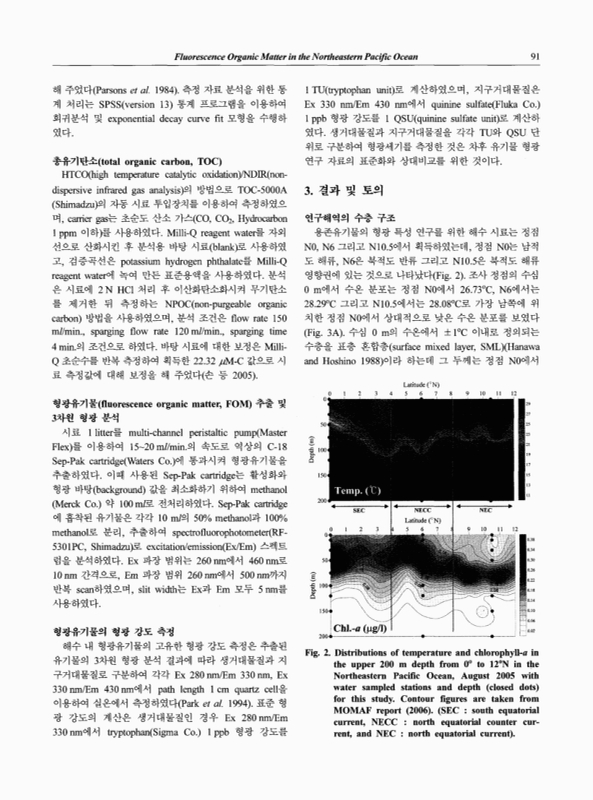
연구해역의 수층 구조 5

유기물 분포 특성 7

형광유기물 분포 결정 요인 10

4. 결론 11

사사 12

참고문헌 12

Appendix 13

초록보기


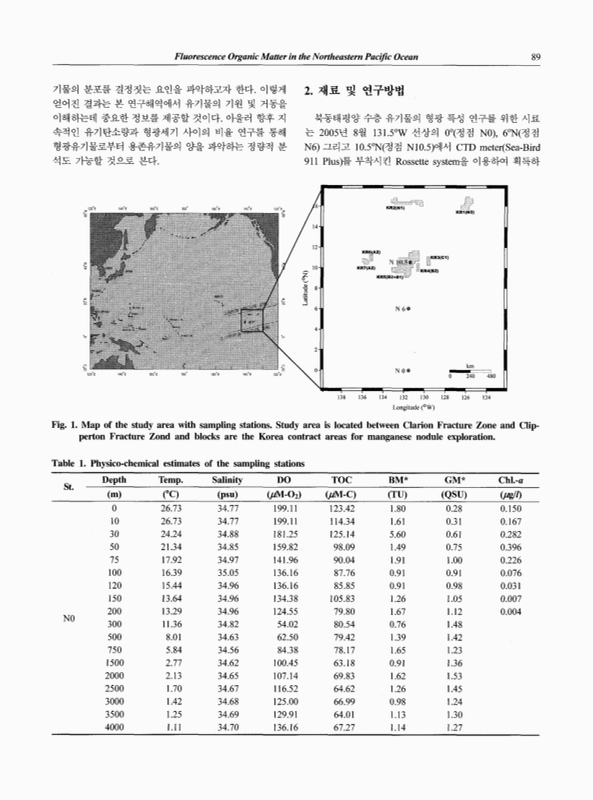
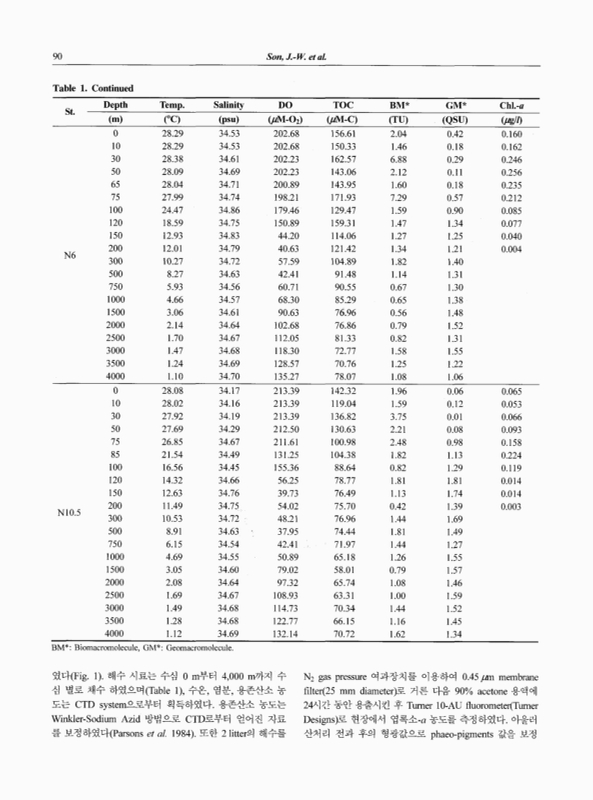
This study was conducted to understand the source and behavior of organic matter using the fluorescent technique (excitation-emission matrix) as a part of environmental monitoring program in the Korea manganese nodule mining site in the Northeastern Pacific Ocean. Water samples were collected at 0o, 6oN, and 10.5oN along 131.5oW in August 2005. The concentration of total organic carbon (TOC) ranged from 58.01 to 171.93 mM-C. The vertical distribution of TOC was characterized as higher in the surface layer and decreased with depth. At 6oN, depth-integrated (from surface to 200 m depth) TOC was 337.1 gC/m2, which was 1.4 times higher value than other stations. The exponential decay curve fit of vertical profile of TOC indicated that 59% of organic carbon produced by primary production in the surface layer could be decomposed by bacteria in the water column. Dissolved organic matter is generally classified into two distinctive groups based on their fluorescence characteristics using three-dimensional excitation/emission (Ex/Em) fluorescence mapping technique. One is known as biomacromolecule (BM; protein-like substance; showing max. at Ex 280/Em 330), mainly originated from biological metabolism. The other is geomacromolecule (GM; humic-like substance; showing max. at Ex 330/Em 430), mainly originated from microbial degradation processes. The concentration of BM and GM was from 0.42 to 7.29 TU (tryptophan unit) and from 0.06 to 1.81 QSU (quinine sulfate unit), respectively. The vertical distribution of BM was similar to that of TOC as high in the surface and decreased with depth. However, the vertical distribution of GM showed the reverse pattern of that of BM. From these results, it appeared that BM occupied a major part of TOC and was rapidly consumed by bacteria in the surface layer. GM was mainly transformed from BM by microbial processes and was a dominant component of TOC in the deep-sea layer.

권호기사

권호기사 목록 테이블로 기사명, 저자명, 페이지, 원문, 기사목차 순으로 되어있습니다.
기사명 저자명 페이지 원문 목차
북동태평야에서 형광 기법을 이용한 용존유기물의 기원 및 분포 손주원 ;손승규 ;주세종 ;김경홍 ;김웅서 ;박용철 pp.87-99

보기
인천 연안의 초가을 식물플랑크톤 대증식기에 식물플랑크톤과 종속영양 원생동물 군집의 단주기 변동 양은진 ;최중기 pp.101-112

보기
황해에서 저주파 음파의 해저손실 변동 김봉채 pp.113-121

보기
동해 후포주변 사질조하대에 서식하는 대형저서동물 군집의 분포 특성 백상규 ;강래선 ;전재옥 ;이재학 ;윤성규 pp.123-134

보기
한국 서해 경기만 연안역에서 수질환경의 시ㆍ공간적 변화 특성과 조절 요인 임동일 ;노경찬 ;장풍국 ;강선미 ;정회수 ;정래홍 ;이원찬 pp.135-153

보기
연안침식방지를 위한 관리체계 개선방안 이문숙 ;박성욱 pp.155-165

보기
국제법상 월경자원의 처리에 관한 고찰 :해저석유 및 가스자원을 중심으로 이용희 pp.167-185

보기
In vitro Peroxynitrite Scavenging Activity of Arctic Seaweed Extracts 서영완, Hee-Jung Lee, You Ah Kim, Jung-Im Lee, Ji Hee Kim, Hosung Chung, Sung-Ho Kang pp.187-191