
 대표어
대표어
 한국학술지인용색인(NRF)
권호기사보기
| 기사명 | 저자명 | 페이지 | 원문 | 기사목차 |
|---|
결과 내 검색
동의어 포함
목차
서해 태안 사질 퇴적물에 서식하는 중형저서동물 군집구조 연구 / 백진욱 ; 김기춘 ; 이승한 ; 이강현 ; 이동주 ; 채진호 ; 이원철 1
Abstract 1
1. 서론 2
2. 재료 및 방법 2
3. 결과 3
저서 환경 3
중형저서동물의 군집 조성 4
생물량 6
저서성 요각류의 분포 7
군집분석 7
4. 토의 10
사사 12
참고문헌 12
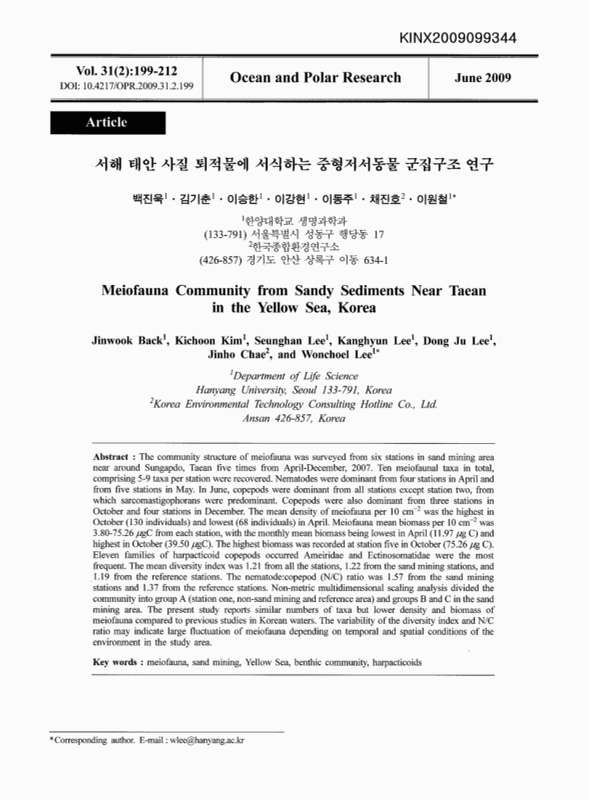
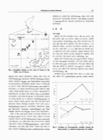
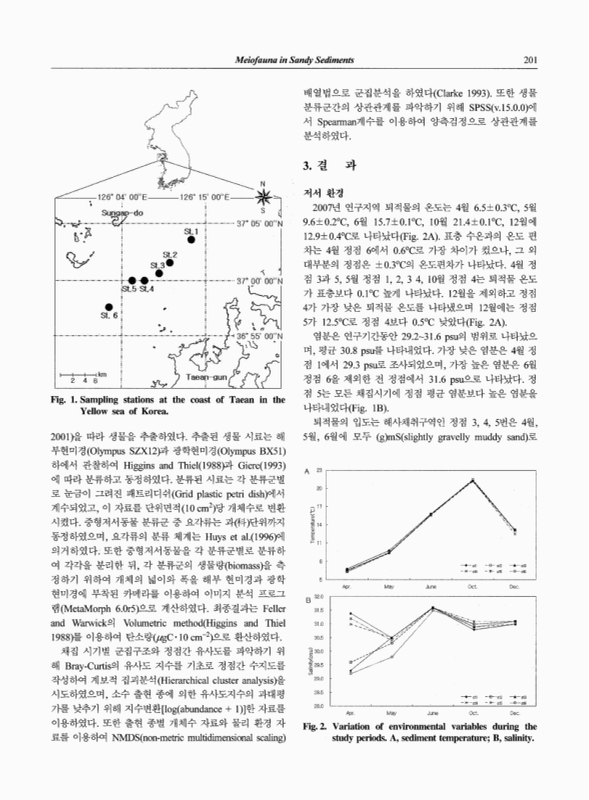
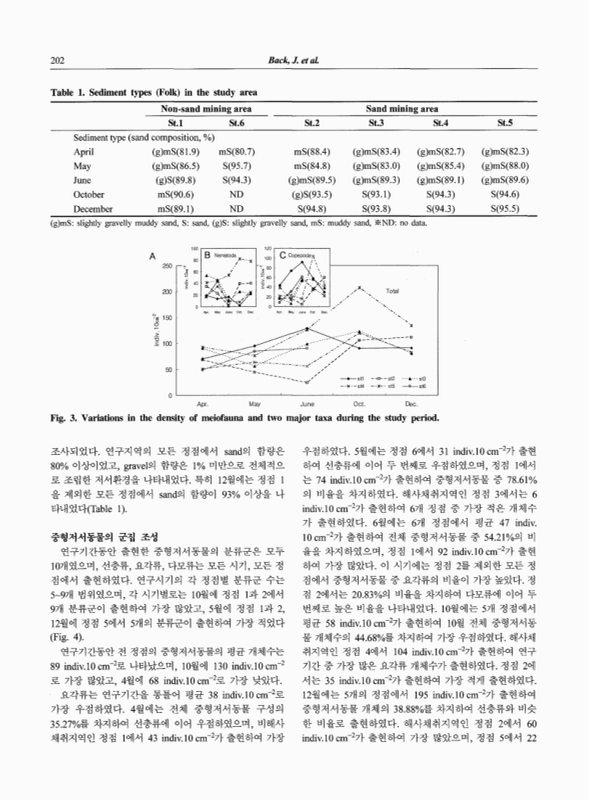
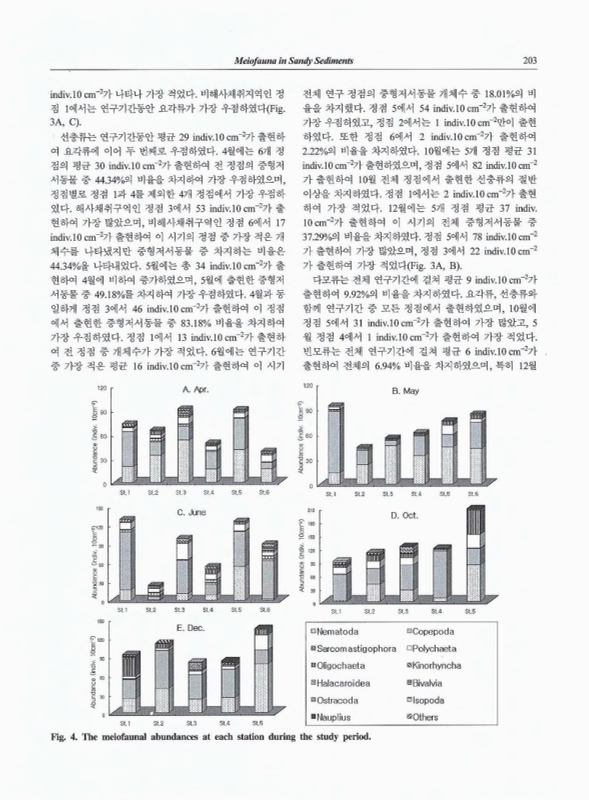
The community structure of meiofauna was surveyed from six stations in sand mining area near around Sungapdo, Taean five times from April-December, 2007. Ten meiofaunal taxa in total, comprising 5-9 taxa per station were recovered. Nematodes were dominant from four stations in April and from five stations in May. In June, copepods were dominant from all stations except station two, from which sarcomastigophorans were predominant. Copepods were also dominant from three stations in October and four stations in December. The mean density of meiofauna per 10 cm?2 was the highest in
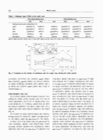
October (130 individuals) and lowest (68 individuals) in April. Meiofauna mean biomass per 10 cm?2 was 3.80-75.26 μgC from each station, with the monthly mean biomass being lowest in April (11.97 μg C) and highest in October (39.50 μgC). The highest biomass was recorded at station five in October (75.26 μg C). Eleven families of harpacticoid copepods occurred Ameiridae and Ectinosomatidae were the most frequent. The mean diversity index was 1.21 from all the stations, 1.22 from the sand mining stations, and
1.19 from the reference stations. The nematode:copepod (N/C) ratio was 1.57 from the sand mining stations and 1.37 from the reference stations. Non-metric multidimensional scaling analysis divided the community into group A (station one, non-sand mining and reference area) and groups B and C in the sand
mining area. The present study reports similar numbers of taxa but lower density and biomass of meiofauna compared to previous studies in Korean waters. The variability of the diversity index and N/C ratio may indicate large fluctuation of meiofauna depending on temporal and spatial conditions of the
environment in the study area.| 기사명 | 저자명 | 페이지 | 원문 | 목차 |
|---|---|---|---|---|
| 쉐퍼모형 응용을 통한 어로활동수준 검정 | 이광남 | pp.157-165 |
|
보기 |
| 심해저 망간각 개발의 경제성 평가 | 박세헌 ;양희철 | pp.167-176 |
|
보기 |
| Variability of surface water properties in the Japan/East Sea on different time scales | Vladimir Ponomarev ;Natalya Rudykh ;Elena Dmitrieva ;Hajime Ishida | pp.177-187 |
|
보기 |
| 안면도에서 대기 중 가스상 PAHs의 계절적 변동 | 안준건 ;임운혁 ;심원준 ;김기범 ;김승규 ;이희일 | pp.189-198 |
|
보기 |
| 서해 태안 사질 퇴적물에 서식하는 중형저서동물 군집구조 연구 | 백진욱 ;김기춘 ;이승한 ;이강현 ;이동주 ;채진호 ;이원철 | pp.199-212 |
|
보기 |
| 북극 스발바드 군도 콩스피요르드에서 채집한 해조류 추출물의 항산화 활성 | 이정임 ;김유아 ;공창숙 ;예성수 ;한태준 ;강성호 ;김지희 ;서영완 | pp.213-218 |
|
보기 |
| 동중국해 북부해역에서 부유물질과 입자성유기탄소의 분포 특성 및 연간 변화 | 김동선 ;최상화 ;김경희 ;김철호 | pp.219-229 |
|
보기 |
| 번호 | 참고문헌 | 국회도서관 소장유무 |
|---|---|---|
| 1 | 국립해양조사원 (2007) 연안수온통계. http://www.nori.go.kr/. Accessed 19 Dec 2008 | 미소장 |
| 2 | 국토해양부 (2007) 해양생태계 기본조사. 국립수산과학원, 861 p | 미소장 |
| 3 | 김동성, 민원기, 김웅서 (2002) 독도 주변 해역에 서식하는 중형저서생물. Ocean and Polar Res 24(4):419-427 | 미소장 |
| 4 | 김동성, 민원기, 이재학 (2004b) 대부도 방아머리 연안 퇴적 물에 서식하는 중형저서동물 군집변동. 환경생물 22(2): 308-320 | 미소장 |
| 5 | 김동성, 민원기, 제종길 (2004a) 강화도 여차리 니질갯벌과 사질갯벌에 서식하는 중형저서동물의 군집구조. 한국습 지학회지 6(1):43-55 | 미소장 |
| 6 | 김동성, 이재학 (2000) 시화호 오염수 방류에 따른 중형저서 생물의 군집변동. 환경생물 18(2):279-290 | 미소장 |
| 7 | 김동성, 이재학 (2001) 시화호 퇴적물에 서식하는 중형저서 동물의 군집구조에 관하여. 환경생물 19(2):159-171 | 미소장 |
| 8 | 김동성, 제종길, 신상호 (2000) 가막만의 중형저서생물을 활 용한 오염 모니터링. 한국수산학회지 33(4):217-225 | 미소장 |
| 9 | 김동성, 최진우, 강래선 (2001) 영광원전 주변 해역의 조간대 갯벌에 서식 중형저서생물. Ocean and Polar Res 23(2): 109-119 | 미소장 |
| 10 | 김동성, 최진우, 제종길, 이재학 (1998) 서해 대부도 갯벌에 서식하는 중형저서생물의 군집구조. 해양연구 20:81-87 | 미소장 |
| 11 | 김백운, 이상호, 양재삼 (2005) 서해 배타적경제수역(EEZ)내 해사채취구역의 지형변화. 한국지구과학회지 26(8):836- 843 | 미소장 |
| 12 | 민원기, 김동성, 최청일 (2003) 해초지와 주변 퇴적물에 서식 하는 중형저서동물 군집 특성비교. 한국해양학회지「바 다」 8(1):1-13 | 미소장 |
| 13 | 이재학, 고병설, 박흥식 (1997) 인천연안역 저서동물의 종조 성을 이용한 환경평가. 한국수산학회지 30(5):771-781 | 미소장 |
| 14 | 임현식, 홍재상 (1994) 해양저서동물군집을 이용한 진해만의 환경평가. 종별 개체수 분포특성에 따른 그래프분석기법 의 적용. 한국수산학회지 27(5):659-672 | 미소장 |
| 15 | 장학봉, Grigalunas T, 한경남 (2004) 바닷모래 채취의 경제, 환경적 통합평가 모형에 관한 연구(II). 한국해양수산개발 원, 116 p | 미소장 |
| 16 | 한국해양연구원 (1999) 연안어장 환경모니터링 기법 개발. 한국해양연구원, BSPG 98282-00-1196-3, 535 p | 미소장 |
| 17 | Albertelli G, CovazziHarriague A, Danovaro R, Fabiano M, Fraschetti D, Pusceddu A (1999) Differential reponses of bacteria, meiofauna and macrofauna in a shelf area (Ligurian Sea, NW Mediterranean): role of food availability. J Sea Res 42(1):11-26 | 미소장 |
| 18 | Amjad S, Gray JS (1983) Use of the nematodes copepod ratio as an index of organic pollution. Mar Pollut Bull 14(5):178-181 | 미소장 |
| 19 | Borja A, Franco J, Perez V (2000) A marine biotic index to establish the ecological quality of soft-bottom benthos within european estuarine and coastal environments. Mar Pollu Bull 40(12):1100-1114 | 미소장 |
| 20 | Brown AC, McLachan A (1990) Ecology of sandy shores. Elsevier, Amsterdam, 328 p | 미소장 |
| 21 | Brown CJ, Lambshead PJD, Smith CR, Hawkins LE, Farely R (2001) Phytodetritus and the abundance and biomass of abyssal nematodes in the central, equatorial Pacific. Deep-Sea Res I 48(2):555-565 | 미소장 |
| 22 | Burgess R (2001) An improved protocol for separation meiofauna from sediments using colloidal silica sols. Mar Ecol Prog Ser 214:161-165 | 미소장 |
| 23 | Byrnes MR, Hammer RM, Thibaut TD, Snyder DB (2004) Physical and biological effects of sand mining offshore Alabama, U.S.A. J Coast Res 20(1):6-24 | 미소장 |
| 24 | Chapman PM (1990) The sediment quality triad approach to determining pollution-induced degradation. Sci Total Environ 97-98:815-825 | 미소장 |
| 25 | Chapman PM, Long ER, Dexter RN (1987) Synoptic measures of sediment contamination, toxicity and infaunal community composition (the Sediment Quality Triad) in San Francisco Bay. Mar Ecol Prog Ser 37(1):75-96 | 미소장 |
| 26 | Clark RB (2001) Marine pollution. 5th ed. Oxford University Press, Oxford, 236 p | 미소장 |
| 27 | Clarke KR (1993) Non-parametric multivariate analyses of hanges in community structure. Aust J Ecol 18(1):117- 143 | 미소장 |
| 28 | Coull BC, Hicks GRF, Wells BJ (1981) Nematode/Copepod ratio for monitoring pollution: a rebuttal. Mar Pollu Bull 12(11):378-381 | 미소장 |
| 29 | Danovaro R, Croce ND, Fabiano MA, Papadopolou N, Smith C, Tselepides A (1995) Meiofauna of deep eastern Mediterranean Sea: distribution and abundance in elation to bacterial biomass, organic matter composition and other environmental factors. Prog Oceanogr 36:329- 341 | 미소장 |
| 30 | Danovaro, R, Dinet A, Duneveld G, Tselepides A (1999) Benthic response to particulate fluxes in different tropic environments: a comparison between the Gulf of Lions Catalan Sea (western Mediterranean) and the Cretan sea (eastern Mediterranean). Prog Oceanogr 44:287-312 | 미소장 |
| 31 | Danovaro R, Gambi A, Croce ND (2002) Meiofauna hotspot in the Atacama Trench, eastern south pacific ocean. Deep-Sea Res I 49(5):843-857 | 미소장 |
| 32 | Folk RL (1974) Petrology of sedimentary rocks. Henphills, Austin Texas, pp 15-28 | 미소장 |
| 33 | iere O (1993) Meiobenthology: the microscopic fauna in aquatic sediment. Springer-Verlag, Berlin, 328 p | 미소장 |
| 34 | Gooday AJ, Pfannkuche O, Lambshead PJD (1996) An apparent lack of response by metazoan meiofauna to phytodetritus deposition in the bathyal north-eastern Atlantic. J Mar Biol Assoc UK 76(2):297-310 | 미소장 |
| 35 | Grove SL, Probert PK, Berkenbusch K, Nodder SD (2006) Distribution of bathyal meiofauna in the regon of the Subtropical front, Chatham Rise, south-west Pacific. J Exp Mar Biol Ecol 330(1):342-355 | 미소장 |
| 36 | Hydrobiologia  |
미소장 |
| 37 | Heip C, Warwick RM, Carr MR, Herman PMJ, Huys R, Smol N, Van Holsbeke K (1988) Analysis of community attributes of the benthic meiofauna of frierfjord/ langesundfjord. Mar Ecol Prog Ser 46(1-3):171-180 | 미소장 |
| 38 | Higgins RP, Thiel H (1988) Introduction to the study of meiofauna. Smithsonian Institution Press. Washington DC, 488 p | 미소장 |
| 39 | Huys R, Gee JM, Moore CG, Hamond R (1996) Marine and brackish water harpacticoid copepods. Part 1. Synopses of the British Fauna (New Series). FSC Publications, London, 352 p | 미소장 |
| 40 | Kim DS, Je JG, Lee JH (2000) The community structure and spatial distribution of meiobenthos in the Kanghwa tidal flat, west coast of Korea. Ocean Res 22(1):15-23 | 미소장 |
| 41 | Maa JPY, Hobbs CH, Kim CH, Wei E (2004) Potential impacts of sand mining offshore of Maryland and Delaware: Part 1-Impacts on physical oceanographic processes. J Coast Res 20(1):44-60 | 미소장 |
| 42 | McIntyre AD (1977) Effects of pollution on inshore benthos. In: Coull BC (ed) Ecology of marine benthos. University of South Carolina Press, Columbia, pp 301-318 | 미소장 |
| 43 | Moore CG, Bett BJ (1989) The use of meiofauna in marine pollution impact assessment. Zool J Linn Soc 96(3): 263-280 | 미소장 |
| 44 | Odum EP (1971) Fundamentals of ecology. Saunders company, Philadelphia, 574 p | 미소장 |
| 45 | Pfannkuche O (1993) Benthic response to the sedimentation of particulate organic matter at the BIOTRANS station, 47oN, 22oW. Deep-Sea Res II 40(1-2):135-149 | 미소장 |
| 46 | Pfannkuche O, Sommer S, Kähler A (2000) Coupling between phytodetritus and the small-sized benthic biota in the deep Arbian Sea: analyses of biogenic sediment compounds. Deep-Sea Res II 47(14):2805-2833 | 미소장 |
| 47 | Raffaelli DG, Mason CF (1981) Pollution monitoring with meiofauna, using the ratio of nematodes to copepods. Mar Pollu Bull 12(5):158-163 | 미소장 |
| 48 | Rodriguez JG, Lastra M, Lopez J (2003) Meiofauna distribution along a gradient of sandy beaches in northern Spain. Estuar Coast Shelf Sci 58:63-69 | 미소장 |
| 49 | Santos PJP, Castel J, Souza-Santos LP (1996) Seasonal variability of meiofaunal abundance in the oligomesohaline area of the gironde estuary, France. Estuar Coast Shelf Sci 43(5):549-563 | 미소장 |
| 50 | Sandulli R, De Nicola M (1990) Pollution effects on the structure of meiofaunal communities in the bay of Naples. Mar Pollu Bull 21(3):144-153 | 미소장 |
| 51 | Schratzberger M, Dinmore TA, Jennings S (2002) Impacts of trawling on the diversity, biomass and structure of meiofauna assemblages. Mar Biol 140(1):83-93 | 미소장 |
| 52 | Shirayama Y (1983) Size structure of deep-sea meio- and macrobenthos in western Pacific. Int. Revue ges. Hydrobiologia 68(6):799-810 | 미소장 |
| 53 | Snelgrove PVR, Butman CA (1994) Animal-sediment relationships revisited: cause versus effect. Oceanogr. Mar Ann Rnn Rev 32:111-177 | 미소장 |
| 54 | Benthic re-colonization in post-dredging pits in the Puck Bay (Southern Baltic Sea) |
미소장 |
| 55 | Van Dalfsen JA, Essink E, Madsen HT, Birkund J, Romero J, Manzanera M (2000) Differential response of macrozoobenthos to marine sand extraction in the North Sea and the western Mediterranean. ICES. J Mar Sci 57(5):1439-1445 | 미소장 |
| 56 | Villora-Moreno S, CapaccioniAzzati R, GarciaCarrascosa AM (1991) Meiobenthos of sandy beaches from the Gulf of Valencia (Western Mediterranean): ecology of interstitial polychaetes. Bull Mar Sci 48(2):376-385 | 미소장 |
| 57 | Warwick RM (1981) The nematode/copepod ratio and its use in pollution ecology. Mar Pollu Bull 12(10):329-333 | 미소장 |
| 58 | Warwick RM (1988) The level of taxonomic discrimination required to detect pollution effects on marine benthic communities. Mar Pollu Bull 19(6):259-268 | 미소장 |
*표시는 필수 입력사항입니다.
| 전화번호 |
|---|
| 기사명 | 저자명 | 페이지 | 원문 | 기사목차 |
|---|
| 번호 | 발행일자 | 권호명 | 제본정보 | 자료실 | 원문 | 신청 페이지 |
|---|
도서위치안내: 정기간행물실(524호) / 서가번호: 국내18
2021년 이전 정기간행물은 온라인 신청(원문 구축 자료는 원문 이용)

우편복사 목록담기를 완료하였습니다.
*표시는 필수 입력사항입니다.
저장 되었습니다.
