
 대표어
대표어
 한국학술지인용색인(NRF)
권호기사보기
| 기사명 | 저자명 | 페이지 | 원문 | 기사목차 |
|---|
결과 내 검색
동의어 포함
목차
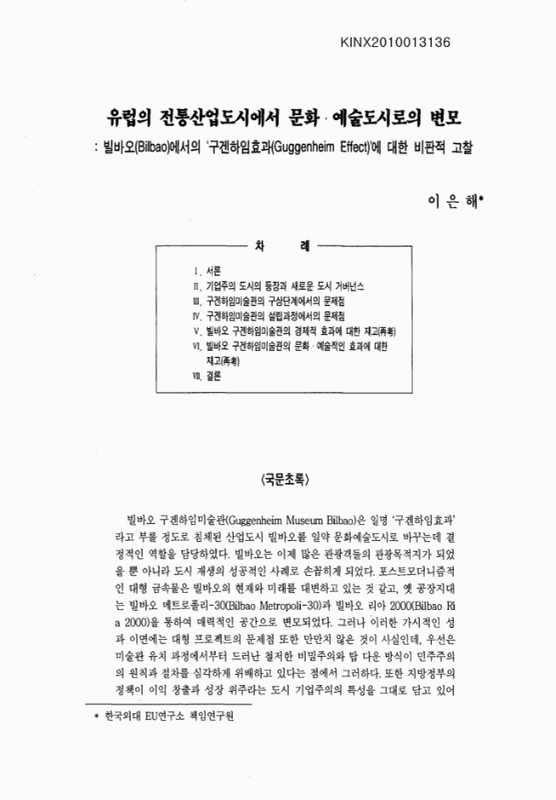
유럽의 전통산업도시에서 문화·예술도시로의 변모 : 빌바오(Bilbao)에서의 '구겐하임효과(Guggenheim Effect)'에 대한 비판적 고찰 / 이은해 1
〈국문초록〉 1
I. 서론 2
II. 기업주의 도시의 등장과 새로운 도시 거버넌스 3
III. 구겐하임미술관의 구상단계에서의 문제점 5
1. 침체기의 산업도시 빌바오 5
2. 도시재생에의 열망과 추진 6
IV. 구겐하임미술관의 설립과정에서의 문제점 9
1. 새로운 문화거점화의 필요성과 구겐하임재단과의 협상 9
2. 미래도시의 아이콘화 13
V. 빌바오 구겐하임미술관의 경제적 효과에 대한 재고(再考) 16
VI. 빌바오 구겐하임미술관의 문화·예술적인 효과에 대한 재고 (再考) 20
VII. 결론 23
〈참고문헌〉 26
〈Abstract〉 29
| 기사명 | 저자명 | 페이지 | 원문 | 목차 |
|---|---|---|---|---|
| <<바르셀로나 프로세스: 지중해를 위한 연합>> 형성 배경과 과정에 대한 연구 | 김응운 | pp.3-21 |
|
보기 |
| EU의 기술규정 통합과정 분석 :New & Global Approach를 중심으로 | 윤성욱 | pp.23-56 |
|
보기 |
| 대테러전쟁에 관한 초국가적 관점 :정책 설정자로서의 유럽의회 | 전혜원 | pp.57-85 |
|
보기 |
| 유럽 상행위법 통일화에 관한 분석 :대리상, 프랜차이즈와 독점판매대리계약을 중심으로 | 김은경 | pp.87-113 |
|
보기 |
| 유럽의 전통산업도시에서 문화·예술도시로의 변모 :빌바오(Bilbao)에서의 '구겐하임효과(Guggenheim Effect)'에 대한 비판적 고찰 | 이은해 | pp.115-144 |
|
보기 |
| 교차제도비교(cross-institutional comparison)를 통한 정부안정성 결정인자의 경험적 탐색 :의회분절도, 대정부 항거시위 및 신뢰의 등가성 평가 | 김지희 | pp.145-172 |
|
보기 |
| The European commission after the June 2009 elections :new appointment rules, old planning approaches? | Bernhard Seliger | pp.173-196 |
|
보기 |
| 초대 유럽집행위원회 의장 할슈타인의 유럽통합사상에 관한 소고(小考) | 이철용 | pp.197-215 |
|
보기 |
| 번호 | 참고문헌 | 국회도서관 소장유무 |
|---|---|---|
| 1 | 박종구, 나도삼, 공자원. “문화중심의 여가문화환경 조성이 지역환경과 지역가치에 미치는 영향.” 한국관광학회 . 제 61차 학술연구논문 발표대회 (2007). pp. 125-134. | 미소장 |
| 2 | 안소민, 장동련, 홍성민. “도시경관의 디자인 혁신이 도시브랜드 제고에 미치는 영향 에 관한 연구(Effect of Innovative Urban Landscape Design on City Brand Promotion).” 디자인학연구 . 제 72호. Vol. 20. No. 4. pp. 129-142. | 미소장 |
| 3 | 오병호. “도심산업 재생: 미래의 선택.” 한국도시행정학회 추계학술대회 (2007) pp. 29-43. | 미소장 |
| 4 | 임성훈, 이동언, “현대건축에서 ‘탈형식적 형태’의 의미와 그 가능성에 관한 연구-‘그 렉린’과 ‘베르나르 까슈’의 형태 개념을 중심으로.” 대한건축학회논문집 . 제 23권 제 4호 (2007). pp. 159-166. | 미소장 |
| 5 | 조명래. “문화경제화와 문화도시계획.” 도시연구 . 한국도시연구소. 제 6호 (2000년 12월). pp. 115-130. | 미소장 |
| 6 | 조희영, 김정곤. “빌바오 구겐하임 미술관을 통한 현대건축물의 아이콘화 요건 분 석.” 대한건축학회 . 학술발표대회 논문집 제 27권 제 1호 (2007),. pp. 343-346. | 미소장 |
| 7 | 기업주의 도시 전략의 논리와 한계 | 소장 |
| 8 | Alonso Aldama, Juan. “La construcción mítica del discurso nacionalista vasco.” Tí picos del Seminario. No. 20 (2008), pp. 113-128. | 미소장 |
| 9 | Arruti, Nerea. “Reflecting Basqueness: Bilbao from mausoleum to museum.” IJIS. Vol. 16. No. 3 (2004), pp. 167-175. | 미소장 |
| 10 | Asuaga, Carolina and Rausell, Pau. “Un anaĺisis de la gestiońde las instituciones culturales: el caso específico de los museos.” pp. 1-14. http://www. observatorio-iberoamericano. org. pdf (2009년 4월 18일 검색) | 미소장 |
| 11 | Art for Whose Sake? Modern Art Museums and their Role in Transforming Societies: The Case of the Guggenheim Bilbao  |
미소장 |
| 12 | Brooksbank Jones, Anny. “Challenging the seductions of the Bilbao Guggenheim.” IJIS. Vol. 16. No. 3 (2004), pp. 159-165. | 미소장 |
| 13 | Fuentes La Roche, Cristina. “Globalizacion de marcas culturales: ́ ¿neocolonialismo cultural o inversión en creatividad?” Area: Lengua y Cultura-ARI. No. 28 (2008), pp. 1-7. | 미소장 |
| 14 | García Canclini, Néstor. “El poder de las imágenes: Diez preguntas sobre su redistribución internacional.” Estudios visuales: Ensayo, teoría y crítica de la cultura visual y el arte contemporáneo. No. 4 (2007), pp. 35-56. | 미소장 |
| 15 | Gómez, María V. and González, Sara. “A Reply to Beatriz Plaza’s The Guggenheim-Bilbao Museum Effect.” Vol 25.4 (December 2001), pp. 898-900. | 미소장 |
| 16 | González Ceballos, Sara. “The role of the Guggenheim Museum in the development of urban entrepreneurial practices in Bilbao.” IJIS. Vol. 16. No. 3 (2004), pp. 177-186. | 미소장 |
| 17 | Gospodini, Aspa. “European cities and place-identity.” Discussion Paper Series, Vol. 8. No. 2. pp. 19-36. | 미소장 |
| 18 | L. Prytherch, David and Huntoon, Laura. “Entrepreneurial regionalist planning in a rescaled Spain: The cases of Bilbao and Valencia.” GeoJournal. Vol. 62 (2005), pp. 41-50. | 미소장 |
| 19 | López, Gentzane. “The Guggenheim effect: Positive transformations for the city of Bilbao?” Euroculture-IP, pp. 1-13. http://www.euriculturemaster.org/pdf/lopez.pdf. (2009년 4월 21일 검색) | 미소장 |
| 20 | Lorente, JoséIgnacio, Antolin, JoséEnrique and Fernández, JoséManuel. “The Image of Urban Regeneration Concerning Bilbao: The City as Narrative and Experience.” Zer english edition (2007), pp. 141-166. | 미소장 |
| 21 | Periañ́ez Cañadillas, Iñaki and Quintana Daza, Miguel Ángel. “Caso praćtico: La planificación estratégica del Museo Guggenheim Bilbao desde una perspectiva de Marketing.” Cuadernos de Gestioń. Vol. 9. No. 1 (2009), pp. 99-122. | 미소장 |
| 22 | The Return on Investment of the Guggenheim Museum Bilbao |
미소장 |
| 23 | ______________. “On some challenges and conditions for the Guggenheim Museum Bilbao to be an Effective Economic Re-activator.” Vol. 32. 2 (June 2008), pp. 506-517. | 미소장 |
| 24 | Rausell Köster, Pau. "Museos y excelencia en las ciudades." El XV Congreso nacional de la federación española de amigos de los museos (Marzo 2007), pp. 1-13. | 미소장 |
| 25 | Rodríguez, Arantxa. “Reinventar la ciudad: Milagros y espejismos de la revitalización urbana en Bilbao.” Lan Harremanak. Vol. 6 (2002-I), pp. 69-108. | 미소장 |
| 26 | Rodríguez, Arantxa and Martínez, Elena. “Del declive a la revitalización: Oportunidades y limites de las nuevas políticas urbanas en Bilbao.” Ciudad y territorio, Estudios Territoriales. Vol. 33. No.129 (2001), pp.441-459 | 미소장 |
| 27 | Rodríguez, Arantxa, Vicario, Lorenzo y Martínez, Elena. “Competitividad y urbanismo ‘creativo’ en la revitalización de Bilbao: entre la necesidad y la especulación.” http://www.ucm.es/info/ec/jec10/ponencias/812Rodriguezetal.pdf. (2009년 4월 30일 검색) | 미소장 |
| 28 | Vidarte, Juan Ignacio. “Nuevas Infraestructuras culturales como factor de renovación urbanística, revitalización social y regeneración econoḿica. El Museo Guggenheim Bilbao.” Museo: Revista de la Asociación Profesional de Museólogos de España. No. 12 (2007), pp. 99-108. | 미소장 |
| 29 | http://www.bilbaoarte.org/esp.index.htm. (2009년 4월 20일 검색) | 미소장 |
*표시는 필수 입력사항입니다.
| 전화번호 |
|---|
| 기사명 | 저자명 | 페이지 | 원문 | 기사목차 |
|---|
| 번호 | 발행일자 | 권호명 | 제본정보 | 자료실 | 원문 | 신청 페이지 |
|---|
도서위치안내: 정기간행물실(524호) / 서가번호: 대학02
2021년 이전 정기간행물은 온라인 신청(원문 구축 자료는 원문 이용)

우편복사 목록담기를 완료하였습니다.
*표시는 필수 입력사항입니다.
저장 되었습니다.
