
 대표어
대표어
 한국학술지인용색인(NRF)
권호기사보기
| 기사명 | 저자명 | 페이지 | 원문 | 기사목차 |
|---|
결과 내 검색
동의어 포함
목차
고려 중기 불교조각에 보이는 북방적 요소 / 정은우 1
I. 머리말 1
II. 고려 중기 불교조각의 특징과 대중교섭 2
III. 고려 중기 불교조각의 북방적 요소 4
1. 여래상 4
2. 보살상 9
3. 나한상의 제작과 유행 13
IV. 북방적 요소와 도상의 공유 16
1. 피건상과 요와의 관계 17
2. 화불과 연꽃을 든 보살상의 유입과 확산 19
V. 맺음말 22
참고문헌 24
국문초록 26
Abstract 27
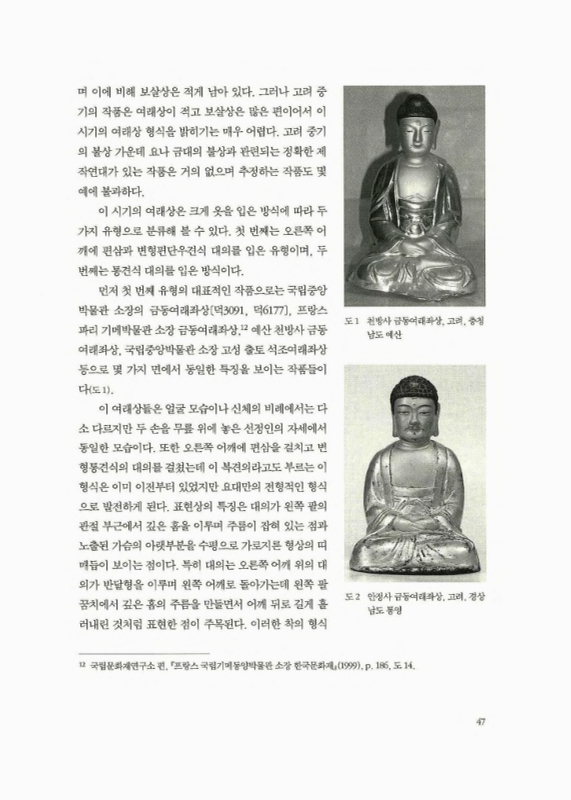
고려 중기의 불교조각은 요나 송 등 중국과의 관계 속에서 유입된 외래요소가 많이 반영된 점이 특
징이다. 통견이나 오른쪽 어깨에 편삼을 입은 착의 형식을 비롯하여 선정인을 한 여래좌상, 보관에
는 화불이 있으면서 손에 연꽃을 든 관음상, 백의관음, 두건을 쓴 나한상의 유행 등은 이 시기에 새
롭게 보이는 형식과 도상들이다. 이러한 특징들은 대체로 중국과 관련되며 요와 금으로 이어지는
북방적 요소와 밀접한 관련성을 보이는 점에서 주목된다.
이 가운데 머리에 두건을 쓴 작품과 보관에 화불이 있으면서 손에 연꽃 을 든 보살상은 여러 도
상과 서로 결합하면서 공유한 점에서 매우 흥미롭다. 먼저 두건을 쓴 작품을 살펴 보면, 고려시대에
는머리에두건을쓴나한상이유난히많이제작되었다.“ 第一賓度盧尊者靈通寺”라는명문이있는
청동빈도로나한상, 강화 출토 석조나한상, 동국대학교 박물관 소장 석조나한상 등은 모두 어깨까지
내려오는 짧은 두건을 쓴 나한상들인 점에서 공통된다. 머리에 쓴 두건은 나한상만이 아니라 보살
상에도 보인다. 강원도 지역의 한송사나 신복사, 월정사 등에 남아 있는 보살상들은 높은 보관 밑으
로 어깨까지 닿은 두건을 쓰고 있어 흥미롭다. 높은 보관 형식은 요대의 보살상들에도 보이는 특징
이며, 두건 또한 나한상이나 상경 지역의 보살상에 보이는 요대의 특징이다. 요대에는 북쪽에 위치
한 지리적 특성상 보온을 위해 두건의 착용이 유행하였으며, 황후의 예복에도 두건이 착용되는 듯
관례화되기도 하였다.
두건은 원래 10세기 돈황 지역을 중심으로 제작된 피건지장보살상에서 처음 보이는데 이러한
형식이 요로 전해졌을 가능성이 높다고 본다. 여기에 요대 황실에서부터 승려, 일반인들까지 폭넓
게 유행했던 두건 착용과 더불어 더욱 유행하면서 요대의 불상 작품에도 반영되었을 것이다. 따라
서 고려에서 유행한 두건을 쓴 나한상 도상은 요를 통해 전해졌을 가능성이 높다고 본다.
다음은 보관에 화불이 있으며 손에 연꽃을 든 보살상이다. 손에 연꽃을 든 보살상은 당대부터
있었지만 본격적인 유행은 요대이다. 요대에는 화불과 연꽃을 든 관음상과 보관에 탑이 있으면서
손에 군지(정병)를 든 미륵상이『팔대보살만다라경』에 의거하여 제작되었다. 고려시대에는 화불과
연꽃을 든 관음보살상이 작은 소금동불 형식으로 제작되었고 대형석불에도 보인다. 화불과 연꽃을
든 은진미륵으로 불리는 관촉사 석조보살입상이나 연꽃만을 든 중원 미륵대원의 석조여래입상 등
은 대표적인 사례로서 대형의 크기와 그 명칭에서 미륵으로 인식된다. 화불이 있는 미륵상은 통일
신라시대인 719년 감산사 석조미륵보살상에서 처음 보이는데 점차 연꽃을 든 불상과 결합되면서
고려만의 새로운 미륵도상이 성립되었을 것으로 생각된다.
Buddhist sculptures from the mid-Goryeo period widely reflect foreign influences,
particularly from the Chinese dynasties of Liao and Song. Popular stylistic details and
themes in Korean Buddhist sculptures such as the thin sheer silk robe worn by Buddha,
the style of dressing in which the robe drapes down from the right shoulder, leaving the
left shoulder bare, dhyana mudra assumed by seated Buddhas, Guanyin Bodhisattva
(Avalokitesvara) surmounted by a jewel crown sculpted with a transformation Buddha
(nirmanabuddha) and holding a blossomed lotus stem in one hand, Guanyin Bodhisattva
clad in a white robe and Arhats wearing a head scarf, were all introduced during this
period. These characteristics are closely related to the northern tradition of Buddhist
sculpture, developed in the Liao and Jin Dynasties.
Of these new features and themes, the head scarf and Bodhisattva wearing a jewel
crown with a transformation of Buddha and holding a lotus blossom are of particular
interest, insofar as they recur in many different combinations. In Goryeo, there was a large
production of Arhat sculptures in which the Arhat wears a head scarf. The bronze Pindola
Arhat, bearing the inscription“Jeil Bindoro jonja Yeongtongsa (Pindola, the first of the
sixteen Arhats, Yeongtongsa Temple)”, a stone Arhat discovered in Ganghwa and the stone Arhat in the collection of Dongguk University Museum are some of the examples in
which an Arhat wears a short head scarf whose bottom edge touches the shoulders. Head
scarves are not seen only in Arhat statues, but also in some Bodhisattva sculptures.
Bodhisattva statues in Gangwon-do temples such as Hansongsa, Sinboksa and
Woljeongsa, for example, also don a head scarf, worn under the jewel crown and reaching
down to the shoulders. These tall bejeweled head pieces are signature features associated
with Liao-dynasty Bodhisattvas. The head scarf, meanwhile, is the telltale feature of both
Arhat statues and Bodhisattvas from the Shangjing area, of the Liao Dynasty. Wearing a
head scarf was common among people of the Liao, a dynasty based in the northern
region, due to climactic reasons. Even formal outfits for the empress customarily included a
head scarf.
The head scarf made its first appearance in a Buddhist sculpture with Ksitigarbha
Bodhisattva statues, produced around the 10th century, in the Dunhuang region. The
popularity of the head scarf in Liao-dynasty Buddhist sculptures could very well have been
an influence from this region. The existing custom of wearing a head scarf, prevalent in all
segments of its society, from members of the imperial house to Buddhist monks and
ordinary people, also probably contributed to its integration into Buddhist sculptures.
Hence, it is more than likely that head-scarved Arhat statues of Goryeo were produced
under the influence of Liao-dynasty Buddhist sculpture.
As for statues of Bodhisattva wearing a jewel crown with a transformation Buddha and
holding a lotus blossom, whilst Bodhisattva sculptures of this type date back to the Tang
Dynasty, they became widely popular only once into the Liao Dynasty. During the Liao
Dynasty, statues of Avalokitesvara surmounted with a jewel crown with a transformation
Buddha, holding a lotus blossom in one hand, were popularly produced, along with
Maitreya carrying a kundika, in accordance with information on these deities found in the
Mandala Sutra of the Eight Great Bodhisattvas (Padaebosal Mandaragyeong). In Goryeo,
sculptures of Avalokitesvara with a transformation Buddha on the head piece and a lotus
blossom in one hand were mostly small gilt-bronze statues, although a few of them were
larger stone statues. The stone standing Bodhisattva of Gwanchoksa Temple, known also
as Eunjin Maitreya, with a transformation Buddha mounted on the head piece and a lotus blossom clutched in one hand, and the stone standing Buddha housed in the Jungwon
Maitreya Prayer Retreat, only carrying a lotus blossom without a headdress, are some of
examples dating from the Goryeo Dynasty. These Buddhist sculptures are identified as
representations of Maitreya Buddha due to their large size and name. The earliest example
of a Maitreya statue wearing a crown mounted with a transformation Buddha is the stone
Maitreya Bodhisattva of Gamsansa Temple from the Unified Silla period, created in 719.
These Maitreya statues gradually merged, over time, with statues holding a lotus blossom,
to eventually shape an image of Maitreya unique to Goryeo.| 기사명 | 저자명 | 페이지 | 원문 | 목차 |
|---|---|---|---|---|
| 海印寺 寺刊版 60券『華嚴經』變相版畵 考察 | 김자현 | pp.5-41 |
|
보기 |
| 고려 중기 불교조각에 보이는 북방적 요소 | 정은우 | pp.43-71 |
|
보기 |
| 조선시대 사천왕상 존명의 변화 | 임영애 | pp.73-104 |
|
보기 |
| 朝鮮時代 指頭畵에 대한 인식과 제작양상 :18-19세기를 중심으로 | 김지은 | pp.105-136 |
|
보기 |
| 華山館 李命基의 生涯와 繪畵世界 | 장인석 | pp.137-165 |
|
보기 |
| 玉溪詩社의 詩畵帖과 <<壽甲계帖>>에 나타난 閭巷모임의 서로 다른 이미지 | 김지연 | pp.167-195 |
|
보기 |
| 朝鮮 後期 白衣觀音壁畵의 圖像과 信仰 硏究 | 유경희 | pp.197-231 |
|
보기 |
| 把溪寺 16羅漢圖의 圖像的 檢討 | 장희정 | pp.233-269 |
|
보기 |
| 번호 | 참고문헌 | 국회도서관 소장유무 |
|---|---|---|
| 1 | 강호선, 「불교사상과신앙의사회적확대」, 『신앙과사상으로본불교전통의흐름』, 국사편찬위원회 2007. | 미소장 |
| 2 | 고려전기 강릉일대 석조보살상 연구 | 소장 |
| 3 | 契丹의 對西夏政策 1 | 소장 |
| 4 | 김위현『 契丹社會文化史論』, 경인문화사 2004. | 미소장 |
| 5 | A study on The Iconography of Nagapusna Flower Mudra of Maitreya Images in the Goryeo Period | 소장 |
| 6 | 장동익『 宋代麗史資料集錄』, 서울대학교출판부 2000. | 미소장 |
| 7 | 遼代 佛像彫刻의 硏究 Ⅱ | 소장 |
| 8 | 동국대학교박물관 소장 고려중기 금동보살입상 | 소장 |
| 9 | _______,『 고려후기불교조각연구』, 문예출판사 2007. | 미소장 |
| 10 | _______,「 개성관음굴석조보살상과송대외래요소의수용」,『 시각문화의전통과해석』, 예경 2007. | 미소장 |
| 11 | 고려시대 불교조각의 흐름과 특징 | 소장 |
| 12 | _______,「 고려중기와남송의보살상」,『 미술사자료와해석』, 일지사 2007. | 미소장 |
| 13 | 진홍섭『 한국의불상』, 일지사 1978 | 미소장 |
| 14 | 溟州地方의 高麗時代 石造菩薩像에 대한 研究  |
미소장 |
| 15 | _______,「 고려시대불교조각의대중관계」,『 고려미술의대외교섭』, 예경 2004 | 미소장 |
| 16 | 국립문화재연구소편『 프랑스국립기메동양박물관소장한국문화재』, 1999. | 미소장 |
| 17 | 『북한의문화재와문화유적IV』고려편 서울대학교출판부 2000. | 미소장 |
| 18 | 국립춘천박물관편『 구도와깨달음의성자나한』, 2003. | 미소장 |
| 19 | 『飛來峰造像』, 文物出版社, 2002. | 미소장 |
| 20 | 遼寧省文物考古硏究所編,『 朝陽北塔考古發掘與維修工程報告』, 文物出版社, 2007. | 미소장 |
| 21 | 朝陽市北塔博物館編,『 朝陽北塔』, 吉林攝影出版社, 2006. | 미소장 |
| 22 | 唐彩蘭編著,『 遼上京文物襭英』, 遠方出版社, 2005. | 미소장 |
| 23 | 李松主編,『 中國史觀彫塑全集』2, 黑龍江文物出版社, 2005. | 미소장 |
| 24 | 監修大英博物館,『 西域美術1 2 3』, 講談社, 1982. | 미소장 |
| 25 | Nancy Shatzman Steinhardt, Dragons of Silk, Flowers of Gold: Liao Textles at the Abegg-Stiftung,Orientations, 2007. | 미소장 |
*표시는 필수 입력사항입니다.
| 전화번호 |
|---|
| 기사명 | 저자명 | 페이지 | 원문 | 기사목차 |
|---|
| 번호 | 발행일자 | 권호명 | 제본정보 | 자료실 | 원문 | 신청 페이지 |
|---|
도서위치안내: 정기간행물실(524호) / 서가번호: 국내05
2021년 이전 정기간행물은 온라인 신청(원문 구축 자료는 원문 이용)

우편복사 목록담기를 완료하였습니다.
*표시는 필수 입력사항입니다.
저장 되었습니다.
