
 대표어
대표어
 한국학술지인용색인(NRF)
권호기사보기
| 기사명 | 저자명 | 페이지 | 원문 | 기사목차 |
|---|
결과 내 검색
동의어 포함
목차
박정희 정권기 외화수입정책 연구 : 1960년대를 중심으로 / 조준형 1
〈국문초록〉 1
1. 서론 2
2. 박정희 정권 이전 외화수입을 둘러싼 제 주체의 갈등양상 4
1) 1950년대 외화수입 방식의 변화 5
2) 입장세를 둘러싼 제작업계와 수입업계의 갈등 7
3) 외화수입쿼터제도의 출발: 국산영화에 대한 보상조치 10
4) 외화수입업계와 제작계 사이의 갈등의 고조: 1960~1961 12
3. 1960년대 '메이저 기업화' 정책과 외화수입 정책 17
1) 서구 모델의 관주도 이식과 민족주의: 1963년 1차 영화법 개정의 배경과 논리 17
2) 양적 통제에서 질적 통제로: 1960년대 외화수입쿼터 배정 기준의 변화 24
3) 시장 왜곡과 외화 우위의 시장관행 고착: 외화수입쿼터제도가 영화산업에 미친 영향 27
4) 국가의 대 시장 우위 확보를 위한 지렛대: 1960년대 외화수입정책의 기능과 의미 30
4. 결론 33
참고문헌 36
Abstract 39
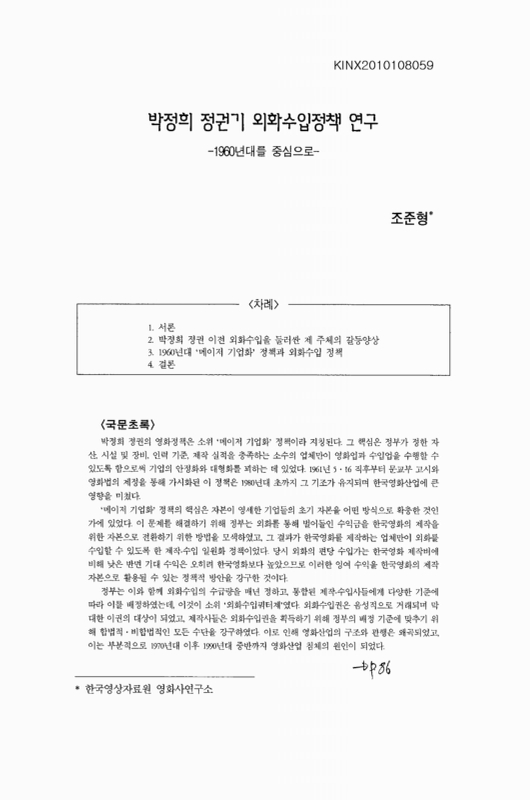
박정희 정권의 영화정책은 소위 ‘메이저 기업화’ 정책이라 지칭된다. 그 핵심은 정부가 정한 자산, 시설 및 장비, 인력 기준, 제작 실적을 충족하는 소수의 업체만이 영화업과 수입업을 수행할 수 있도록 함으로써 기업의 안정화와 대형화를 꾀하는 데 있었다. 1961년 5?16 직후부터 문교부 고시와 영화법의 제정을 통해 가시화된 이 정책은 1980년대 초까지 그 기조가 유지되며 한국영화산업에 큰 영향을 미쳤다.
‘메이저 기업화’ 정책의 핵심은 자본이 영세한 기업들의 초기 자본을 어떤 방식으로 확충한 것인가에 있었다. 이 문제를 해결하기 위해 정부는 외화를 통해 벌어들인 수익금을 한국영화의 제작을 위한 자본으로 전환하기 위한 방법을 모색하였고, 그 결과가 한국영화를 제작하는 업체만이 외화를 수입할 수 있도록 한 제작-수입 일원화 정책이었다. 당시 외화의 편당 수입가는 한국영화 제작비에 비해 낮은 반면 기대 수익은 오히려 한국영화보다 높았으므로 이러한 잉여 수익을 한국영화의 제작자본으로 활용될 수 있는 정책적 방안을 강구한 것이다.
정부는 이와 함께 외화수입의 수급량을 매년 정하고, 통합된 제작-수입사들에게 다양한 기준에 따라 이를 배정하였는데, 이것이 소위 ‘외화수입쿼터제’였다. 외화수입권은 음성적으로 거래되며 막대한 이권의 대상이 되었고, 제작사들은 외화수입권을 획득하기 위해 정부의 배정 기준에 맞추기 위해 합법적?비합법적인 모든 수단을 강구하였다. 이로 인해 영화산업의 구조와 관행은 왜곡되었고, 이는 부분적으로 1970년대 이후 1990년대 중반까지 영화산업 침체의 원인이 되었다.
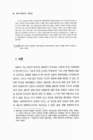
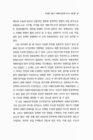
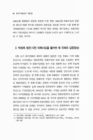
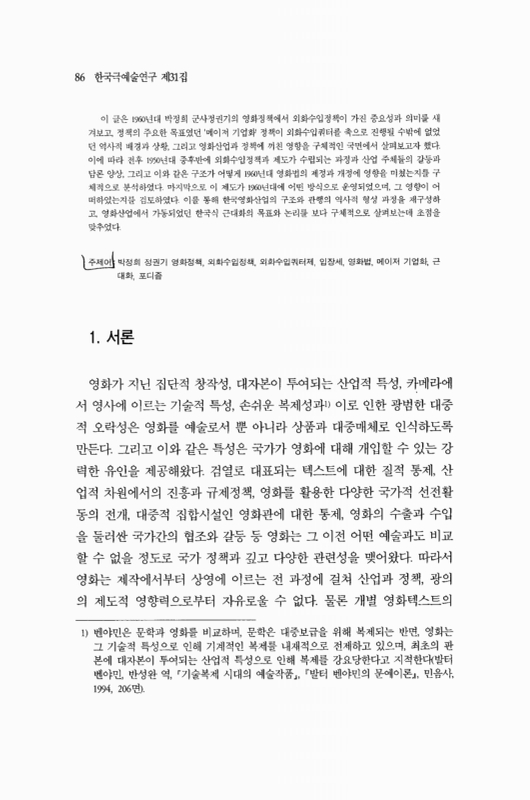
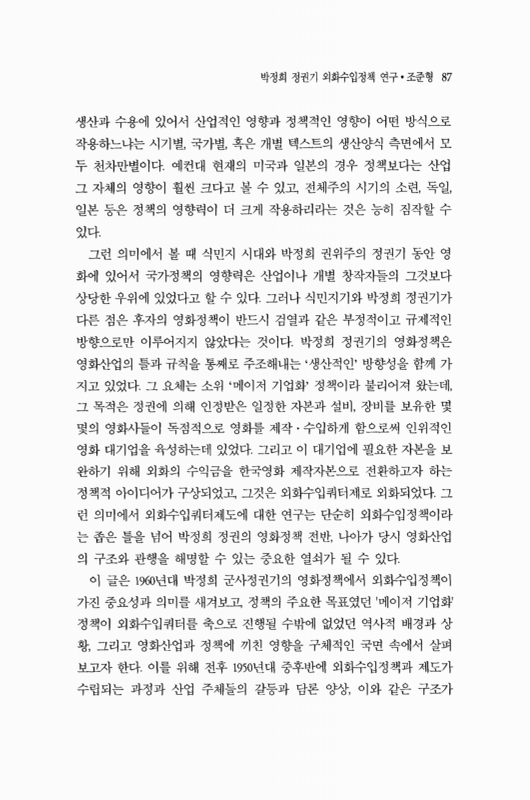
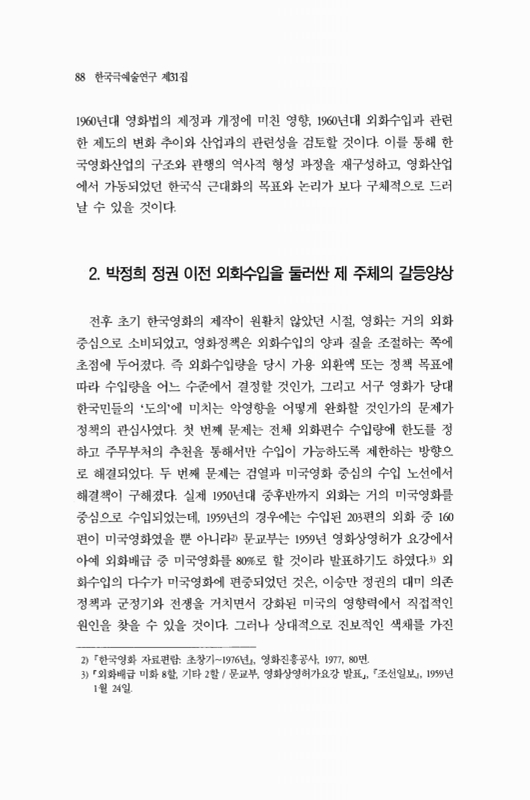
이 글은 1960년대 박정희 군사정권기의 영화정책에서 외화수입정책이 가진 중요성과 의미를 새겨보고, 정책의 주요한 목표였던 '메이저 기업화' 정책이 외화수입쿼터를 축으로 진행될 수밖에 없었던 역사적 배경과 상황, 그리고 영화산업과 정책에 끼친 영향을 구체적인 국면에서 살펴보고자 했다. 이에 따라 전후 1950년대 중후반에 외화수입정책과 제도가 수립되는 과정과 산업 주체들의 갈등과 담론 양상, 그리고 이와 같은 구조가 어떻게 1960년대 영화법의 제정과 개정에 영향을 미쳤는지를 구체적으로 분석하였다. 마지막으로 이 제도가 1960년대에 어떤 방식으로 운영되었으며, 그 영향이 어떠하였는지를 검토하였다. 이를 통해 한국영화산업의 구조와 관행의 역사적 형성 과정을 재구성하고, 영화산업에서 가동되었던 한국식 근대화의 목표와 논리를 보다 구체적으로 살펴보는데 초점을 맞추었다.
The film policy in Park Jung-Hee's regime is called 'Promoting Major-Company' policy. The essence of this policy was to expand and stabilize the business of big companies, which supposedly could meet the government standards on assets, facilities and equipments, manpower, and the production records, by providing them with exclusive rights for film productions and international trades. Being conceived in 1961 right after the 5?16 military coup, this policy was materialized through the notification of the Ministry of Education and the legislation of film laws. It afterwards continued its critical impact on Korean film industry until the early 1980's.
What we have to consider about this policy is how it secured the seed money for the companies with poor capital capacities: the government tried to encourage the profit arising from foreign film distribution to be invested in local film production. This was practically put into action with a production-import integration policy, which limited the right to import foreign films to local film production companies. At that time buying foreign films costed less than producing local films, while it made more profit in most cases. The government tried to use this profit generating from foreign film distribution for local film production.
Along this policy, the government also set a quota for foreign films and allocated it to the unified production-import companies. This was called 'Foreign Films Import Quota System.' Import rights for foreign films became the way to make profits and started to be traded under-the-table: production companies risked any possible measures, legal or illegal, to meet the government requirements for quota in order to acquire the import rights. This regretfully led the film industry to turn into perverted system and custom, which was one of the reasons that brought about the depression from 1970's to mid 1990's.
In this thesis I will look into the meaning and importance of the film import policy under Park's military regime in 1960's. I go over the environmental background where the 'major-corporate-friendly' policy had to be based primarily on the film import policy, along with its impact on the film industry in general. In addition, I will take an in-depth look on how the film import policy was formed in the late 1950's post-war time and what conflicts and social issues film industry had to face. Furthermore, I will bring an detailed analysis about what kind of impact this policy had on the legislation and the revision of film laws in the 1960's. The last, I'd like to see how this policy was run that time and what general impacts it had. With a close look at these issues, I will try to reconstruct the system and custom of recent Korean film history and see how the goals and theories of modernizing Korea was activated in the film industry.| 기사명 | 저자명 | 페이지 | 원문 | 목차 |
|---|---|---|---|---|
| 연극경연대회의 탄생과 제도화 :동아일보사 주최 연극경연대회의 정치경제학 | 권두현 | pp.11-56 |
|
보기 |
| 1970년대 연극평론가들의 부상과 정전화의 시작 | 김윤정 | pp.57-83 |
|
보기 |
| 박정희 정권기 외화수입정책 연구 :1960년대를 중심으로 | 조준형 | pp.85-124 |
|
보기 |
| 국어 교육과정에서 극 텍스트의 활용 양상 :중, 고등학교 교과서를 중심으로 | 김만수 | pp.125-161 |
|
보기 |
| '2007년 개정 국어과 교육과정'에 반영된 영화 관련 '매체언어'의 성취 기준에 관한 연구 :2010년 도입 7학년 국어과 교과서를 대상으로 | 김남석 | pp.163-209 |
|
보기 |
| 카프의 연극대중화론과 정치연극의 대중적 형식 | 이민영 | pp.211-238 |
|
보기 |
| 제국의 호명, 빗나간 응답 :영화 <지원병>과 '내선일체'의 문제 | 이덕기 | pp.239-270 |
|
보기 |
| 일본 게이주쓰(藝術)좌의 <읿코죠덴(春香女傳)> 공연(1941년)에 관한 연구 | 이홍이 | pp.271-296 |
|
보기 |
*표시는 필수 입력사항입니다.
| 전화번호 |
|---|
| 기사명 | 저자명 | 페이지 | 원문 | 기사목차 |
|---|
| 번호 | 발행일자 | 권호명 | 제본정보 | 자료실 | 원문 | 신청 페이지 |
|---|
도서위치안내: 정기간행물실(524호) / 서가번호: 국내12
2021년 이전 정기간행물은 온라인 신청(원문 구축 자료는 원문 이용)

우편복사 목록담기를 완료하였습니다.
*표시는 필수 입력사항입니다.
저장 되었습니다.
