
 대표어
대표어
 한국학술지인용색인(NRF)
권호기사보기
| 기사명 | 저자명 | 페이지 | 원문 | 기사목차 |
|---|
결과 내 검색
동의어 포함
목차
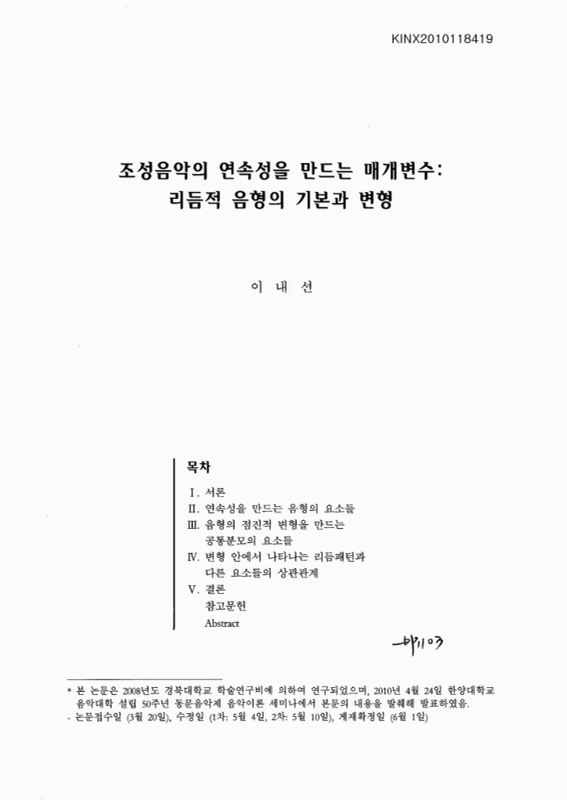
조성음악의 연속성을 만드는 매개변수 : 리듬적 음형의 기본과 변형 / 이내선 1
목차 1
I. 서론 2
II. 연속성을 만드는 음형의 요소들 3
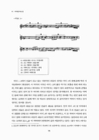
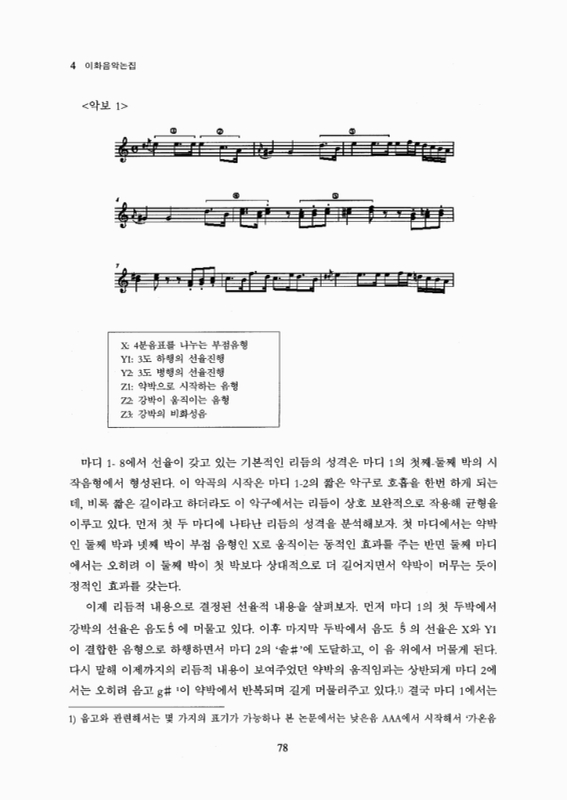
분석 1: 모차르트, 피아노소나타, K. 310, 제 1악장, 마디 1-8 3
III. 음형의 점진적인 변형을 만드는 공통분모의 요소들 8
분석 2: 베토벤, 피아노소나타, Op. 53, 제 1악장, 마디 23-35 8
분석 3: 베토벤, 피아노소나타, Op. 53, 제 1악장, 마디 140-156 12
분석 4: 베토벤, 피아노소나타, Op. 10, No. 3, 제 1악장, 마디 113-132 14
IV. 변형 안에서 나타나는 리듬패턴과 다른 요소들의 상관관계 17
분석 5: 베토벤, 피아노소나타, Op. 7, 제 1악장, 마디 111-132 17
분석 6: 베토벤, 현악4중주, Op. 95, 제 11번, 'Serioso', 제 2악장, 마디 94-114 20
분석 7: 베토벤, 현악4중주, Op. 95, 제 11번, 'Serioso', 제 3악장, 마디 78-110 22
분석 8: 베토벤, 현악4중주, Op. 95, 제 11번, 'Serioso', 제 4악장, 마디 1-18 25
V. 결론 28
참고문헌 29
Abstract 30
It is important to have an expectation on next event in the flow of time in music. To create ways to make a continuation in music is relevant to satisfy the expectation. Thus we need prepared devices for the next event to have the expectation and let it go understanding them to be satisfied. In the present paper, I examine what kinds of common features make the musical continuation in two different phrases or sections considering rhythmic elements as the devices. The common features are the devices to lead the continuation of the time and power to induce the expectation in the flow of time.
After the presentation of a figure, some of distinctive characters in the figure are selectively and partly sustained in the course of transformation of the figure, thus it is possible to trace the gradual processes to transform the figure in spite of the new figuration which is dissimilar to the basic one. This process is achieved during the time to make the continuation. In doing
so, we have the answer about the following question: “If there are no rhythmic divisions, what kinds of connections can we hear between two different rhythmic patterns?” In addition, it might be understandable that some characteristic contents of the theme to be followed is prepared in
advance to obtain “agree” based on the expectation in the flow of the time.| 기사명 | 저자명 | 페이지 | 원문 | 목차 |
|---|---|---|---|---|
| 15세기와 16세기의 비례 기호 이론에 관한 논의 | 박을미 | pp.1-34 |
|
보기 |
| 「아이네아스와 라비니아의 결혼」 :몬테베르디의 분실된 베니스 오페라 | 변혜련 | pp.35-51 |
|
보기 |
| 피에트로 메타스타지오의 오라토리오 「우리 주 예수 그리스도의 수난」연구 ,1 :대본과 작곡가들 | 이남재 | pp.53-74 |
|
보기 |
| 조성음악의 연속성을 만드는 매개변수 :리듬적 음형의 기본과 변형 | 이내선 | pp.75-104 |
|
보기 |
| 슈만의 피아노 작품에서 나타나는 다양한 병행구조 :피아노 소나타와 「C장조 환상곡」을 중심으로 | 안소영 | pp.105-128 |
|
보기 |
| Modes of phrygian functionality :♭2-centered progressions in chromatic music | JiHyun Woo | pp.129-157 |
|
보기 |
| 2009년 서울 지역 피아노 듀오 연주회 프로그램 분석을 통한 제언 | 유승지 | pp.159-190 |
|
보기 |
| 통합적 접근에 의한 제주 칠머리당 영등굿의 국악 교육적 적용 방안 | 박주만 | pp.191-219 |
|
보기 |
| 번호 | 참고문헌 | 국회도서관 소장유무 |
|---|---|---|
| 1 | 연장된 종지 안에 내재되어 있는 선율의 이중적 기능 : 종결과 연속 | 소장 |
| 2 | 이내선 ・최혜경. “화성적 종지의 반복을 유도하는 선율적 연속성.” 음악이론 연구 12 (2007), 49-69쪽. | 미소장 |
| 3 | Berry, Wallace. Form in Music. New Jersey: Prentice Hall, 1986. | 미소장 |
| 4 | Berry, Wallace. Structural Functions in Music. New Jersey: Prentice Hall, 1976. | 미소장 |
| 5 | Caplin, William E. Classical Form. New York: Oxford University Press, 1998. | 미소장 |
| 6 | Cooper, Grosvenor & Leonard B. Meyer. The Rhythmic Structure of Music. Chicago: The University of Chicago Press, 1960. | 미소장 |
| 7 | Hepokoski, James & Warren Darcy. Elements of Sonata Theory: Norms, Types, and Deformation Late-Eighteenth-Century. New York: Oxford University Press, 2006. | 미소장 |
| 8 | Kramer, Jonathan D. The Time of Music: New Meanings New Temporalities New Letening Strategies. New York: Schirmer Books, 1988. | 미소장 |
| 9 | Leichtentritt, Hugo. Musical Form. Cambridge: Harvard University Press, 1967. | 미소장 |
| 10 | Mathes, James. The Analysis of Musical Form. New Jersey: Prentice Hall, 2007. | 미소장 |
| 11 | Leonard B. Meyer. 김용진 역. 음악구조의 분석적 이해 . Explaining Music: Essays and Explorations. 서울: 세광출판사, 1990. | 미소장 |
| 12 | Roberts, Stella. 서경선 역. 대위법: 16세기 스타일 서울: 수문당, 2000. | 미소장 |
| 13 | Rosener, B. S. & Leonard B. Meyer. (1982),“Melodic Processes and the Perception of Music.” ,The Psychology of Music , pp. 317-341. | 미소장 |
| 14 | Rothgeb, John. “Design as a Key to Structure in Tonal Music.” Readings in Schenker Analysis and Other Approaches (New Haven: Yale University Press, 1977), pp. 72-93. | 미소장 |
| 15 | Rothstein, William. Phrase Rhythm in Tonal Music. New York: Schirmer Books, 1989. | 미소장 |
| 16 | Schoenberg, Arnold. Fundamentals of Musical Composition. Edited by Gerald Strang. London, Boston: Faber & Faber, 1967. | 미소장 |
| 17 | Sheer, Miriam. (1996),“Comparison of Dynamic Practices in Selected Piano Sonatas by Clementi and Beethoven.” ,Beethoven Forum, 5, pp. 86-101. | 미소장 |
| 18 | Stein, Leon. Structure & Style: The Study and Analysis of Musical Forms. Expanded Edition. Princeton, New Jersey: Summy-Birchared Music, 1979. | 미소장 |
*표시는 필수 입력사항입니다.
| 전화번호 |
|---|
| 기사명 | 저자명 | 페이지 | 원문 | 기사목차 |
|---|
| 번호 | 발행일자 | 권호명 | 제본정보 | 자료실 | 원문 | 신청 페이지 |
|---|
도서위치안내: 정기간행물실(524호) / 서가번호: 대학01
2021년 이전 정기간행물은 온라인 신청(원문 구축 자료는 원문 이용)

우편복사 목록담기를 완료하였습니다.
*표시는 필수 입력사항입니다.
저장 되었습니다.
