
 대표어
대표어
 한국학술지인용색인(NRF)
권호기사보기
| 기사명 | 저자명 | 페이지 | 원문 | 기사목차 |
|---|
결과 내 검색
동의어 포함
목차
행복지수와 사회문화적 분석 / 김윤태 1
[요약] 1
I. 머리말 2
II. 돈과 행복: '이스털린 역설'의 재검토 3
III. 행복지수의 다차원성과 사회문화적 분석 8
IV. 행복과 공공정책 14
V. 맺음말 18
[참고문헌] 20
[Abstract] 23
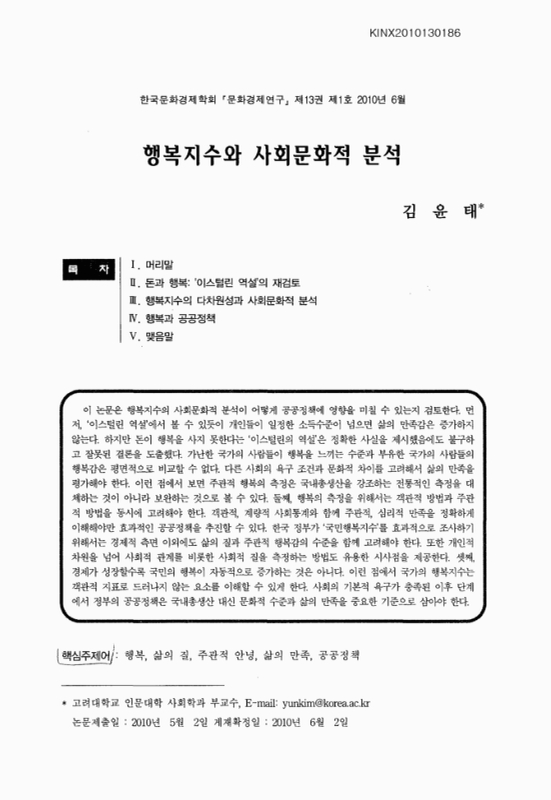
이 논문은 행복지수의 사회문화적 분석이 어떻게 공공정책에 영향을 미칠 수 있는지 검토한다. 먼
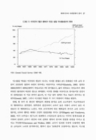
저, ‘이스털린 역설’에서 볼 수 있듯이 개인들이 일정한 소득수준이 넘으면 삶의 만족감은 증가하지
않는다. 하지만 돈이 행복을 사지 못한다는 ‘이스털린의 역설’은 정확한 사실을 제시했음에도 불구하
고 잘못된 결론을 도출했다. 가난한 국가의 사람들이 행복을 느끼는 수준과 부유한 국가의 사람들의
행복감은 평면적으로 비교할 수 없다. 다른 사회의 욕구 조건과 문화적 차이를 고려해서 삶의 만족을
평가해야 한다. 이런 점에서 보면 주관적 행복의 측정은 국내총생산을 강조하는 전통적인 측정을 대
체하는 것이 아니라 보완하는 것으로 볼 수 있다. 둘째, 행복의 측정을 위해서는 객관적 방법과 주관
적 방법을 동시에 고려해야 한다. 객관적, 계량적 사회통계와 함께 주관적, 심리적 만족을 정확하게
이해해야만 효과적인 공공정책을 추진할 수 있다. 한국 정부가 ‘국민행복지수’를 효과적으로 조사하기
위해서는 경제적 측면 이외에도 삶의 질과 주관적 행복감의 수준을 함께 고려해야 한다. 또한 개인적
차원을 넘어 사회적 관계를 비롯한 사회적 질을 측정하는 방법도 유용한 시사점을 제공한다. 셋째,
경제가 성장할수록 국민의 행복이 자동적으로 증가하는 것은 아니다. 이런 점에서 국가의 행복지수는
객관적 지표로 드러나지 않는 요소를 이해할 수 있게 한다. 사회의 기본적 욕구가 충족된 이후 단계
에서 정부의 공공정책은 국내총생산 대신 문화적 수준과 삶의 만족을 중요한 기준으로 삼아야 한다.
This article examines the impact of happiness index and social and cultural
analysis on public policy. First, as argued in the 'Easterlin Paradox', though
income per person rose steadily, average reported happiness showed no long-term trend. Easterlin found that happiness at a national level does not increase with wealth once basic needs are fulfilled. He used adequate data, but reached to wrong conclusion. It is difficult to compare happiness across nations with different levels of national income. As human satisfaction is the outcome of meeting a set of needs, life satisfaction should be evaluated on the basis of different needs. Thus, this paper argues that happiness measures could be used not as a replacement for more traditional measures but as a supplement. Second, we consider objective measures and subjective measures to evaluate happiness. It is necessary to understand quantitative statistics and psychological satisfaction for effective public policy-making. The government should consider quality of life and subjective well-being as well as economic income to measure 'national happiness index'. It is also useful to measure social quality as individual level of human happiness. Finally, as economic growth does not increase human happiness, the government should examine the level of subjective well-being in a society. The implication for government policy is that once basic needs are met, policy should focus not on economic growth or GDP, but rather on increasing life satisfaction or Gross Happiness Level.| 기사명 | 저자명 | 페이지 | 원문 | 목차 |
|---|---|---|---|---|
| Problematising the creative industries discourse :from a perspective of cultural market and creative labour | Hye-Kyung Lee | pp.3-21 |
|
보기 |
| 행복지수와 사회문화적 분석 | 김윤태 | pp.23-45 |
|
보기 |
| Mission flexibility for public cultural halls looking at the realities of baumol and bowen's theory and the activities of kansai's two major prefectural cultural halls | Emiko Hazama ;Hiroshi Yahagi | pp.47-84 |
|
보기 |
| 문화관광을 통한 창조적 농촌가꾸기 전략 :일본 나가노현(長野縣) 오부세마치(小布施町)를 중심으로 | 강신겸 | pp.85-106 |
|
보기 |
| 계획적 행위이론을 적용한 여가행동 영향요인 분석 | 이양수 | pp.107-131 |
|
보기 |
| 문화기업가의 기업가정신이 사업활동에 영향을 미치는 결정요인 | 구문모 ;이현숙 | pp.133-160 |
|
보기 |
| 인터랙티브 스토리텔링을 통한 콘텐츠 이용 활성화 사례 연구 :서태지 8집의 '미싱태지(Missing Taiji)' 프로젝트를 중심으로 | 이선미 ;유승호 | pp.161-192 |
|
보기 |
| TV광고에 표현된 애니메이션 캐릭터 분석 | 최은섭 | pp.193-214 |
|
보기 |
| 문화기술의 정책담론 형성과 제도화 과정에 관한 연구 | 김성일 | pp.215-246 |
|
보기 |
| 사회화 기관으로서의 인터넷과 소비자사회화 | 박수호 ;민경배 | pp.247-269 |
|
보기 |
| 번호 | 참고문헌 | 국회도서관 소장유무 |
|---|---|---|
| 1 | 김경동 외. 2006. 세계 주요도시 행복도 및 경쟁력 분석 . 서울복지재단. | 미소장 |
| 2 | Explorations on the happy life of Koreans on the bases of their social structural variables | 소장 |
| 3 | 김승권 외, 2008. 한국인의 행복결정요인과 행복지수에 관한 연구 , 한국보건사회연구원. | 미소장 |
| 4 | A Study of Sociological Classics onLogic of ‘Happiness’ in Modern Society | 소장 |
| 5 | 이정전. 2008. 우리는 행복한가 , 한길사. | 미소장 |
| 6 | 이재열, 2007. ‘한국사회의 질(social quality)의 변화와 전망’, 정운찬·조흥식 편, 외환위기 10년 한국사회 얼마나 달라졌나? , 서울대출판부. | 미소장 |
| 7 | 황명진·심수진. 2008. ‘한국의 행복지수 지속가능’, 『조사연구』 9권 3호, pp. 93-117. | 미소장 |
| 8 | Bentham, Jeremy. 1789. An Introduction to the Principles and Morals of Legislation etc. London: T. Payne & Son. | 미소장 |
| 9 | Blanchflower, David G. and Andrew J Oswald, 2005. 'Happiness and the Human Development Index: The Paradox of Australia' Australian Economic Review, Vol. 33. No. 3. pp. 307-318. | 미소장 |
| 10 | Bruno S. Frey and Alois Stutzer. 2000. 'Happiness, Economy and Institutions', Economic Journal 110(466, October), pp. 918-938. | 미소장 |
| 11 | Campbell, A., P. E. Converse and W. L. Rodgers. 1976. The Quality of Life: Perceptions, Evaluations, and Satsifactions. New York: Russell Sage Foundation. | 미소장 |
| 12 | Factors predicting the subjective well-being of nations.  |
미소장 |
| 13 | Diener, Ed. and Shigehiro Oishi, 2006. "Are Scandinavians Happier than Asians? Issues in Comparing Nations on Subjective Well-Being," in Politics and Economics of Asia, ed. F. Columbus. Hauppauge, NY: Nova Science. | 미소장 |
| 14 | Easterlin, Richard. 1974. Does economic growth improve the human lot? Some empirical evidence. In David, R. and Reder, R. Eds. Nations and Households in Economic Growth: Essays in Honor of Moses Abramovitz. New York: Academic Press. | 미소장 |
| 15 | Easterlin, Richard. 1995. Will raising the incomes of all increase the happiness of all? Journal of Economic Behavior and Organization, vol. 27, pp. 35-47. | 미소장 |
| 16 | Frank, Robert. 1999. Luxury Fever, The Free Press. | 미소장 |
| 17 | Friedman, Benjamin M. 2005. The Moral Consequences of Economic Growth. New York: Alfred A. Knopf. | 미소장 |
| 18 | Wealth and Happiness Revisited – Growing National Income Does Go with Greater Happiness |
미소장 |
| 19 | Hofstede, Geert. 2001. Culture's Consequences: comparing values, behaviors, institutions, and organizations across nations (2nd ed.). Thousand Oaks, CA: SAGE Publications. | 미소장 |
| 20 | Inglehart, R. 1990. Cultural Shift in Advanced Industrial Society. Princeton University Press. | 미소장 |
| 21 | Inglehart, R. and Klingemann, H-D. 2000. 'Genes, culture, democracy and happiness', in Diener, E. and Suh, E.M. eds. Culture and Subjective Well-being. Cambridge MA: MIT Press. | 미소장 |
| 22 | Kahneman, D., Diener, E., & Schwarz, N., eds. 1999. Wellbeing: The foundations of hedonic psychology. Russell Sage Foundation, New York. | 미소장 |
| 23 | Lane, R.E. 2001. The Loss of Happiness in Market Economies. New Haven: Yale University Press. | 미소장 |
| 24 | Layard, Richard. 2005. Happiness: Lessons from a new science, Penguin Press, New York. | 미소장 |
| 25 | Maesen, L. and A. Walker. 2002. European Foundation on Social Quality: Theoretical state of affairs. Amsterdam. EFSQ. | 미소장 |
| 26 | Maslow, A. H. 1970. Motivation and Personality. New York: Harper & Row. | 미소장 |
| 27 | McMahon, Darrin. 2005. Happiness: A History. Atlantic Monthly Press. | 미소장 |
| 28 | Organisation for Economic Cooperation and Development(OECD). 2006, Economic Policy Reforms: Going for Growth 2006. OECD Publishing, Paris. | 미소장 |
| 29 | Happiness and Economic Performance |
미소장 |
| 30 | Putnam, Robert. 2000. Bowling Alone: The Collapse and Revival of American Community. Simon and Shuster. | 미소장 |
| 31 | Seligman, M.E.P. 2006. Positive Psychology, Positive Prevention, and Positive Therapy. pp 3-12 in The Handbook of Positive Psychology. eds. Snyder, C. R., Lopez, S. J. Oxford: Oxford University Press Ltd. | 미소장 |
| 32 | Sen, Armatya. 1999. Development as Freedom, Oxford University Press, Oxford. | 미소장 |
| 33 | Economic Growth and Subjective Well-Being: Reassessing the Easterlin Paradox |
미소장 |
| 34 | Stiglitz, Joseph E., Amartya Sen and Jean Paul Fitoussi. 2009. Report by the Commission on the Measurement of Economic Performance and Social Progress. www.stiglitz-sen-fitoussi.fr/documents/rapport_anglais.pdf | 미소장 |
| 35 | Strategy Unit. 2003. Life Satisfaction: the state of knowledge and implications for Government. London: Cabinet Office. | 미소장 |
| 36 | Preferences over Inflation and Unemployment: Evidence from Surveys of Happiness |
미소장 |
| 37 | Veenhoven, Ruut. 1984. Conditions of Happiness. Dordrecht. Holland: Reidel. | 미소장 |
| 38 | Veenhoven, Ruut. 1989. 'National Wealth and Individual Happiness', in Grunert, K & Oelander, F. eds., Understanding Economic Behaviour, Kluwer Academic Publishers, Dordrecht, pp 9-32. | 미소장 |
| 39 | Why Social Policy Needs Subjective Indicators |
미소장 |
| 40 | Veenhoven, Ruut. 2007. "Measure of Gross National Happiness", Presentation at OECD World Forum on Statistics, Knowledge and Policy, Turkey, June 27-30. | 미소장 |
| 41 | Wilkinson, Richard and Kate Pickett. 2009. The Spirit Level: Why More Equal Societies Almost Do Better. Allen Lane. | 미소장 |
*표시는 필수 입력사항입니다.
| 전화번호 |
|---|
| 기사명 | 저자명 | 페이지 | 원문 | 기사목차 |
|---|
| 번호 | 발행일자 | 권호명 | 제본정보 | 자료실 | 원문 | 신청 페이지 |
|---|
도서위치안내: 정기간행물실(524호) / 서가번호: 국내04
2021년 이전 정기간행물은 온라인 신청(원문 구축 자료는 원문 이용)

우편복사 목록담기를 완료하였습니다.
*표시는 필수 입력사항입니다.
저장 되었습니다.
