
 대표어
대표어
 한국학술지인용색인(NRF)
권호기사보기
| 기사명 | 저자명 | 페이지 | 원문 | 기사목차 |
|---|
결과 내 검색
동의어 포함
목차
화이트칼라 근로자의 근로시간 관리규범에 대한 새로운 모색 : 미국 White-Collar Exemption 제도를 중심으로 / 신은종 1
[요약] 1
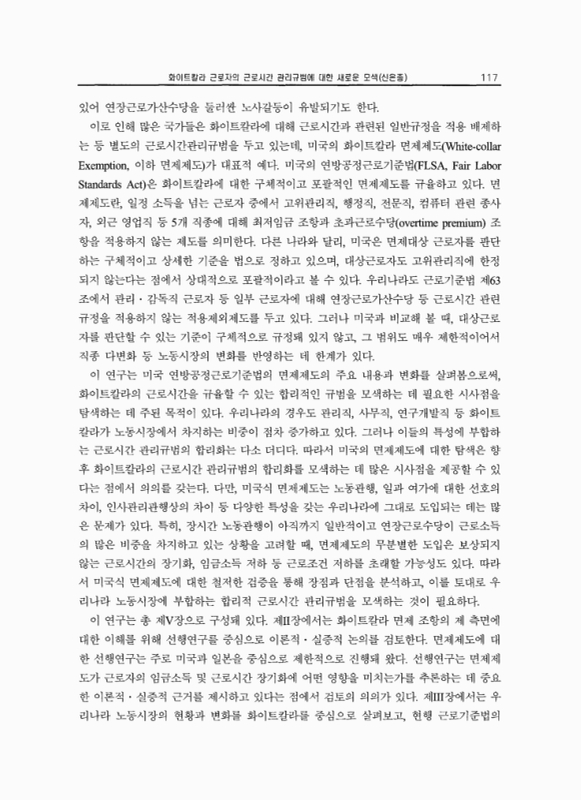
I. 문제 제기 2
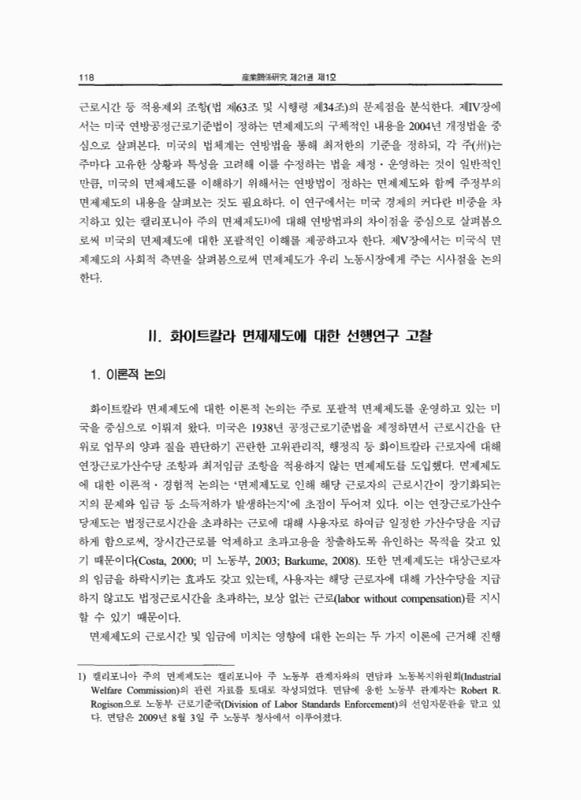
II. 화이트칼라 면제제도에 대한 선행연구 고찰 4
1. 이론적 논의 4
2. 경험적 연구 5
III. 우리나라의 화이트칼라 근로시간 관리규범 9
1. 화이트칼라 규모와 특성 9
2. 화이트칼라 근로시간 관리규범의 문제점 10
3. 재량근로시간제의 주요 내용과 한계 13
IV. 미국의 화이트칼라 면제제도 15
1. 도입 배경 15
2. 주요 변화 16
3. 주요 내용: 2004년 개정법을 중심으로 17
4. 주 법에 의한 보완: 캘리포니아 주 사례 27
V. 화이트칼라 면제제도의 사회적 측면 29
1. 근로조건에 미치는 영향에 대한 선행연구의 해석 29
2. 임금에 미치는 영향 30
3. 근로시간에 미치는 영향 31
4. 적용범위 합리화의 문제 31
5. 근로자 건강과 관련된 문제 32
VI. 결론 33
참고문헌 34
Abstract 36
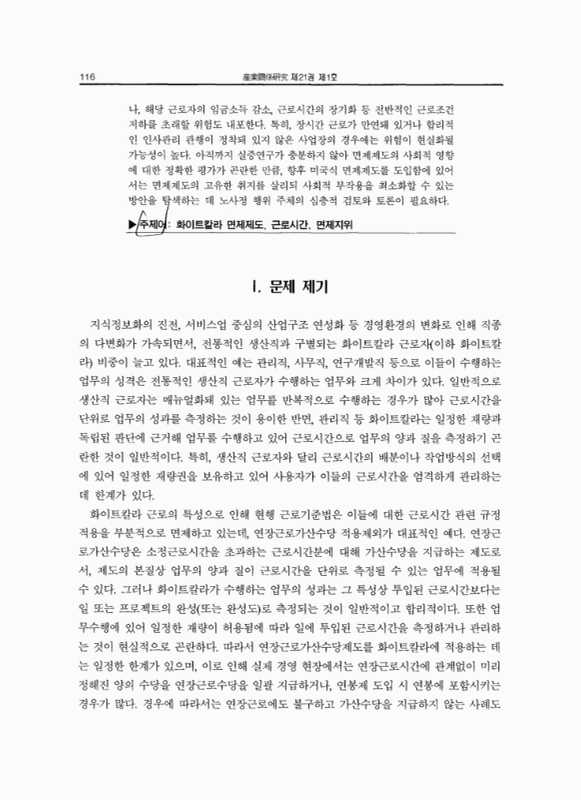
이 연구는 미국의 화이트칼라 면제제도(white-collar exemption)의 주요 내
용을 비판적으로 검토하고 근로조건에 미치는 영향을 분석함으로써, 우리나
라 화이트칼라 근로자의 근로시간 관리규범을 합리화하는 데 필요한 시사점
을 탐색하는 데 주된 초점이 있다. 산업구조 변화로 인해 직종 다변화가 가속
되면서 전통적인 생산직과 구별되는 화이트칼라 근로자의 비중이 증가하고
있다. 화이트칼라는 업무수행에 있어 근로시간의 배분, 작업방식의 선택 등에
있어 일정한 재량권을 보유하고 있으며, 화이트칼라 업무의 양과 질은 근로
시간을 단위로 측정되고 평가되는 데 현실적인 한계가 있다.
이러한 화이트칼라의 속성을 고려해 미국은 1938년 공정근로기준법 제정
시 화이트칼라 면제제도를 도입해 운영해 왔으며, 2004년에는 소득기준 조정
등 법개정이 대폭 이루어졌다. 미국식 면제제도는 최저임금 조항과 연장근로
가산수당조항을 적용하지 않는 화이트칼라의 범주에 고위관리자, 행정직 근
로자, 전문가 등 5개 군을 특정하고 있으며, 소득 기준과 함께 면제지위를 획
득하는 데 필요한 구체적인 업무 기준을 규율하고 있다. 우리나라의 경우도
현행 근로기준법은 미국과 유사한 면제제도를 규율하고 있으나, 그 범위가
제한적이고 면제대상 여부를 판단하는 데 필요한 구체적인 기준도 결여하고
있어 이를 둘러싼 불확실성을 가중시킬 뿐만 아니라 남용의 우려도 존재한다.
미국식 면제제도는 화이트칼라의 속성에 부합하는 근로시간 관리규범을
체계화함으로써 근로시간 규율 체제의 합리성을 제고할 수 있는 장점이 있으나, 해당 근로자의 임금소득 감소, 근로시간의 장기화 등 전반적인 근로조건
저하를 초래할 위험도 내포한다. 특히, 장시간 근로가 만연돼 있거나 합리적
인 인사관리 관행이 정착돼 있지 않은 사업장의 경우에는 위험이 현실화될
가능성이 높다. 아직까지 실증연구가 충분하지 않아 면제제도의 사회적 영향
에 대한 정확한 평가가 곤란한 만큼, 향후 미국식 면제제도를 도입함에 있어
서는 면제제도의 고유한 취지를 살리되 사회적 부작용을 최소화할 수 있는
방안을 탐색하는 데 노사정 행위 주체의 심층적 검토와 토론이 필요하다.
This study is aimed at examining the white-collar exemption of the Fair Labor Standard
Act(FLSA) in the United State in order to explore an alternative way to regulate the work
hour of the Korean white-collar workers. In recent time the Korean labor market has
witnessed the increase of white-collar workers whose work performance cannot easily
estimated in the frame of working time. Even if the Korean Labor Standard Acts(KLSA)
allows the employer to exclude some kinds of white-collar workers including executive
managers and superintendents from the provision of mandatory overtime premium, it lacks
the details of legal standards to judge who gains the exempt status. Consequently, it is likely
that there be conflicts between labor and management over as to whether to be exempted
or not reinforing uncertainty at the workplace. In contrast, the FLSA involves concrete
details of exempt status as well as relatively broad coverages including executive,
managerial, and professional employees. It is also featured by the provision regulating both
duty standards and income standards which the white-collar should meet for their exempt
status.
Despite the white-collar exemption provides a sound ground for work hour regulation for
the white-collar workers, it may produce undesirable social outcomes such as long hours
worked without compensation and the decrease in hourly wages. Limited prior research is
not enough to convince the association between the white-collar exemption and core terms
of employment, and thus we have to take a careful look into the newly introduction of the
American exemption system in the future. In particular, we need to make every efforts through social dialogues among the industrial actors involving labor, business and the
government to search for an alternative way satisfying the need for constructing a new norm
to manage work hours of white-collars with minimization of social risks.| 기사명 | 저자명 | 페이지 | 원문 | 목차 |
|---|---|---|---|---|
| 통일적인 종업원대표시스템 정립을 위한 소고 | 이철수 | pp.1-31 |
|
보기 |
| 고성과작업시스템의 측정지표에 대한 탐색적 연구 | 박준성 | pp.33-63 |
|
보기 |
| 서비스노동 유형별 직무스트레스의 발생메커니즘에 관한 연구 | 이병훈 ,이상호 | pp.65-93 |
|
보기 |
| 고충처리의 ADR식 해결방법 | 원창희 | pp.95-114 |
|
보기 |
| 화이트칼라 근로자의 근로시간 관리규범에 대한 새로운 모색 :미국 White-Collar Exemption 제도를 중심으로 | 신은종 | pp.115-151 |
|
보기 |
| 한국에는 Glass Ceiling 효과가 존재하는 가? :노동조합과 분위별 성별 임금격차 분석을 중심으로 | 정한나 ,이태 | pp.153-183 |
|
보기 |
| Gender, globalization and small scale business in Nigeria | Ayobade, Adebowale | pp.185-210 |
|
보기 |
| 번호 | 참고문헌 | 국회도서관 소장유무 |
|---|---|---|
| 1 | 김유성(2005), 노동법 I-개별적 근로관계법 , 서울: 박영사. | 미소장 |
| 2 | 김재훈(2006), 근로시간․휴일․휴가제도의 합리적 운용을 위한 제도개선방안 연구 , 노동부 연구용역보고서, 과천: 노동부. | 미소장 |
| 3 | Legal Research on Special Provisions as to Working and Recess Hours | 소장 |
| 4 | 김형배(2005), 노동법 , 서울: 박영사. | 미소장 |
| 5 | 노동부(2007), “임금구조실태조사 원자료,” 과천: 노동부. | 미소장 |
| 6 | 노동부(2008), “근로기준법제 개정효과 분석 및 향후 개선방안,” 과천: 노동부(미간행물). | 미소장 |
| 7 | 노동부(2008), 고용형태별 근로실태조사 보고서 , 과천: 노동부. | 미소장 |
| 8 | 근로기준법상 근로자개념 ―근로기준법의 적용확대와 선별적용과 관련하여― | 소장 |
| 9 | 산업연구원(2009), “우리나라 제조업 경쟁력 현황과 추이분석 및 시사점,” 산업경제정보 , 제447호, pp.1-8. | 미소장 |
| 10 | 신수길(1999), “포괄임금제에 의한 임금지급계약이 유효하기 위한 요건,” 대법원판례해설 , 제32호. | 미소장 |
| 11 | 임종률(2004), 노동법 , 서울: 박영사. | 미소장 |
| 12 | 통계청(2007), 한국표준직업분류 , 대전: 통계청. | 미소장 |
| 13 | 통계청(2007), 한국표준산업분류 , 대전: 통계청. | 미소장 |
| 14 | 하갑래(2010), 근로기준법 (제21판), 서울: (주) 중앙경제사. | 미소장 |
| 15 | 한국노동연구원(2008), 근로기준선진화방안의 고용효과 등 분석 , 과천: 노동부. | 미소장 |
| 16 | 한국직업능력개발원(2007), 한국고용직업분류 , 서울: 한국직업능력개발원. | 미소장 |
| 17 | Barkume, Anthony J.(2008), “The Structure of Labor Costs with Overtime Work in U.S. Jobs,” Industrial and Labor Relations Review, Vol.64, No.1, pp.128-142. | 미소장 |
| 18 | Wages, Hours, and Overtime Premia: Evidence from the British Labor Market  |
미소장 |
| 19 | Bhattacharya, Jay, Thomas DeLeire, and Thomas MaCurdy(2000), “The California Overtime Experiment: Labor Demand and the Impact of Overtime Regulation on Hours of Work,” Presented Paper at the Seminar. | 미소장 |
| 20 | Borgen, David(2004), “The New White Collar Exemption Regulations,” Presented at ‘The American Bar Association's Annual Convention’ Aug. pp.9-10, Atlanta, Georgia. | 미소장 |
| 21 | The FLSA and Overtime Pay |
미소장 |
| 22 | Department of Labor(2004), Fair Labor Standard Act: White Collar Exemptions, Chicago: WoldersKluewer Company. | 미소장 |
| 23 | Ehrenberg, Ronald G.(1971), Fringe Benefits and Overtime Behavior: Theoretical and Econometric Analysis, Lexington, MA: Lexington Books. | 미소장 |
| 24 | Compliance with the Overtime Pay Provisions of the Fair Labor Standards Act |
미소장 |
| 25 | Fine, Charles L.(1993), “Exempt or Not? Classification Can Mean Big Dallors,” Management Review, Vol.82, No.7, pp.58-60. | 미소장 |
| 26 | Industrial Welfare Commission(2001), “IWC Order No.4-2001: Regulating Wages, Hours and Working Conditions in the Professional, Technical, Clerical, Mechanical and Similar Occupations,” The State of California, The United States. | 미소장 |
| 27 | Kuroda, Sachiko and Isamu Yamamoto(2009), “How are Hours worked and Wages affected by Labor Regulation?: The White-collar Exemption and 'Name-only Managers' in Japan,” RIETI Discussion Paper Series 09-E-031, The Research Institute of Economy, Trade and Industry, RIETI, 通商産業研究所). | 미소장 |
| 28 | The Effects of Overtime Pay Regulation on Worker Compensation |
미소장 |
| 29 | Trejo, Stephen J.(2003), “Does the Statutory Overtime Premium Discourage Long Workers?” Industrial and Labor Relations Review, Vol.56, No.3, pp.530-551. | 미소장 |
*표시는 필수 입력사항입니다.
| 전화번호 |
|---|
| 기사명 | 저자명 | 페이지 | 원문 | 기사목차 |
|---|
| 번호 | 발행일자 | 권호명 | 제본정보 | 자료실 | 원문 | 신청 페이지 |
|---|
도서위치안내: 정기간행물실(524호) / 서가번호: 국내06
2021년 이전 정기간행물은 온라인 신청(원문 구축 자료는 원문 이용)

우편복사 목록담기를 완료하였습니다.
*표시는 필수 입력사항입니다.
저장 되었습니다.
