
 대표어
 한국학술지인용색인(NRF)
권호기사보기
| 기사명 | 저자명 | 페이지 | 원문 | 기사목차 |
|---|
결과 내 검색
동의어 포함
목차
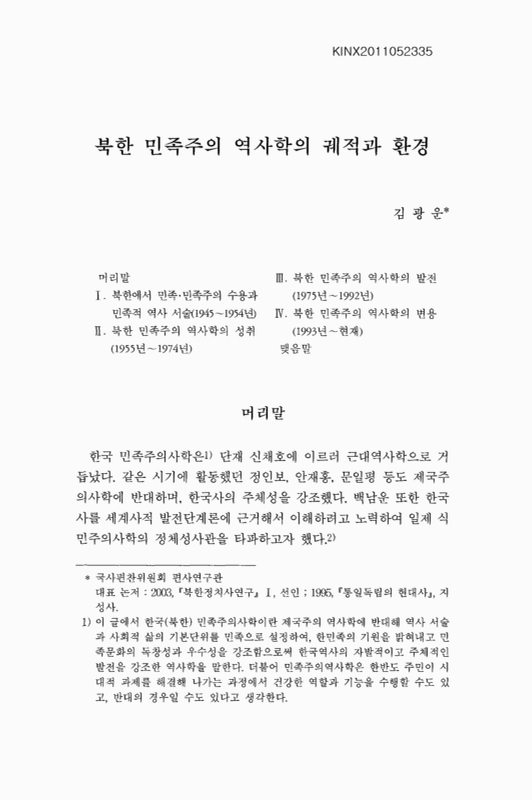
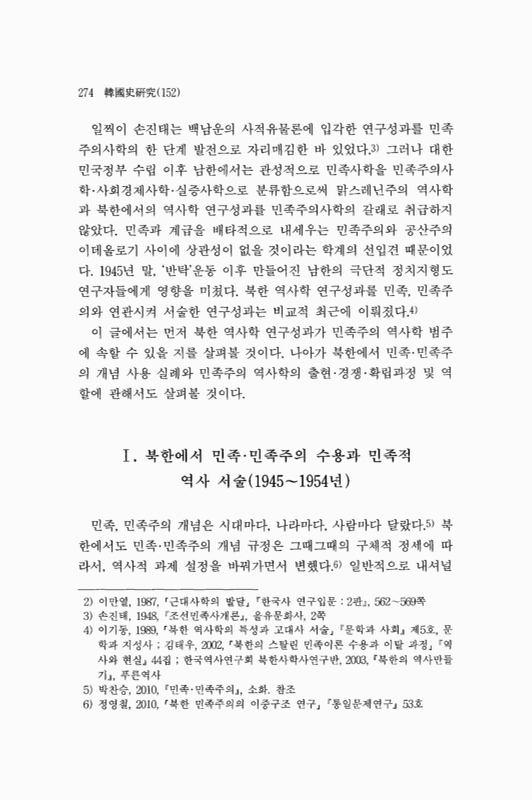
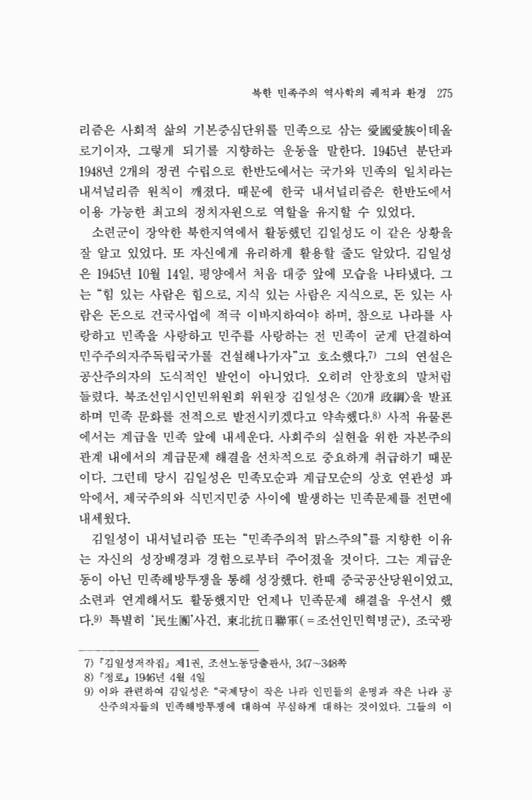
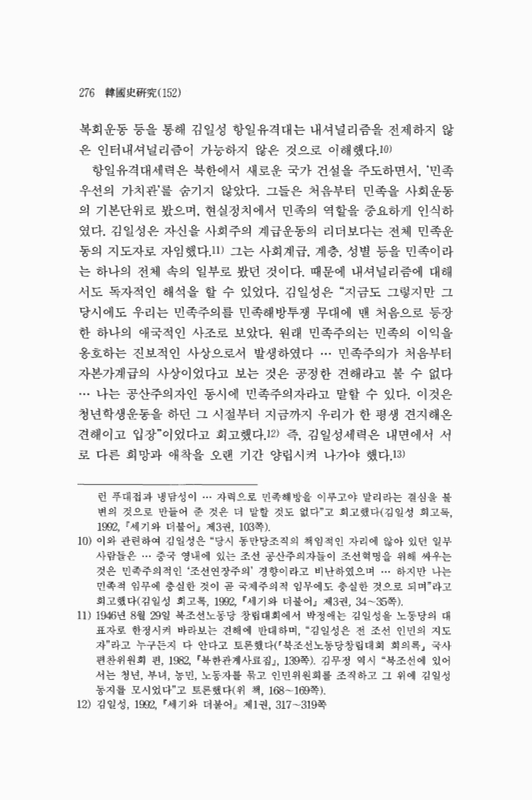
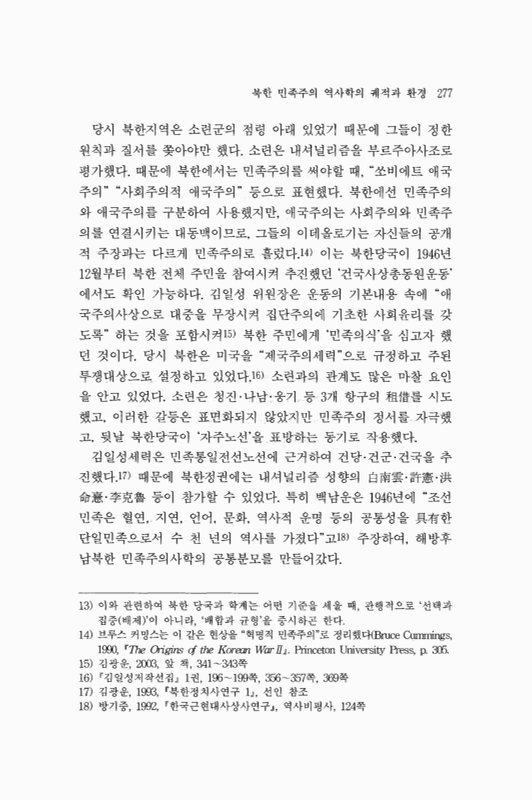
북한 민족주의 역사학의 궤적과 환경 / 김광운 1
머리말 1
I. 북한에서 민족·민족주의 수용과 민족적 역사 서술(1945~1954년) 2
II. 북한 민족주의 역사학의 성취(1955~1974년) 9
III. 북한 민족주의 역사학의 발전(1975~1992년) 19
IV. 북한 민족주의 역사학의 변용(1993년~현재) 24
맺음말 28
참고문헌 32
〈ABSTRACT〉 33
Korean nationalist history had widened the position and faculty as the regime that regulate the traitors to the nation each other in South and North Korea due to the division into 2 regime in 1948 and the partition of the Korean peninsula in 1945.
The North Korean historical group occupied it first, developed and grown the Korean nationalist history. However, the South Korean historical group didn't think the academic achievement of North Korean as the Korean nationalist history at all.
This article reviews the achievement of historical study in North Korea as a fork of Korean nationalist history. It is also examines about the examples of nation, nationalist notions used in North Korea, and the procedures of appearance, competition and establishment, and the role of Korean nationalist history.
As a result of this study, the regulation of national, nationalist notions in North Korea had changed depending on the situation and the policy of the Worker's Party of Korea.
The North Korean historical group created the compilation committee of the Korean history in 1947 and tried to describe a national history rather than the class line. In this process, they could eradicate the vestiges of Japanese imperialist colonial history by making clear that there divided into the Old Stone Age, the Neolithic era and the Bronze Age in Korean peninsular.
The North Korean historical group issued the Historical Science from 1955 and researched the formation of nation and periodization. They also tried to systemize logically the nationalist history based on the national theory focusing the lineage.
The North Korean historical group criticized the limitation of the materialistic conception of history as revising the Korean history based on a history view of Juche from the 6th conference Worker's Party of Korea. However, they didn't apply a struggle of the people's independence to the description of history in ancient and middle ages. They aimed at fostering of North Korea nationalist history for respecting Kim Il-seong and DPRK. The historians lost their autonomy as a result of excessive interference for the historical studies and publication in this process.
North Korea had tried to hard maintain their system since 1990. They clarified the Korea nation-first-principle in public as one of crisis breakthrough and historical group created new mythology and ancient history. The restoration of Dangun tomb and the civilization of Daedong River can be examples of that.
The characteristic in the path of national history naturalization in North Korea is the formulation and balance of the category in ‘people' and ‘class' through the reformulation of concept as accepting national values, parallelism with class category → expand of nationalism content by emphasizing the leadership of popular mass → ‘true nationalism' regarding universal Marx-Leninist content and patriotism as a medium. The North nationalist history currently naturalized as a Tangun (nation)-Kim Ilseong(Socialist) nationalism.| 기사명 | 저자명 | 페이지 | 원문 | 목차 |
|---|---|---|---|---|
| 新羅 聖德王代의 災異와 儒敎政治 | 이기봉 | pp.1-40 |
|
보기 |
| 고려시대 役官制의 운영과 성격 | 김난옥 | pp.41-69 |
|
보기 |
| 16세기 조선과 野人 사이의 모피 교역의 전개 | 김순남 | pp.71-108 |
|
보기 |
| 星湖 李瀷의 대외인식과 조선의 대응방안 모색 | 김지은 | pp.109-157 |
|
보기 |
| 북한의 사유제 정착과정과 민간산업정책, 1945~1950 | 김재웅 | pp.159-211 |
|
보기 |
| 한국산업은행원의 식민지 기업과 탈식민 :『産友』(1954~1971)를 중심으로 | 정병욱 | pp.213-238 |
|
보기 |
| '내재적 발전론' 역사인식의 궤적과 전망 | 이영호 | pp.239-272 |
|
보기 |
| 북한 민족주의 역사학의 궤적과 환경 | 김광운 | pp.273-306 |
|
보기 |
| 고등학교 검정 '한국사'교과서와 역사부도의 전근대 서술과 문제점 | 윤재운 | pp.307-345 |
|
보기 |
*표시는 필수 입력사항입니다.
| 전화번호 |
|---|
| 기사명 | 저자명 | 페이지 | 원문 | 기사목차 |
|---|
| 번호 | 발행일자 | 권호명 | 제본정보 | 자료실 | 원문 | 신청 페이지 |
|---|
도서위치안내: 정기간행물실(524호) / 서가번호: 국내12
2021년 이전 정기간행물은 온라인 신청(원문 구축 자료는 원문 이용)

우편복사 목록담기를 완료하였습니다.
*표시는 필수 입력사항입니다.
저장 되었습니다.
