본문 바로가기 주메뉴 바로가기
국회도서관 홈으로 정보검색 소장정보 검색

결과 내 검색

동의어 포함

초록보기

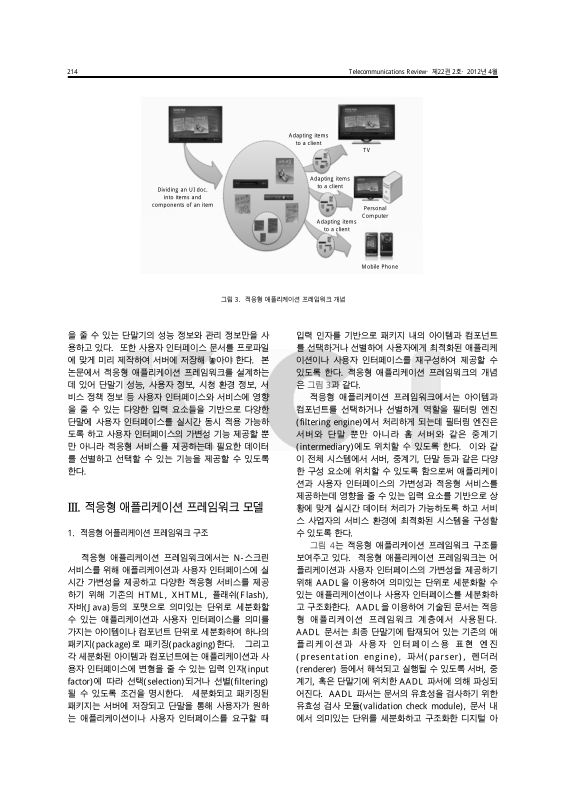
스마트 TV의 보급으로 방송ㆍ통신 융합 환경이 본격화 되어짐에 따라 방송 서비스는 인터넷 웹 기반의 응용 서비스를 흡수하여 방송 콘텐츠와 연계된 새로운 서비스를 창출하고 있으며 인터넷 서비스는 초고속 인터넷망을 통해 방송콘텐츠를 흡수하여 인터넷 서비스 기반의 콘텐츠 서비스를 제공하고 있다. 이와 발맞추어 다양한 콘텐츠를 수용할 수있는 디지털 단말기들의 종류도 다양화 되고 있다. 본 논문에서는 N-스크린 서비스 환경에서 서로 다른 특성을 가지는 다양한 단말기기에 애플리케이션과 사용자 인터페이스를 동시 적용 가능케 하고 단말 특성, 사용자 정보, 사용자의 취향, 사용자의 시청 상황, 서비스 가입정보, 네트워크 정보, 위치정보, 시간정보 등에 따라 다양하고 최적화된 서비스를 제공할 수 있도록 하는 적응형 애플리케이션 프레임워크 구조를 제시한다. 제시한 프레임워크를 구현하기 위하여XML 스키마 형식으로 디지털 아이템을 구조화하고 선별할 수 있도록 하는 새로운 서술 언어인 Adaptive Application Description Language(AADL)를 설계하고 실시간 적응형 타켓팅 광고 시스템을 구현하여 그 실효성을 보여준다.

As high-speed internet and digital broadcasting services have propagated and various consumer devices are appeared rapidly, internet service providers and broadcasting service providers are targeting to provide their services through various consumer devices such as smart TVs, personal computers, mobile phones, etc. They are looking for the advertisement system that is able to present the suitable advertisement contents on various consumer devices with different capabilities and that is able to deliver the targeted advertisement contents to each user depending on user profile, user behavior, device capabilities, and/or their service policies. For the success of services through different type of devices and different preferences of users, suitable multimedia contents for various consumer devices should be provided. In this paper, we propose a new framework to provide scalability of applications, and functionality of real-time adaptive services in a form of XML schema called Adaptive Application Description Language (AADL). We design AADL to accommodate functions of selecting and filtering applications or fragments of an application based on the factors such as device capabilities, user's viewing states, network states, or service policies called delivery context, as well as to provide version management capabilities of the applications or fragments of an application based on AADL. In Adaptive Application Framework, an application is divided into items and items are further divided into components, which can be considered as fragments of an application. This set of items and components is reconstructed to be optimally presented at each individual environment in the adaptation process, based on the delivery context.

권호기사

권호기사 목록 테이블로 기사명, 저자명, 페이지, 원문, 기사목차 순으로 되어있습니다.
기사명 저자명 페이지 원문 목차
스마트 TV 산업 활성화를 위한 정책적 이슈 윤명현, 김대진 pp.154-167

보기
비즈니스 모델 혁신 관점에서 살펴본 스마트 TV 진화에 관한 연구 송민정 pp.168-187

스마트 광고 기술 분석 및 전망 홍진우, 이한규, 김성민 pp.188-200

스마트 TV 플랫폼 기술 분석 및 구현방안 권기선, 김형훈, 박지호 pp.201-209

보기
N-스크린 서비스를 위한 적응형 애플리케이션 프레임워크 기술 임태범, 윤경로, 김경원, 문재원, 이석필 pp.210-227

스마트 TV 환경에서 응용 가능한 멀티미디어 정보 검색 기술 윤경로 pp.228-243

스마트 TV를 위한 멀티 I/O 인터페이스 기반 다기능 UI/UX기술 이장원, 김규헌, 장동일, 김동규 pp.244-257

스마트 TV 중시의 콘텐츠 공유 서비스를 위한 SVC 기반의 전송률 조절 기법 이성희, 김동칠, 정광수 pp.258-270

다상분해신호에 대한 처리 지연시간을 개선한 정규형 주파수 대역압축 알고리즘과 FPGA 회로 설계 박영석 pp.271-286

리포팅셀 위치 관리 시스템 최적 설계를 위한 개선된 이진 인공벌 군집 알고리즘 개발 김성수, 변지환 pp.287-297

실시간 모델기반 카메라 추적을 위한 속도 지향적 SURF 알고리즘 개발 박한훈, 미츠미네 히데키, 후지 마히토 pp.298-311

정확한 폐색 영역 탐지와 처리를 통한 변위 지도 개선 방법 장우석, 호요성 pp.312-322

A cost-conscious item grouping method for online shopping services Kwanho Kim, Beom-Suk Chung, Yongsuk Yang, Jae-Yoon Jung, Jonghun Park pp.323-335