국제결혼을 한 한국남성과 여성결혼이민자의 결혼만족도와 삶의 질 비교 / 박윤지 ; 전명희 1
서론 1
연구의 필요성 1
연구 목적 2
용어 정의 2
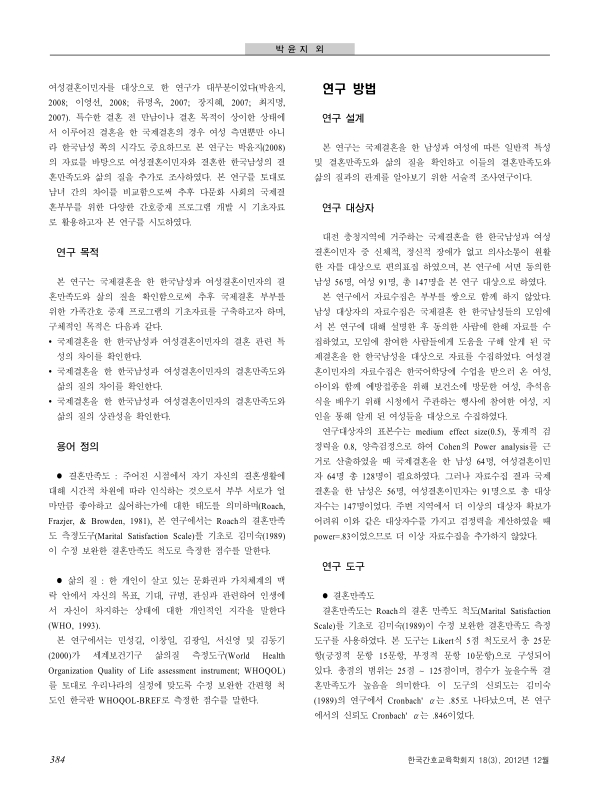
연구 방법 2
연구 설계 2
연구 대상자 2
연구 도구 2
자료 수집 방법 3
자료 분석 방법 3
연구 결과 3
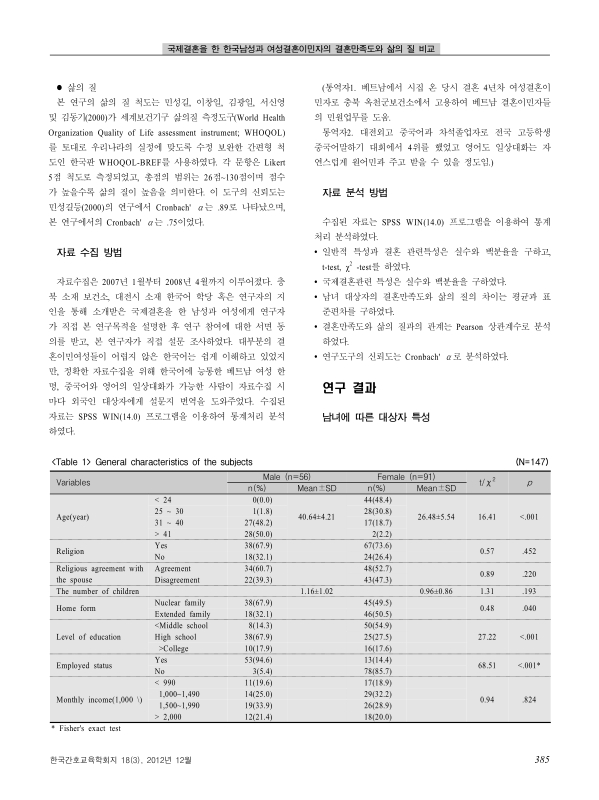
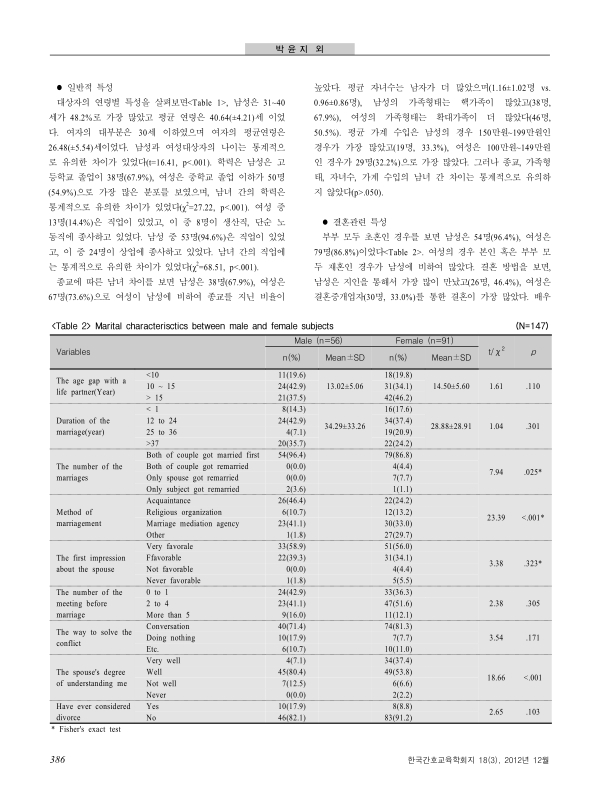
남녀에 따른 대상자 특성 3
국제결혼 한 남성과 여성결혼이민자의 결혼만족도와 삶의 질의 차이 6
국제결혼 한 남성과 여성결혼이민자의 결혼만족도와 삶의 질과의 관계 6
논의 6
결론 및 제언 8
참고문헌 8
Abstract 10
List of Tables
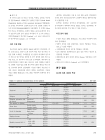
〈Table 1〉 General characteristics of the subjects 3
〈Table 2〉 Marital characterisctics between male and female subjects 4
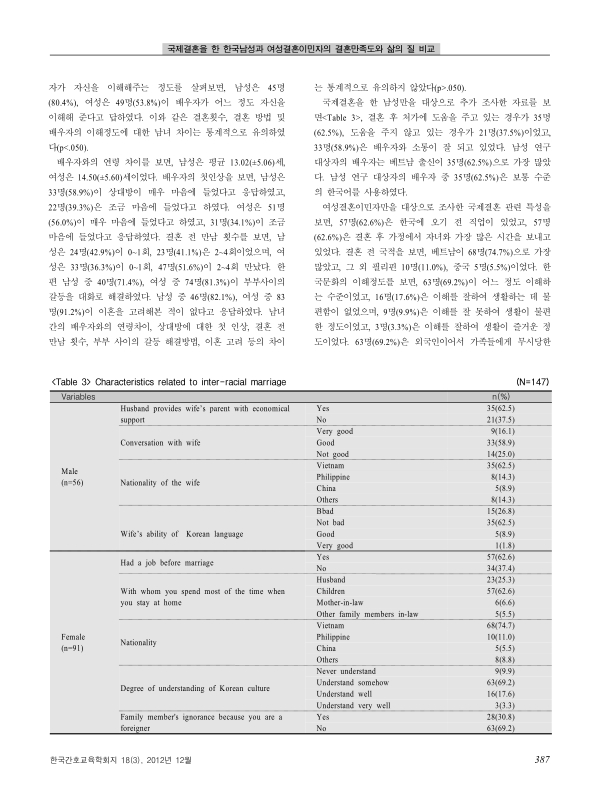
〈Table 3〉 Characteristics related to inter-racial marriage 5
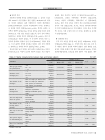
〈Table 4〉 Mean difference and correlation of the marital satisfaction and the quality of life according to male and female 6
초록보기
Purpose: The purpose of this study was to identify the relationship between marital satisfaction and the quality of life for women and men who live in a rural area in Korea through an international marriage. Methods: A descriptive correlational research design was used. Ninety-one women and 56 men were surveyed from May 1st.,2007 to April 6th., 2008. Data were analyzed by t-test, Pearson's correlation coefficients, and Fisher's exact test. Two types of questionnaires were used: Marital satisfaction scale (MSS) and WHO quality of life-brief (WHOQOL-BREF). Result: There is a gap between men's age and women's in the average of their marriage ; 37vs 24. In addition, men's marital satisfaction was much higher than women’s (t =2.16, p=.032) and quality of life was also higher than women's (t=- 0.85, p=.005). According to this survey, therefore, it has been shown that there is a positive correlation between marital satisfaction and the quality of life (r =.435, p<.001). Conclusion: In order to improve the quality of life, marital satisfaction should be promoted by practical family nursing programs and it is necessary for the internationally married women to be continuously provided with language education and cultural awareness.

 대표어
대표어
 한국학술지인용색인(NRF)