
 대표어
대표어
 한국학술지인용색인(NRF)
권호기사보기
| 기사명 | 저자명 | 페이지 | 원문 | 기사목차 |
|---|
결과 내 검색
동의어 포함
| 기사명 | 저자명 | 페이지 | 원문 | 목차 |
|---|---|---|---|---|
| 신석기시대 토기의 기종분류에 대한 비판적 검토 | 구자진 | pp.5-33 |
|
|
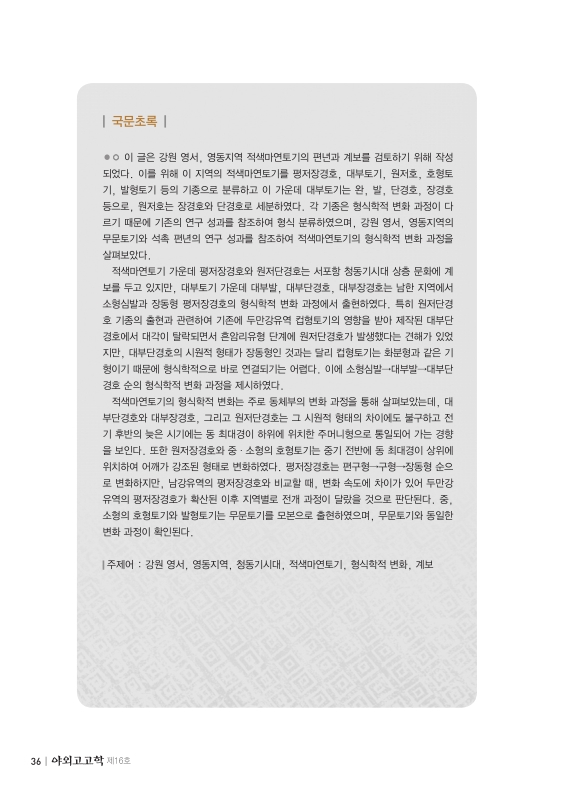
| 강원 영서, 영동지역 적색마연토기의 편년과 계보 | 宋滿榮 | pp.35-66 |
|
|
| 慶州 雁鴨池 中心建物 創建瓦 硏究 | 조성윤 | pp.67-90 |
|
|
| 高麗時代 遺蹟 出土 宋代 靑白瓷의 현황과 특징 | 金允貞 | pp.91-119 |
|
|
| 土器附着物 分析을 통한 飮食物 復元硏究의 現況과 課題 : 일본 연구성과를 중심으로 | 쇼다 신야 | pp.121-143 |
|
|
| 북유럽 3개국(덴마크, 스웨덴, 핀란드)의 문화재 정책과 활용 | 최민정 | pp.145-177 |
|
| 번호 | 참고문헌 | 국회도서관 소장유무 |
|---|---|---|
| 1 | 강인욱, 2007, 「두만강 유역 청동기시대 문화의 변천 과정에 대하여-동북한 토기의 편년및 주변 지역과의 비교를 중심으로-」, 『국고고학보』 62, 46-89, 한국고고학회. | 미소장 |
| 2 | 김권중, 2010, 「청동기시대 중부지방의 시·공간적 정체성」, 『중부지방 고고학의 시·공간적 정체성(Ⅰ)』, 중부고고학회 제1회 학술대회 발표요지, 중부고고학회. | 미소장 |
| 3 | 김권중, 2011, 「江原 嶺西地域 靑銅器時代 聚落의 편년과 變遷」, 『한일 취락 연구의 전개』,한일취락연구회 제7회 공동연구회 발표 요지, 한일취락연구회. | 미소장 |
| 4 | 김권중, 2012, 「강원 영서지역 청동기시대 조기-전기문화의 편년」, 『청동기시대 광역편년을 위한 조기~전기문화 펴년』, 제6회 한국청동기학회 학술대회 발표요지, 한국청동기학회. | 미소장 |
| 5 | 김미영, 2010, 「적색마연토기의 변천과 분포에 관한 연구」, 『경남연구』 2, 44-68, 경남발전연구원 역사문화센터. | 미소장 |
| 6 | A Study of Daebu Pottery in the Early Bronze Age - Focusing on origin of Daebu Pottery - | 소장 |
| 7 | 김현식, 2012, 「동남해안지역(경주-포항-울산지역) 청동기시대 편년」, 『청동기시대광역편년을 위한 조기~전기문화 편년』, 제6회 한국청동기학회 학술대회발표요지, 한국청동기학회. | 미소장 |
| 8 | Reexamination on chronology of the mid-bronze age in the central part of the country | 소장 |
| 9 | 강원 영서, 영동지역 청동기시대 편년 병행 관계 : 석촉 형식 분류를 중심으로 | 소장 |
| 10 | A study of Red burnished pottery in the southern part of Korea Peninsula | 소장 |
| 11 | Changes of Burnished Pottery from the Namgang Basin and the Transition of the Period | 소장 |
| 12 | 安在晧, 2002, 「赤色磨硏土器의 出現과 松菊里式土器」, 『韓國 農耕文化의 形成』(학연문화사), 韓國考古學會. | 미소장 |
| 13 | 정원철, 2010, 「강원지역 전기 무문토기의 전개 양상」, 『전기 무문토기의 지역양식 설정』, 2010년 한국청동기학회 토기분과 워크숍, 한국청동기학회. | 미소장 |
| 14 | 중부지역 돌대문토기의 편년 연구 | 소장 |
| 15 | 河仁秀, 1989, 「嶺南地方 丹塗磨硏土器에 대한 新考察」, 부산대학교 대학원 사학과 석사학위논문. | 미소장 |
| 16 | 嶺南地方 丹塗磨硏土器의 編年 | 소장 |
| 17 | 江陵大學校博物館, 1996, 『江陵 坊內里 住居址』. | 미소장 |
| 18 | 江陵大學校博物館, 2000, 『束草 朝陽洞 住居址』. | 미소장 |
| 19 | 江陵大學校博物館, 2002, 『江陵 校洞 住居址』. | 미소장 |
| 20 | 강원고고문화연구원, 2012a, 『洪川 下花溪里 聚落』. | 미소장 |
| 21 | 강원고고문화연구원, 2012b, 『平昌 泉洞里·馬池里 聚落』. | 미소장 |
| 22 | 강원문화재연구소, 2003a, 『춘천 신매리 주차장 신축예정부지 유적』. | 미소장 |
| 23 | 강원문화재연구소, 2003b, 『擧頭里 遺蹟』. | 미소장 |
| 24 | 강원문화재연구소, 2005a, 『新梅里 54-4番地 遺蹟』. | 미소장 |
| 25 | 강원문화재연구소, 2005b, 『龍岩里 遺蹟Ⅱ』. | 미소장 |
| 26 | 강원문화재연구소, 2007a, 『新梅里 373-6番地 遺蹟』. | 미소장 |
| 27 | 강원문화재연구소, 2007b, 『新梅里 10·47-1番地 遺蹟』. | 미소장 |
| 28 | 강원문화재연구소, 2007c, 『龍岩里』. | 미소장 |
| 29 | 강원문화재연구소, 2007d, 『高城 泗川里 遺蹟』. | 미소장 |
| 30 | 강원문화재연구소, 2008a, 『洪川 外三浦里 遺蹟』. | 미소장 |
| 31 | 강원문화재연구소, 2008b, 『泉田里』. | 미소장 |
| 32 | 강원문화재연구소, 2010a, 「강릉 방내리 가축위생처리장 신축부지 내 유적 발굴조사」, 『江陵地域 文化遺蹟 發掘調査 報告書』. | 미소장 |
| 33 | 강원문화재연구소, 2010b, 『洪川 哲亭里Ⅱ遺蹟』. | 미소장 |
| 34 | 강원문화재연구소, 2011a, 『原州 加峴洞 遺蹟』. | 미소장 |
| 35 | 강원문화재연구소, 2011b, 『춘천 牛頭洞遺蹟 Ⅰ』. | 미소장 |
| 36 | 강원문화재연구소, 2011c, 『정선 아우라지 유적』. | 미소장 |
| 37 | 京畿文化財硏究院, 2009, 『加平 大成里遺蹟』. 집필 | 미소장 |
| 38 | 동국문화재연구원, 2012, 「영주 가흥-상망간 우회도로 건설구간 내 문화유적 발굴조사」 | 미소장 |
| 39 | 신라문화유산조사단, 2009, 『慶州 忠孝洞 都市開發事業地區 遺蹟』. | 미소장 |
| 40 | 연세대학교 원주박물관, 2008, 『원주 태장동유적』. | 미소장 |
| 41 | 예맥문화재연구원, 2009a, 『華川 龍岩里遺蹟』. | 미소장 |
| 42 | 예맥문화재연구원, 2009b, 『高城 大垈里遺蹟』. | 미소장 |
| 43 | 예맥문화재연구원, 2010, 『寧越 酒泉里遺蹟』. | 미소장 |
| 44 | 예맥문화재연구원, 2011, 『春川 玄岩里遺蹟』. | 미소장 |
| 45 | 울산발전연구원 문화재센터, 2007, 『蔚州 九英里 遺蹟-蔚州 九英地區 宅地開發事業敷 地內 Ⅳ·Ⅴ地區』. | 미소장 |
| 46 | 忠北大學校博物館, 2001, 『忠州 早洞里 先史遺蹟(Ⅰ)』. | 미소장 |
| 47 | 한림대학교박물관, 2002, 『춘천 하중도 제방공사 구간 문화유적 발굴조사 보고서』. | 미소장 |
| 48 | 한림대학교박물관, 2003, 『춘천 신매대교부지 문화유적 발굴조사 보고서』. | 미소장 |
| 49 | 한림대학교박물관, 2007, 『가평 달전리유적』-靑銅器時代 聚落-. | 미소장 |
| 50 | 한림대학교박물관, 2008, 『춘천 천전리 121-16번지 유적』. | 미소장 |
| 51 | 한백문화재연구원, 2009, 『가평 연하리 유적』.현장 설명회 자료. | 미소장 |
*표시는 필수 입력사항입니다.
| 전화번호 |
|---|
| 기사명 | 저자명 | 페이지 | 원문 | 기사목차 |
|---|
| 번호 | 발행일자 | 권호명 | 제본정보 | 자료실 | 원문 | 신청 페이지 |
|---|
도서위치안내: 정기간행물실(524호) / 서가번호: 국내07
2021년 이전 정기간행물은 온라인 신청(원문 구축 자료는 원문 이용)

우편복사 목록담기를 완료하였습니다.
*표시는 필수 입력사항입니다.
저장 되었습니다.
