본문 바로가기 주메뉴 바로가기
국회도서관 홈으로 정보검색 소장정보 검색

결과 내 검색

동의어 포함

초록보기

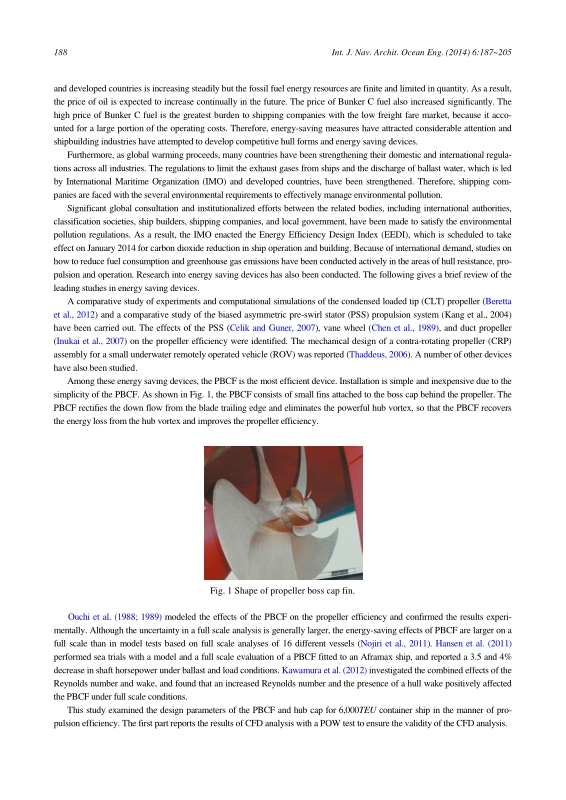
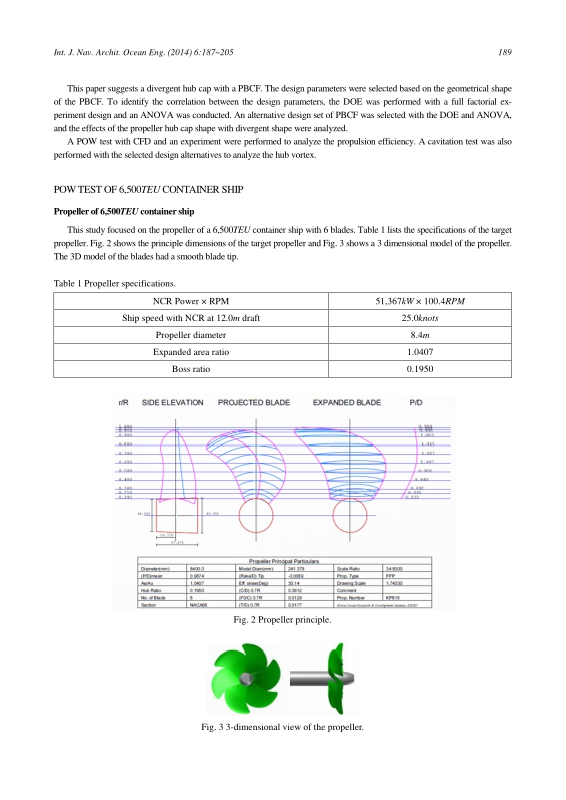
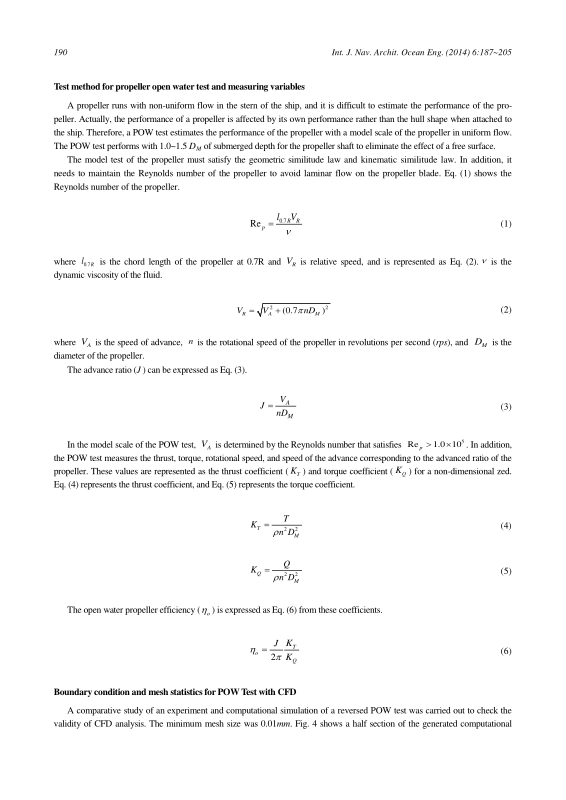
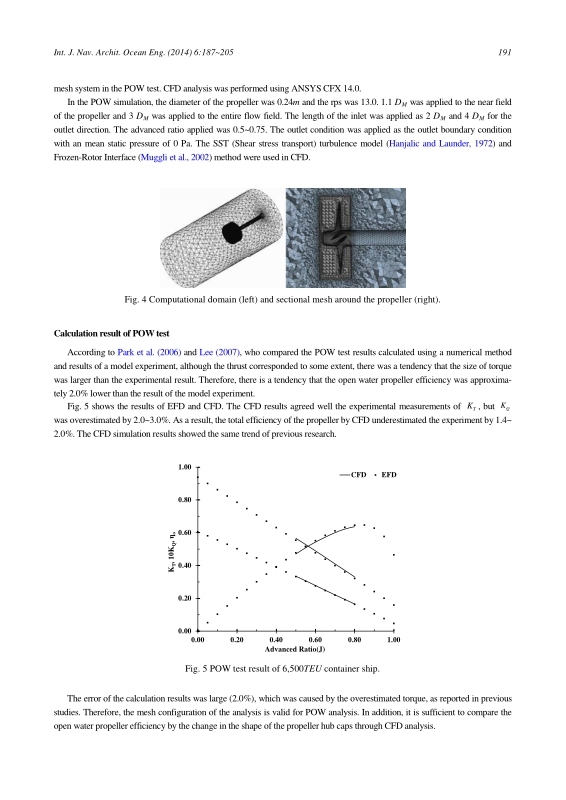
The global price of oil, which is both finite and limited in quantity, has been rising steadily because of the increasing requirements for energy in both developing and developed countries. Furthermore, regulations have been strengthened across all industries to address global warming. Many studies of hull resistance, propulsion and operation of ships have been performed to reduce fuel consumption and emissions. This study examined the design parameters of the propeller boss cap fin (PBCF) and hub cap for 6,000TEU container ships to improve the propulsion efficiency. The design parameters of PBCF have been selected based on the geometrical shape. Computational fluid dynamics (CFD) analysis with a propeller open water (POW) test was performed to check the validity of CFD analysis. The design of ex-periment (DOE) case was selected as a full factorial design, and the experiment was analyzed by POW and CFD analysis. Analysis of variance (ANOVA) was performed to determine the correlation among design parameters. Four design alternatives of PBCF were selected from the DOE. The shape of a propeller hub cap was selected as a divergent shape, and the divergent angle was determined by the DOE. Four design alternatives of PBCF were attached to the divergent hub cap, and the POW was estimated by CFD. As a result, the divergent hub cap with PBCF has a negative effect on the POW, which is induced by an increase in torque coefficient. A POW test and cavitation test were performed with a divergent hub cap with PBCF to verify the CFD result. The POW test result showed that the open water effici-ency was increased approximately 2% with a divergent hub cap compared to a normal cap. The POW test result was similar to the CFD result, and the divergent hub cap with the PBCF models showed lower open water efficiency. This was attributed to an increase in the torque coefficient just like the CFD results. A cavitation test was performed using the 2 models selected. The test result showed that the hub vortex is increased downstream of the propeller.

권호기사

권호기사 목록 테이블로 기사명, 저자명, 페이지, 원문, 기사목차 순으로 되어있습니다.
기사명 저자명 페이지 원문 목차
An iterative boundary element method for a wing-in-ground effect Omer Kemal Kinaci pp.282-296

Experimental investigation of frictional resistance reduction with air layer on the hull bottom of a ship Jinho Jang, Soon Ho Choi, Sung-Mok Ahn, Booki Kim, Jong Soo Seo pp.363-379

Hydrodynamic optimization of twin-skeg LNG ships by CFD and model testing Keunjae Kim, Fabian Tillig, Nicolas Bathfield, Hans Liljenberg pp.392-405

Modeling of steady motion and vertical-plane dynamics of a tunnel hull Christopher S. Chaney, Konstantin I. Matveev pp.323-332

Numerical simulations of two-dimensional floating breakwaters in regular waves using fixed cartesian grid Kwang-Leol Jeong, Young-Gill Lee pp.206-218

On the effects of hull-girder vibration upon fatigue strength of a Post-Panamax container ship disaggregated by short-term sea state Toichi Fukasawa, Keiichi Mukai pp.431-441

New business opportunity : Green field project with new technology Seung Jae Lee, Jong Hun Woo, Jong Gye Shin pp.471-483

Optimization of energy saving device combined with a propeller using real-coded genetic algorithm Tomohiro Ryu, Takashi Kanemaru, Shiro Kataoka, Kiyoshi Arihama, Akira Yoshitake, Daijiro Arakawa, Jun Ando pp.406-417

Research of design challenges and new technologies for floating LNG Dong-Hyun Lee, Mun-Keun Ha, Soo-Young Kim, Sung-Chul Shin pp.307-322

A numerical study of scale effects on performance of a tractor type podded propeller Jung-Kyu Choi, Hyoung-Gil Park, Hyoung-Tae Kim pp.380-391

A study on an efficient prediction of welding deformation for T-joint laser welding of sandwich panel. part2, Proposal of a method to use shell element model Jae Woong Kim, Beom Seon Jang, Sung Wook Kang pp.245-256

A RANS modelling approach for predicting powering performance of ships in waves Björn Windén, Stephen Turnock, Dominic Hudson pp.418-430

Verification of CFD analysis methods for predicting the drag force and thrust power of an underwater disk robot Tae-Hwan Joung, Hyeung-Sik Choi, Sang-Ki Jung, Karl Sammut, Fangpo He pp.269-281

Application of welding simulation to block joints in shipbuilding and assessment of welding-induced residual stresses and distortions Wolfgang Fricke, Sonja Zacke pp.459-470

Assessment of whipping and springing on a large container vessel Mondher Barhoumi, Gaute Storhaug pp.442-458

Flow-driven rotor simulation of vertical axis tidal turbines : A comparison of helical and straight blades Tuyen Quang Le, Kwang-Soo Lee, Jin-Soon Park, Jin Hwan Ko pp.257-268

Damage scenarios and an onboard support system for damaged ships Jin Choi, Dongkon Lee, Hee Jin Kang, Soo-Young Kim, Sung-Chul Shin pp.236-244

Parametric study of propeller boss cap fins for container ships Sang-Seop Lim, Tae-Won Kim, Dong-Myung Lee, Chung-Gil Kang, Soo-Young Kim pp.187-205

Numerical analysis of two and three dimensional buoyancy driven water-exit of a circular cylinder Shahab Moshari, Amir Hossein Nikseresht, Reza Mehryar pp.219-235

Design of an adaptive backstepping controller for auto-berthing a cruise ship under wind loads Jong-Yong Park, Nakwan Kim pp.347-360

Self-similarity in the equation of motion of a ship Gyeong Joong Lee pp.333-346

The use of network theory to model disparate ship design information Douglas Rigterink, Rebecca Piks, David J. Singer pp.484-495

Simulating three dimensional wave run-up over breakwaters covered by antifer units A. Najafi-Jilani, M. Zakiri Niri, Nader Naderi pp.297-306

Scenario based optimization of a container vessel with respect to its projected operating conditions Jonas Wagner, Eva Binkowski, Robert Bronsart pp.496-506