
 대표어
대표어
 한국학술지인용색인(NRF)
권호기사보기
| 기사명 | 저자명 | 페이지 | 원문 | 기사목차 |
|---|
결과 내 검색
동의어 포함
| 기사명 | 저자명 | 페이지 | 원문 | 목차 |
|---|---|---|---|---|
| Oral Medicine in Korea, Can We Become a Global Leader? | 고홍섭 | pp.1-2 | ||
| Psychological Aspects of Burning Mouth Syndrome | 김철 | pp.3-9 |
|
|
| Comparison of the Effects of Pilocarpine Solution and Tablet on Salivary Flow Rate | 박좋은, 송찬우, 김기석, 김미은 | pp.10-16 |
|
|
| Association between Temporomandibular Disorders and Occupations by Korean Standard Classification of Occupations | 김지수, 김영애, 허준영, 옥수민, 김경희, 안용우, 정성희 | pp.17-27 |
|
|
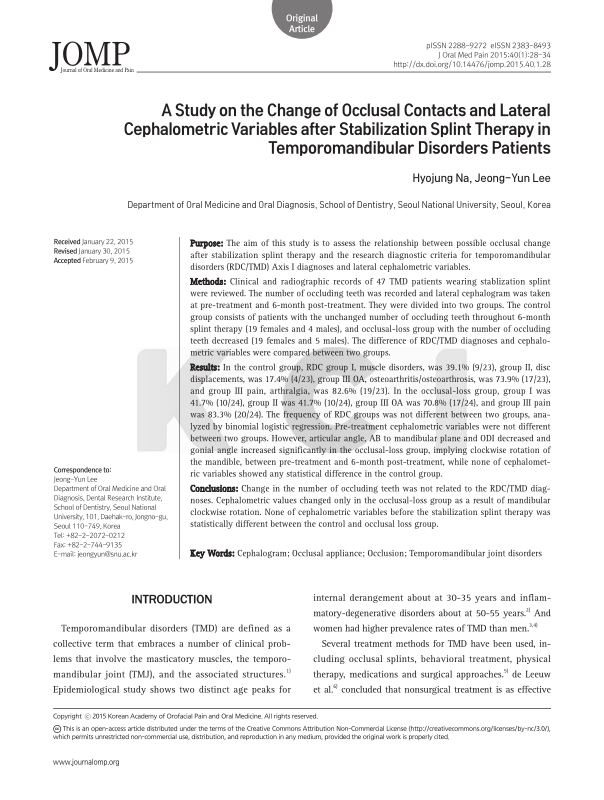
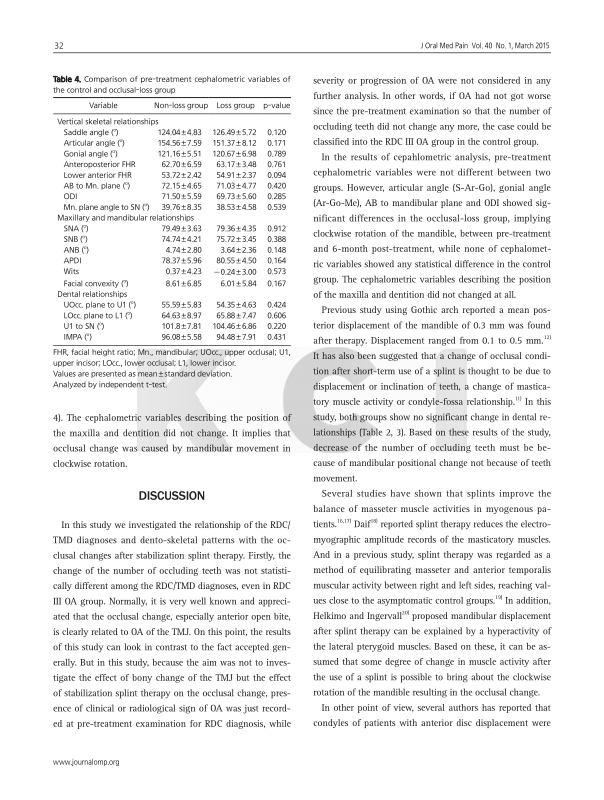
| A Study on the Change of Occlusal Contacts and Lateral Cephalometric Variables after Stabilization Splint Therapy in Temporomandibular Disorders Patients | 나효정, 이정윤 | pp.28-34 |
|
|
| Psychological Assessment of Patients with Iatrogenic Trigeminal Nerve Injury Using Symptom Checklist-90-Revised | 박미선, 노병윤, 안종모, 윤창륙, 유지원 | pp.35-40 |
|
| 번호 | 참고문헌 | 국회도서관 소장유무 |
|---|---|---|
| 1 | de Leeuw R, Klasser GD. Orofacial pain: guidelines for assessment, diagnosis, and management. Chicago: Quintessence; 2008. | 미소장 |
| 2 | Age peaks of different RDC/TMD diagnoses in a patient population  |
미소장 |
| 3 | Prevalence study of signs and symptoms of temporomandibular disorders in university students |
미소장 |
| 4 | Gender difference in prevalence of signs and symptoms of temporomandibular joint disorders: a retrospective study on 243 consecutive patients. |
미소장 |
| 5 | Okeson JP. Management of temporomandibular disorders and occlusion. St. Louis: Mosby Elsevier; 2008. | 미소장 |
| 6 | Assessment of treatment outcome in patients with craniomandibular dysfunction. |
미소장 |
| 7 | Al-Ani MZ, Davies SJ, Gray RJ, Sloan P, Glenny AM. Stabilisation splint therapy for temporomandibular pain dysfunction syndrome. Cochrane Database Syst Rev 2004;(1):CD002778. | 미소장 |
| 8 | Use of protrusive splint therapy in anterior disk displacement of the temporomandibular joint: A 1- to 3-year follow-up |
미소장 |
| 9 | The significance of posterior open bite after anterior repositioning splint therapy for anteriorly displaced disk of the temporomandibular joint. |
미소장 |
| 10 | Change in the Number of Occlusal Contacts Following Splint Therapy in Patients with a Temporomandibular Disorder (TMD) |
미소장 |
| 11 | A change of occlusal conditions after splint therapy for bruxers with and without pain in the masticatory muscles. |
미소장 |
| 12 | A graphic evaluation of the intermaxillary relationship before and after therapy with the Michigan splint |
미소장 |
| 13 | Research diagnostic criteria for temporomandibular disorders: review, criteria, examinations and specifications, critique. |
미소장 |
| 14 | Research Diagnostic Criteria for Temporomandibular Disorders (RDC/TMD) axis I diagnoses in an Italian patient population |
미소장 |
| 15 | Dahlberg G. Statistical methods for medical and biological students. London: G. Allen & Unwin Ltd.; 1940. | 미소장 |
| 16 | The immediate effects of a stabilization splint on the muscular symmetry in the masseter and anterior temporal muscles of patients with a craniomandibular disorder |
미소장 |
| 17 | Short-term effect of the stabilization appliance on masticatory muscle activity in myogenous craniomandibular disorder patients. |
미소장 |
| 18 | Correlation of splint therapy outcome with the electromyography of masticatory muscles in temporomandibular disorder with myofascial pain |
미소장 |
| 19 | An electromyographic study of masseter and anterior temporalis muscles in extra-articular myogenous TMJ pain patients compared to an asymptomatic and normal population. |
미소장 |
| 20 | Recording of the retruded position of the mandible in patients with mandibular dysfunction. |
미소장 |
| 21 | A comparative assessment of mandibular condylar position in patients with anterior disc displacement of the temporomandibular joint |
미소장 |
| 22 | Condyle position in the temporomandibular joint: Comparison between asymptomatic volunteers with normal disk position and patients with disk displacement |
미소장 |
| 23 | A quantitative analysis of splint therapy of displaced temporomandibular joint disc |
미소장 |
| 24 | Ekberg EC, Vallon D, Nilner M. Occlusal appliance therapy in patients with temporomandibular disorders. A double-blind controlled study in a short-term perspective. Acta Odontol Scand 1998;56:122-128. | 미소장 |
| 25 | Unilateral Posterior Crossbite is Not Associated with TMJ Clicking in Young Adolescents |
미소장 |
| 26 | A systematic review of individual patient data meta-analyses on surgical interventions. |
미소장 |
| 27 | Thilander B, Bjerklin K. Posterior crossbite and temporomandibular disorders (TMDs): need for orthodontic treatment? Eur J Orthod 2012;34:667-673. | 미소장 |
*표시는 필수 입력사항입니다.
| 전화번호 |
|---|
| 기사명 | 저자명 | 페이지 | 원문 | 기사목차 |
|---|
| 번호 | 발행일자 | 권호명 | 제본정보 | 자료실 | 원문 | 신청 페이지 |
|---|
도서위치안내: 정기간행물실(524호) / 서가번호: 국내17
2021년 이전 정기간행물은 온라인 신청(원문 구축 자료는 원문 이용)

우편복사 목록담기를 완료하였습니다.
*표시는 필수 입력사항입니다.
저장 되었습니다.
