
 대표어
대표어
 한국학술지인용색인(NRF)
권호기사보기
| 기사명 | 저자명 | 페이지 | 원문 | 기사목차 |
|---|
결과 내 검색
동의어 포함
목차
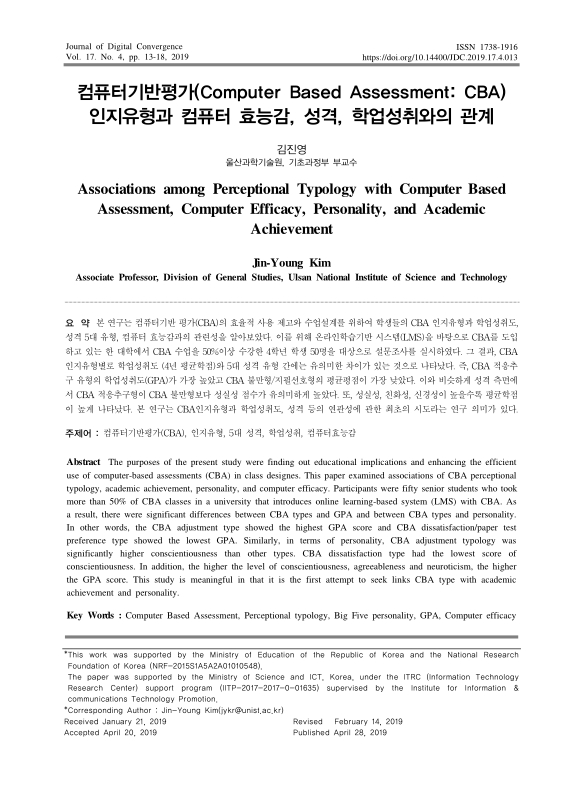
컴퓨터기반평가(Computer Based Assessment : CBA) 인지유형과 컴퓨터 효능감, 성격, 학업성취와의 관계 = Associations among perceptional typology with computer based assessment, computer efficacy, personality, and academic achievement / 김진영 1
요약 1
Abstract 1
1. 서론 2
2. 선행연구 2
2.1. CBA 정의와 유형 2
2.2. CBA에 대한 인식과 유형 2
2.3. 컴퓨터효능감, 성격, 학업성취도 3
3. 연구방법 3
3.1. 조사대상 3
3.2. 척도의 측정 3
4. 결론 4
5. 논의 5
REFERENCES 5
[저자소개] 6
| 번호 | 참고문헌 | 국회도서관 소장유무 |
|---|---|---|
| 1 | Development and Evaluation of a Questionnaire to Assess Physical Educators' Knowledge of Student Assessment  |
미소장 |
| 2 | The Impact on Student Performance of Altering the Assessment Criteria around Formative Computer Based Assessments |
미소장 |
| 3 | P. Marriott & A. Lau. (2008). The use of online summative assessment in an undergraduate financial accounting course. Journal of Accounting Education, 26(2), 73-90. | 미소장 |
| 4 | L. McDowell & K. Sambell. (1999). The experience of innovative assessment: Students perspectives. In Assessment matters in higher education: Choosing and using diverse approaches (Eds S. Brown, & A. Glasner)UK: McGraw-Hill Education. | 미소장 |
| 5 | Twelve tips for computer-based assessment in medical education. |
미소장 |
| 6 | O. J. Kim. (2018). The effects of music lesson applying the blended learning-based STEAM education on the musical knowledge and STEAM literacy of pre-service kindergarten teachers. Journal of the Korea Convergence Society, 9(2), 217-227. | 미소장 |
| 7 | J. Bull & C. McKenna. (2000). Computer-assisted assessment centre (TLTP3) update. In 4th International CAA Conference, Loughborough, UK: Loughborough University. | 미소장 |
| 8 | Sustainable Assessment: Rethinking assessment for the learning society |
미소장 |
| 9 | Implementation of computer assisted assessment: lessons from the literature |
미소장 |
| 10 | Conative Feedback in Computer-Based Assessment |
미소장 |
| 11 | Y. Choi & D. Seo. (2018). Developing a prototype of learning epistemic frame using computer based learning system : Learning analytics. Journal of the Korea Convergence Society, 9(3), 23-29. | 미소장 |
| 12 | S. Zakrzewski & J. Bull. (1999). The mass implementation and evaluation of computer based assessments. Assessments and Evaluation in Higher Education, 23(2), 141-152. | 미소장 |
| 13 | A review of computer‐assisted assessment |
미소장 |
| 14 | C. McKenna. (2001). Academic approaches and attitudes towards CAA: A qualitative study in Danson, M. &Eabry, C. (eds.) Fifth International Computer Assisted Assessment (CAA) Conference Proceedings, Loughborough University, UK. | 미소장 |
| 15 | Formative Assessment in Higher Education: Moves Towards Theory and the Enhancement of Pedagogic Practice |
미소장 |
| 16 | Computer-based assessment of student-constructed responses |
미소장 |
| 17 | W. Harlen & R. Deakin-Crick. (2002). A Systematic review of the impact of summative assessment and tests on students’ motivation for learning. London:EPPI-Centre, Social Science Research Unit, University of London Institute of Education. | 미소장 |
| 18 | A Study of Perceptional Typologies on Computer Based Assessment (CBA): Instructor and Student Perspectives |
미소장 |
| 19 | An investigation of Big Five and narrow personality traits in relation to Internet usage |
미소장 |
| 20 | MBTI personality type and other factors that relate to preference for online versus face-to-face instruction |
미소장 |
| 21 | Students’ ICT self-efficacy and computer and information literacy: Determinants and relationships |
미소장 |
| 22 | Computer Based Assessment Acceptance: A Cross-cultural Study in Greece and Mexico |
미소장 |
| 23 | O. P. John & S. Srivastava. (1999). The Big Five trait taxonomy: History, measurement, and theoretical perspectives. In LA Pervin, O. P. John (Eds.), Handbook of Personality: Theory and Research (pp.102-138), New York: Guilford Press. | 미소장 |
*표시는 필수 입력사항입니다.
| 전화번호 |
|---|
| 기사명 | 저자명 | 페이지 | 원문 | 기사목차 |
|---|
| 번호 | 발행일자 | 권호명 | 제본정보 | 자료실 | 원문 | 신청 페이지 |
|---|
도서위치안내: 정기간행물실(524호) / 서가번호: 국내04
2021년 이전 정기간행물은 온라인 신청(원문 구축 자료는 원문 이용)

우편복사 목록담기를 완료하였습니다.
*표시는 필수 입력사항입니다.
저장 되었습니다.
