
 대표어
대표어
 한국학술지인용색인(NRF)
권호기사보기
| 기사명 | 저자명 | 페이지 | 원문 | 기사목차 |
|---|
결과 내 검색
동의어 포함
Purpose
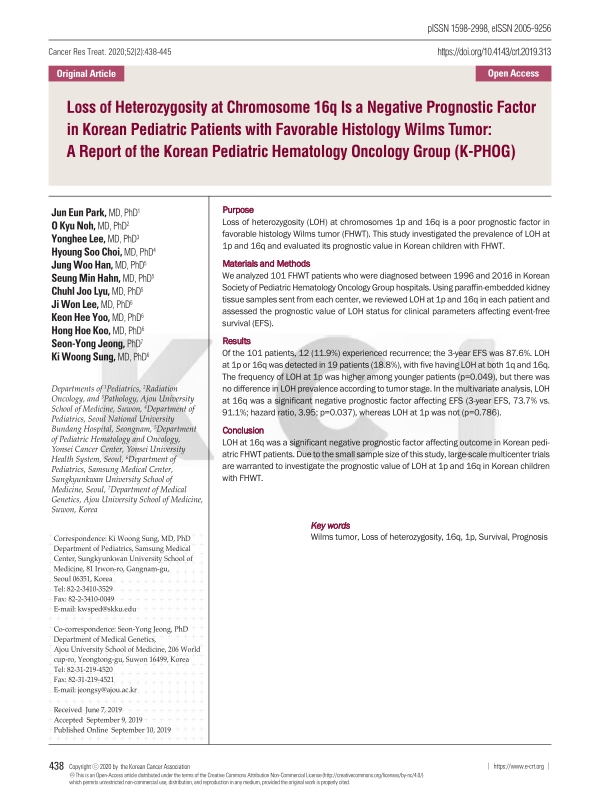
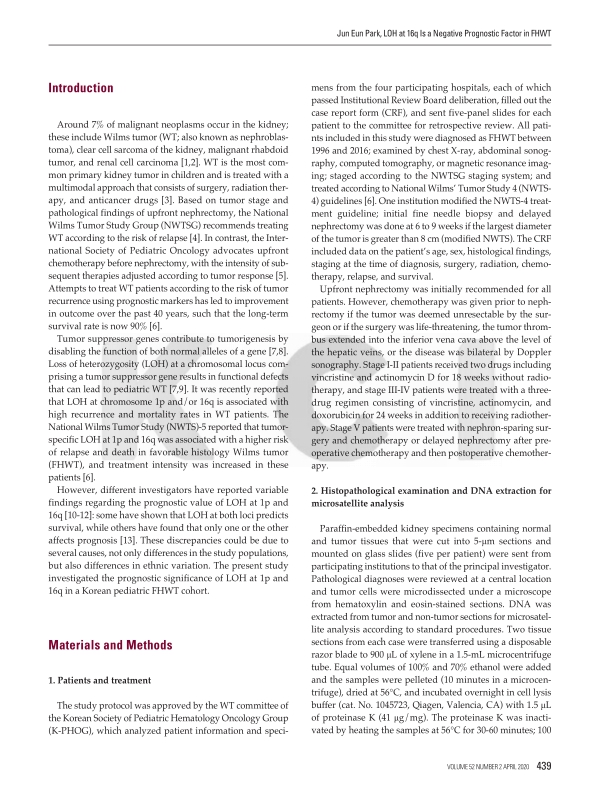
Loss of heterozygosity (LOH) at chromosomes 1p and 16q is a poor prognostic factor in favorable histology Wilms tumor (FHWT). This study investigated the prevalence of LOH at 1p and 16q and evaluated its prognostic value in Korean children with FHWT.
Materials and Methods
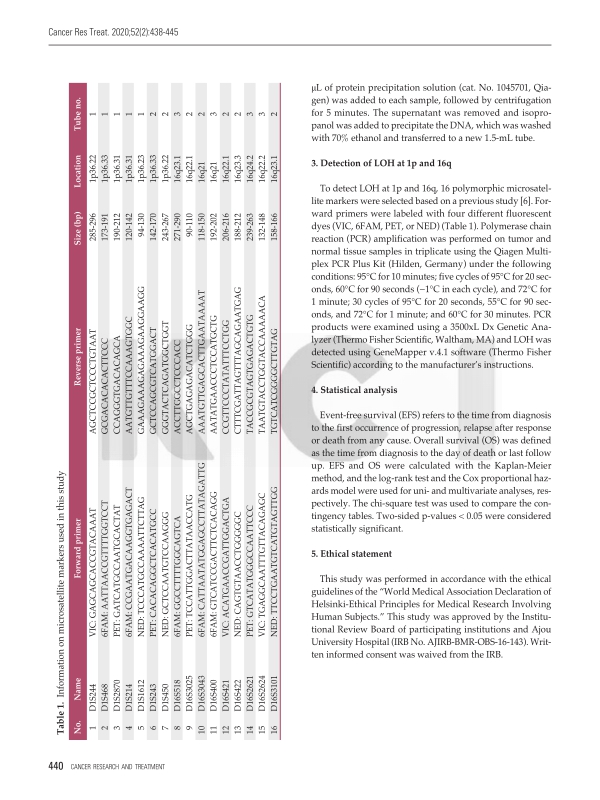
We analyzed 101 FHWT patients who were diagnosed between 1996 and 2016 in Korean Society of Pediatric Hematology Oncology Group hospitals. Using paraffin-embedded kidney tissue samples sent from each center, we reviewed LOH at 1p and 16q in each patient and assessed the prognostic value of LOH status for clinical parameters affecting event-free survival (EFS).
Results
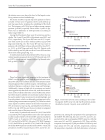
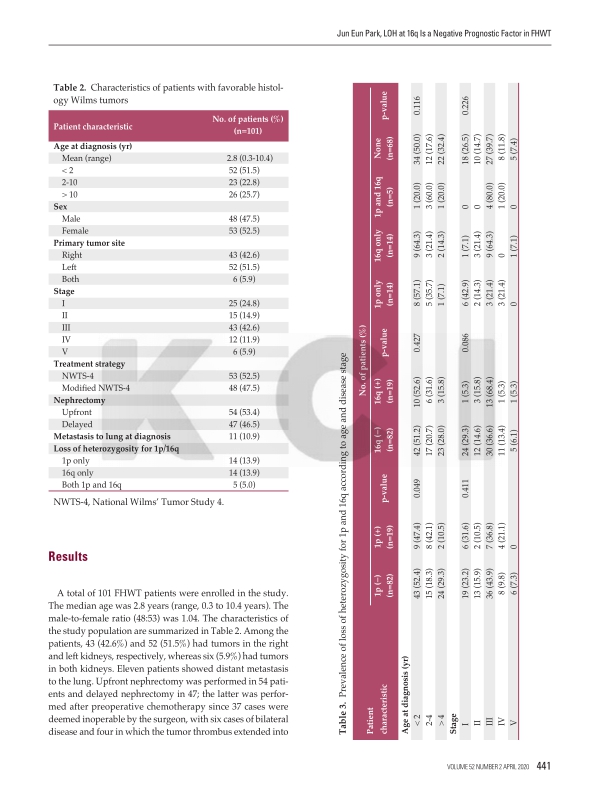
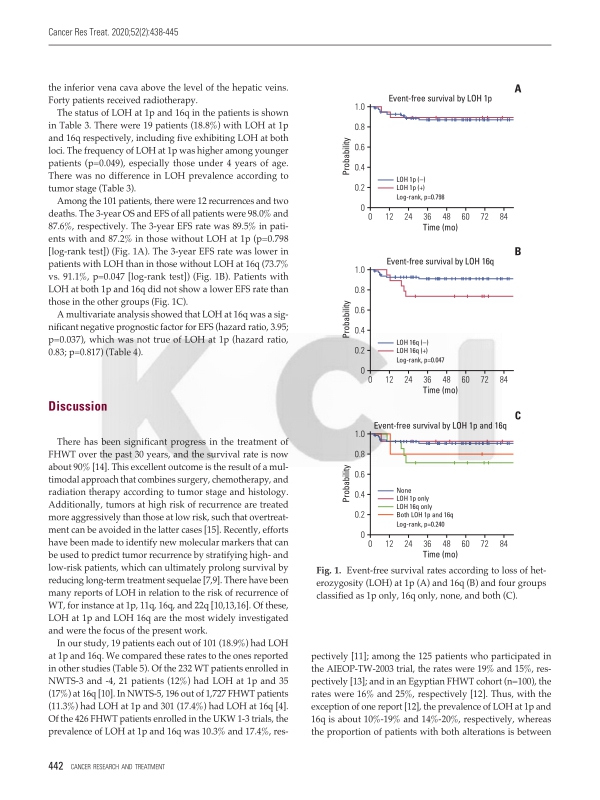
Of the 101 patients, 12 (11.9%) experienced recurrence; the 3-year EFS was 87.6%. LOH at 1p or 16q was detected in 19 patients (18.8%), with five having LOH at both 1q and 16q. The frequency of LOH at 1p was higher among younger patients (p=0.049), but there was no difference in LOH prevalence according to tumor stage. In the multivariate analysis, LOH at 16q was a significant negative prognostic factor affecting EFS (3-year EFS, 73.7% vs. 91.1%; hazard ratio, 3.95; p=0.037), whereas LOH at 1p was not (p=0.786).
Conclusion
LOH at 16q was a significant negative prognostic factor affecting outcome in Korean pediatric FHWT patients. Due to the small sample size of this study, large-scale multicenter trials are warranted to investigate the prognostic value of LOH at 1p and 16q in Korean children with FHWT.| 번호 | 참고문헌 | 국회도서관 소장유무 |
|---|---|---|
| 1 | Association between loss of heterozygosity of chromosome 16q and survival in Wilms’ tumor: A meta-analysis  |
미소장 |
| 2 | Effect of Preoperative Chemotherapy on Outcome of Wilms Tumor |
미소장 |
| 3 | The evolution of treatment for Wilms tumor |
미소장 |
| 4 | Outcome and Prognostic Factors in Stage III Favorable-Histology Wilms Tumor: A Report From the Children's Oncology Group Study AREN0532. |
미소장 |
| 5 | Risk Stratification for Wilms Tumor: Current Approach and Future Directions |
미소장 |
| 6 | Loss of heterozygosity for chromosomes 1p and 16q is an adverse prognostic factor in favorable-histology Wilms tumor: a report from the National Wilms Tumor Study Group. |
미소장 |
| 7 | 16q heterozygosity loss in Wilms» tumour in children and its clinical importance |
미소장 |
| 8 | Clinical, pathological and loss of heterozygosity differences in Wilms tumors between Asian and non-Asian children. |
미소장 |
| 9 | A systematic review of St. John's wort for major depressive disorder. |
미소장 |
| 10 | Loss of heterozygosity for chromosomes 16q and 1p in Wilms' tumors predicts an adverse outcome. |
미소장 |
| 11 | Allele loss at 16q defines poorer prognosis Wilms tumour irrespective of treatment approach in the UKW1–3 clinical trials: A Children’s Cancer and Leukaemia Group (CCLG) study |
미소장 |
| 12 | Profiling Loss of Heterozygosity Patterns in a Cohort of Favorable Histology Nephroblastoma Egyptian Patients: What is Consistent With the Rest of the World. |
미소장 |
| 13 | Spreafico F, Gamba B, Mariani L, Collini P, D'Angelo P, Pession A, et al. Loss of heterozygosity analysis at different chromosome regions in Wilms tumor confirms 1p allelic loss as a marker of worse prognosis: a study from the Italian Association of Pediatric Hematology and Oncology. J Urol. 2013;189:260-6. | 미소장 |
| 14 | Effect of duration of treatment on treatment outcome and cost of treatment for Wilms' tumor: a report from the National Wilms' Tumor Study Group. |
미소장 |
| 15 | Comparison between single-dose and divided-dose administration of dactinomycin and doxorubicin for patients with Wilms' tumor: a report from the National Wilms' Tumor Study Group. |
미소장 |
| 16 | Treatment of Stage IV Favorable Histology Wilms Tumor With Lung Metastases |
미소장 |
*표시는 필수 입력사항입니다.
| 전화번호 |
|---|
| 기사명 | 저자명 | 페이지 | 원문 | 기사목차 |
|---|
| 번호 | 발행일자 | 권호명 | 제본정보 | 자료실 | 원문 | 신청 페이지 |
|---|
도서위치안내: 정기간행물실(524호) / 서가번호: 국내16
2021년 이전 정기간행물은 온라인 신청(원문 구축 자료는 원문 이용)

우편복사 목록담기를 완료하였습니다.
*표시는 필수 입력사항입니다.
저장 되었습니다.
