
 대표어
대표어
권호기사보기
| 기사명 | 저자명 | 페이지 | 원문 | 기사목차 |
|---|
결과 내 검색
동의어 포함
목차
표제지=0,1,1
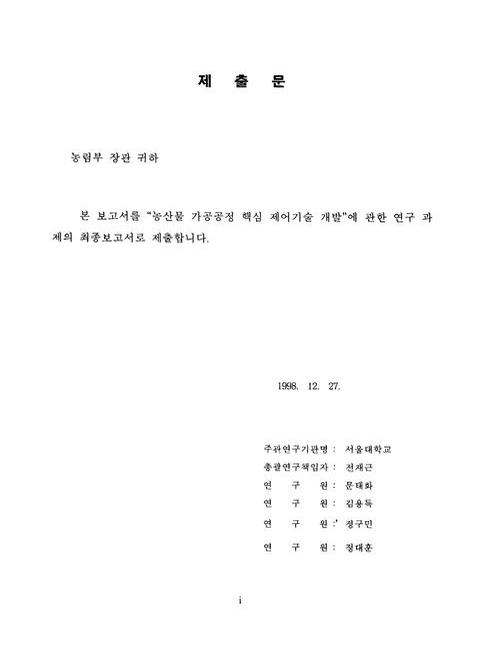
제출문=i,2,2
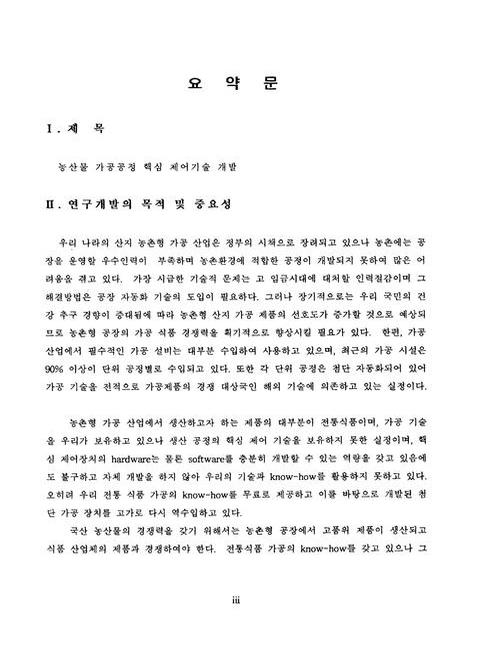
요약문=iii,4,8
SUMMARY=xi,12,7
CONTENTS=xviii,19,11
목차=xxix,30,12
제1장 서론=1,42,2
제2장 전통 식품 가공 공정의 개발 분야=3,44,1
제1절 서설=3,44,2
제2절 재료 및 방법=5,46,1
1. 재료=5,46,1
가. 콩=5,46,1
나. 응고제=5,46,1
다. 압착용 여제=5,46,1
2. 방법=5,46,1
가. 두유 및 두부 제조 방법=5,46,1
나. 즉석두부용 두유 조제=6,47,1
다. 두유분말의 제조=6,47,2
라. 무면포 압착틀에서 여과면적에 따른 탈수량 측정=7,48,3
마. 무면포 압착틀의 Mesh수에 따른 탈수량 측정=9,50,1
바. 두유의 분무 건조 온도 측정=9,50,1
사. 분무 건조기의 Feed Rate 조절=9,50,2
아. 분무 건조온도와 Atomizer 회전속도의 조절=10,51,1
제3절 결과 및 고찰=11,52,1
1. 연속식 두부 제조 공정의 개발=11,52,1
가. 재래식 두부제조공정의 분석=11,52,2
나. 연속식 응고공정의 설계=12,53,2
다. 연속식 두부응고 장치의 설계=13,54,2
2. 무면포 두부 성형 공정 개발=14,55,2
가. 무면포 압착 성형틀의 상판설계=15,56,2
나. 무면포 압착 성형틀의 제작=16,57,2
다. 무면포 성형틀로 제조된 두부의 외형=18,59,1
3. 즉석 두부제조의 신공정 개발=18,59,2
가. 분무 건조용 두유의 제조=19,60,2
나. 두유의 분무 건조=20,61,2
다. 즉석 두부 조직감 측정장치의 설계 및 제작=21,62,1
1) 실험용 무면포 두부 성형틀=21,62,3
2) 무면포 성형 압축장치=24,65,3
라. 물성 분석용 즉석두부의 제조법=27,68,1
1) 용해 및 끓임=27,68,1
2) 응고=27,68,1
3) 압착 성형=27,68,2
참고문헌=29,70,4
제3장 전통 농산 가공 공정 신기술 개발 분야=33,74,1
제1절 서설=33,74,1
1. Microwave 기술의 적용 필요성=33,74,1
2. 초음파 여과 공정=33,74,3
3. Ohmic Heating을 이용한 식품의 선택적 가열 공정=35,76,2
4. 초단파를 이용한 두유 추출 공정의 특성=36,77,2
제2절 이론=38,79,1
1. 초음파의 이론적 성질 및 여료내에서의 작용=38,79,3
2. 초음파 공정에서의 주요 요소=40,81,2
3. 초음파 여과시스템의 설계요소=41,82,4
4. Ohmic Heating의 특성 및 주파수 설정=44,85,1
가. Ohmic Heating의 특성=44,85,3
나. Twin-T 회로에서의 주파수 설정=46,87,2
제3절 재료 및 방법=48,89,1
1. 재료=48,89,1
가. Microwave 추출 공정 개발=48,89,1
나. 초음파 여과 실험 재료=48,89,1
다. Ohmic Heating시료=48,89,2
라. 초단파를 이용한 두유 추출=49,90,1
2. 방법=49,90,1
가. MAE 시스템을 이용한 농산물 추출 시험=49,90,1
1) 녹차의 추출=49,90,1
2) 치자 색소의 추출=50,91,1
3) 온도의 측정=50,91,1
4) Electric Field Intensity 분포 측정=50,91,1
나. 초음파 여과 실험 방법=50,91,1
1) 초음파 여과 방법=50,91,1
2) 초음파 회로 출력검사 방법=50,91,2
다. Ohmic Heating 장치 개발 방법=51,92,1
1) Ohmic Heater의 전원 발생장치=51,92,1
2) 온도 계측 방법=51,92,2
3) Ohmic Heating System의 주파수 측정=52,93,1
4) Voltage, Current 및 Power의 측정방법=52,93,2
5) 액상 식품의 가열방법=53,94,1
6) Gel의 가열방법=53,94,2
7) 중층 NaCl용액의 동결 및 해동=54,95,2
라. 초단파 가열을 이용한 두유 추출 공정의 특성=55,96,3
제4절 결과 및 고찰=58,99,1
1. Microwave 추출 공정 개발=58,99,1
가. Microwave 추출 System의 설계 및 제작=58,99,1
1) 기존의 가정용 Microwave Oven을 이용한 추출 System 제작=58,99,1
가) 가정용 Microwave Oven Cavity(삼성, RE-652N)=58,99,2
나) Rectangular Cavity in Microwave Oven=59,100,1
나. 독립적인 Cylinder형 Microwave 추출 System 개발=59,100,1
1) Cylinder형 Microwave 추출 System 설계=60,101,2
2) Microwave Cavity Simulation=61,102,2
3) 각 Cavity에서의 Power 비교=62,103,2
다. 연속식 Microwave 추출 시스템 개발=63,104,2
라. 연속식 Microwave 추출 시스템을 이용한 녹차 추출 공정=64,105,1
1) 추출관 제작=64,105,2
2) Microwave 와 Water Bath에서의 녹차 추출 비교=65,106,3
3) Microwave 와 Water Bath에서의 치자 추출 비교=67,108,2
2. 초음파 여과 공정 개발=68,109,1
가. 초음파 발진회로의 설계 및 제작=68,109,3
1) 초음파 여과용 수조의 제작=70,111,2
2) 초음파 여과 장치의 제작=71,112,2
나. 전분유액 여과=72,113,2
다. 탈기효과=73,114,2
3. Ohmic Heating 장치 개발=74,115,1
가. Ohmic Heating System의 설계 및 제작=74,115,1
1) Ohmic Heater의 발진부 설계=74,115,3
2) 증폭부=76,117,2
3) 출력부=77,118,1
4) 데이터 측정 프로그램=77,118,2
나. Ohmic Heating System을 이용한 식품의 가열=78,119,1
1) 액체 식품의 가열과 염농도의 영향=78,119,2
2) 반고체 식품(Agar Gel)의 가열=79,120,1
가) 반고체 식품의 가열과 염류농도의 영향=79,120,2
나) 당 및 염류농도가 가열속도에 미치는 영향=80,121,1
(1) 비전해질 유기물(Sucrose)=81,122,1
(2) 전해질 첨가물(NaCl, CaCl₂)=82,123,1
(가) 액체식품에서 첨가물의 종류에 따른 가열속도=82,123,1
(나) Agar Gel에서 첨가물의 농도에 따른 가열속도=82,123,2
다) 염농도 다층(多層) Gel의 통전방향에 따른 가열효과=84,125,3
라) 염농도 중층(重層) Agar Gel의 가열방법에 따른 가열효과=87,128,1
(1) 사선형 가염 Agar Gel의 가열=87,128,2
(2) V자형 가염 한천 토막의 가열=89,130,3
(3) N자형 가염 한천 토막의 가열=92,133,3
3) Ohmic Heating 방법에 의한 얼음의 선택적 해동=95,136,4
4. 초단파를 이용한 두유 추출 공정의 특성=98,139,1
가. 연속식 초단파 추출=98,139,4
나. 일반 성분 및 단백질 분석=101,142,3
다. 수용성 단백질의 전기영동=103,144,3
라. 반응의 동적 변화 모니터링=105,146,4
마. 초단파가 콩의 세포구조에 미치는 영향=108,149,3
참고 문헌=111,152,8
제4장 전통 두류식품의 물성 및 가공분야=119,160,1
제1절 서설=119,160,3
제2절 재료 및 방법=122,163,1
1. 대두식품의 물성규명=122,163,1
가. 두유 응고 과정 중의 측정=122,163,1
나. 응고 중인 두유의 흐름도(Fluidity)측정=122,163,2
다. 무면포 압착틀에서 두부의 압착력에 따른 조직감 측정=123,164,2
2. 압출성형과 혼합접종을 이용한 간장 Koji 제조=125,166,1
가. 압출(Extrusion)처리 및 최적화=125,166,1
나. 압출물의 물리적 특성 측정=125,166,2
다. 코오지의 제조 및 효소 활성 측정=126,167,2
1) 원료의 전처리 및 사용균주=127,168,1
2) 코오지 제조=127,168,2
3) 코오지 효소활성의 측정=128,169,2
라. 간장의 제조=129,170,1
마. 화학성분의 분석=129,170,1
제3절 결과 및 고찰=130,171,1
1. 대두식품의 물성규명=130,171,1
가. 연속 응고관에서의 유변 특성=130,171,4
나. 응고두유의 흐름특성=133,174,3
다. 두유 응고액의 유속=135,176,2
2. 압출성형과 혼합접종을 이용한 간장 Koji 제조=136,177,1
가. 압출물의 물리적 특성=136,177,2
1) 팽화율의 최적화=137,178,2
2) 수분 흡수율=139,180,1
3) 하적밀도=140,181,1
나. 압출성형물의 미세 구조=140,181,1
다. 효소활성 비교=141,182,1
라. 간장 숙성기간 중 일반성분의 변화=141,182,1
1) 질소성분=141,182,1
2) 환원당=141,182,2
3) pH=142,183,1
4) 색도=142,183,9
참고문헌=151,192,4
제5장 전통 전분 식품의 물성 분석 분야=155,196,1
제1절 서설=155,196,4
제2절 재료 및 방법=159,200,1
1. 재료=159,200,1
2. 방법=159,200,1
가. 시차주사열량기(DSC)에 의한 전분의 열적 특성=159,200,2
나. 전분의 팽윤력, 용해도, λmax(최대흡수파장)=160,201,1
다. 겔의 물성 측정=160,201,2
라. 겔의 호화도 측정=161,202,1
마. RVA에 의한 점도 특성=161,202,1
바. 초음파처리=161,202,2
사. 전분의 물성 측정=162,203,1
1) 전분립의 붕괴정도=162,203,1
2) 겉보기 점도(Apparent Viscosity), 고유 점도(Inherent Viscosity), 요오드 친화도=162,203,2
3) 전분액의 저장중 점도와 호화도 측정=163,204,1
아. 취반방법=163,204,1
자. 밥의 특성 측정=163,204,1
1) 온도의 측정=163,204,2
2) 전력의 측정=164,205,1
3) 밥의 수분측정=164,205,1
4) 비열의 측정=164,205,1
5) 밥의 열전도도=164,205,3
6) 밥의 온도 측정 방법=166,207,2
차. Programming=167,208,1
제3절 결과 및 고찰=168,209,1
1. 녹두전분을 수분-열처리(Annealing)하여 제조한 묵의 성질=168,209,1
가. 시차주사열량기(DSC)에 의한 녹두전분의 열적 특성=168,209,2
나. Annealing 온도와 시간에 따른 녹두전분의 팽윤력, 용해도, λmax(최대흡수파장)=169,210,6
다. Annealing한 녹두전분 겔의 물성과 노화도=174,215,9
라. RVA에 의한 전분의 점도 특성=182,223,3
2. 초음파 처리한 녹두 전분의 이화학적 성질=184,225,1
가. 초음파 처리 시기와 전분의 상태=185,226,2
나. 초음파 처리 강도와 전분농도에 따른 효과=187,228,3
다. 초음파처리 시간에 따른 전분립의 붕괴정도=189,230,2
라. 겉보기 점도(Apparent Viscosity), 고유 점도(Inherent Viscosity), 요오드 친화도=190,231,3
마. 초음파 처리한 전분 호화액의 저장 중 점도와 호화도 변화=192,233,5
3. 밥의 열특성 분석=196,237,1
가. 가수비에 따른 밥의 수분함량=196,237,2
나. 수분함량에 따른 밥의 비열=197,238,2
다. 취반된 밥의 열 전도도=198,239,1
1) 된밥의 열 전도도=198,239,2
2) 밥의 열 전도도=199,240,2
3) 진밥의 열 전도도=200,241,2
라. 밥의 온도변화 예측을 위한 Model 식의 개발=201,242,6
마. 열전도도의 검정=207,248,2
참고문헌=209,250,6
제6장 농촌형 식품 가공 공정의 핵심 제어 기술 개발 분야=215,256,1
제1절 서설=215,256,1
1. 공정 제어 장치의 개발연구=215,256,2
2. 메주 제조 공정의 자동화 응용 연구=216,257,3
제2절 재료 및 방법=219,260,1
1. 재료=219,260,1
가. Microcontroller Chip 및 전자 부품=219,260,3
1) Sensor=221,262,1
2) 운영 Program 개발장치=221,262,1
3) Power Supply=221,262,1
나. 종국 원료 및 균주=221,262,1
다. 종국 배양 제어장치의 CPU 및 전자 부품=221,262,2
1) 종국 배양 환경의 계측용 Sensor=222,263,1
2) 종국 배양 제어장치=222,263,1
3) 종국 배양 제어장치용 Controller Box의 배전설비 부품=222,263,2
라. 종국 배양 시설=223,264,3
2. 방법=225,266,1
가. 농산물 가공용 핵심 제어장치 Microcontroller 회로의 설계 및 검증=225,266,2
나. 계측용 센서의 설계 및 보정=226,267,1
1) 온도 계측 회로 설계 및 보정=226,267,1
2) 습도 Sensor 보정=226,267,1
다. 농산물 가공 핵심 제어장치 운영 Program 개발 방법=226,267,1
라. 농산물 가공 핵심 제어장치 PCB 설계 및 제작=226,267,2
마. 종국 배양법=227,268,1
바. 종국 배양 공정의 온도와 습도의 계측 및 제어 방법=227,268,2
사. 종국 배양 시의 실시간 On-Line Monitoring 방법=228,269,1
아. 종국 배양 환경 제어장치 운영 프로그램의 개발 방법=228,269,1
자. 종국 배양 공정 Monitoring 프로그램 개발 방법=229,270,1
제3절 결과 및 고찰=230,271,1
1. 농산물 가공 공정 운영장치의 설계 및 제작=230,271,1
가. 농산물 가공 공정 제어 장치의 핵심 Microcontroller 선택=230,271,1
1) Erasable Program Memory의 내장=230,271,1
2) 프로그래밍이 가능한 Timer의 내장=230,271,2
3) ADC(Analog-to-Digital Converter)의 내장=231,272,1
4) 입출력 Port 수와 종류의 적합성=231,272,1
5) 직렬 통신 기능(Serial Communication Interface)의 내장=231,272,2
6) 내환경성의 검토=232,273,1
7) 농촌형 가공 기계 설계를 위한 기술 선진성=232,273,1
나. 농산물 가공 공정 제어 장치의 설계=232,273,1
1) TMS370C758b의 포트 설계=232,273,3
2) 식품 가공 기계의 공정 변수 계측 회로=235,276,1
가) 가공 공정 온도 계측 회로=235,276,5
나) 다양한 센서들을 위한 인터페이스 회로=239,280,2
다) 표시부와 입력부의 회로=240,281,1
라) 전원 공급부 회로와 정전 대책 회로=241,282,3
마) 제어 신호 출력 회로=243,284,2
바) On-Line Monitoring을 위한 통신 회로=244,285,2
사) 외부 제어 모듈을 연결할 수 있는 Interfacing 회로=245,286,1
다. PCB의 설계=245,286,4
라. 농산물 가공 공정을 위한 운영 프로그램의 개발=248,289,1
1) 농산물 가공 공정을 위한 제어 장치 운영프로그램의 개발 기준=248,289,2
2) 농산물 가공 공정을 위한 초기화 프로그램과 주 프로그램=249,290,2
3) 농산물 가공 공정을 위한 제어 장치의 식품 가공 공정 변수 계측 부프로그램=250,291,4
4) 농산물 가공 공정을 위한 실시간 처리 부프로그램=253,294,2
5) 제어 장치 LCD 표시 부프로그램=254,295,2
6) 농산물 가공 공정을 위한 제어장치 조작키 동작 부프로그램=255,296,2
7) 농산물 가공 공정을 위한 통신 부프로그램=256,297,2
8) 정전 감지와 Battery Backup Routine=257,298,2
2. 장류용 종국 제조 공정의 자동화분석=258,299,1
가. 장류용 종국 제조 공정의 분석=258,299,1
1) 곡자실의 규모와 설비=258,299,2
2) 기존 종국 배양 환경 및 제어 방식=259,300,1
3) 종국 배양 공정의 자동화 분석=259,300,2
나. 종국 배양 환경 제어 System=261,302,1
다. 종국 배양 환경 제어장치의 운영 프로그램 설계=262,303,1
1) 제어기 프로그램의 구조=262,303,3
2) 종국 배양 제어장치 부프로그램=264,305,1
가) 종국 배양 제어장치 운영 프로그램의 초기화 Routine=264,305,1
나) 종국 배양 시의 공정 자료 송신 Routine=264,305,3
다) 종국 배양 공정 자료 수신 Routine=268,307,2
3) 종국 배양 공정 Monitoring Computer의 운영 프로그램=267,308,1
가) 프로그램의 개요=267,308,2
나) 종국 배양 공정의 감시 메뉴=269,310,2
다) 종국 배양실 환경 제어용 Relay 제어 및 제어 목표값 변경 메뉴=270,311,3
라) 제어 장치의 Timer Switch기능용 시간표 메뉴=272,313,2
4) 종국 배양 제어장치를 이용한 종국의 제조=273,314,4
참고문헌=277,318,3
Appendix A. The Top Layer of the PCB=280,321,1
Appendix B. Bottom Layer of the PCB=281,322,1
Appendix C. Operation Program=282,323,10
제7장 결론=294,333,3
영문목차
title page=0,1,11
SUMMARY=xi,12,7
CONTENTS=xviii,19,23
Chapter 1. Introduction=1,42,2
Chapter 2. Process Development for Traditional Foods=3,44,1
Section 1. Introduction=3,44,2
Section 2. Materials and Methods=5,46,1
A. Materials=5,46,1
1) Soybean=5,46,1
2) Coagulant=5,46,1
3) Filters for Molding=5,46,1
B. Methods=5,46,1
1) Preparation of Soy Milk and Soybean Curd=5,46,1
2) Soy Milk Preparation for Instant Soybean Curd=6,47,1
3) Preparation of Soy Milk Powder=6,47,2
4) Measurement of Drained Water Depending upon Filtering Area of the Molder=7,48,3
5) Determination of Drained Water with Mesh Size of the Stainless Steel Gauze=9,50,1
6) Measurement of the Spray Drying Temperature of Soy Milk=9,50,1
7) Control of Feed Rate in Spray Dryer=9,50,2
8) Control of Spray Drying Temperature and Revolution of Atomizer=10,51,1
Section 3. Results and Discussion=11,52,1
A. Development of Continuous Process for Soybean Curd Making=11,52,1
1) Analysis of Conventional Soybean Curd Manufacturing Process=11,52,2
2) Design of Continuous Coagulation Process=12,53,2
3) Design of Rotary Coagulating Tank for Continuous Coagulation of Soy Milk=13,54,2
B. Development of Soybean Curd Molding Process without Cotton Cloth=14,55,2
1) Design of Soybean Curd-Press System without Cotton Cloth=15,56,2
2) Manufacture of Soybean Curd Molder without Cotton Cloth=16,57,2
3) Appearance of Soybean Curd Manufactured with New Molder=18,59,1
C. Development of New Manufacturing Process for Instant Soybean Curd=18,59,2
1) Preparation of Soy Milk for Spray Drying=19,60,2
2) Spray Drying of Soy Milk for Instant Soybean Curd Manufacture=20,61,2
3) Design and Manufacture of Apparatus for Texture Analysis of Instant Soybean Curd=21,62,6
4) Preparation of Instant Soybean Curd for Texture Analysis=27,68,1
A) Solubilization and Boiling=27,68,1
B) Coagulation=27,68,1
C) Molding=27,68,2
References=29,70,4
Chapter 3. Development of New Technologies for Traditional Agricultural Processing=33,74,1
Section 1. Introduction=33,74,1
A. Application of Microwave Technology=33,74,1
B. Ultrasonic Filtration=33,74,3
C. Selective Heat Processing with Ohmic Heating=35,76,2
D. Characteristics of Microwave Soy Milk Extraction=36,77,2
Section 2. Theories=38,79,1
A. Theoretical Properties of Ultrasound and Its Action in Filtering Material=38,79,3
B. Principal Factors of Ultrasonic Process=40,81,2
C. Design Factors for Ultrasonic Filtration System=41,82,4
D. Characteristics of Ohmic Heating and Selection of Frequency=44,85,4
Section 3. Materials and Methods=48,89,1
A. Materials=48,89,1
1) Microwave Extraction=48,89,1
2) Materials for Ultrasonic Filtration=48,89,1
3) Materials for Ohmic Heating=48,89,2
4) Extraction of Soy Milk by Microwave=49,90,1
B. Methods=49,90,1
1) Extraction from Agricultural Products by Using MAE System=49,90,1
A) Extraction from Green Tea=49,90,1
B) Extraction of Gardenia Pigment=50,91,1
C) Temperature Measurement=50,91,1
D) Measurement of Electric Field Intensity=50,91,1
2) Ultrasonic Filtration=50,91,1
A) Filtration Method=50,91,1
B) Test of Ultrasonic Wave Output=50,91,2
3) Ohmic Heating System=51,92,1
A) Wave Generator of Ohmic Heating System=51,92,1
B) Measurement of Temperature=51,92,2
C) Determination of Frequency of Ohmic Heating System=52,93,1
D) Measurement of Voltage, Current, and Power=52,93,2
E) Heating Method of Liquid Food=53,94,1
F) Heating Method for Gel=53,94,2
G) Freezing and Thawing of NaCl Solution=54,95,2
4) Characteristics of Soy Milk Extraction Process Using Microwave=55,96,3
Section 4. Results and Discussion=58,99,1
A. Development of Microwave-Assisted Extraction Process=58,99,1
1) Microwave-Assisted Extraction System Using Household Microwave Oven=58,99,1
A) Microwave Oven Cavity=58,99,2
B) Microwave-Assisted Extraction System of Rectangular Cavity Type=59,100,1
2) Microwave-Assisted Extraction System with Cylindrical Cavity=59,100,1
A) Design of Microwave-Assisted Extraction System with Cylindrical Cavity=60,101,2
B) Microwave Cavity Simulation=61,102,2
C) Comparison of Microwave Power in Different Type of Cavity=62,103,2
3) Continuous Microwave-Assisted Extraction System=63,104,2
4) Extraction Process of Green Tea Using Continuous Microwave-Assisted Extraction System=64,105,1
A) Design and Manufacture of Extraction Cell=64,105,2
B) Comparison of Green Tea Extraction between Microwave Extraction System and Water Bath Extraction System=65,106,3
C) Comparison of Gardenia Pigment Extraction between Microwave Extraction System and Water Bath Extraction System=67,108,2
B. Development of Ultrasonic Filtration Process=68,109,3
1) Ultrasonic Bath for Filtration of Food Slurry=70,111,2
2) Manufacture of Ultrasonic Filtration System=71,112,4
C. Development of Ohmic Heating System=74,115,1
1) Design of Manufacture of Ohmic Heating System=74,115,1
A) Design of Oscillator Circuit for Sine-Wave Generator=74,115,3
B) Power Amplifier=76,117,2
C) Generator=77,118,1
D) Data Acquisition Program=77,118,2
2) Heating of Food by Using Ohmic Heating System=78,119,33
References=111,152,8
Chapter 4. Rheological Properties and Processing of Traditional Soy Foods=119,160,1
Section 1. Introduction=119,160,3
Section 2. Materials and Methods=122,163,1
A. Rheological Properties of Soybean Foods=122,163,1
1) Measurement of Soy Milk Coagulation=122,163,1
2) Measurement of Fluidity of Soy Milk During Coagulation=122,163,2
3) Texture Analysis of Soybean Curd in Molder as a Function of Compression Force=123,164,2
B. Preparation of Soysauce Koji by Using Extrusion and Mixed Strain Culture=125,166,1
1) Optimization of Extrusion Conditions=125,166,1
2) Measurement of Physical Properties of Extrudate=125,166,2
3) Preparation of Koji and Measurement of Enzyme Activity=126,167,4
4) Preparation of Soysauce=129,170,1
5) Chemical Analysis=129,170,1
Section 3. Results and Discussion=130,171,1
A. Rheological Properties of Soybean Foods=130,171,1
1) Rheological Properties in Continuous Coagulation Cell=130,171,4
2) Flow Characteristics of Coagulating Soy Milk=133,174,3
3) Flow Rate of Coagulating Soy Milk=135,176,2
B. Preparation of Soysauce Koji by Using Extrusion and Mixed Strain Culture=136,177,1
1) Physical Properties of Extrudate=136,177,5
2) Microstructure of Extrudate=140,181,1
3) Comparison of Enzyme Activity=141,182,1
4) Changes in Proximate Composition During Aging of Soysauce=141,182,10
References=151,192,4
Chapter 5. Rheological Properties of Traditional Starchy Foods=155,196,1
Section 1. Introduction=155,196,4
Section 2. Materials and Methods=159,200,1
A. Materials=159,200,1
B. Methods=159,200,1
1) DSC Analysis of Starch=159,200,2
2) Swelling Power, Solubility and λmax of Starch=160,201,1
3) Analysis of Gel Texture=160,201,2
4) Degree of Gelatinization of Gel=161,202,1
5) RVA Viscosity of Starch=161,202,1
6) Ultrasonic Treatment of Starch=161,202,2
7) Rheological Properties of Starch=162,203,1
A) Disintegration of Starch Granules=162,203,1
B) Apparent Viscosity, Inherent Viscosity and Iodine Affinity of Starch=162,203,2
C) Viscosity and Degree of Gelatinization of Starch Sol=163,204,1
8) Method of Rice Cooking=163,204,1
9) Measurement of Characteristics of Cooked Rice=163,204,1
A) Temperature=163,204,2
B) Electric Power=164,205,1
C) Moisture Content=164,205,1
D) Heat Capacity=164,205,1
E) Conductivity=164,205,3
F) Changes in Temperature of Cooked Rice=166,207,2
10) Programming=167,208,1
Section 3. Results and Discussion=168,209,1
A. Properties of Annealed Mung Bean Starch Gel=168,209,1
1) Thermal Properties of Mung Bean Starch by DSC=168,209,2
2) Effects of Annealing on Selling Power, Solubility and λmax=169,210,6
3) Effects of Annealing on Texture and Retrogradation of Mung Bean Starch Gel=174,215,9
4) RVA Viscosity of Annealed Starch=182,223,3
B. Physicochemical Properties of Sonicated Mung Bean Starch=184,225,1
1) Effects of Sonication Time=185,226,2
2) Effects of Sonication Level and Starch Concentration=187,228,3
3) Effects of Sonication Time on Disintegration of Starch Granules=189,230,2
4) Apparent Viscosity, Inherent Viscosity, and Iodine Affinity=190,231,3
5) Viscosity and Degree of Gelatinization of Sonicated Starch Sol During Storage=192,233,5
C. Thermal Properties of Cooked Rice=196,237,1
1) Effect of Water Ratio on Moisture Content of Cooked Rice=196,237,2
2) Effect of Moisture Content on Heat Capacity of Cooked Rice=197,238,2
3) Thermal Conductivity of Cooked Rice=198,239,4
4) Model Equation for Prediction of Temperature Change in Cooked Rice=201,242,6
5) Verification of Thermal Conductivity=207,248,2
References=209,250,6
Chapter 6. Development of Core Control Technologies for Rural Food Processing=215,256,1
Section 1. Introduction=215,256,1
A. Development of Process Controllers=215,256,2
B. Application Study for Automation of Koji Making Process=216,257,3
Section 2. Materials and Methods=219,260,1
A. Materials=219,260,1
1) Microcontroller Chip and Electronic Parts=219,260,3
2) Raw Materials and Starter for Koji Making=221,262,1
3) CPU and Electronic Parts of Process Controller for Rural Food Processing=221,262,3
4) Facilities for Koji Making=223,264,3
B. Methods=225,266,1
1) Design of Microcontroller circuitry and Verification=225,266,2
2) Design of Sensors for Temperature and Humidity Measurement=226,267,1
3) Operating Program for Process Controller=226,267,1
4) Design and Manufacture of PCB for Process Controller=226,267,2
5) Preparation of Koji=227,268,1
6) Measurement and Control of Temperature and Humidity During Koji Making=227,268,2
7) Real-Time On-Line Monitoring of Koji Making=228,269,1
8) Operating Program for Controller in Koji Manufacture=228,269,1
9) Monitoring Program for Koji Making Process=229,270,1
Section 3. Results and Discussion=230,271,1
A. Design and Manufacture of Process Controller for Rural Agricultural Food Processing=230,271,1
1) Selection of Core Microcontroller=230,271,1
A) Erasable Program Memory=230,271,1
B) Programmable Timer=230,271,2
C) Analog-to-Digital Converter=231,272,1
D) Compatibility of I/O Ports=231,272,1
E) Serial Communication Interface=231,272,2
F) Examination of Resistance to Environment=232,273,1
G) Advanced Technology for Design of Agricultural Processing Controller=232,273,1
2) Design of Process Controller for Agricultural Food Processing=232,273,1
A) Design of Port for TMS370C758b=232,273,3
B) Circuit for Measuring Process Variables of Agricultural Processing Machines=235,276,11
3) Design of PCB for Process Controller=245,286,4
4) Operating Program for Controller in Agricultural Food Processing=248,289,1
A) Requirements for Development of Operating Program=248,289,2
B) Initializing Program and Main Program=249,290,2
C) Subprogram for Measuring Process Variables=250,291,4
D) Subprogram for Real-Time Operation=253,294,2
E) LCD Display Subprogram=254,295,2
F) Subprogram for Key-Check and Response=255,296,2
G) Subprogram for Serial Communication=256,297,2
H) Power Detection and Battery Backup Routine=257,298,2
B. Application Study for Automation of Koji Making Process=258,299,1
1) Analysis of Koji Manufacturing Process=258,299,1
A) Facilities for Koji Making=258,299,2
B) Conventional Koji Manufacture and Control of Environmental Factors=259,300,1
C) Analysis of Current Koji Making Process for Automation=259,300,2
2) Control System for Koji Making=261,302,1
3) Operating Program for Process Controller in Koji Manufacture=262,303,1
A) Composition of Operating Program=262,303,3
B) Subprogram for Process Controller in Koji Manufacture=264,305,4
C) Operating Program for Monitoring Computer=267,308,7
D) Application of Process Controller in Koji Making=273,314,4
References=277,318,3
Appendix A. Top Layer of the PCB=280,321,1
Appendix B. Bottom Layer of the PCB=281,322,1
Appendix C. Operation Program=282,323,10
Chapter 7. Conclusions=294,333,3
| 등록번호 | 청구기호 | 권별정보 | 자료실 | 이용여부 |
|---|---|---|---|---|
| 0000794343 | 664.02 ㄴ293ㄴ | 서울관 서고(열람신청 후 1층 대출대) | 이용가능 |
*표시는 필수 입력사항입니다.
| 전화번호 |
|---|
| 기사명 | 저자명 | 페이지 | 원문 | 기사목차 |
|---|
| 번호 | 발행일자 | 권호명 | 제본정보 | 자료실 | 원문 | 신청 페이지 |
|---|
도서위치안내: / 서가번호:

우편복사 목록담기를 완료하였습니다.
*표시는 필수 입력사항입니다.
저장 되었습니다.
