
 대표어
대표어

권호기사보기
| 기사명 | 저자명 | 페이지 | 원문 | 기사목차 |
|---|
결과 내 검색
동의어 포함
목차
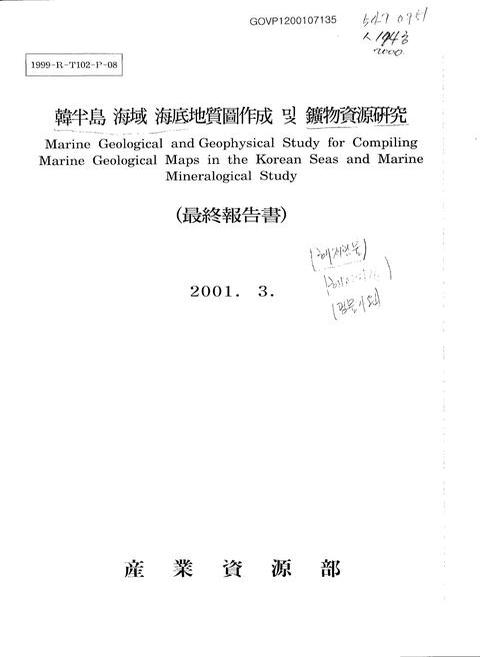
[표제지 등]=0,1,2
제출문=1,3,2
요약문=3,5,4
목차=7,9,2
List of Figures=9,11,6
List of Tables=15,17,2
제1장 서론=17,19,4
제2장 제주서남부해역=21,23,1
제1절 자료취득=21,23,1
1. 선위 측정 자료=21,23,4
2. 탄성파 자료=24,26,2
3. 중력 자료=26,28,1
4. 자력 자료=26,28,2
5. 수심 자료=27,29,1
6. 주상 시추 자료=28,30,3
제2절 자료처리 및 분석=31,33,1
1. 탄성파 자료처리 및 분석=31,33,20
2. 중력 자료 처리 및 분석=50,52,8
3. 자력 자료 처리 및 분석=57,59,7
4. 해저 지형 자료 처리 및 분석=63,65,2
5. 천부지층자료 처리 및 해석=65,67,12
6. 주상 시추 시료 처리 및 분석=76,78,4
제3장 흑산서부해역=80,82,1
제1절 자료취득=80,82,3
제2절 자료처리 및 분석=83,85,1
1. 탄성파 자료처리 및 분석=83,85,15
2. 중력 자료 처리 및 분석=97,99,3
3. 자력 자료 처리 및 분석=99,101,5
4. 해저 지형 자료 처리 및 분석=103,105,1
5. 천부지층자료 처리 및 분석=103,105,19
6. 주상 시추 시표처리 및 분석=122,124,2
제4장 해저광물연구=124,126,1
제1절 서언=124,126,2
제2절 조사지역 개요=125,127,1
1. 원산도 납부해역=125,127,5
2. 무안만 해역=129,131,5
제3절 연구방법=134,136,1
1. 야외조사=134,136,6
2. 실내 분석 빙법=138,141,6
제4절 연구결과=145,147,1
1. 원산도 남부해역=145,147,23
2. 무안만 해역=167,169,18
제5절 자원부존 평가=184,186,1
1. 원산도 남부해역=184,186,2
2. 무안만 해역=185,187,4
제6절 토의 및 결론=189,191,5
제5장 결론=194,196,3
참고문헌=197,199,6
부록=203,205,1
부록1. Result of Grain Size Analysis=203,205,4
부록2. Result of Geochemical Analysis=207,209,4
부록3. Radiographs of Piston Cores=211,213,189
Fig1-1 Geophysical traverse lines with core sampling sites of the study area=18,20,1
Fig1-2 Geophysical traverse lines with core sampling sites of the study area=19,21,1
Fig2-1 GPS problem where raw GPS shows spikes. Trinav Estimator is rejecting the bad data, and gives a smooth estimator track=23,25,1
Fig2-2 The diagram of magnetic survey=27,29,1
Fig2-3 lsophch map of total sediments (contours in seconds)=32,34,1
Fig2-4 Stack section showing sequences I,II,III and IV=34,36,1
Fig2-5 Stack section showing sequences I,II,III and IV. The acoustic basement is likely of vocanic origin=35,37,1
Fig2-6 Isopach map of scquence IV (contours in seconds)=36,38,1
Fig2-7 Stack section showing sequences I,Il,III and IV. The sequence III fills a half graben made by listhc faults=38,40,1
Fig2-8 Stack section showing sequences I,II,IIl and IV. The sequence TV fills a half graben made by Iistric faults. Note that the sequence III displays hummocky renections in the lower part, whereas it is suparallel...(이미지참조)=39,41,1
Fig2-9 Isopach map of sequence III (contours in seconds)=41,43,1
Fig2-10 lsopach map of sequence lI (contours in seconds)=43,45,1
Fig2-11 Isopach map of subsequence IC (contours in seconds)=45,47,1
Fig2-12 First trace single channel profile showing sequences I, II, III. It shows alternations of acoustically stratified and scattered reflections that may be comparable to alternations of coarsely stratified...(이미지참조)=46,48,1
Fig2-13 Stacked section showing well-expressed hummocky reflections of the subsequence IC possibly merged with the subsequence IB=47,49,1
Fig2-14 Stackcd section showing that the subsequence IB in its depocentcr is hummocky in seismic reflection and much thickcr than subsequences IA and IC=48,50,1
Fig2-15 Isopach map of subsequence IB (contours in seconds)=49,51,1
Fig2-16 Stack section showing hummocky reflections of the subsequence IA in its depocenter where it is lnuch thicker than subsequence IB and IC are=51,53,1
Fig2-17 Isopach map of subsequence IA (contours in seconds)=52,54,1
Fig2-18 The height difference between known absolute value of Jangchon and gravity meter of Tamhae II=54,56,1
Fig2-19 Free-air gravity anomaly map for 1999 survey=58,60,1
Fig2-20 Total intensity anomaly map for 1999 survey=62,64,1
Fig2-21 Bathymetric map of the study area (contour interval is 5 m). Dotted lines denote track lines=64,66,1
Fig2-22 High-resolution (3.5 kHz) seismic profile (Line 99-09) showing two sedimentary units.Note that lower unit (III) above acoustic basement shows hummocky with weakly stratified reflectors, whereas upper unit (I) is...(이미지참조)=66,68,1
Fig2-23 High-resolution (3.5 kHz) seismic profile (Line 99-07) showing unit II=68,70,1
Fig2-24 High-resolution (3.5 kHz) seismic profile (Line 99-12) shows three sedimentary units=69,71,1
Fig2-25 High-resolution (3.5 kHz) seismic profile (Line 99-02) showing sand ridge (IV)=71,73,1
Fig2-26 High-resolution (3.5 kHz) seismic profile (Line 99-02) showing two sedimentary units=72,74,1
Fig2-27 High-resolution (3.5 kHz) seismic profilc (Line 99-01) showing channel fill deposits (V)=73,75,1
Fig2-28 Sediment Types of surface sediment in the study area=79,81,1
Fig3-1 Stack section showing sequence I,II,III and IV The sequense IV fills a half graben developed on the former basin fill (A)=84,86,1
Fig3-2 Isopach map of total sedimentary sequences (contours in seconds)=85,87,1
Fig3-3 Stack section showing the acoustic basement comprising volcanic (A) and old sedimentary (B) rocks=87,89,1
Fig3-4 Isopach map of sequence IV (contours in seconds)=88,90,1
Fig3-5 Stack section showing sequences I,II and IV. Note that a half graben was filled with syn-rift sedimentary strata. The half-graben fill is divisible into two subsequences, based on a mid-reflectors (open anroAv heads)...(이미지참조)=90,92,1
Fig3-6 Isopach map of sequence III (contours in seconds)=91,93,1
Fig3-7 Isopach map of sequence II (contours in seconds)=93,95,1
Fig3-8 Stack section showing sequences I,II and IV. Note that the sequence II is divisible into two subsequences, based on a laterally continuous low-amplitude reflector. Paleochannels and fills (open arrow head) are well...(이미지참조)=95,97,1
Fig3-9 Isopach map of sequence I (contours in seconds)=96,98,1
Fig3-10 Track section showing sequence I that is largely chaoticreflected with some parallel reflectors in the lower part. The reflectors are increasingly distinctive to the left=98,100,1
Fig3-11 Free-air gravity anomaly map for 2000 survey=100,102,1
Fig3-12 Total intencity anomaly map for 2000 survey=102,104,1
Fig3-13 Bathymetric map of the study area (contour interval is 5 m). Dotted lines denote track lines=104,106,1
Fig3-14 High-resolution (3.5 kHz) seismic profile (Line map-04) collected from southwestern part of study area, showing three(I,II, and IV) sedimentary units=107,109,1
Fig3-15 High-resolution (3.5 kHz) seismic profile (Line map-09) collected from the northern part of the study area, showing three (I,II, and IV) units above the acoustic basement=108,110,1
Fig3-16 High-resolution (3.5 kHz) seismic profile (Line map-07) collected from the central part of the study area, showing three (I,II, and IV) units=109,111,1
Fig3-17 High-resolution (3.5 kHz) seismic profiles (Line map-08, A; Line map-09, B) collected from the western part of the study area, showing a sand ridge (unit III) overIying unit IV. Uint III was partly covered by unit I...(이미지참조)=110,112,1
Fig3-18 High-resolution (3.5 kHz) seismic profile (Line map-09) collected from the northern part of the study area=112,114,1
Fig3-19 High-resolution (3.5 kHz) seismic profile (Line map-09) collected from the northwestern part of the study area, showing three (I,IV,and V) units above thc acoustic basement showing two units (II and IV). Unit IV...(이미지참조)=114,116,1
Fig3-20 High-resoIution (3.5 kHz) seismic profile (Line map-09) coIlected from northern part of study area, showing twu (II and V) sedimentary units=115,117,1
Fig3-21 A schematic diagram of the sequence-straigraphic model, showing three systems tracts and their bounding surfaces (modified from vail,1987)=117,119,1
Fig3-22 Proposed sequence stratigraphic architecture of the study area=121,123,1
Fig3-23 Sediment Types of surface sediment in the study area=123,125,1
Fig4-1 Geologic map of the Wonsando area=127,129,1
Fig4-2 Geologic map of the Muan area=131,133,1
Fig4-3 Track lines for seismic survey of the Wonsando area=136,138,1
Fig4-4 Track lines for echo-sounding survey of the Wonsando area=137,139,1
Fig4-5 Location map of sampling sites of the Wonsando area=138,140,1
Fig4-6 Location map of sampling sites of the Muan Bay area=140,142,1
Fig4-7 Track lines for seismic survey of the Muan Bay area=141,143,1
Fig4-8 Track lines for echo-sounding survey of Muan Bay area=142,144,1
Fig4-9 Bathymetric map of the Wonsando area=146,148,1
Fig4-10 Distribution map of the surface sediment types in the Wonsando area=147,149,1
Fig4-11 Distribution map of mean grain size of the surface sediment samples from the Wonsando area=149,151,1
Fig4-12 Distribution map of sorting values (in (이미지참조)) of the surfacc sediment samples from the Wonsando area=150,152,1
Fig4-13 Distribution map of Skewness of the surface sediment samples from the Wonsando area=152,154,1
Fig4-14 Distribution map of kurtosis of the surface sedirment samples from the Wonsando area=153,155,1
Fig4-15 Seismic track lines. The figure numbers are the sites of the seismic profiles=154,156,1
Fig4-16 Scismic profile of Line 01 (track line shown as Fig.4-15)=155,157,1
Fig4-17 Seismic profile of Line 02 (track line shown as Fig.4-15)=156,158,1
Fig4-18 Seismic profile of Line 03 (track line shown as Fig.4-15)=157,159,1
Fig4-19 Seismic profile of Line 07 (track line shown as Fig.4-15)=160,162,1
Fig4-20 Distribution map showing the heavy mineral contents in 1~4(이미지참조) fractions of bottom sediment=161,163,1
Fig4-21 Distribution map showing the heavy mineral contents in the total bottom sediment=163,165,1
Fig4-22 Microphotographs for the1~4(이미지참조) heavy mineral fractions of surfacc sediments under the poarizing microscope=165,167,1
Fig4-23 Bathymetric map of the Muan Bay area=168,170,1
Fig4-24 Columnar section, vertical variations of sediment composition and mineral composition of 00M-C01=170,172,1
Fig4-25 Columnar section, vertical variations of sediment composition and mineral composition of 00M-C03=171,173,1
Fig4-26 Columnar section, vertical variations of sediment composition and mineral composition of 00M-C04=172,174,1
Fig4-27 Columnar section, vertical variations of sediment composition and mineral composition of 00M-C05=174,176,1
Fig4-28 Columnar section, vertical variations of sediment composition and mineral composition of 00M-CO6=176,178,1
Fig4-29 Columnar section, vertical variations of sediment composition and mineral composition of 00M-C07=177,179,1
Fig4-30 Columnar section, vertical variations of sediment composition and mineral composition of 00M-C08=178,180,1
Fig4-31 Columnar section, vertical variations of sediment composition and mineral composition of 00M-C09=179,181,1
Fig4-32 Distribution map showing the zircon contents in 1~4(이미지참조) fractions of heavy minerals=186,188,1
Fig4-33 Distribution map showing the zircon contents in the total bottom sediment=190,192,1
jpg
Fig2-19 Free air gravity anomaly map for 1999 survey=58,60,1
Fig2-20 Total intensity anomaly map for 1999 survey=62,64,1
Fig3-12 Total intensity anomaly map for 2000 survey=102,104,1
| 등록번호 | 청구기호 | 권별정보 | 자료실 | 이용여부 |
|---|---|---|---|---|
| 0000868827 | 549.0951 ㅅ194ㅎ | 2000 | 서울관 서고(열람신청 후 1층 대출대) | 이용가능 |
*표시는 필수 입력사항입니다.
| 전화번호 |
|---|
| 기사명 | 저자명 | 페이지 | 원문 | 기사목차 |
|---|
| 번호 | 발행일자 | 권호명 | 제본정보 | 자료실 | 원문 | 신청 페이지 |
|---|
도서위치안내: / 서가번호:

우편복사 목록담기를 완료하였습니다.
*표시는 필수 입력사항입니다.
저장 되었습니다.
