
 대표어
대표어

권호기사보기
| 기사명 | 저자명 | 페이지 | 원문 | 기사목차 |
|---|
결과 내 검색
동의어 포함
목차
[표제지 등]=0,1,2
요약문=i,3,4
Contents=v,7,2
Table Caption=vii,9,1
Figure Caption=viii,10,5
ABSTRACT=xiii,15,2
I. 서론=1,17,2
II. 조사 내용 및 방법=3,19,1
1. 조사기간=3,19,1
2. 조사내용=3,19,1
가. 흡음재의 흡음성능=3,19,3
나. 흡음재의 흡음성능 평가방법=5,21,3
다. 방음벽의 흡음계수 및 투과손실=7,23,1
3. 측정방법=7,23,1
가. 흡음계수 측정=7,23,6
나. 투과손실 측정=12,28,3
III. 연구결과 및 고찰=15,31,1
1. 흡음재의 흡음성능=15,31,1
가. 측정기기의 기록응답속도에 따른 흡음계수 변화=15,31,2
나. 흡음재별 흡음특성 비교=16,32,3
다. 두께 변화에 따른 흡음계수 비교=18,34,6
라. 밀도 변화에 따른 흡음계수 비교=23,39,5
마. 표면마감에 따른 흡음계수 비교=27,43,12
바. 배후공기층 크기변화에 따른 흡음계수 비교=38,54,17
사. 흡음계수 평가방법에 따른 흡음계수 비교=55,71,6
아. 타 기관과의 흡음계수 비교=60,76,4
자. 측정방법(관내법)에 따른 흡음계수 비교=64,80,4
2. 방음벽의 흡음계수 및 투과손실=68,84,1
3. 흡음재별 단가 비교=69,85,3
IV. 결론=72,88,3
참고문헌=75,91,3
부록=78,94,1
잔향실법 흡음계수 측정결과=79,95,45
관내법 흡음계수 측정결과=124,140,16
영문목차
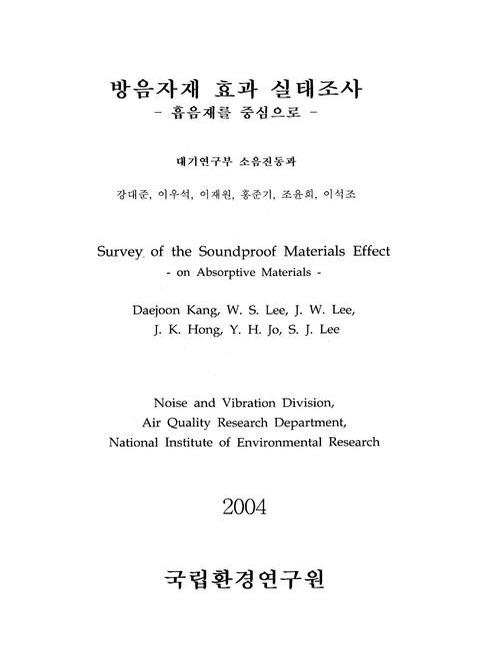
[title page etc.]=0,1,2
Abstract=i,3,4
Contents=v,7,2
Table Caption=vii,9,1
Figure Caption=viii,10,5
ABSTRACT=xiii,15,2
I. Introduction=1,17,2
I. Contents and Method=3,19,1
1. Investigation Period=3,19,1
2. Investigation Suobject=3,19,1
a. Performance of Absorptive Materials=3,19,3
b. Performance Test Method of Absorptive Materials=5,21,3
c. Absorption Coefficient and Transmission Loss of Noise Barrier=7,23,1
3. Measurement Method=7,23,1
a. Absorption Coefficient Test=7,23,6
b. Transmission Loss Test=12,28,3
III. Results and Discussion=15,31,1
1. Absorptive Performance of Absorptive Materials=15,31,1
a. Absorption Coefficient according to Recording Response Speed of Instrument=15,31,2
b. Absorption Coefficient of Absorptive Materials=16,32,3
c. Absorption Coefficient according to the Thichless Change=18,34,6
d. Absorption Coefficient according to the Density Change=23,39,5
e. Absorption Coefficient according to the Surface Materials=27,43,12
f. Absorption Coefficient according to the Air Gap Thickness=38,54,17
g. Absorption Performance by NRC and Weighted Sound Absorption Coefficient=55,71,6
h. Absorption Coefficient of Other Institutes=60,76,4
i. Absorption Coefficient according to Test Method(Impedence Tube Method)=64,80,4
2. Absorption Coefficient and Transmission Loss of Noise Barrier=68,84,1
3. Unit Price Comparison of Absorptive Materials=69,85,3
IV. Conclusion=72,88,3
Reference=75,91,3
Appendix=78,94,62
(Fig. 2-1) Reference curve for weighted absorption coefficients=6,22,1
(Fig. 2-2) Schematic diagram of measuring instruments in a reverberation room=9,25,1
(Fig. 2-3) Selection of source position=9,25,1
(Fig1. 2-4) Selection of microphone position=10,26,1
(Fig. 2-5) Schematic diagram of measuring instruments for impedance tube method=12,28,1
(Fig. 2-6) Schematic diagram of measuring instruments in a reverberation room=13,29,1
(Fig. 3-1) Absorption coefficient according to recording response speed=15,31,1
(Fig. 3-2) Comparison of absorptive performance of absorptive materials(thickness 25 mm)=17,33,1
(Fig. 3-3) Comparison of absorptive performance of absorptive materials(thickness 50 mm)=18,34,1
(Fig. 3-4) Absorption coefficient according to thickness of materials(polyester)=19,35,1
(Fig. 3-5) Absorption coefficient according to thickness of material(polyurethane)=20,36,1
(Fig. 3-6) Absorption coefficient according to thickness of material(inconbustible melamine)=21,37,1
(Fig. 3-7) Absorption coefficient according to thickness of material(mineral wood)=22,38,1
(Fig. 3-8) Absorption coefficient according to thickness of material(fibrous natural wood)=23,39,1
(Fig. 3-9) Absorption coefficient according to density of material(polyester)=24,40,1
(Fig. 3-10) Absorption coefficient according to density of material(glass wool,C. Co.)=25,41,1
(Fig. 3-11) Absorption coefficient according to density of material(glass wool,N. CO.)=26,42,1
(Fig. 3-12) Absorption coefficient according to density of material(scrub stem)=27,43,1
(Fig. 3-13) Absorption coefficient according to facing of material (incombustible fabric+polyester 25mm)=28,44,1
(Fig. 3-14) Absorption coefficient according to facing of material(incombustible fabric+polyurethane 25 mm)=29,45,1
(Fig. 3-15) Absorption coefficient according to facing of matenal(peforated resin+polyurethane 25 mm)=30,46,1
(Fig. 3-16) Absorption coefficient according to lacing of material(perforated resinㆍpolyurethane 50 mm)=31,47,1
(Fig. 3-17) Absorption coefficient according to facing of material(incombustible fabric,perforated resin,mineral compound + incombustible melamine 25 mm)=32,48,1
(Fig. 3-18) Absorption coefficient according to facing of material(perforated resin + incombustible melanune 50 mm)=33,49,1
(Fig. 3-19) Absorption coefficient according to facing of material(perforated metallic panel + incombustible melamine 20 mm + incombustible fabric)=34,50,1
(Fig. 3-20) Absorption coefficient according to facing of material(mineral compound . glass wool 25,50 mm)=35,51,1
(Fig. 3-21) Absorption coefficient according to lacing of material(glass wool 50 min/64 K)=36,52,1
(Fig. 3-22) Absorption coefficient according to facing of material(glass cloth + glass wool + vapor barrier 90,120 mm)=37,53,1
(Fig. 3-23) Absorption coefficient according to thickness of air-gap(polyester 25 mm)=39,55,1
(Fig. 3-24) Absorption coefficient according to thickness of air-gap(polyester 50 mm)=40,56,1
(Fig. 3-25) Absorption coefficient according to thickness of air-gap(incombustible fabricㆍpolyester 25 mm)=41,57,1
(Fig. 3-26) Absorption coefficient according to thickness of air-gap(polyester 9 mm)=42,58,1
(Fig. 3-27) Absorption coefficient according to thickness of air-gap(polyurethane 25 mm)=42,58,1
(Fig. 3-28) Absorption coefficient according to thickness of air-gap(polyurethane 50 mm)=43,59,1
(Fig. 3-29) Absorption coefficient according to thickness of air-gap(incombustible fabric + polyurethane 25 mm)=43,59,1
(Fig. 3-30) Absorption coefficient according to thickness of air-gap(perforated resin + polyurethane 25 mm)=44,60,1
(Fig. 3-31) Absorption coefficient according to thicknesss of air-gap(perforated resin + polyurethane 50 mm)=45,61,1
(Fig. 3-32) Absorption coefficient according to thickness of air-gap(incombustible melamine 25,50 mm)=46,62,1
(Fig. 3-33) Absorption coefficient according to thickness of air-gap(incombustible fabric + incombustible melamine 25 mm)=46,62,1
(Fig. 3-34) Absorption coefficient according to thichkness of air-gap(perforated resin + incombustible melamine 25,50 mm)=47,63,1
(Fig. 3-35) Absorption coefficient according to thichkness of air-gap(mineral compound + incombustible melamine 25 mm)=48,64,1
(Fig. 3-36) Absorption coefficient according to thicknness of air-gap(perforated metallic panel + incombustible melamine 20 mm + incombustible fabric)=48,64,1
(Fig. 3-37) Absorption coefficient according to thickness of air-gap(glass wool 50 mm)=49,65,2
(Fig. 3-38) Absorption coefficient according to thickness of air-gap(mineral compound + glass wool 25 mm)=51,67,1
(Fig. 3-39) Absorption coefficient according to thickness of air-gap(mineral compound + glass wool 50 mm)=51,67,1
(Fig. 3-40) Absorption coefficient according to thicknness of air-gap(incombustible fabric + glass wool,mineral wool)=52,68,1
(Fig. 3-41) Absorption coefficient according to thickness of air-gap(scrub stem)=53,69,1
(fig. 3-42) Absorption coefficient according to thickness of air-gap of faced materials=54,70,1
(Fig. 3-43) Correlation between noise reduction coefficient and weighted sound absorption coefficient=59,75,1
(Fig. 3-44) Comparison of absorption coefficient measured by NIER and other institutes without air-gap=62,78,1
(Fig. 3-45) Comparison of absorption coefficient measured by NIER and other institutes with 50 mm air-gap=63,79,1
(Fig. 3-46) Comparison of absorption coefficient by reverberation method and impedance tube method=65,81,2
(Fig. 3-47) Absorptive performance of noise barrier=68,84,1
| 등록번호 | 청구기호 | 권별정보 | 자료실 | 이용여부 |
|---|---|---|---|---|
| 0001062400 | 620.23 ㄱ427ㅂ | 서울관 서고(열람신청 후 1층 대출대) | 이용가능 | |
| 0001062401 | 620.23 ㄱ427ㅂ | 서울관 서고(열람신청 후 1층 대출대) | 이용가능 |
*표시는 필수 입력사항입니다.
| 전화번호 |
|---|
| 기사명 | 저자명 | 페이지 | 원문 | 기사목차 |
|---|
| 번호 | 발행일자 | 권호명 | 제본정보 | 자료실 | 원문 | 신청 페이지 |
|---|
도서위치안내: / 서가번호:

우편복사 목록담기를 완료하였습니다.
*표시는 필수 입력사항입니다.
저장 되었습니다.
