
 대표어
대표어
권호기사보기
| 기사명 | 저자명 | 페이지 | 원문 | 기사목차 |
|---|
결과 내 검색
동의어 포함
목차
표제지=0,1,1
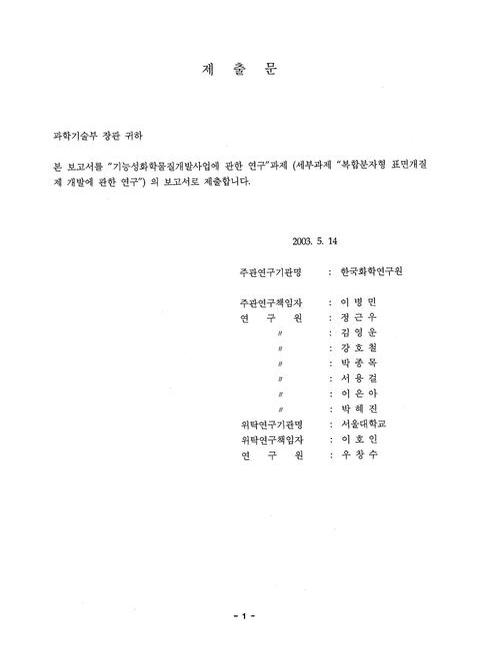
제출문=1,2,1
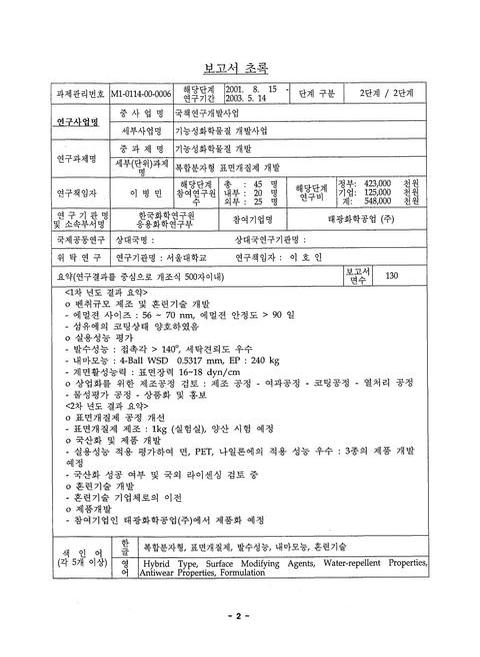
보고서 초록/이병민=2,3,1
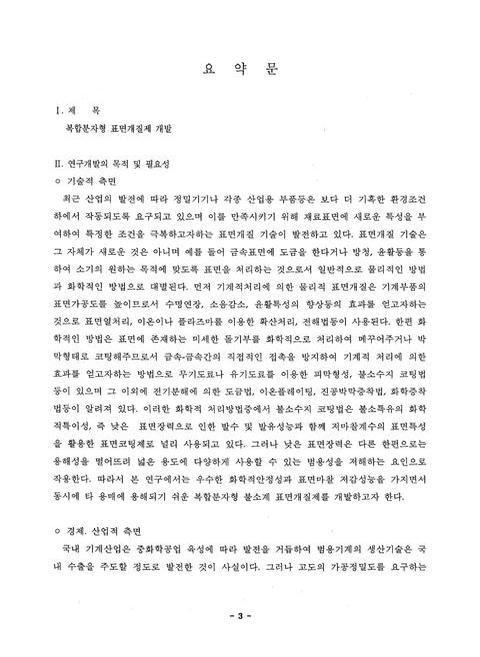
요약문=3,4,4
SUMMARY=7,8,1
CONTENTS=8,9,9
목차=17,18,4
표목차=21,22,2
그림목차=23,24,3
제1장 연구개발과제의 개요=26,27,1
제1절 연구목적=26,27,1
제2절 연구개발과제의 필요성=26,27,2
제3절 연구개발의 범위=28,29,2
제2장 국내외 기술개발 현황=30,31,2
제3장 연구개발수행 내용 및 결과=32,33,1
제1절 이론적 배경=32,33,1
1. 표면개질제의 작용=32,33,2
2. 계면활성제의 정의와 역할=33,34,3
3. 엔진보호 코팅제=35,36,2
4. 발수제=36,37,4
제2절 실험방법=40,41,1
1. 섬유 종이용 표면처리제=40,41,1
가. 시약 및 사용기기=40,41,1
나. 불소계 계면활성제의 합성=40,41,2
(1) Perfluorooctyl glycidyl ether(F8GE)의 합성=41,42,1
(2) Perfluoropentyl glycidyl ether(F5GE)의 합성=41,42,1
(3) Perfluorohexyl glycidyl ether(F6GE)의 합성=41,42,1
(4) Perfluorodecyl glycidyl ether(F10GE)의 합성=41,42,4
2. 엔진보호 코팅제=44,45,1
가. 시약 및 기기분석=44,45,2
나. 물성분석=45,46,1
다. 합성=45,46,2
3. 발수 표면 개질제=46,47,1
가. 과불화기를 포함한 아크릴레이트 단량체의 합성=46,47,1
(1) 시약 및 기기분석=46,47,1
(2) 합성=46,47,2
나. 수용성 에멀젼 중합체의 합성=47,48,1
(1) 시약 및 기기분석=47,48,1
(2) 합성=47,48,1
(3) 물성분석 방법=47,48,1
(가) 발수도 분석 (KS K0590)=48,49,3
(나) 세탁 견뢰도 분석 (KS K0430)=50,51,2
제3절 연구결과=52,53,1
1. 섬유종이용 표면처리제=52,53,1
가. 서론=52,53,1
나. 연구결과 및 고찰=52,53,1
(1) Perfluoroalkyl glycidyl ether의 합성=52,53,1
(가) 용매 효과=52,53,3
(나) 수산화나트륨 효과=54,55,1
(다) Epichorohydrin 효과=54,55,2
(라) 촉매 효과=55,56,1
(마) 반응온도의 영향=55,56,2
(바) 최적화된 반응조건=56,57,6
(2) Perfluoroalkyl glycidyl ether로부터 유도된 hybrid 화합물의 합성과 물성=61,62,1
(가) HYbrid 2차아민 화합물(FnHmN)=61,62,2
(나) HYbrid 3차아민 화합물(2FnHmN)=62,63,2
(다) Ethylene oxide가 부가된 hybrid 3차아민 화합물(FnHmN-kEO)=63,64,1
(라) HYbrid 암모니아 화합물(Q2FnHmN)=63,64,2
(마) Ethylene oxide가 부가되 shybrid 암모늄 화합물(QFnHmN-kEO)=64,65,1
(바) perfluoroalkyl glycidyl ehter로부터 유도된 hybrid 화합물 (Q2FmHn,FnHm-kEO,QfnHm)의 물성=64,65,9
다. 결론=72,73,1
2. 불소계 엔진 코팅제=73,74,1
가. 서론=73,74,1
나. 연구결과 및 고찰=73,74,1
(1) 합성=73,74,3
(2) 불소계 폴리올 에스테르의 용해성=75,76,3
(3) 유용성 Semi-Fluorinated 폴리올 에스테르의 마모성=77,78,3
(4) 유용성 Semi-Fluorinated 폴리올 에스테르의 급압성=79,80,3
(5) 유용성 NPG Semi-Fluorinated 폴리올 에스테르의 엔진 오일 첨가 효과=81,82,2
다. 결론=82,83,1
3. 불소계 발수 표면개질제=83,84,1
가. 서론=83,84,1
나. 결과 및 토론=83,84,1
(1) 불소계 단량체의 합성=83,84,5
(2) 에멀젼 중합=88,89,1
(가) AIBN 개시제 사용=88,89,6
(나) Ammonium persulfate 개시제 사용=93,94,2
(다) 2,2-azobis(2-methylpropionamidine) dihydrochloride 개시제=94,95,3
(라) 전문 발수 평가업체 1차 성능 평가=96,97,2
(마) 기본 물성 up-grade를 위한 실험=97,98,1
① 제타 전위 실험=97,98,2
② 발수도 향상 실험=98,99,3
③ 에멀젼의 pH=101,102,1
④ 세탁 견뢰도(내구성) 향상 실험=101,102,2
⑤ 종합평가=102,103,3
제4절 위탁연구결과=105,106,1
1. 활성기의 전자적이 특성 제어=105,106,3
2. 촉매의 구조에 따른 메카니즘 규명=108,109,4
제4장 목표달성도 및 관련분야에의 기여도=112,113,1
제5장 연구개발결과의 활용계획=113,114,1
제6장 연구개발과정에서 수집한 해외과학기술정보=114,115,4
제7장 참고문헌=118,119,2
특정연구개발사업 연구결과 활용계획서=120,121,10
영문목차
title page=0,1,1
SUBMISSION=1,2,1
ABSTRACTS OF REPORTS=2,3,1
SUMMARY (Korea)=3,4,4
SUMMARY (English)=7,8,1
CONTENTS (English)=8,9,9
CONTENTS (Korean)=17,18,4
List of Tables=21,22,2
List of Figures=23,24,3
CHAPTER I INTRODUCTION=26,27,1
Section I Research Objectives=26,27,1
Section II importance of Research Development=26,27,2
Section III Research Scope=28,29,2
CHATRER II FORENIGN AND DOMESTIC RESEARCH ACTIVITIES=30,31,2
CHAPTER III RESEARCH SCOPE AND RESULTS=32,33,1
Section I Research Background=32,33,1
1. Function of Surface Modyfying Agents=32,33,2
2. Definition of Surface Modyfying Agents=33,34,3
3. Coating Agents for Engine=35,36,2
4. Water-repellent Agents=36,37,4
Section II Experimental=40,41,1
1. Surface Treatments for Fabric and Paper=40,41,1
a. Reagents and Instrument=40,41,1
b. Syntheses of Fluoro Surfacts=40,41,2
(1) Syntheses of Perfluorooctyl glycidyl ether(F8GE)=41,42,1
(2) Syntheses of Perfluoropentyl glycidyl ether(F5GE)=41,42,1
(3) Syntheses of Perfluorohexyl glycidyl ether(F6GE)=41,42,1
(4) Syntheses of Perfluorodecyl glycidyl ether(F10GE)=41,42,4
2. Coating Agents for Engine=44,45,1
a. Reagent and Instrument=44,45,2
b. Analyses of Physical Properties=45,46,1
c. Syntheses=45,46,2
3. Water-repellent Agents=46,47,1
a. Syntheses of Acrylate Monomer Containing Perfluoro Group=46,47,1
(1) Reagent and Instrument=46,47,1
(2) Syntheses=46,47,2
b. Syntheses of Emulsion Polymer=47,48,1
(1) Reagent and Instrument=47,48,1
(2) Syntheses=47,48,1
(3) Analyses of Physical Properties=47,48,1
(a) Analyses of Water-repellent (KS K0590)=48,49,3
(b) Analyses of Cleaning Properties (KS K0430)=50,51,2
Section III Results and Discussion=52,53,1
1. Surface Treatment for Fabric and Paper=52,53,1
a. Introduction=52,53,1
b. Results and Discussion=52,53,1
(1) Synthese of Perfluoroalkyl glycidyl ether=52,53,1
(a) Solvern Effects=52,53,3
(b) NaOH Effects=54,55,1
(c) Epichlorohydrin Effects=54,55,2
(d) Catalyst Effects=55,56,1
(e) Reaction Temperature Effects=55,56,2
(f) Optimum Condition=56,57,6
(2) Syntheses and Physical Properties of Hybrid Compounds=61,62,1
(a) Hybrid Secondary Amine Compounds (FnHmN)=61,62,2
(b) Hybrid Tertiary Amine Compounds (2FnHmN)=62,63,2
(c) Hybrid Tertiary Amine Compounds Containing Ethylene Oxide (FnHmN-kEO)=63,64,1
(d) Hybrid Ammonium Compounds (Q2FnHmN)=63,64,2
(e) Hybrid Ammonium Compounds Containing Ethylene Oxide (QFnHmN-kEO)=64,65,1
(f) Physical Properties of Hybrid Compounds Containing Perfluoroalkyl Glycidyl Ether (Q2FmHn,FnHm-kEO,QFnHm)=64,65,9
c. Conclusion=72,73,1
2. Coating Agents for Engine=73,74,1
a. Introduction=73,74,1
b. Results and Discussion=73,74,1
(1) Syntheses=73,74,3
(2) Solubilities of Semi-fluorinated Polyol Esters=75,76,3
(3) Anti-wrar Properties of Oil Soluble Semi-Fluorinated Polyol Esters=77,78,3
(4) Extreme Pressure Properties of Oil Soluble Semi-Fluorinated Polyol Esters=79,80,3
(5) Addition Effects into Engine Oil of NPG-Polyol Esters=81,82,2
c. Conclusion=82,83,1
3. Water-repellent Agents=83,84,1
a. Results and Discussion=83,84,1
b. Results and Discussion=83,84,1
(1) Syntheses of Fluorinated Monomer=83,84,5
(2) Emulsion Polymerization=88,89,1
(a) AIBN Initiator=88,89,6
(b) Ammonuium persulfate Initiator=93,94,2
(c) 2,2-azobis(2-methylpropionamidine) dihydrochloride Initiator=94,95,3
(d) First Physical Properties Evaluation Experiment in Special Company=96,97,2
(e) Experiments for Physical Properties Up-grade=97,98,1
① Zetta Value=97,98,2
② Water-repellent Up-grade=98,99,3
③ pH of Emulsion=101,102,1
④ Cleaning Properties Up-grade=101,102,2
⑤ Summary of Evaluation=102,103,3
Section IV Commit Research Results=105,106,1
1. Electronic Property Control of Activity Groups=105,106,3
2. Mechanism Proof of Catalyst Structure=108,109,4
CHAPTER IV ACHIEVEMENT OF RESEARCH OBJECTIVES AND FOREIGN CONTRIBUTION=112,113,1
CHAPTER V APPLICATION PLAN OF RESULTS=113,114,1
CHAPTER VI FOREIGN INFORMATION=114,115,4
CHAPTER VII REFERENCES=118,119,12
Fig. 1-1 연구개발 추진체계=28,29,1
Fig. 3-1 The General concept of adsorbed film=32,33,1
Fig. 3-2 The general properties of surfactant in aqueous solution=34,35,1
Fig. 3-3 엔진 내부 코팅 메카니즘=36,37,1
Fig. 3-4 Contact angle and Young's equation=37,38,1
Fig. 3-5 padding 시험기=48,49,1
Fig. 3-6 열경화용 오븐=48,49,1
Fig. 3-7 발수도 시험장치=48,49,1
Fig. 3-8 발수도 시험장치의 사양=48,49,1
Fig. 3-9 세탁 견뢰도 시험용 튜브=51,52,1
Fig. 3-10 세탁 견뢰도 시험기=51,52,1
Fig. 3-11a Compositions of the reaction mixtures according to the amount of wzter used for the formation of octyl glycidyl ether. (a) ■;Octyl glycidyl ether,(b) □;1,3-dioctyloxy-2-propyl glycidyl ether,(c) ◇;3-chloroprop-2-enyl glycidyl,(d) ○;o=57,58,1
Fig. 3-11b Compositions of the reaction mixtures according to the amount of hexane used for the formation of octyl glycidyl ether. (a) ■;Octyl glycidyl ether,(b) □;1,3-dioctyloxy-2-propyl glycidyl ether,(c) ◇;3-chloroprop-2-enyl glycidyl,(d) ○;=57,58,1
Fig. 3-12 Compositions of the reaction mixtures according to the amount of sodium hydroxide used for the formation of perfluorooctyl glycidyl ether. (a) ■;perfluorooctyl glycidyl ether,(b) □;1,3-diperfluorooctyloxy-2-propyl glycidyl ether,(c) ○;pe=58,59,1
Fig. 3-13a ¹H NMR spectrum of perfluorooctyl glycidyl ether(F8GE)=58,59,1
Fig. 3-14b ¹H,¹H COSY NMR spectrum of perfluorooctyl glycidyl ether(F8GE)=59,60,1
Fig. 3-14 Compositions of the reaction mixtures according to the amount of epichlorohydrin used for the formation of perfluorooctyl glycidyl ether. (a) ■;perfluorooctyl glycidyl ether,(b) □;1,3-diperfluorooctyloxy-2-propyl glycidyl ether,(c) ○;per=60,61,1
Fig. 3-15 Compositions of the reaction mixtures according to the amount of TEAH used for the formation of perfluorooctyl glycidyl ether. (a) ■;Perfluorooctyl glycidyl ether,(b) □;1,3-diperfluorooctyloxy-2-propyl glycidyl ether,(c) ○;perfluorooctan=60,61,1
Fig. 3-16 Compositions of the reaction mixtures according to reaction temperature for the formation of perfluorooctyl glycidyl ether. (a) ■;perfluorooctyl glycidyl ether,(b) □;1,3-diperfluorooctyloxy-2-propyl glycidyl ether,(c) ○;perfluorooctanol=61,62,1
Fig. 3-17a ¹H NMR spectrum of F8Hi8N=65,66,1
Fig. 3-17b ¹H NMR spectrum of F8Hi8N=66,67,1
Fig. 3-18 Compositions of the reaction mixtures according to reaction time the reactionof F8H8N with octyl amine. (a) ■;2F8H8N,(b) □;F8H8N,(e) ●;F8GE and (d) ○;Octyl amine.=66,67,1
Fig. 3-19 ¹H NMR spectrum of 2F6H4N=67,68,1
Fig. 3-20a Mass spectrum of the product after the reaction of H6H4N with ethylene oxide at 180 ℃=67,68,1
Fig. 3-20b Mass spectrum of the product after the reaction of H6H4N with ethylene oxide at 120 ℃=68,69,1
Fig. 3-21a Mass spectrum of the product after the reaction of H6H4N with ethylene oxide at 130 ℃=68,69,1
Fig. 3-21b Mass spectrum of F8H8-7EO=69,70,1
Fig. 3-22a Mass spectrum of Q2F5H6N=69,70,1
Fig. 3-22b Mass spectrum of Q2F6H4N=70,71,1
Fig. 3-22c Mass spectrum of Q2F8H8N=70,71,1
Fig. 3-23 Q2F6H4N soluton drop on toluene=71,72,1
Fig. 3-24 Wettability test for various surfactants=71,72,1
Fig. 3-25 Emulsion stability of NP-10(reft),Q2F6H4N(center) and ZONYL-FSA(right).=72,73,1
Fig. 3-26 FT-IR Spectrum of NPG polyol ester=74,75,1
Fig. 3-27 ¹H NMR spectrum of NPG polyol ester=75,76,1
Fig. 3-28 ¹H NMR spectrum of acrylate monomer of entry 1=86,87,1
Fig. 3-29 EI-Mass spectrum of acrylate monomer of entry 1(n=87,88,1
Fig. 3-30 EI-Mass spectrum of acrylate monomer of entry 6(n=87,88,1
Fig. 3-31 Mechanism of AKD synthesis over silica surface=105,106,1
Fig. 3-32 Activities with respect to various amounts of Al grafting on SBA-15=106,107,1
Fig. 3-33 Effect of the amount of TPA in SBA-15 on the reaction temperatures=107,108,1
Fig. 3-34 MOLDI-TOF spectrum of the products formed by catalytic dehydration of stearic acid=108,109,1
Fig. 3-35 Structure of trimer=109,110,1
Fig. 3-36 Activities of various mesoporous silica catalysts according to their structures=110,111,1
Fig. 3-37 Formation scheme of stearic anhydride=110,111,1
*표시는 필수 입력사항입니다.
| 전화번호 |
|---|
| 기사명 | 저자명 | 페이지 | 원문 | 기사목차 |
|---|
| 번호 | 발행일자 | 권호명 | 제본정보 | 자료실 | 원문 | 신청 페이지 |
|---|
도서위치안내: / 서가번호:

우편복사 목록담기를 완료하였습니다.
*표시는 필수 입력사항입니다.
저장 되었습니다.
