

 대표어
권호기사보기
| 기사명 | 저자명 | 페이지 | 원문 | 기사목차 |
|---|
결과 내 검색
동의어 포함
목차
표제지=0,1,1
제출문=1,2,1
요약문=2,3,2
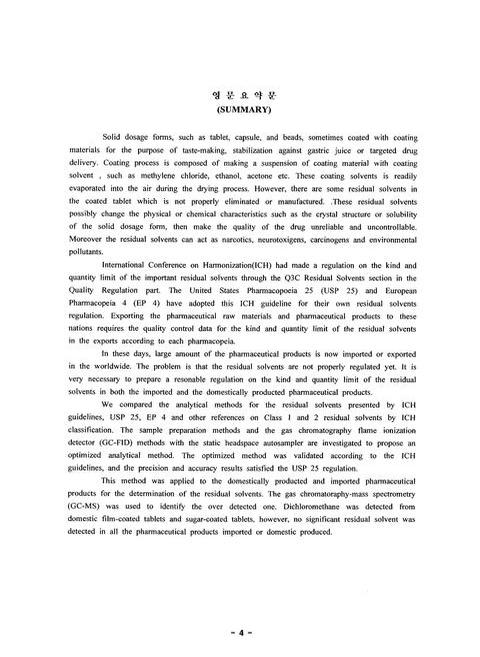
영문요약문(SUMMARY)=4,5,1
목차=5,6,1
표목차=6,7,1
도목차=7,8,1
제1장 서론=8,9,3
제2장 국내ㆍ외 기술개발 현황=11,12,1
제1절 약전에 규정된 방법=11,12,1
1. 미국약전 25개정 (USP 25)에 규정된 방법=11,12,4
2. 유럽약전 4개정 (EP 4)에 규정된 방법=15,16,2
제2절 기타 학술문헌에 제안된 방법=16,17,2
제3장 연구개발 수행내용 및 결과=18,19,1
제1절 연구개발 수행내용=18,19,1
제2절 연구방법=18,19,1
1. 고형제제의 코팅제 중 잔류유기용매 관련 국내외 기준조사,검토 및 관련 자료 수집=18,19,2
2. 국내외 시험방법 검토에 따른 잔류유기용매 시험방법 확립 및 제안=19,20,3
3. 시료채취 계획수립 및 모니터링 실시=21,22,2
4. 시판 고형제제의 생산국가별 잔류유기용매의 동향파악=22,23,1
제3절 연구개발 수행결과=22,23,1
1. 분석방법 검증결과=22,23,7
2. 시판 고형제제에 대한 분석 결과=28,29,3
제4장 연구개발 목표 달성도 및 대외기여도=31,32,1
제1절 연구개발목표 달성도=31,32,1
1. 잔류유기용매 분석방법의 검증=31,32,1
2. 고형제제의 코팅제 중 잔류유기용매 모니터링=31,32,1
제2절 대외기여도=31,32,2
제5장 연구개발결과의 활용성과 및 계획=33,34,1
제6장 기타 중요변경사항=34,35,1
제7장 참고문헌=35,36,1
연구과제(세부과제) 요약서=36,37,2
별첨자료=38,39,34
도1. 건조온도 및 시간에 따른 코팅정제 중 아세톤 농도의 변화 (Change of acetone concentration of a tablet after enteric coating as drying temperature and time)=8,9,1
도2. 건조온도 및 시간에 따른 코팅정제 중 메틸렌클로리드 농도의 변화 (Change of methylene chloride concentration of a tablet after enteric coating as drying temperature and time)=9,10,1
도3. 표준용매의 크로마토그램 (Chromatograms of residual solvents standard. A:chromatogram of similar concentration of residual limit,B:chromatogram of upper concentration of calibration. Peaks 1. 1,1-Dichloroethene 2. Nitromethane 3. Carbon tetrachloride=25,26,1
도4. 1,2 디클로로에탄 표준용매의 크로마토그램 (Chromatograms of 1,2-dichloroethane. A:chromatogram of similar concentration of residual limit,B:chromatogram of upper concentration of calibration)=25,26,1
도5. 메탄올 표준용매의 크로마토그램 (Chromatograms of methanol. A:chromatogram of similar concentration of residual limit,B: chromatogram of upper concentration of calibration)=26,27,1
도6. 표준용매의 크로마토그램 (Chromatograms of residual solvents standard. A:chromatogram of similar concentration of residual limit,B:chromatogram of upper concentration for caLibration. Peaks:1. Acetonitrile 2. Chloroform 3 Cyclohexane 4. 1,2-Dimethoxy=26,27,1
도7. 표준용매의 크로마토그램 (Chromatograms of residual solvents standard. A:chromatogram of similar concentration of residual limit,B:chromatogram of upper concentration of calibration. Peaks:1. Dichlorornethane 2. Hexane 3. 1,2-Dichloroethene 4. 1,1,1-=27,28,1
도8. 표준용매의 크로마토그램(Chromatograms of residual solvents standard. A:chromatogram of similar concentration of residual limit,B:chromatogram of upper concentration of calibration. Peaks:1. 2-Methoxyrnethanol 2. 2-Ethoxymethanol 3. Ethylene glycol 4=27,28,1
도9. 표준용매의 크로마토그램 (Chromatograms of residual solvents standard. A:chromatogram of similar concentration of residual limit,B:chromatogram of upper concentration of calibration. Peaks:1. N,N-dimethylformamide 2. N,N-dimethylacetamide)=28,29,1
도10. F1 제제 중 디클로로메탄 (4.268분) (Dichloromethane in F4 drug product-4.269 min)=29,30,1
도11. F2 제제 중 디클로로메탄 (4.269분) (Dichloromethane in F4 drug product-4.269 min)=29,30,1
도12. F3 제제 중 디클로로메탄 (4.721분) (Dichloromethane in F4 drue product-4.721 min)=29,30,1
도13. F4 제제 중 디클로로메탄 (4.269분) (Dichloromethane in F4 drug product-4.269 min)=30,31,1
도14. S1 제제 중 디클로로메탄 (4.269분) (Dichloromethane in F4 drug product-4.269 min)=30,31,1
*표시는 필수 입력사항입니다.
| 전화번호 |
|---|
| 기사명 | 저자명 | 페이지 | 원문 | 기사목차 |
|---|
| 번호 | 발행일자 | 권호명 | 제본정보 | 자료실 | 원문 | 신청 페이지 |
|---|
도서위치안내: / 서가번호:

우편복사 목록담기를 완료하였습니다.
*표시는 필수 입력사항입니다.
저장 되었습니다.
