
 대표어
권호기사보기
| 기사명 | 저자명 | 페이지 | 원문 | 기사목차 |
|---|
결과 내 검색
동의어 포함
목차
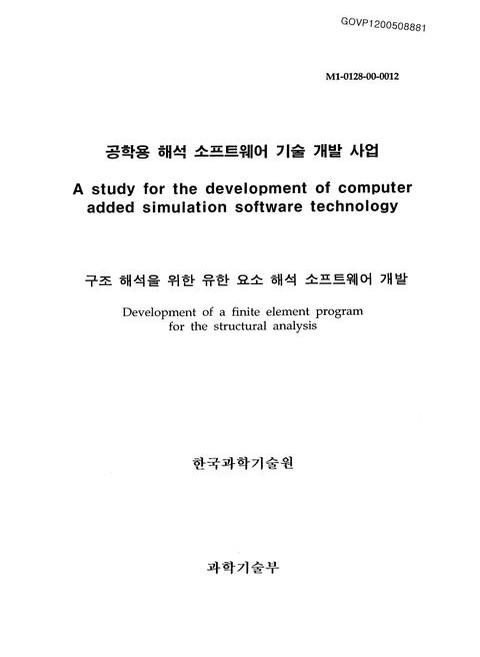
표제지=0,1,1
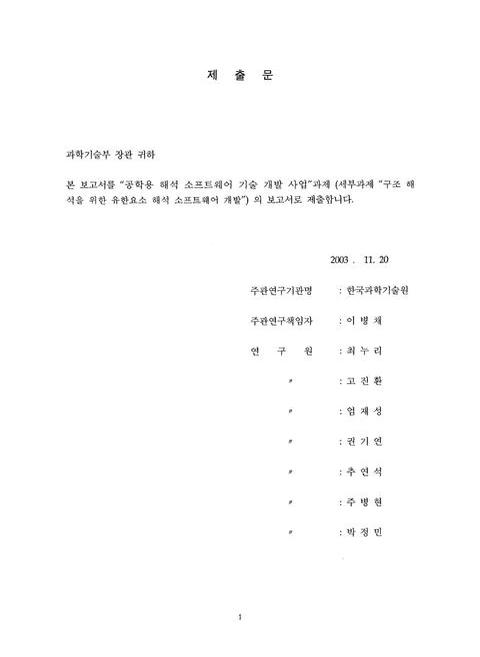
제출문=1,2,1
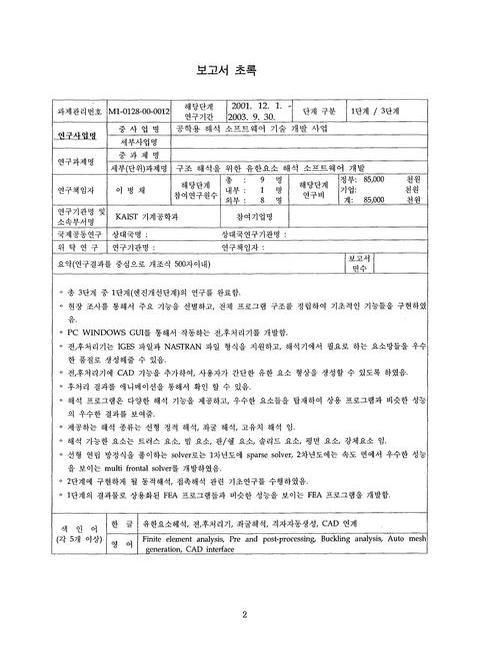
보고서 초록/이병채=2,3,1
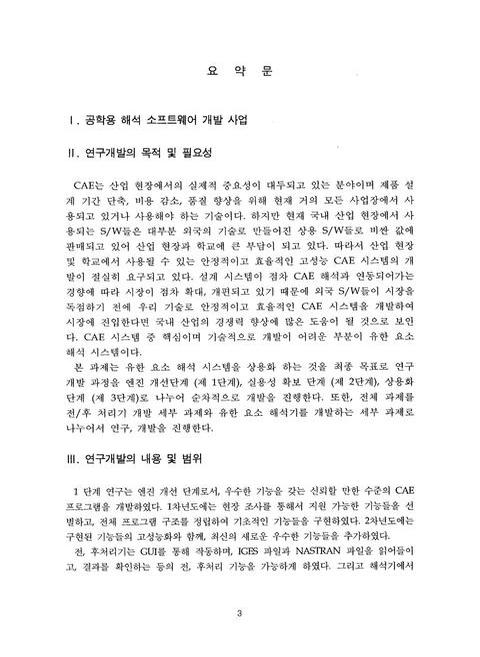
요약=3,4,2
영문요약문(Summary)=5,6,2
영문목차(CONTENTS)=7,8,5
목차=12,13,5
제1장 연구개발과제의 개요=17,18,1
제1절 개요=17,18,1
제2절 연구개발과제의 필요성=17,18,2
제3절 연구개발과제의 최종목표=18,19,1
제2장 국내외 기술 개발 현황=19,20,1
제1절 개요=19,20,1
제2절 해외 기술 개발 현황=19,20,1
제3절 국내 기술 개발 현황=20,21,1
1. 범용 유한 요소 해석 S/W VisuaIFEA=20,21,2
2. 범용 유한 요소 해석 S/W STRA-0=21,22,3
3. 건축/토목 구조 해석 및 설계 S/W MIDAS=23,24,2
4. 범용 구조 해석 및 설계 S/W neoMAX-3D=24,25,2
5. 구조 동역학 해석 S/W RecurDyn=25,26,2
6. 구조 진동 해석 S/W SVS=26,27,1
7. 기타 S/W=27,28,1
제3장 연구개발수행 내용 및 결과=28,29,1
제1절 전,후처리기=29,30,1
1. 프로그램 구성=29,30,1
가. 그래픽 알고리즘=29,30,1
(1) 선택 알고리즘(picking algorithm)=29,30,1
(2) Orthogonal & Perspective 화면 보기=29,30,2
(3) 회전 알고리즘=31,32,1
2. 메뉴구성=32,33,1
3. 파일 교환=33,34,1
가. IGES 파일 포맷 입출력=33,34,1
(1) IGES 파일 포맷 입출력=33,34,2
(2) NASTRAN 파일 포맷 입출력=34,35,2
4. CAD=36,37,1
가. 직선(Line) 생성=36,37,1
나. 원호(Arc) 생성=36,37,2
다 자유 곡선 생성=37,38,2
라. 곡선에 의한 곡면 생성(Ruled surface)=38,39,1
(1) 방향과 거리 입력에 의한 곡면 생성(Typel)=38,39,1
(2) 두 개의 곡선에 의한 곡면 생성(Type2)=39,40,1
마. 회전에 의한 곡면 생성=39,40,3
5.요소망 생성=42,43,1
가. 삼각형 사각형 요소망 생성=42,43,1
(1) 변환평면 결정=42,43,1
(2) 경계 절점 생성=42,43,2
(3) 평면에저 의 요소망 생성=43,44,3
(4) 요소망 평활화=45,46,2
나. 매핑 에 의 한 요소망 생성=47,48,1
다. 수동요소망=47,48,1
(1) 끌기에 의한 요소망 생성=47,48,2
(2) 회 전에 의 한 요소망 생성=48,49,1
(3) 스윕에 의한 요소망 생성=49,50,1
(4) 절점 매 핑 에 의한 요소망 생성=49,50,1
6. 요소 편집=50,51,1
가. 절점 선택에 의한 요소망 생성=50,51,1
나. 요소 결합=50,51,1
7. 후처리=51,52,1
가. 변형 및 응력분포=51,52,1
나. 애니메이션 및 그래프=52,53,2
8. 요소망 생성 적용 예=54,55,1
가. 자동차 휠=54,55,1
나. 자동차 문=55,56,1
다. 솔리드 모델링=56,57,1
제2절 해석기=57,58,1
1.전체 프로그램 개요 및 구조=57,58,1
가. 개요=57,58,1
나. 구조=57,58,2
다. 프로그램 제공하는 기능=59,60,1
2. 요소개발=60,61,1
가. 연속체 요소=60,61,2
나. 구조 요소=61,62,2
(1) 평면 응력 요소=63,64,1
(2) 쉘 요소=64,65,6
(3) 엘 요소의 구성=70,71,2
(4) 기하 강성 행렬의 구성=71,72,2
(5) 보 요소=72,73,6
다. 수치 결과=78,79,1
(1) 평면 응력 요소=78,79,1
(가) Straight beam problem=78,79,1
(나) Cook의 문제=78,79,2
(다) Curved beam prolbem=79,80,1
(2) 쉘 요소=80,81,1
(가) 원형 평판 문제=80,81,1
(나) Pinched cylinder problem=81,82,1
(다) Hemi-spherical shell problem=82,83,1
(라) Scordelis-Lo roof problem=83,84,1
(마) 45℃ 기울어진 마름모꼴 평판문제=84,85,1
(3) 솔리드 요소=85,86,1
(가) Straight beam problem=85,86,1
(나) Curved beam problem=86,87,1
(다) Distorted mesh=87,88,1
3. 선형 연립 방정식의 풀이(Spa.se/Multi Frontal)=88,89,1
가. 연구범위=88,89,1
나. 이론적/실험적 접근 방법=88,89,1
다. 연구 내용=88,89,1
(1) 문제 정의와 적용 범위=88,89,1
(2) 행렬분해법=88,89,1
(가) 삼각시스템(triangular system)=89,90,1
(나) 행렬분해법의 개념=89,90,2
(다) 내적분해(Inner product decompostion)=90,91,2
(라) 외적분해(outer product decompostion)=91,92,2
(3) 행렬분해법에 근거한 고성능 해석기=92,93,1
(가) 스파스 해석기=92,93,2
(나) 멀티프론탈 해석기=93,94,5
라. 적용 프로그램=97,98,3
마. 연구 결과=100,101,1
(1) 수치 예제=100,101,1
(2) 수치결과=100,101,1
(가) 스파스해삭기와의 비교=100,101,1
(나) NE-NASTRAN과의 비교=100,101,5
4. 고유치 해석=105,106,1
가. 개요=105,106,2
나. 기본적인 부공간 축차 방법=106,107,3
다. 부공간 축차법의 성능 개선=108,109,1
(1) 리츠벡 터 의 적용=108,109,2
(2) 직교화의 유지=109,110,2
(3) 수정된 리츠벡터의 적용=110,111,2
(4) 준적정 리츠벡터의 적용=111,112,1
(5) 블록 알고리즘의 적용=111,112,1
라. 개선된 블록 알고리즘=111,112,1
(1) 기본 알고리=111,112,2
(2) 이전 블록에서 수렴하지 못한 축차벡터의 이용=112,113,2
(3) 적절한 이동값의 선택=113,114,2
(4) 수정된 리츠벡터에서 초기 벡터의 적절한 개수=114,115,1
(5) 절적한 블록개수 정하기=115,116,2
(6) 수렴한 고유벡터와의 직교화=116,117,2
(7) 재시작(resta.1) 알고리즘=118,119,1
마. 수치 결과=119,120,1
(1) Oil tank=119,120,1
(2) Car door=120,121,1
5. 좌굴해석=121,122,1
가. 개요=121,122,1
나. 일반적인 기하 강성 계산=121,122,3
다. 수치 결과=123,124,1
(1) 보 요소=123,124,1
(가) Euler Beam=123,124,2
(나) erid with Rigid joints=124,125,2
(다) Bar Dome=126,127,2
(라) Portal Frame=127,128,2
(2) 쉘 요소=129,130,1
(가) Buckling of a simply supported square plate=129,130,2
(나) Laterat buckling of an I-barcket=131,132,2
(다) Axially compressed cylinder=132,133,2
6. 접촉해석 연구=134,135,3
7. 동적 해석 연구=137,138,1
가. 개요=137,138,1
(1) 질량 행렬의 구성방법=137,138,2
(2) 감쇠 행렬의 구성방법=138,139,1
(3) 자유도 축약=138,139,1
(4) 직접적분법과 모드 해석=138,139,2
(5) 주파수 해석=139,140,1
나. 시간적분법=139,140,1
(1) Newmark 법=139,140,2
(2) 선형 다단계 법=140,141,3
다. 결론=142,143,1
8. 하중/제한조건=143,144,1
가. 하중조건=143,144,1
나. 제한조건=144,145,1
9. 입/출력문=145,146,1
가. 입 력문=145,146,1
나. 출력문=145,146,1
제3절 프로그램 성능 및 평가=146,147,1
제4장 목표달성도 밑 관련분야에의 기여도=147,148,1
제1절 목표달성도=147,148,2
제2절 관련분야에의 기여도=148,149,2
제5장 연구개발결과의 활용계획=150,151,1
제1절 연구개발결과의 기대효과=150,151,1
제2절 연구개발결과의 활용계획=150,151,1
1. 활용계획=150,151,2
2. 추가연구의 필요성=151,152,1
제3절 사업화 계획=151,152,2
제6장 연구개발과정에서 수집한 해외과학기술정보=153,154,1
제1절 프리즘 요소를 사면체 요소로 분할=153,154,2
제2절 Multi Frontal Solver=155,156,1
1. 기본 개념=155,156,2
2. 성능향상을 위한 방법=156,157,1
제3절 외삽(extrapolation)을 이용한 대체 변형률법 솔리드 요소=157,158,1
제4절 Lanczos 알고리즘=158,159,1
1. 이론적인 Lanczos 알고리즘=158,159,1
2. 실제적인 Lanczos 알고리즘=158,159,1
가. 완전한 재직교화(Full reorthogonalization)=158,159,2
나. 선택적인 재직교화=159,160,2
다. 부분적인 재직교화=160,161,1
제7장 참고문헌=161,162,6
특정연구개발사업 연구결과 활용계획서=157,168,1
연구결과 활용계획서=168,169,4
기술 요약서=172,173,5
영문목차
title page=0,1,1
Submission(Korean)=1,2,1
Abstract=2,3,1
Summary(Korean)=3,4,2
Summary(English)=5,6,2
Contents(English)=7,8,5
Contents=12,13,5
Chapter 1. Introduction=17,18,1
1-1 Introduction=17,18,1
1-2 The necessity of this project=17,18,2
1-3 The main objectives of this project=18,19,1
Chapter 2. The current dorTtestic CAE technologies=19,20,1
2-1 Tntroduction=19,20,1
2-2 The foreign CAE technologies=19,20,1
2-3 The domestic CAE technologies=20,21,1
1. CommerciaB fEA S/W VisuaIFEA=20,21,2
2. Commercial fEA S/W STRA-D=21,22,3
3. Architecturejcivil structural analysis and design S/W MIUAS=23,24,2
4. Commercial structural analysis and design S/W neoMAX-3D=24,25,2
5. Structural dynamic analysis S/W RecurDyn=25,26,2
6. Structural vibration analysis S/W SVS=26,27,1
7. Others=27,28,1
Chapter 3. The scope of this project and research results=28,29,1
3-1 Pre/post processor=29,30,1
1. Program structure=29,30,1
A. Graphic algorithm=29,30,1
(1) Pricking algorithm=29,30,1
(2) Orthogonal & Perspective screen display=29,30,2
(3) Rotation algorithm=31,32,1
2. Menu contents=32,33,1
3. File Exchange=33,34,1
A.IGES file access=33,34,1
(1) ICES file access=33,34,2
(2) NASTRAN file access=34,35,2
4. CAD tool=36,37,1
A. Line creation=36,37,1
B. Arc creation=36,37,2
C. Free curve creation=37,38,2
D. Ruled surface creation using a curve=38,39,1
(1)By direction and distance input(Type1)=38,39,1
(2)By two selected curves (Type2)=39,40,1
E. Surface creation by revolving=39,40,1
F. Surface creation by sweeping=40,41,1
G. Surface creation by boundary edges=40,41,1
H. Rounding and Champer=41,42,1
5. Mesh generation=42,43,1
A. Triangular/Tetra element mesh generation=42,43,1
(1) Decision of a translation plane=42,43,1
(2) Generation of boudayr nodes=42,43,2
(3) Mesh generation=43,44,3
(4) Smoothing=45,46,2
B. Mesh generation by mapping=47,48,1
C. Manual mesh generation=47,48,1
(1) Mesh generation by dragging=47,48,2
(2) Mesh generation by revolving=48,49,1
(3) Mesh generation by sweeping=49,50,1
(4) Mesh generation by node mapping=49,50,1
6. Element edit=50,51,1
A. Mesh generation by node selection=50,51,1
B. Merging element=50,51,1
7. Post processor=51,52,1
A. Displacement and stress distribution=51,52,1
B. Animation and graph function=52,53,2
8. Examples on mesh genera=54,55,1
A. Vehicle wheel model=54,55,1
B. Vehicle door model=55,56,1
C. Solid modeling=56,57,1
3-2 Solver=57,58,1
1. Program introduction an its structure=57,58,1
A. Introduction=57,58,1
B. Structure=57,58,2
C. Function list=59,60,1
2.Element development=60,61,1
A. Contimum element=60,61,2
B. Structure element=61,62,2
(1) Plane stress element=63,64,1
(2) Shell element=64,65,6
(3) Shell element construction=70,71,2
(4) Stiffless mat.ix construction=71,72,2
(5) Beam element=72,73,6
C. Numerical examples=78,79,1
(1) Plane stress element=78,79,1
(A) Straight beam problem=78,79,1
(B) Cook's problem=78,79,2
(C) Curved beam prolbem=79,80,1
(2) Shell element=80,81,1
(A) Circular plate problem=80,81,1
(B) Pinched cylinder problem=81,82,1
(C) Hemi-spherical shell problem=82,83,1
(D) Scordelis-Lo roof problem=83,84,1
(E) 45℃ Rhombic plate=84,85,1
(3) Solid element=85,86,1
(A) Straight beam problem=85,86,1
(B) Curved beam problem=86,87,1
(C) Distorted mesh=87,88,1
3.Solving the linear simultaneous equation(Sparse/multi frontal)=88,89,1
A. The scope of the study=88,89,1
B. Theoretical/experimental approaches=88,89,1
C. Investigation=88,89,1
(1) Problem definition and application range=88,89,1
(2) Elementary matrix decomposition=88,89,1
(A) Triangular system=89,90,1
(B) The concept of matrix decomposition=89,90,2
(C) Inner product decomposition=90,91,2
(D) Outer product decomposition=91,92,2
(3) Efficient solvers based matrix decomposition=92,93,1
(A) Sparse solver=92,93,2
(B) Multi frontal solver=93,94,5
D. Programs=97,98,3
E. Research result=100,101,1
(1) Numerical analysis example=100,101,1
(2) Nume.ical analysis result=100,101,1
(A) Comparison with sparse solver result=100,101,1
(B) Comparison with NE-NASTRAN result=100,101,5
4. Eigert value analysis=105,106,1
A. Introduction=105,106,2
B. Elementary subspace iteration method=106,107,3
C. Performance improvement of the subspace iteration method=108,109,1
(1) aitz vector application=108,109,2
(2) Orthogonality preservation=109,110,2
(3) Modified Ritz vector application=110,111,2
(4) Duasi-static Ritz vector application=111,112,1
(5) Block algo.ithm application=111,112,1
D. Improved block algorithm=111,112,1
(1) Elementary algorithm=111,112,2
(2) Utilization ite.ation ye.for did not converged in the previous block=112,113,2
(3) Definition of the moving distance=113,114,2
(4) Definition of the number of initial vectors in modified Ritz vector=114,115,1
(5) Definition of the number of block=115,116,2
(6) Orthogonalization with the converged eigen vector=116,117,2
(7) Restart algo.ithm=118,119,1
E. Numercal examples=119,120,1
(1) Oil tank=119,120,1
(2) Car door=120,121,1
5. Buckling analysis=121,122,1
A. Introduction=121,122,1
B. Ceneral stiffrless matrix calculation=121,122,3
C. Numerical examples=123,124,1
(1) Beam element=123,124,1
(A) Euler Beam=123,124,2
(B) Crid with Rigid joints=124,125,2
(C) Bar Dome=126,127,2
(D) Portal Fram=127,128,2
(2) Shell element=129,130,1
(A) Buckling of a simply supported square plate=129,130,2
(B) Lateral buckling of an L-barcket=131,132,2
(C) Axialfy compressed cylinder=132,133,2
6. Contact analysis study=134,135,3
7. Dynamic analysis study=137,138,6
8. Loads/boundary conditions=143,144,1
A. Load condition=143,144,1
B. Boundary condition=144,145,1
9. Input/output data file=145,146,1
A. Input data file=145,146,1
B. Output data file=145,146,1
3-3 Program=146,147,1
Chapter 4. The project achievement and its contribution=147,148,1
4-1 The project objective achievement=147,148,3
Chapter 5. The utilization plan of the project=150,151,1
5-1. The positive expectation=150,151,1
5-2. The utilization plan of the project=150,151,1
1. Utilization plan=150,151,2
2. Necessity of the supplemental study=151,152,2
Chapter 6. The collected foreign science technology information=153,154,1
6-1. Split prism element into tetrahedarl element=153,154,2
6-2. Multi Frontal Solver=155,156,2
6-3. Altemative strain method solid element using extrapolation=157,158,1
6-4 Lanczos algorithm=158,159,1
1. Theoretical Lanczos algorithm=158,159,1
2. Practical Lanczos algorithm=158,159,1
A. full reorthogonalization=158,159,2
B. Selective reorthogonalization=159,160,2
C. Partial reorthogonalization=160,161,1
Chapter 7 References=161,162,16
*표시는 필수 입력사항입니다.
| 전화번호 |
|---|
| 기사명 | 저자명 | 페이지 | 원문 | 기사목차 |
|---|
| 번호 | 발행일자 | 권호명 | 제본정보 | 자료실 | 원문 | 신청 페이지 |
|---|
도서위치안내: / 서가번호:

우편복사 목록담기를 완료하였습니다.
*표시는 필수 입력사항입니다.
저장 되었습니다.
