
 대표어
대표어
권호기사보기
| 기사명 | 저자명 | 페이지 | 원문 | 기사목차 |
|---|
결과 내 검색
동의어 포함
목차
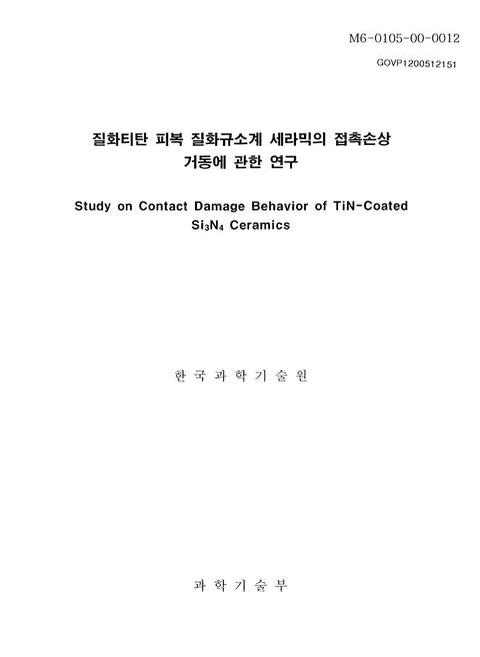
표제지=0,1,1
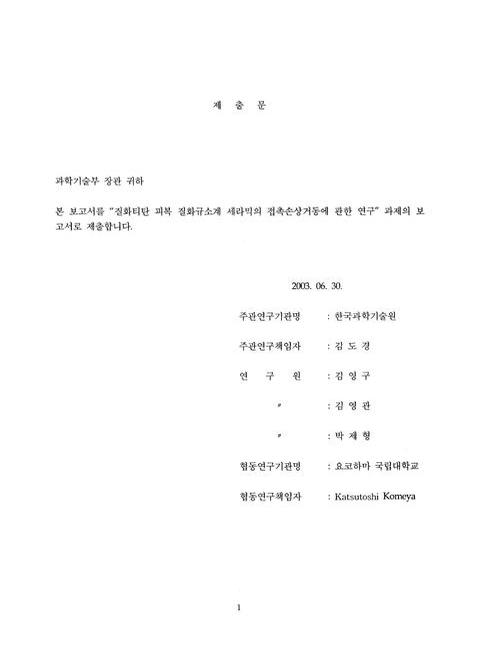
제출문=1,2,1
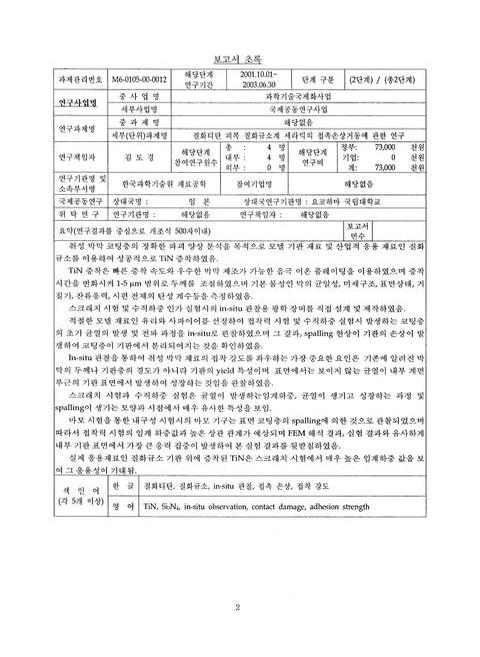
보고서 초록/김도경=2,3,1
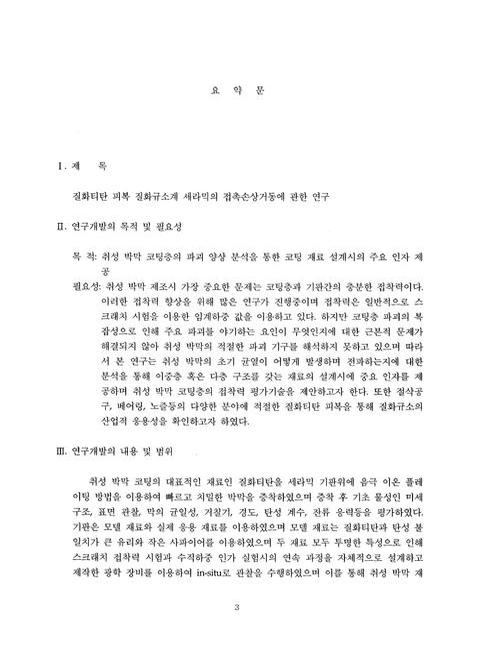
요약문=3,4,3
SUMMARY=6,7,3
CONTENT=9,10,3
목차=12,13,3
제1장 연구개발과제의 개요=15,16,2
제2장 국내외 기술개발 현황 및 연구결과의 위치=17,18,1
2.1절 국내외 취성 박막 기술개발 현황=17,18,1
2.1.1 플라즈마 PVD 원리 및 기술 동향=17,18,7
2.1.2 플라즈마 CVD의 원리 및 기술 동향=23,24,2
2.2절 취성 박막 코팅 재료의 특성 및 응용성=25,26,4
2.3절 연구결과가 차지하는 위치=29,30,2
제3장 연구개발수행 내용 및 결과=31,32,1
3.1절 연구 내용 및 과정=31,32,1
3.1.1 모델 재료 선정=31,32,1
3.1.2 TiN 증착=31,32,6
3.1.3 TiN 기본 물성 측정=36,37,3
3.1.4 접착 강도 측정=38,39,1
3.1.5 in-situ 관찰용 광학 장비 설계 및 측정=38,39,4
3.1.6 비커스 경도 측정=41,42,1
3.1.7 마모 시험=42,43,4
3.1.8 잔류 응력 측정=46,47,1
3.1.9 탄성 계수 측정=46,47,2
3.1.10 FEM 전산 모사=48,49,2
3.2절 연구 결과 및 고찰=50,51,1
3.2.1 TiN 기초 물성 평가=50,51,1
3.2.1.가. TiN 상=50,51,1
3.2.1.나. TiN 두께 측정=50,51,6
3.2.1.다. TiN 구조 및 균일성=55,56,1
3.2.1.라. TiN 표면 관찰 및 표면 거칠기 측정=55,56,7
3.2.2 In-situ 파괴 양상 관찰=62,63,1
3.2.2.가. 모델 재료 I:TiN이 코팅된 사파이어의 in-situ 관찰=62,63,10
3.2.2.나. 모델 재료 II:TiN이 코팅된 유리의 in-situ 관찰=72,73,15
3.2.3 임계 하중 측정=87,88,1
3.2.3.가. TiN이 증착된 모델 재료의 임계하중 측정=87,88,1
3.2.3.나. TiN이 증착된 질화 규소의 임계하중 측정=87,88,5
3.2.4 취성 박막 코팅의 파괴 모드 제안=92,93,2
3.2.5 비커스 경도 측정=94,95,6
3.2.6 마모 시험=100,101,11
3.2.7 잔류 응력 측정=111,112,3
3.2.8 탄성 계수 측정=114,115,2
3.2.9 FEM 전산 모사=116,117,2
제4장 목표달성도 및 관련분야에의 기여도=118,119,1
4.1절 연구 내용 요약=118,119,3
4.2절 연구 목표와의 달성도=120,121,1
4.3절 관련분야의 기술발전에의 기여도=120,121,3
제5장 연구개발결과의 활용계획=123,124,1
5.1절 추가연구의 필요성=123,124,1
5.2절 타연구에의 응용=123,124,2
제6장 연구개발과정에서 수집한 해외과학기술정보=125,126,1
6.1절 접착강도에 영향을 주는 요인들=125,126,4
6.1.1 하중 인가 속도와 스크래치 속도의 영향=129,130,1
6.1.2 다이아몬드 팁의 곡률 반경의 영향=129,130,4
6.1.3 다이아몬드 팁의 마모에 의한 영향=132,133,1
6.1.4 기판 경도 및 코팅층 두께의 영향=132,133,5
6.1.5 코팅층 표면 거칠기 영향=136,137,1
6.1.6 증착전의 기판의 표면 거칠기 영향=136,137,1
6.1.7 마찰력 및 마찰 계수의 영향=136,137,4
6.2절 코팅내의 잔류 응력 계산=140,141,1
6.2.1 XRD 방법=140,141,3
6.2.2 곡률반경 측정법=142,143,4
6.3절 취성 박막 코팅 재료의 파괴 모드 분석=146,147,1
6.3.1 Interfacial spallation=146,147,1
6.3.2 Continuous ductile perforation=146,147,1
6.3.3 Chevron and hertzian cracks=146,147,3
6.3.4 Forward chevron cracks=148,149,1
6.3.5 Conformal type buckling cracks=148,149,1
6.3.6 Cohesive spallation=148,149,1
6.3.7 Large area interfacial spallation=148,149,1
6.3.8 Hertzian type circular cracks=148,149,2
6.3.9 Gross interfacial shell-shaped spallation=149,150,3
6.4절 마모 시험=152,153,1
6.4.1 ballon disc=152,153,1
6.4.2 ball on three plates=152,153,4
제7장 참고문헌=156,157,5
과학기술국제화사업 연구결과 활용계획서=161,162,10
영문목차
[title page etc.]=0,1,9
CONTENT=9,10,6
Chapter 1 Research synopsis=15,16,2
Chapter 2 Research state of art and results position=17,18,1
Paragraph 2.1 State of art of hard thin coating=17,18,1
2.1.1 Principle of plasma PVD and research trend=17,18,7
2.1.2 Principle of plasma CVD and research trend=23,24,2
Paragraph 2.2 Characteristics and application of hard thin coating=25,26,4
Paragraph 2.3 Position of research results=29,30,2
Chapter 3 Research scope and experiment and result=31,32,1
Paragraph 3.1 Experimental procedures=31,32,1
3.1.1 Model material selection=31,32,1
3.1.2 TiN deposition=31,32,6
3.1.3 TiN basic properties measurement=36,37,3
3.1.4 Adhesion strength measurement=38,39,1
3.1.5 Design of in-situ observation equipment and observation=38,39,4
3.1.6 Vickers hardness measurement=41,42,1
3.1.7 Wear test=42,43,4
3.1.8 Residual stress measurement=46,47,1
3.1.9 Elastic modulus measurement=46,47,2
3.1.10 FEM simulation=48,49,2
Paragraph 3.2 Results and Discussion=50,51,1
3.2.1 TiN basic properties measurement=50,51,1
3.2.1 A TiN phase=50,51,1
3.2.1 B TiN thickness=50,51,6
3.2.1 C TiN structure and uniformity=55,56,1
3.2.1 D TiN surface observation and roughness=55,56,7
3.2.2 In-situ observation of TiN fracture sequence=62,63,1
3.2.2 A Model material I:in-situ observation of TiN coated sapphire=62,63,10
3.2.2 B Model material II:in-situ observation of TiN coated glass=72,73,15
3.2.3 Critical load measurement=87,88,1
3.2.3 A Critical load of TiN coated model material=87,88,1
3.2.3 B Critical load of TiN coated Si₃N₄=87,88,5
3.2.4 Propose of fracture mode of thin hard coating system=92,93,2
3.2.5 Vickers Hardness measurement=94,95,6
3.2.6 Wear=100,101,11
3.2.7 residual stress=111,112,3
3.2.8 Elastic modulus=114,115,2
3.2.9 FEM simulation=116,117,2
Chapter 4 Achievement level and contribution to related field=118,119,1
Paragraph 4.1 Summary of research results=118,119,3
Paragraph 4.2 Research achievement level=120,121,1
Paragraph 4.3 Contribution to research field=120,121,3
Chapter 5 Application plan to research results=123,124,1
Paragraph 5.1 Necessity of further research=123,124,1
Paragraph 5.2 Application to other research field=123,124,2
Chapter 6 Literature survey of advanced foreign technology=125,126,1
Paragraph 6.1 Factors affecting critical load=125,126,4
6.1.1 Effect of loading rate and scratch speed=129,130,1
6.1.2 Effect of diamond tip radius=129,130,4
6.1.3 Effect of diamond tip wear=132,133,1
6.1.4 Effect of substrate hardness and cotating thickness=132,133,5
6.1.5 Effect of coating roughness=136,137,1
6.1.6 Effect of substrate roughness before deposition=136,137,1
6.1.7 Effect of friction and frictional coefficient=136,137,4
Paragraph 6.2 Residual stress in TiN film=140,141,1
6.2.1 XRD method=140,141,3
6.2.2 Substrate curvature method=142,143,4
Paragraph 6.3 Failure mode of thin hard coating system=146,147,1
6.3.1 Interfacial spallation=146,147,1
6.3.2 Continumous ductile perforation=146,147,1
6.3.3 Chevron and Hertzian cracks=146,147,3
6.3.4 Forward chevron cracks=148,149,1
6.3.5 Conformal type buckling cracks=148,149,1
6.3.6 Cohesive spallation=148,149,1
6.3.7 Large area interfacial spallation=148,149,1
6.3.8 Hertzian type circular cracks=148,149,2
6.3.9 Gross interfacial shell-shaped spallation=149,150,3
Paragraph 6.4 Wear test=152,153,1
6.4.1 ball on disc method=152,153,1
6.4.2 ball on three plates method=152,153,4
Chapter 7 Reference=156,157,15
*표시는 필수 입력사항입니다.
| 전화번호 |
|---|
| 기사명 | 저자명 | 페이지 | 원문 | 기사목차 |
|---|
| 번호 | 발행일자 | 권호명 | 제본정보 | 자료실 | 원문 | 신청 페이지 |
|---|
도서위치안내: / 서가번호:

우편복사 목록담기를 완료하였습니다.
*표시는 필수 입력사항입니다.
저장 되었습니다.
