
 대표어
대표어

권호기사보기
| 기사명 | 저자명 | 페이지 | 원문 | 기사목차 |
|---|
결과 내 검색
동의어 포함
목차
표제지=0,1,1
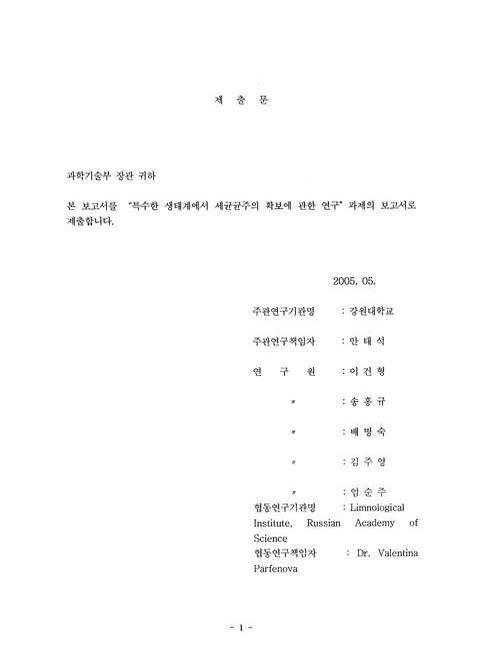
제출문=1,2,1
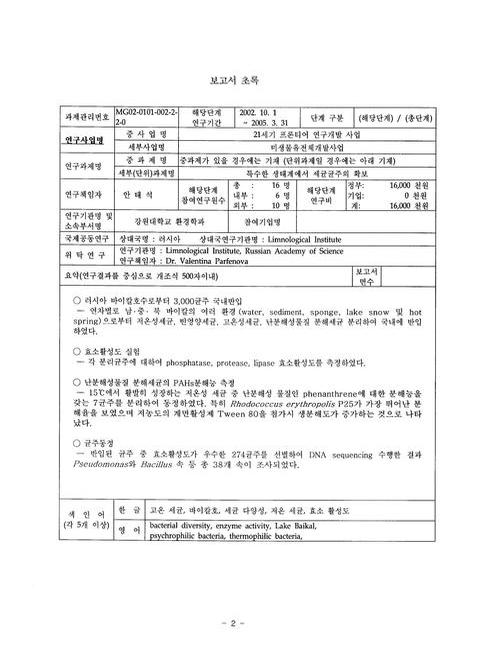
보고서 초록/안태석=2,3,1
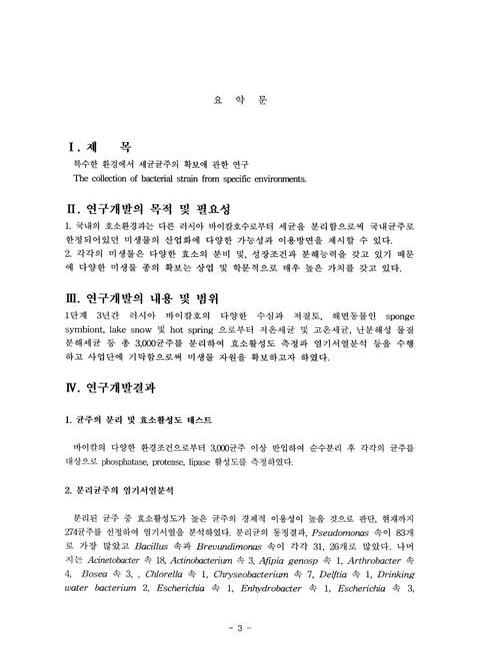
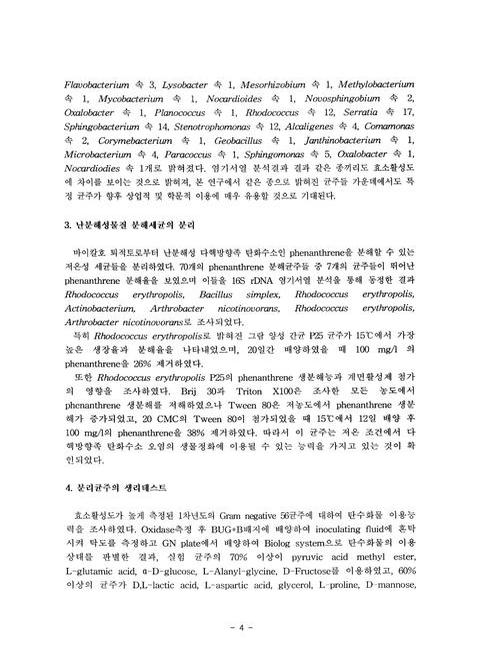
요약문=3,4,3
SUMMARY=6,7,3
CONTENTS=9,10,2
TABLE=11,12,1
FIGURE=12,13,2
목차=14,15,3
제1장 연구개발과제의 개요=17,18,1
제1절 연구개발의 목적 및 필요성=17,18,1
1. 연구의 목적=17,18,1
2. 연구의 필요성=17,18,2
제2장 국내외 기술개발 현황=19,20,1
제1절 서론=19,20,1
1. 바이칼호에서의 응집세균 군집 분석=20,21,4
2. 응집세균 - 새로운 미생물 다양성의 세계=23,24,1
3. 세균의 고밀도 상태로 회수하는 장치의 개발 및 적용=23,24,1
4. 저온 세균의 이용=23,24,2
5. 고온 세균의 이용=24,25,2
제3장 연구개발수행 내용 및 결과=26,27,1
제1절 서론=26,27,1
제2절 재료 및 방법=26,27,1
1. 조사대상 지역=26,27,1
2. 세균의 배양 및 분리=26,27,3
3. 활성도 측정=29,30,1
4. 분리균주의 탄수화물 이용도 측정=29,30,1
5. 난분해성 물질 분해세균의 분리=29,30,2
6. 분리균주의 16S rDNA분석=30,31,3
7. 고온성 세균의 분리 및 효소 활성도 측정=32,33,2
제3절 결과 및 고찰=33,34,1
1. 미생물 분리 및 효소활성도 측정=33,34,1
2. 분리균주의 탄수화물 이용도 측정=33,34,12
3. 난분해성물질 분해세균의 분리 및 분해능 조사=45,46,8
4. 분리균주의 염기서열 분석=53,54,10
5. 바이칼 주변 Hot Spring에서 분리한 고온 균주의 특성=63,64,7
제4장 목표달성도 및 관련분야에의 기여도=70,71,1
제5장 연구개발결과의 활용계획=71,72,1
제6장 연구개발과정에서 수집한 해외과학기술정보=72,73,1
1. 몽골 흡수굴 (Khubsgul)호=72,73,1
2. 고기후학 연구 (paleoclimatology)=72,73,1
제7장 참고문헌=73,74,6
부록=79,80,129
영문목차
[title page etc.]=0,1,9
CONTENTS=9,10,8
Chapter 1 The outline of research development=17,18,1
Section 1 The purpose and necessity of research development=17,18,1
1. The purpose of research=17,18,1
2. The necessity of research=17,18,2
Chapter 2 The technology development present state of inside and outside of the country=19,20,1
Section 2 Introduction=19,20,1
1. The community of aggregated bacteria in Lake Baikal=20,21,4
2. The aggregated bacteria - The world of new microbial diversity=23,24,1
3. The equipment development and analysis for getting high density bacteria=23,24,1
4. The using of psychrophilic bacteria=23,24,2
5. The using of psychrophilic bacteria=24,25,2
Chapter 3 The research development achivements and results=26,27,1
Section 1 Introduction=26,27,1
Section 2 Materials and Methods=26,27,1
1. Sampling Site=26,27,1
2. The isolation and cultivation of bacteria=26,27,3
3. The measurement of activity=29,30,1
4. The carbohydrate utilization measurement of isolated bacteria=29,30,1
5. The degradable bacteria isolation of non-degradable materials=29,30,2
6. 16S rDNA analysis of isolated bacteria=30,31,3
7. The isolation of thermophilic bacteria and the measurement of enzymatic activity=32,33,2
Section 3 The results and investigation=33,34,1
1. The isolation of bacteria and measurement of enzymatic activity=33,34,1
2. The carbohydrate utilization measurement of isolated bacteria=33,34,12
3. The degradabl ebacteria isolation of non-degradable materials and research degradable ability=45,46,8
4. The sequence analysis of isolated bacteria=53,54,10
5. The character of thermophilic bacteria from Hot Spring nearby Lake Baikal=63,64,7
Chapter 4 The extent of aim achievement and contribution of related filed=70,71,1
Chapter 5 The application of research results=71,72,1
Chapter 6 The information of foreign countries science technology from research process=72,73,1
1. Lake Khubsgul in Mogolian=72,73,1
2. The paleoclimatology research=72,73,1
Chapter 7 Reference=73,74,6
Appendix=79,80,129
Fig. 1. Microphotograph of typical aggregated bacteria=21,22,1
Fig. 2. Vertical profile of total bacterial numbers in Lake Baikal on August 2000(left) and on April 2001 (right)=21,22,1
Fig. 3. Distribution of bacterial communities in free-living (left) and aggregated bacteria (right) at Lake Baikal on August,2000=22,23,1
Fig. 4. Distribution of bacterial communities in free-living (left) and aggregated bacteria (right) at Lake Baikal on April,2001=22,23,1
Fig. 5. Submerging the media for aggregated bacteria retrieving. This system was developed by Prof. Ahn=23,24,1
Fig. 6. The procedure for extraction of DNA=31,32,1
Fig. 7. Carbon utilization patterns of oligotrophic bacteria (103 strains) of oxidase test negative group (GN-ENT group) by BIOLOG system isolated from Lake Baikal from September to December,2000 and from January to July,2002=39,40,1
Fig. 8. Carbon utilization patterns of oligotrophic bacteria (65 strains) of oxidase test positive group (GN-NENT group) by BIOLOG system isolated from Lake Baikal from September to December,2000 and from January to July,2002=40,41,1
Fig. 9. Carbon utilization patterns of psychrotrophic bacteria (104 strains) of oxidase test negative group (GN-ENT group) by BIOLOG system isolated from Lake Baikal from January to December,2002=41,42,1
Fig. 10. Carbon utilization patterns of psychrotrophic bacteria (28 strains) of oxidase test positive group (GN-NENT group) by BIOLOG system isolated from Lake Baikal from January to December,2002=42,43,1
Fig. 11. The dendrogram of oligotrophic and psychrotrophic bacteria isolated from Lake Baikal during 2000 ~ 2002=44,45,1
Fig. 12. Growth curves of P12 strain with different C source=49,50,1
Fig. 13. Degradation of phenanthrene by bacterial strains=50,51,1
Fig. 14. Degradation of phenanthrene by Rhodococcus erythropolis P25 at different concentration of glucose=50,51,1
Fig. 15. Effects of addition of nitrate sources on phenanthrenen biodegradation by Rhodococcus erythropolis P25=51,52,1
Fig. 16. Degradation of phenanthrene by Rhodococcus erythropolis P25 at different temperature=51,52,1
Fig. 17. Effects of addition of surfactants on phenanthrenen biodegradation by Rhodococcus erythropolis P25. A-Brij 30,B-Triton X100,C-Tween 80=52,53,1
Fig. 18. Locality map of the sampling area at Kotelnikovsky,Khakusy,an Zmeinaya hot springs,Lake Baikal,Siberia,Russia=68,69,1
Fig. 19. Transmission electron micrographs of bacteria from the thermal water of Kotelnikovsky (A) and Khakusy (B) hot springs. Microorganisms obtained directly from the natural samples were characterized by extracellular amorphous mineral particles (marked by arrows)=69,70,1
*표시는 필수 입력사항입니다.
| 전화번호 |
|---|
| 기사명 | 저자명 | 페이지 | 원문 | 기사목차 |
|---|
| 번호 | 발행일자 | 권호명 | 제본정보 | 자료실 | 원문 | 신청 페이지 |
|---|
도서위치안내: / 서가번호:

우편복사 목록담기를 완료하였습니다.
*표시는 필수 입력사항입니다.
저장 되었습니다.
