
 대표어


권호기사보기
| 기사명 | 저자명 | 페이지 | 원문 | 기사목차 |
|---|
결과 내 검색
동의어 포함
목차
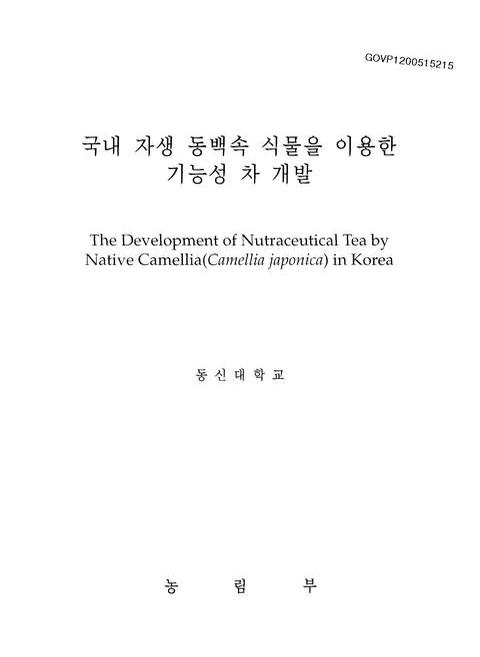
표제지=0,1,1
제출문=2,2,1
요약문=3,3,13
SUMMARY=16,16,11
CONTENTS=27,27,7
목차=34,34,7
제1장 연구개발과제의 개요=41,41,1
제1절 연구개발의 목적과 필요성=41,41,1
제2절 연구개발의 범위=41,41,2
제2장 국내외 기술개발 현황=43,43,1
제1절 국내=43,43,2
제2절 국외=44,44,2
제3장 동백차의 주요성분 분석,효능탐색 및 제다조건 확립=46,46,1
제1절 서설=46,46,3
제2절 재료 및 방법=49,49,1
1. 동백차의 주요성분 분석=49,49,1
가. 재료=49,49,1
나. 일반성분 분석=49,49,1
다. 카페인 분석=49,49,1
라. 카테킨 분석=49,49,1
마. 탄닌의 정량=50,50,1
바. 테아닌=50,50,1
사. 비타민C=50,50,1
아. 유리아미노산 분석=50,50,2
자. 핵산관련물질의 정량=51,51,1
차. 유리당의 정량=51,51,2
2. 생리ㆍ약리활성 탐색=52,52,1
가. 재료=52,52,1
나. 동백추출물의 조제=52,52,2
다. 항미생물 활성 테스트=53,53,2
라. 세포독성효과 측정=54,54,1
마. Chemosensitizing effect=54,54,2
바. 혈전용해테스트=55,55,1
사. 항산화활성 검색=55,55,1
아. 간기능 장애에 미치는 영향=55,55,2
자. HL-60에 대한 Anti-proliferative effect=56,56,1
차. 안전성 테스트=56,56,2
3. 차 제조를 위한 적합조건 확립 및 관능평가=58,58,1
가. 동백잎 재료=58,58,1
나. 시험장소=58,58,1
다. 시험방법=58,58,1
1) 동백 신초의 생육 조사=58,58,1
2) 동백차 제다전 동백 신초 및 꽃 채취=58,58,1
라. 동백차 제다=58,58,1
1) 덖음차=58,58,2
2) 찐차=59,59,1
3) 반발효차=59,59,1
4) 완전발효차=59,59,1
마. 화차=59,59,1
바. 가루차=60,60,1
1) 동백나무 차광=60,60,1
2) 가루차 제조=60,60,1
사. 시료 분쇄=60,60,1
아. 성분분석 및 평가=60,60,1
자. 관능평가=60,60,2
제3절 결과 및 고찰=62,62,1
1. 동백엽차와 화차의 주요성분분석=62,62,1
가. 일반성분=62,62,1
나. 카페인 함량=62,62,2
다. 카테킨 함량=63,63,2
라. 탄닌=64,64,1
마. 테아닌=64,64,2
바. 비타민C=65,65,1
사. 유리아미노산 분석=65,65,3
아. 핵산 관련물질의 정량=68,68,1
자. 유리당의 정량=68,68,2
2. 생리ㆍ약리활성 탐색=70,70,1
가. 항미생물 활성 테스트=70,70,4
나. 세포독성 효과=73,73,3
다. Chemosensitizing effect=76,76,1
라. 혈전용해 테스트=76,76,3
마. 항산화 활성=78,78,2
바. 간기능 장애에 미치는 영향=79,79,6
사. HL-60에 대한 Anti-proliferative effect=84,84,2
아. 안전성 테스트=86,86,11
3. 차 제조를 위한 적합조건 확립 및 관능평가=97,97,1
가. 동백차 제조를 위한 제다전 생육 및 품질과 엽위별 성분 함량=97,97,1
1) 동백엽의 수확전 생육=97,97,1
2) 엽위별 품질=97,97,5
나. 동백잎 차 제조=101,101,1
1) 덖음차=101,101,2
2) 찐차=103,103,1
3) 반발효차=104,104,2
4) 완전발효차=105,105,1
다. 화차 제조=105,105,1
1) 찐차=105,105,4
2) 덖음차=108,108,2
라. 가루차 제조를 위한 차광 및 제다=109,109,1
1) 동백나무 차광=109,109,2
2) 가루차 제다=111,111,1
3) 가루차 품질=111,111,1
4) 차광 잎의 성분함량=111,111,2
제4절 적요=113,113,5
제4장 동백 혼합차의 배합조건확립 및 기능성 검증=118,118,1
제1절 서설=118,118,2
제2절 재료 및 방법=120,120,1
1. 혼합차의 주요성분분석 및 생리활성 검색=120,120,1
가. 혼합차의 주요성분분석=120,120,1
1) 혼합차의 제조=120,120,4
2) 일반성분 분석=124,124,1
3) 카페인=124,124,1
4) 카테킨=124,124,1
5) 탄닌=124,124,1
6) 테아닌=124,124,1
7) 비타민C=125,125,1
8) 유리아미노산=125,125,1
9) 핵산관련물질의 정량=126,126,1
10) 유리당=126,126,1
나. 생리활성 검색=127,127,1
1) 항산화 활성=127,127,1
2) Chemosensitizing effect=127,127,1
3) 암세포독성테스트=127,127,2
4) 혈전용해 효과=128,128,1
5) 항미생물 활성 테스트=128,128,2
2. 생약을 이용한 혼합조건 확립 및 기능성 검증=129,129,1
가. 적정 배합생약 및 배합비율 검토=129,129,1
나. 혈청 중 glucose 및 콜레스테롤에 미치는 영향=129,129,1
다. 뇌혈류량에 미치는 영향=129,129,2
라. 뇌세포 세포독성 측정=130,130,2
마. 혈관에 미치는 영향=131,131,2
3. 기능성 강화 혼합차의 배합조건 확립 및 제품 개발=132,132,1
가. 동백차 및 생약제 재료=132,132,1
나. 시험장소=133,133,1
다. 시험방법=133,133,1
1) 동백차와 녹차 및 생약제의 배합조건 및 배합비율=133,133,1
2) 동백차와 녹차 및 생약 추출물을 이용한 음료형 혼합차 제조=133,133,2
3) 동백차와 녹차 및 생약 추출 후 용기차 제조=134,134,1
4) 동백차와 녹차 및 생약의 티백차 제조=134,134,1
5) 동백 분말(가루)차 제조=134,134,1
6) 품질 및 관능평가=135,135,1
제3절 결과 및 고찰=136,136,1
1. 혼합차의 주요성분분석 및 생리활성 검색=136,136,1
가. 혼합차의 주요성분 분석=136,136,1
1) 일반성분의 분석=136,136,1
2) 카페인 함량=137,137,1
3) 카테킨=138,138,1
4) 탄닌=138,138,1
5) 테아닌=138,138,2
6) 비타민C=139,139,1
7) 유리아미노산 분석=139,139,3
8) 핵산관련물질의 정량=142,142,1
9) 유리당의 정량=142,142,2
나. 생리활성 검증=143,143,1
1) 항산화 활성의 검증=143,143,3
2) 세포독성테스트=146,146,1
3) Chemosensitizing effect=146,146,2
4) 혈전용해 효과=148,148,2
5) 항미생물 활성 테스트=149,149,3
2. 생약을 이용한 혼합조건 확립 및 기능성 검증=152,152,1
가. 적정 배합생약 및 배합비율 검토=152,152,2
나. 혈청 중 glucose 및 콜레스테롤에 미치는 영향=153,153,5
다. 뇌혈류량에 미치는 영향=157,157,9
라. 뇌세포 세포독성 측정=166,166,2
마. 혈관에 미치는 영향=168,168,1
3. 기능성 강화 혼합차의 배합조건 확립 및 제품 개발=169,169,1
가. 동백차와 녹차 및 생약제의 배합조건 및 배합비율=169,169,1
나. 동백차와 녹차 및 생약 추출물을 이용한 음료형 혼합차 제조=170,170,10
다. 동백차와 녹차 및 생약의 티백차 제조=180,180,3
라. 동백 분말(가루)차 제조=183,183,1
마. 품질 및 관능평가=183,183,5
제4절 적요=188,188,6
제5장 목표달성도 및 관련분야에의 기여도=194,194,1
1. 목표달성도=194,194,1
2. 관련분야에의 기여도=194,194,2
제6장 연구개발결과의 활용계획=196,196,1
1. 후속 연구의 필요성=196,196,1
2. 타 분야에의 응용=196,196,2
3. 기업화 추진방안=197,197,1
제7장 연구개발과정에서 수집한 해외과학기술정보=198,198,4
제8장 참고문헌=202,202,7
영문목차
[title page etc.]=0,1,26
CONTENTS=27,27,14
Chapter 1. Introduction=41,41,1
Section 1. Objectives and significance of the project=41,41,1
Section 2. Categories of the project=41,41,2
Chapter 2. Literature review and case study=43,43,3
Chapter 3. Major composition and optimized conditions for making tea from camellia(Camellia japonica) Leaves and flowers=46,46,1
Section 1. Introduction=46,46,3
Section 2. Materials and methods=49,49,1
1. Analysis of main contents of camellia leaf tea and flower tea=49,49,1
1) Materials=49,49,1
2) General compositions=49,49,1
3) Caffeine=49,49,1
4) Catechin=49,49,1
5) Tannin=50,50,1
6) Theanine=50,50,1
7) Vitamin C=50,50,1
8) Analysis of free amino acid=50,50,2
9) The analysis of nucleotides and their related compounds=51,51,1
10) Analysis of free sugar contents=51,51,2
2. Investigation of physiological and pharmacological activities=52,52,1
1) Materials=52,52,1
2) Making procedure of camellia extract=52,52,2
3) Antimicrobial activities=53,53,2
4) Cytotoxicity effect=54,54,1
5) Chemosensitizing effect=54,54,2
6) Antithrombotic effect=55,55,1
7) Antioxidative effect=55,55,1
8) Anti-hepatotoxic effects=55,55,2
9) Anti-proliferative effect on cancer cells=56,56,1
10) Confirmation of short and long term adminstration safety=56,56,2
3. Development of optimized conditions for making tea from camellia(Camellia japonica) and sensory evaluation=58,58,1
1) Camellia leaf=58,58,1
2) Place of experiment=58,58,1
3) Method of experiment=58,58,1
(1) Examination of camellia young shoot=58,58,1
(2) Harvest of camellia young shoot and flower=58,58,1
4) Making procedure of camellia tea=58,58,1
(1) Roasted tea=58,58,2
(2) Steamed tea=59,59,1
(3) Semi-fermented tea=59,59,1
(4) Fermented tea=59,59,1
5) Flower tea=59,59,1
6) Powder tea=60,60,1
(1) Shading test=60,60,1
(2) Making procedure of powder tea=60,60,1
7) Grounding samples=60,60,1
8) Analysis of composition and evaluation=60,60,1
9) Sensory evaluation=60,60,2
Section 3. Results and discussion=62,62,1
1. Analysis of main contents of camellia leaf tea=62,62,1
1) General compositions=62,62,1
2) Caffeine=62,62,2
3) Catechin=63,63,2
4) Tannin=64,64,1
5) Theanine=64,64,2
6) Vitamin C=65,65,1
7) Analysis of free amino acid=65,65,3
8) The analysis of nucleotides and their related compound=68,68,1
9) Analysis of free sugar contents=68,68,2
2. Investigation of physiological and pharmacological activities=70,70,1
1) Antimicrobial activities=70,70,4
2) Cytotoxicity effect=73,73,3
3) Chemosensitizing effect=76,76,1
4) Antithrombotic effect=76,76,3
5) Antioxidative effect=78,78,2
6) Anti-hepatotoxic effects=79,79,6
7) Anti-proliferative effect on cancer cells=84,84,2
8) Confirmation of short and long term adminstration safety=86,86,11
3. Development of optimized conditions for making tea from camellia(Camellia japonica) and sensory evaluation=97,97,1
1) Plant growth,quality and chemical composition of different leaf positions in a camellia before harvest=97,97,1
(1) Leaf growth and development at harvest=97,97,1
(2) Tea quality by leaf position=97,97,5
2) Making procedure of camellia tea=101,101,1
(1) Roasted tea=101,101,2
(2) Steamed tea=103,103,1
(3) Semi-fermented tea=104,104,2
(4) Fermented tea=105,105,1
3) Making procedure of flower tea=105,105,1
(1) Steamed tea=105,105,4
(2) Roasted tea=108,108,2
4) Shading effect and making procedure for powder tea=109,109,1
(1) Shading of camellia tree=109,109,2
(2) Making procedure of powder tea=111,111,1
(3) Quality of powder tea=111,111,1
(4) Change in composition of shade-treated leaves=111,111,2
Section 4. Abstract=113,113,5
Chapter 4. Establishment of mixture ratios and physiological function from Camellia japonica mixed tea=118,118,1
Section 1. Introduction=118,118,2
Section 2. Materials and methods=120,120,1
1. Analysis of main contents and research of physiological activities from camellia mixed tea=120,120,1
1) Analysis of main contents from mixed tea=120,120,1
(1) Making of mixed tea=120,120,4
(2) Analysis of general compositions=124,124,1
(3) Caffeine=124,124,1
(4) Catechin=124,124,1
(5) Tannin=124,124,1
(6) Theanine=124,124,1
(7) Vitamin C=125,125,1
(8) Free amino acid=125,125,1
(9) Analysis of nucleotides and their related compounds=126,126,1
(10) Free sugar contents=126,126,1
2) Investigation of physiological activities=127,127,1
(1) Antioxidative effect=127,127,1
(2) Chemosensitizing effect=127,127,1
(3) Cytotoxicity effect=127,127,2
(4) Antithrombotic effect=128,128,1
(5) Antimicrobial activities=128,128,2
2. Investigation on mixture conditions and physiological function=129,129,1
1) Establishment of ideal mixture conditions=129,129,1
2) Effect on the serum level of glucose and cholesterol=129,129,1
3) Effect on the cerebral blood flow and blood pressure=129,129,2
4) Effect on the LDH release from cerebral cells=130,130,2
5) Effect on the relaxational response in aorta=131,131,2
3. Establishment of mixture ratios and product development for functional-intensified mixed tea=132,132,1
1) Materials for camellia tea and herbs=132,132,1
2) Experimental place=133,133,1
3) Experimental methods=133,133,1
(1) Making of mixed tea with camellia tea,green tea and herbs=133,133,1
(2) Mixture of extract from camellia tea,green tea and herbs=133,133,2
(3) Making of can-tea mixed with extract from camellia tea,green tea and herbs=134,134,1
(4) Making of tea bag mixed with camellia tea,green tea and herbs=134,134,1
(5) Making of camellia tea powder=134,134,1
(6) Quality and sensory evaluation=135,135,1
Section 3. Results and discussion=136,136,1
1. Analysis of main contents and research of physiological activities from camellia mixed tea=136,136,1
1) Analysis of main contents from mixed tea=136,136,1
(1) Analysis of general compositions=136,136,1
(2) The contents of caffeine=137,137,1
(3) Catechin=138,138,1
(4) Tannin=138,138,1
(5) Theanine=138,138,2
(6) Vitamin C=139,139,1
(7) Analysis of the amino acid=139,139,3
(8) Analysis of nucleotides and their related compounds=142,142,1
(9) Free sugar contents=142,142,2
2) Investigation of physiological activities=143,143,1
(1) Antioxidative effect=143,143,3
(2) Cytotoxicity effect=146,146,1
(3) Chemosensitizing effect=146,146,2
(4) Antithrombotic effect=148,148,2
(5) Antimicrobial activities=149,149,3
2. Investigation on mixture conditions and physiological function=152,152,1
1) Establishment of ideal mixture conditions=152,152,2
2) Effect on the serum level of glucose and cholesterol=153,153,5
3) Effect on the cerebral blood flow and blood pressure=157,157,9
4) Effect on the LDH release from cerebral cells=166,166,2
5) Effect on the relaxational response in aorta=168,168,1
3. Establishment of mixture ratios and product development for functional-intensified mixed tea=169,169,1
1) Making of mixed tea with camellia tea,green tea and herbs=169,169,1
2) Mixture of extract from camellia tea,green tea and herbs=170,170,10
3) Making of tea bag mixed with camellia tea,green tea and herbs=180,180,3
4) Making of camellia tea powder=183,183,1
5) Quality and sensory evaluation=183,183,5
Section 4. Abstract=188,188,6
Chapter 5. The achievement degree of research goals and the degree of contribution to the related field=194,194,2
Chapter 6. Plan for using research results=196,196,1
1. The necessity of the additional research=196,196,1
2. Application to other fields=196,196,2
3. Industrialized programs=197,197,1
Chapter 7. Collection of foreign technique information=198,198,4
Chapter 8. References=202,202,7
jpg
Fig. 13. HL_60 Marphotogy observation. HL-60 cells were incubated for 48 hrs in the absence (A) and presence (B) of MeOH extracted fresh leaves(250ug/ml). Arrows show apoptotic characters=84,84,1
Fig. 27. 동맥 선초 생육 상황(포엡에서 신천의 전개)=98,98,1
Fig. 28. 신초부위별 덖음차 수색(지엽,1:제1엽,2:제2엽,3:제3엽,4:제4엽,5:제5엽,6:제6엽)=100,100,1
Fig. 29. 신초 부위별 찐차 수색(지엽,1:제1엽,2:제2엽,3:제3엽,4:제4엽,5:제5엽,6:제6엽)=100,100,1
Fig. 30. 찐차,덖음차,반발효차,발효차 수색=102,102,1
Fig. 31. 동백화차 수색=107,107,1
Fig. 32. 동백나무 차광 전경=110,110,1
Fig. 33. 동백나무 차광후 신초=110,110,1
Fig. 34. 동백 가루차 품질=112,112,1
Fig. 35. The shape of mixed tea of camellia and green tea;catemix-1,catemix-2 and catemix-3=121,121,1
Fig. 36. The shape of mixed tea of camellia and berb tha;Cahemix-1,Cahemix-2 and Cahemix-3=123,123,1
[그림 51] 동백차 추출=171,171,1
[그림 52] 녹차 추출=171,171,1
[그림 53] 동백차+녹차=171,171,1
[그림 54] 동백반발효차+녹차=171,171,1
[그림 55] 동백 완전발효차+녹차=171,171,1
[그림 56] 동백차+구기차=173,173,1
[그림 57] 동백차+산수유=173,173,1
[그림 58] 동백차+오미자=173,173,1
[그림 59] 동백차+수삼=173,173,1
[그림 60] 동백불발효자+녹차=173,173,1
[그림 61] 동백반발효차+오룡차=173,173,1
[그림 62] 동백완전발효차+홍차=173,173,1
[그림 63] 동백차+감국=173,173,1
[그림 64] 동백차+구기자=173,173,1
[그림 65] 동백차+감초=173,173,1
[그림 66] 동백차+산수유=174,174,1
[그림 67] 동백차+대추=174,174,1
[그림 68] 동백차+수삼=174,174,1
[그림 69] 동백차+율무=174,174,1
[그림 70] 동백차+박하=174,174,1
[그림 71] 동백차+오미자=174,174,1
[그림 72] 동백차+동백차+당귀=174,174,1
Fig. 73. The shape of mixed teaof camellia and herb tea;cahemix-1,cahemix-1-1,cahemix-2 and cahemix-3=176,176,1
[그림 74] Cahemix 혼합 추출물의 수색=177,177,1
[그림 75] 동백차+감국=178,178,1
[그림 76] 동백차+감초=178,178,1
[그림 77] 동백차+구기자=178,178,1
[그림 78] 동백차+당귀(반발효)=178,178,1
[그림 79] 동백차+대추=178,178,1
[그림 80] 동백불발효차+녹차=178,178,1
[그림 81] 동백불발효차+녹차반발효차=179,179,1
[그림 82] 동백불발효차+녹차완전발효차=179,179,1
[그림 83] 동백차+박하=179,179,1
[그림 84] 동백차+산수유=179,179,1
[그림 85] 동백차+수삼=179,179,1
[그림 86] 동백차+오미자=179,179,1
[그림 87] 동백차+율무=179,179,1
[그림 88] 동백차+유자피=179,179,1
[그림 89] 동백불발효차+녹차=180,180,1
[그림 90] 동백반발효차+녹차=180,180,1
[그림 91] 동백완전발효차+녹차=180,180,1
[그림 92] 동백차+감국=182,182,1
[그림 93] 동백차+감초=182,182,1
[그림 94] 동백차+구기자=182,182,1
[그림 95] 동백차+당귀=182,182,1
[그림 96] 동백차+대추=182,182,1
[그림 97] 동백차+박하=182,182,1
[그림 98] 동백차+산수유=182,182,1
[그림 99] 동백차+수삼=182,182,1
[그림 100] 동백차+오미자=182,182,1
[그림 101] 동백차+율무=182,182,1
[그림 102] 동백차+유자피=182,182,1
[그림 103] 동백 분말차=183,183,1
[그림 104] 동백 분말차=183,183,1
[그림 105] 동백+생약 제품의 침전물=186,186,1
*표시는 필수 입력사항입니다.
| 전화번호 |
|---|
| 기사명 | 저자명 | 페이지 | 원문 | 기사목차 |
|---|
| 번호 | 발행일자 | 권호명 | 제본정보 | 자료실 | 원문 | 신청 페이지 |
|---|
도서위치안내: / 서가번호:
우편복사 목록담기를 완료하였습니다.
*표시는 필수 입력사항입니다.
저장 되었습니다.